
Etsy SEO in 2026: The Algorithm Changed — Here’s What Actually Works Now
If you’ve been selling on Etsy for more than a year, you already know the feeling: what worked last season suddenly stops working. Rankings drop. Impressions vanish. Listings that once brought daily sales go quiet. It’s not your imagination — Etsy’s search algorithm underwent its most significant overhaul in early 2026, and most sellers are still optimizing for rules that no longer apply.
We’ve spent months testing, tracking, and reverse-engineering what actually moves the needle in Etsy search right now. This guide breaks down every ranking factor we’ve confirmed, the strategies that are producing results today, and the mistakes that are silently killing your visibility.
Table of Contents
- What Changed in Etsy’s 2026 Algorithm
- How AI Now Powers Etsy Search
- Title Optimization That Actually Works
- The 13-Tag Strategy: Every Slot Matters
- Category and Attribute Optimization
- Understanding Listing Quality Score
- How Reviews and Shop History Affect Ranking
- Photography and Video Optimization
- How Pricing Strategy Impacts Visibility
- Common SEO Mistakes That Hurt Your Rankings
- Keeping Your Optimized Listings Compliant
- FAQ
What Changed in Etsy’s 2026 Algorithm
Etsy rolled out what sellers are calling the “Context Update” between January and March 2026. The changes weren’t announced in a single blog post — they were deployed gradually, which is why so many sellers are confused about what happened.
Here’s what we’ve confirmed through testing:
Keyword stuffing is now actively penalized. In 2025, you could still get away with cramming every synonym into your title and seeing decent results. In 2026, Etsy’s system identifies unnaturally dense keyword usage and suppresses those listings. This is the single biggest change and the one causing the most damage to sellers who haven’t adapted.
Semantic matching has replaced exact-match dominance. Etsy’s search engine now understands that “handmade ceramic coffee mug” and “artisan pottery cup for coffee” describe the same product. You no longer need to include every possible phrasing — the algorithm connects related concepts automatically.
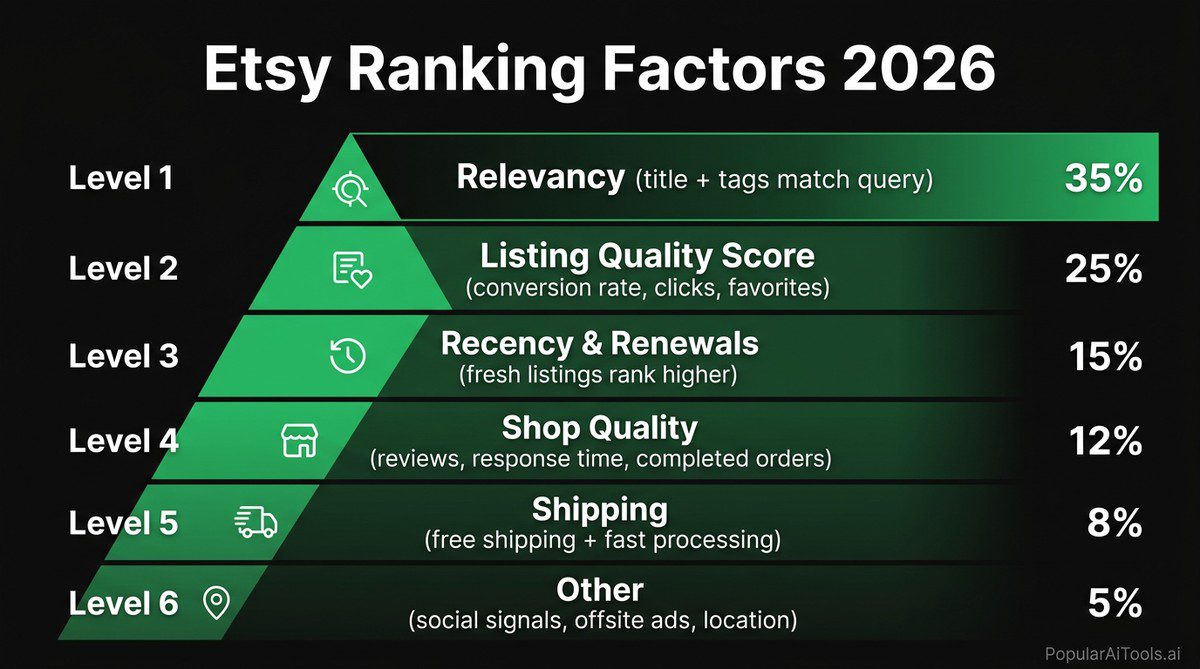
Buyer behavior signals carry more weight than ever. Click-through rate, conversion rate, repeat purchases, and even how long a buyer spends on your listing page now factor into ranking more heavily than raw keyword relevance. Etsy has shifted from “which listing mentions this keyword most” to “which listing do buyers actually want when they search this keyword.”
Freshness and consistency matter. Listings that are regularly updated — new photos, adjusted descriptions, refreshed tags — get a measurable boost over stale listings. This doesn’t mean you should change things daily, but listings untouched for 6+ months are at a disadvantage.
| Factor | 2025 Weight | 2026 Weight |
|---|---|---|
| Exact keyword match | High | Medium |
| Semantic relevance | Low | High |
| Conversion rate | Medium | Very High |
| Listing freshness | Minimal | Medium |
| Click-through rate | Medium | High |
| Keyword density | Positive (more = better) | Negative if overdone |
How AI Now Powers Etsy Search
Etsy has been integrating machine learning into its search for years, but 2026 is the first year where the AI component is genuinely sophisticated enough to change seller strategy.
Natural Language Processing (NLP) drives query understanding. When a buyer types “gift for mom who likes gardening,” Etsy’s system no longer just looks for listings tagged with those exact words. It understands the intent — this buyer wants a gardening-related gift suitable for a mother figure — and surfaces listings that match that intent, even if they use completely different terminology.
Visual search and image analysis affect ranking. Etsy’s AI now analyzes your listing photos to understand what the product actually is. If your title says “minimalist gold necklace” but your primary image shows a cluttered scene where the necklace is barely visible, the algorithm detects the mismatch and may rank you lower for that query. Image content and title content should tell the same story.
Personalization is deeper than ever. Two buyers searching the exact same keyword will see different results based on their browsing history, purchase history, price sensitivity, and even the time of day. This means your “rank” for any given keyword isn’t a fixed number — it fluctuates per buyer. The implication: obsessing over a single keyword ranking is less useful than optimizing for the buyer behaviors that feed into personalized ranking (more on this below).
AI-powered fraud and policy detection runs continuously. This is the part most sellers overlook. Etsy’s AI doesn’t just rank listings — it also flags them. Misleading tags, prohibited keywords, trademark issues, and policy violations are caught faster than ever. We’ve seen sellers spend weeks perfecting their SEO only to have listings suppressed because their optimized keywords triggered a policy flag. This is why tools like Unflagged have become essential — there’s no point ranking on page one if your listing gets flagged and pulled 48 hours later.
Title Optimization That Actually Works
Your title is still the single most important SEO element on Etsy, but how you write it needs to change in 2026.
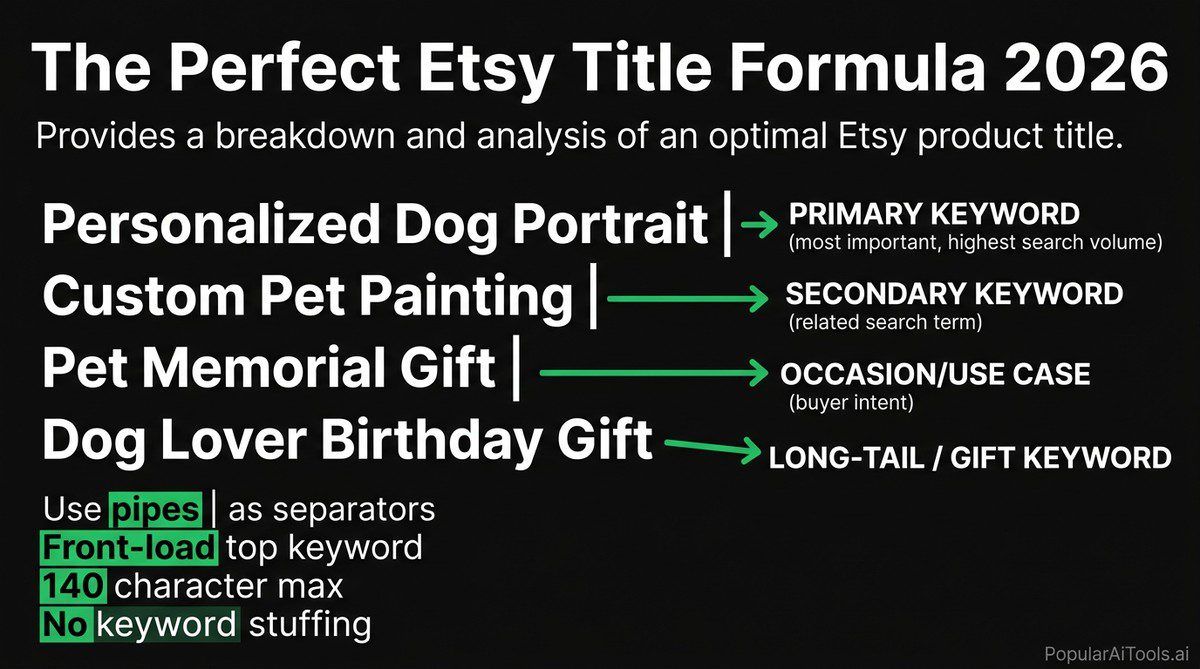
Lead with the primary keyword phrase. The first 40-50 characters of your title carry the most weight. Put your highest-value keyword phrase here — the term your ideal buyer is most likely to type.
Write for humans first, search second. A title like “Personalized Leather Journal — Custom Engraved Notebook for Men, Anniversary Gift” reads naturally and covers multiple search intents. Compare that to “Leather Journal Personalized Custom Engraved Notebook Gift Men Anniversary Leather” — which is keyword soup that the 2026 algorithm will flag as stuffing.
Use pipes or dashes to separate keyword phrases. These separators signal to Etsy’s parser that you’re listing distinct attributes or use cases, not trying to game the system. They also improve readability for buyers, which improves click-through rate.
Here are real before-and-after examples that show the difference:
| Before (2025 style) | After (2026 optimized) |
|---|---|
| Dog Collar Personalized Custom Engraved Leather Dog Collar Pet Collar Name Collar Puppy Collar | Personalized Leather Dog Collar — Custom Engraved with Name | Handmade Pet Gift |
| Wedding Invitation Suite Template Digital Download Printable Invitation Save the Date RSVP Card | Wedding Invitation Suite Template — Printable Digital Download | Save the Date + RSVP Included |
| Candle Soy Candle Scented Candle Handmade Candle Gift Candle Home Decor Candle | Hand-Poured Soy Candle — Natural Scented Home Decor | Thoughtful Handmade Gift |
Notice the pattern: primary keyword first, natural language, separated phrases, and a clear indication of what the product is and who it’s for.
Keep titles under 140 characters. Etsy allows more, but our testing shows that titles between 80-140 characters perform best. Beyond 140, you’re likely repeating yourself, and the algorithm notices.
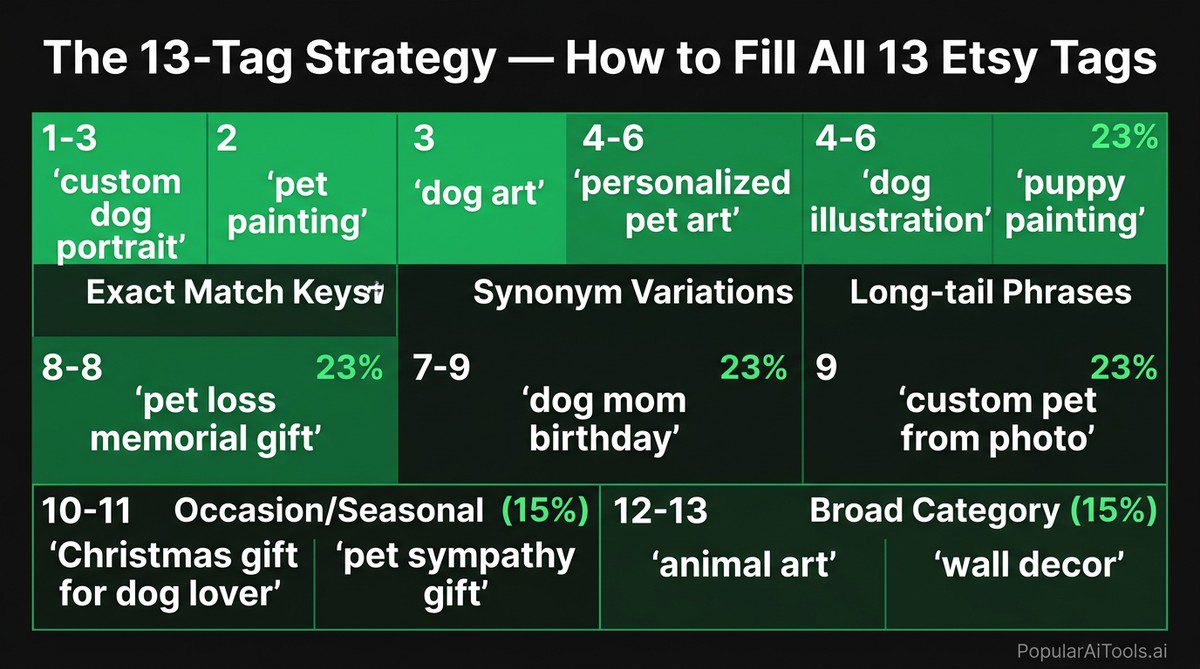
The 13-Tag Strategy: Every Slot Matters
Etsy gives you 13 tags per listing, and in 2026, leaving any of them empty is leaving money on the table. Each tag is an additional pathway for buyers to find your listing.
Here’s the strategy we use:
Tags 1-3: Your highest-volume keywords. These should be the broadest, most-searched terms relevant to your product. Think “leather wallet,” “birthday gift for him,” “minimalist jewelry.”
Tags 4-7: Long-tail phrases. These are more specific, lower-competition terms that attract buyers with strong purchase intent. “Personalized men’s bifold wallet,” “dainty gold layering necklace,” “first anniversary gift leather.”
Tags 8-10: Use case and occasion tags. “Christmas gift,” “wedding favor,” “office desk accessory.” These connect your listing to seasonal and intent-driven searches.
Tags 11-13: Synonym and alternate phrasing tags. This is where you capture the searches your title and other tags don’t cover. If your title says “mug,” use a tag for “cup.” If your title says “necklace,” add “pendant” as a tag.
Critical rules for tags in 2026:
- Multi-word phrases outperform single words. “Leather journal” is a better tag than “leather” and “journal” as separate tags.
- Don’t repeat words from your title exactly — use variations and synonyms. The algorithm already reads your title; duplicate tags waste slots.
- Don’t use tags for things like your shop name, subjective qualities (“beautiful,” “amazing”), or information already captured in attributes (color, size).
- Tags are case-insensitive and punctuation is ignored. Don’t waste characters on capitalization or commas within a tag.
Category and Attribute Optimization
This is the most underrated SEO lever on Etsy. Many sellers rush through category selection and skip optional attributes entirely. In 2026, attributes are a primary ranking signal.
When you select a category, Etsy unlocks a set of specific attributes for that category — things like color, material, occasion, style, recipient, and more. Fill in every single attribute available. Each attribute you set gives Etsy another way to match your listing to a buyer’s search or filter.
Here’s why this matters more now: Etsy’s left-sidebar filters and the “Refine Search” options that buyers use are powered by attributes. If a buyer searches “gold necklace” and then filters by “Minimalist” style, your listing won’t appear unless you set the style attribute to Minimalist — no matter how perfectly optimized your title and tags are.
We’ve seen listings jump from page 4 to page 1 simply by correcting their category selection and filling in all available attributes. It’s the easiest win in Etsy SEO and the one most sellers neglect.
Pro tip: If you’re unsure which category to choose, search for your primary keyword on Etsy and see which category the top-ranking listings use. Etsy’s algorithm has a preferred category for each query, and being in the wrong category puts you at a structural disadvantage.
Understanding Listing Quality Score
Etsy assigns each listing an internal quality score that influences ranking. While Etsy doesn’t publish the exact formula, we’ve identified the components through extensive testing:
Conversion rate is king. The single biggest factor in your quality score is how often people who click your listing actually buy. A listing with a 5% conversion rate will consistently outrank a listing with a 1% conversion rate, even if the lower-converting listing has “better” SEO.
Click-through rate from search results. When your listing appears in search results, do people click on it? Your thumbnail image, title preview, price, and free shipping badge all affect this. A listing that gets skipped over repeatedly will see its ranking decline.
Favorites-to-views ratio. When buyers favorite your listing, it signals relevance and desirability. This doesn’t carry as much weight as conversion rate, but it’s a meaningful secondary signal.
Listing completeness. Descriptions, all 10 photo slots filled, shipping profiles completed, return policies set, processing times specified — the more complete your listing, the higher its quality score. Etsy interprets completeness as a signal of seller seriousness and buyer experience quality.
Recency and renewal patterns. Newly listed items get a temporary boost (the “new listing bump”), and renewing listings gives a smaller boost. But the boost is temporary — if the listing doesn’t convert during the bump period, it settles into a rank determined by its other quality signals.
How Reviews and Shop History Affect Ranking
Your individual listing SEO doesn’t exist in isolation — it sits on top of your shop’s overall reputation score.
Star seller status still provides a ranking boost. Shops that maintain Star Seller consistently receive preferential placement in search results, particularly for competitive keywords. If two listings are equally well-optimized, the Star Seller’s listing will rank higher.
Recent review velocity matters more than total review count. A shop with 50 reviews in the last month outperforms a shop with 5,000 total reviews but only 2 in the last month. Etsy’s algorithm prioritizes active, currently-thriving shops.
Negative reviews hurt more than positive reviews help. One 1-star review can undo the ranking benefit of twenty 5-star reviews, particularly if it mentions product quality issues, shipping problems, or accuracy complaints. Responding professionally to negative reviews mitigates (but doesn’t eliminate) the impact.
Shop age provides a baseline trust score. Shops that have been active for 2+ years with consistent sales history have a structural advantage over brand-new shops. This isn’t insurmountable — new shops can compete on keyword specificity and niche targeting — but it’s real.
Cases and intellectual property disputes are ranking killers. Open cases, suspended listings, and IP takedown notices don’t just affect the specific listing involved. They lower your entire shop’s trust score, dragging down every listing’s ranking. This is another area where proactive compliance checking matters — running your listings through Unflagged before publishing catches potential trademark and policy issues before they become cases that damage your shop’s reputation score.
Photography and Video Optimization
In 2026, Etsy’s algorithm doesn’t just count your photos — it analyzes them.
Your first photo IS your SEO. It determines click-through rate from search results, which is a primary ranking signal. The first photo should show the product clearly, on a clean background, with accurate color representation. Lifestyle shots are great for photos 2-10, but photo 1 needs to be your clearest, most click-worthy product shot.
Use all 10 photo slots. Listings with 10 photos convert at nearly double the rate of listings with 3-4 photos. More photos mean more information for the buyer, fewer questions, and higher conversion — which feeds directly back into your ranking.
Photo optimization checklist for 2026:
- Minimum 2000×2000 pixels (Etsy compresses smaller images, reducing quality)
- Natural lighting or professional studio lighting — avoid harsh shadows and yellow casts
- Show scale by including a common reference object or a hand holding the item
- Include detail shots of materials, textures, and construction quality
- Show the product in use (lifestyle/context shots for photos 2-5)
- Include size reference or dimensional diagram for products where size matters
- Add a photo showing packaging if your packaging is part of the brand experience
Video increases conversion by 20-40%. Etsy allows a listing video up to 15 seconds. In our testing, listings with video consistently outperform identical listings without video, primarily through improved conversion rate. Even a simple 360-degree product rotation or a quick demonstration of the product in use makes a measurable difference.
Alt text is now indexed. Etsy added alt text fields for listing photos in late 2025, and in 2026 this text is factored into search relevance. Describe what’s in each photo using natural language that includes relevant keywords. Don’t keyword stuff the alt text — describe the image honestly with keyword awareness.
How Pricing Strategy Impacts Visibility
Price doesn’t directly affect your Etsy search rank — but it profoundly affects the behavioral signals that do.
Price affects click-through rate. In search results, buyers see your price alongside your thumbnail and title. If your price is significantly higher than competing listings for the same keyword, buyers skip your listing. Lower CTR = lower ranking over time.
Price affects conversion rate. Even if buyers click, an unreasonable price relative to perceived value kills conversions. And conversion rate is the most heavily weighted behavioral signal in 2026.
Free shipping boosts ranking. Etsy has officially confirmed that listings with free shipping receive a search boost, and this boost increased in 2026. If you’re not offering free shipping, build the shipping cost into your product price. The ranking benefit of the free shipping badge outweighs any perceived increase in product price.
The “value zone” sweet spot. For any given product category, there’s a price range where most sales occur. Pricing within this range maximizes both click-through and conversion rates. You can identify this range by searching your primary keyword and noting the prices of the top 20 listings. That’s your value zone.
| Pricing Move | CTR Impact | Conversion Impact | Net Ranking Effect |
|---|---|---|---|
| Free shipping added | +15-25% | +10-20% | Strong positive |
| Priced in value zone | Neutral | +10-15% | Moderate positive |
| Priced 30%+ above competitors | -20-30% | -25-40% | Strong negative |
| Sale pricing active | +10-20% | +15-25% | Moderate positive |
Common SEO Mistakes That Hurt Your Rankings
After auditing hundreds of Etsy shops in 2026, we see the same mistakes repeatedly. These aren’t just “not optimal” — they’re actively hurting rankings.
1. Keyword stuffing in titles. We covered this above, but it bears repeating: the 2026 algorithm penalizes unnatural keyword density. If your title reads like a list of search terms rather than a product description, you’re being suppressed.
2. Duplicating tags across listings. If you sell 15 variations of the same product, don’t use identical tags on all 15 listings. You’re competing against yourself. Differentiate tags across similar listings so each one targets a slightly different search audience.
3. Ignoring attributes. We’ve seen shops with perfect titles and tags sitting on page 5 because they skipped the category attributes. When a buyer uses the “Refine” filters — and millions do — your listing is invisible if its attributes aren’t set.
4. Using all single-word tags. The tag “leather” matches thousands of listings. The tag “distressed leather laptop bag” matches a specific buyer intent. Multi-word phrase tags dramatically outperform single-word tags for converting searches.
5. Neglecting listing descriptions. While descriptions carry less direct SEO weight than titles and tags, they affect conversion rate — which is now the dominant ranking signal. A thorough, well-written description with clear product details, dimensions, materials, and care instructions converts better than a two-sentence description.
6. Infrequent listing updates. Listings that haven’t been touched in 6+ months lose freshness signals. Even small updates — swapping photo order, tweaking a few words in the description, adjusting a tag — re-signal to Etsy that this listing is actively managed.
7. Copying competitor titles verbatim. Beyond the ethical issues, Etsy’s AI detects near-duplicate titles and considers them a negative signal. If your title is suspiciously similar to a top-ranking competitor’s title, you may be suppressed rather than boosted.
8. Not using Etsy Ads data for organic optimization. If you run even a small Etsy Ads budget, the search terms report shows you exactly which keywords drive clicks and conversions for your products. This data is gold for organic SEO optimization — yet most sellers never look at it.
9. Ignoring listing compliance. This is the mistake that costs the most when it hits. You can have flawless SEO — perfect title, all 13 tags, complete attributes, great photos — and lose it all if your listing gets flagged for a policy violation. Trademark terms in tags, prohibited materials, misleading claims, or miscategorized items all trigger flags. Sellers who are serious about their SEO use Unflagged to scan their listings for compliance issues before and after optimization, because one flag can undo months of ranking progress.
10. Obsessing over rank tracking instead of conversion optimization. In the personalized-search era, your rank varies per buyer. Spending hours checking where you rank for a keyword is less productive than improving your photos, descriptions, and pricing to increase conversion rate — which is the metric that actually determines your average ranking across all buyers.
Keeping Your Optimized Listings Compliant
Here’s the uncomfortable truth about Etsy SEO in 2026: the more aggressively you optimize, the more likely you are to accidentally trigger a policy violation. Pushing into new keyword territories, testing trendy phrases, and expanding your tag coverage all increase the risk of including a term that Etsy’s AI flags.
This is why compliance checking should be the final step in every SEO optimization workflow. After you’ve crafted your title, selected your tags, set your attributes, and uploaded your photos — run the listing through a compliance check before you publish or update.
The sellers who sustain top rankings over months (not just weeks) are the ones who treat SEO and compliance as two sides of the same coin. Ranking means nothing if your listing gets taken down.
FAQ
How long does it take for Etsy SEO changes to affect ranking?
Most changes begin affecting your ranking within 24-48 hours, but the full impact takes 2-4 weeks to stabilize. This is because Etsy needs to collect new behavioral data (clicks, conversions, favorites) on your updated listing before it can properly assess its new ranking. During this period, you may see ranking fluctuations — this is normal. Avoid making additional changes during the stabilization window.
Do Etsy Ads help organic ranking?
Not directly — Etsy has stated that running ads doesn’t boost your organic rank. However, there’s an indirect benefit: ads drive traffic to your listing, which generates sales and reviews, which improve your conversion rate and shop reputation, which do boost organic ranking. More importantly, the search terms data from Etsy Ads is invaluable for organic keyword research.
How often should I update my listings for SEO?
We recommend a quarterly SEO audit where you review and refresh titles, tags, and photos across your shop. Between audits, update individual listings whenever you notice a significant ranking drop or when seasonal opportunities arise. Avoid changing things weekly — the algorithm needs time to evaluate each change, and constant modifications prevent stabilization.
Is it worth paying for Etsy SEO tools?
It depends on the tool. Tools that provide keyword search volume estimates, competition analysis, and listing audits can save significant time and surface opportunities you’d miss manually. Compliance tools are worth their weight in gold because they prevent the catastrophic ranking loss that comes with policy violations. Avoid tools that promise guaranteed rankings or claim to “hack” the algorithm — those don’t work and may violate Etsy’s terms of service.
Should I create separate listings for every keyword variation?
No. In 2026, creating near-duplicate listings to target different keywords is a recognized spam pattern that Etsy actively penalizes. Instead, create one well-optimized listing per unique product and use your 13 tags to cover keyword variations. If you sell genuinely different products (different colors, sizes, or styles that can’t be handled through variations), separate listings are appropriate — but each should have distinct titles and tags.
Start Ranking Higher on Etsy Today
Etsy SEO in 2026 rewards sellers who think like buyers. Write titles that make sense to read. Choose tags that reflect how real people search. Fill in every attribute. Invest in photography that converts browsers into buyers. Keep your listings fresh, your reviews strong, and your compliance clean.
The algorithm has changed, but the core principle hasn’t: the best-optimized listing is the one that most accurately connects a buyer’s search with the product they actually want. Everything in this guide serves that principle.
Start with your top 10 listings. Audit them against the strategies in this guide. Update titles, fill in missing attributes, refresh tags, and check compliance. Track the results over the next month. Then roll the changes out to your entire shop.
The sellers who adapt fastest to the 2026 algorithm will capture the traffic that confused sellers are leaving on the table. Make sure you’re on the right side of that equation.
Related: Trademark And Compliance Issues
Related: Best Tools For Etsy Sellers
Have an AI tool or resource that helps Etsy sellers? Submit it to Popular AI Tools to get featured alongside the tools top sellers use every day.