
How to Make Money with Suno AI: Complete Guide 2026
The AI music industry just crossed a tipping point. What was a novelty experiment two years ago is now a legitimate revenue channel, and the numbers prove it. The global AI music market hit $3.1 billion in 2025 and is projected to reach $12.4 billion by 2030, growing at a staggering 32% compound annual rate. Suno AI sits at the center of this explosion as the most capable consumer-facing music generation tool on the planet.
We have been tracking AI music monetization since Suno v2, and the landscape in 2026 is radically different from even twelve months ago. People are earning real money — not hypothetical “potential income” but actual deposits hitting their bank accounts from streams, licensing deals, beat sales, and freelance gigs. The barrier to entry has never been lower, and the window of opportunity is still wide open.
This guide breaks down exactly how to turn Suno AI into a money-making machine. Seven proven methods, real earning expectations, difficulty ratings, and the critical legal and technical hurdles you need to clear before your first dollar arrives.
Table of Contents
- The AI Music Money Opportunity in 2026
- 7 Ways to Make Money with Suno AI
- 1. Streaming Revenue
- 2. Selling Beats and Instrumentals
- 3. YouTube Background Music Channels
- 4. Sync Licensing
- 5. Custom Music for Content Creators
- 6. Music NFTs and Web3
- 7. Teaching and Courses About AI Music
- Comparison Table: All 7 Methods
- Real Earnings Examples and Expectations
- The Legal Landscape
- The Detection Hurdle
- Frequently Asked Questions
The AI Music Money Opportunity in 2026
Let us put the opportunity in context. In 2024, the music industry generated $28.6 billion in global recorded music revenue, with streaming accounting for 67% of that total. The AI-generated music segment was a rounding error. By early 2026, AI-created tracks account for an estimated 4-6% of new uploads across major streaming platforms — and that share is doubling every eight months.
Three forces are driving this growth:
Tool maturity. Suno AI’s latest models produce tracks that are genuinely difficult to distinguish from human-produced music. Full arrangements, natural vocals, genre-accurate production — the quality ceiling has risen dramatically. You are no longer limited to lo-fi ambient loops. You can generate radio-ready pop, hard-hitting trap beats, cinematic orchestral scores, and everything in between.
Distribution accessibility. Services like DistroKid, TuneCore, and CD Baby have made it trivially easy to get music onto every major streaming platform. A track you generate today can be live on Spotify, Apple Music, Amazon Music, and YouTube Music within 48 hours.
Demand explosion. There are over 50 million active content creators worldwide, and every single one of them needs music. YouTubers, podcasters, TikTok creators, indie game developers, filmmakers, advertisers — the demand for affordable, licensable music has never been higher, and traditional music libraries cannot keep up.
The people who are positioning themselves now are the ones who will own this market in 18 months. Here is how to join them.
7 Ways to Make Money with Suno AI
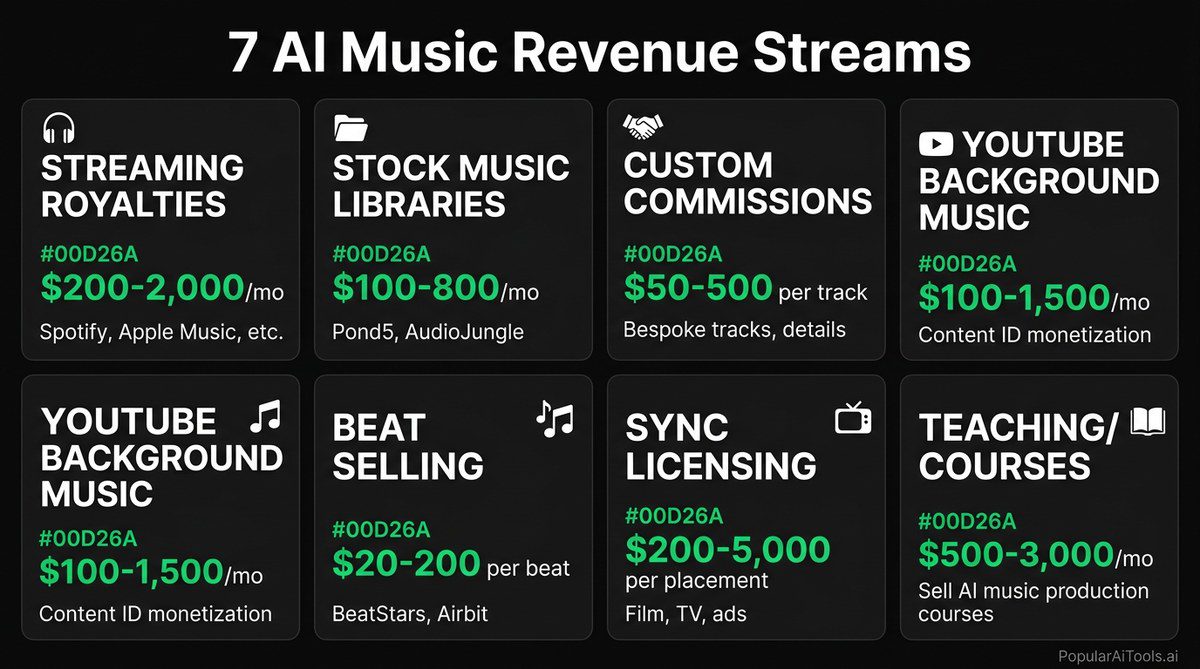
1. Streaming Revenue
How it works: You generate tracks with Suno AI, distribute them to streaming platforms (Spotify, Apple Music, YouTube Music, Amazon Music, Tidal) through a distributor like DistroKid or TuneCore, and earn royalties every time someone streams your music. You build a catalog over time, and the revenue compounds as more tracks attract more listeners.
Earning potential: A single stream pays between $0.003 and $0.005 on Spotify, roughly $0.008 on Apple Music, and around $0.007 on YouTube Music. That sounds tiny, but it scales. A catalog of 100 tracks averaging 1,000 streams per month each generates $300-$500/month in passive income. Top AI music producers with 500+ track catalogs report $2,000-$8,000/month.
Difficulty: Medium. The music generation itself is straightforward — Suno handles the heavy lifting. The real challenge is playlist placement, keyword optimization for search, and building a consistent release schedule. You also need to navigate the detection hurdle, which we cover below.
Time to first dollar: 30-60 days. Distributors take 1-3 days to process, but building enough streams to trigger your first payout typically takes 4-8 weeks.
Pro tip: Focus on functional genres that people search for: study music, workout playlists, sleep sounds, lo-fi beats, meditation music, and ambient focus tracks. These genres have massive, evergreen demand and listeners who leave tracks on repeat for hours.
2. Selling Beats and Instrumentals
How it works: You use Suno AI to generate high-quality instrumentals and beats, then sell them on dedicated marketplaces like BeatStars and Airbit. Independent rappers, singers, and content creators buy beats for their own projects. You set your own prices and license tiers — typically offering a basic lease, a premium lease, and an exclusive purchase option.
Earning potential: Basic beat leases sell for $20-$50. Premium leases go for $75-$200. Exclusive rights can fetch $300-$1,000+ for a single beat. Successful beat sellers on BeatStars report earning $500-$3,000/month with a catalog of 50-100 beats. The top tier pulls $10,000+/month, though that takes significant catalog depth and marketing effort.
Difficulty: Medium-High. While Suno generates the raw material, you need an ear for what sells. Hip-hop and R&B beats require specific structural patterns (intro, verse, hook, bridge) that may need post-production tweaking. You also need to understand the marketplace algorithms and invest time in tagging, previews, and promotion.
Time to first dollar: 14-30 days. BeatStars and Airbit have active buyer traffic, so well-tagged beats in popular styles can sell relatively quickly.
Pro tip: Study what is trending on BeatStars’ top charts before generating. Suno is remarkably good at genre-specific prompting — feed it detailed descriptions referencing tempo, mood, and instrument preferences to get beats that match current demand.
3. YouTube Background Music Channels
How it works: You create a YouTube channel dedicated to background music — lo-fi hip hop, jazz café vibes, ambient study music, epic cinematic scores — and upload long-form compilations (1-3 hours) or livestreams of continuous music generated with Suno AI. Revenue comes from YouTube ad placements on your videos.
Earning potential: YouTube pays $2-$8 per 1,000 views (CPM varies by niche and audience location). A background music channel with 100,000 monthly views earns $200-$800/month. Channels that crack 1 million monthly views hit $2,000-$8,000/month. The “Lofi Girl” model proves this category can scale to millions in annual revenue, and AI-generated content dramatically lowers your production costs to near zero.
Difficulty: Low-Medium. The content creation is easy — Suno generates the music, and you compile it into long mixes with a simple visual (animated loop or static image). The hard part is the YouTube algorithm. Growing a channel takes consistent uploads, good thumbnails, SEO-optimized titles, and patience.
Time to first dollar: 90-180 days. You need 1,000 subscribers and 4,000 watch hours to join the YouTube Partner Program. Background music channels can hit this faster than most categories because watch time per session is extremely high.
Pro tip: Livestreams are a cheat code for this niche. A 24/7 “lo-fi beats to study to” livestream racks up watch hours around the clock and signals to YouTube’s algorithm that your content has strong retention.
4. Sync Licensing
How it works: Sync licensing means placing your music in visual media — TV shows, films, commercials, podcasts, video games, and corporate videos. You upload your tracks to sync licensing libraries like Musicbed, Artlist, Epidemic Sound, or Pond5, and earn fees when a buyer licenses your track for their project. You can also pitch directly to production companies and ad agencies.
Earning potential: This is where the big money lives. A single sync placement in a national TV commercial can pay $5,000-$50,000. Placements in indie films and web series typically pay $200-$2,000. Library licensing (where buyers pay a subscription to access your music) generates smaller per-use fees ($5-$50) but at high volume. Producers with strong sync catalogs report $1,000-$10,000/month in recurring revenue.
Difficulty: High. Sync libraries have quality standards and curation processes. Your tracks need to sound professional, be properly mastered, and fit specific moods and use cases. Metadata (genre, mood, tempo, instrumentation tags) must be meticulous. Building relationships with music supervisors takes time and persistence.
Time to first dollar: 60-180 days. Getting accepted into sync libraries takes 2-4 weeks, and placements happen on the library’s timeline, not yours. Direct pitching can be faster but requires a strong portfolio.
Pro tip: Create tracks with clear emotional arcs that work for visual storytelling. “Happy corporate” and “inspirational tech” are the two most in-demand sync categories. Suno excels at generating these feel-good, building-energy tracks that production companies constantly need.
5. Custom Music for Content Creators
How it works: You offer custom music creation as a service on freelance platforms like Fiverr and Upwork. Content creators, podcasters, small businesses, and indie game developers need intro music, background tracks, jingles, and sound design — and most of them cannot afford to hire a traditional composer. You use Suno AI to generate custom tracks based on client briefs, deliver polished results, and charge per project.
Earning potential: Fiverr gigs for custom music start at $25-$50 for simple tracks and scale to $200-$500+ for full compositions with revisions. Upwork contracts for ongoing music needs (like a podcast that needs a new intro every season) can pay $500-$2,000 per project. Active freelancers in this space report $1,000-$4,000/month.
Difficulty: Low-Medium. Suno makes the production fast — you can deliver a custom track in hours instead of days. The challenge is client management, understanding briefs, and making targeted revisions. You also need to build your profile and reviews on these platforms before the orders start flowing.
Time to first dollar: 7-21 days. Fiverr has immediate buyer traffic, and if you price competitively and deliver quality, your first order can come within the first week.
Pro tip: Create “genre packs” as upsells — instead of one track, offer a bundle of 5 variations in the same style. This increases your average order value and takes almost no extra time since Suno can generate variations instantly.
6. Music NFTs and Web3
How it works: You mint your Suno AI-generated tracks as NFTs on music-focused Web3 platforms like Sound.xyz, Catalog, and Zora. Collectors buy limited-edition releases, and you earn from initial sales plus royalties on secondary market trades. Some platforms also offer streaming revenue splits with token holders.
Earning potential: The music NFT space is volatile but lucrative for those who build a following. Single-edition drops can sell for 0.05-1 ETH ($150-$3,000 at current prices). Limited runs of 25-100 editions at lower price points ($10-$50) can generate $250-$5,000 per release. Top music NFT artists report $2,000-$15,000/month, but this is heavily dependent on community engagement and marketing.
Difficulty: High. This is not a “build it and they will come” model. Success in music NFTs requires active community building on Twitter/X and Discord, understanding Web3 culture, and creating a narrative around your releases. The technical barrier (wallets, minting, gas fees) has lowered significantly, but the marketing barrier remains steep.
Time to first dollar: 30-90 days. Building a collector base takes time. Your first few drops may sell slowly or not at all until you establish credibility in the space.
Pro tip: Frame your AI music as a feature, not a secret. The Web3 community values transparency and experimentation. Positioning yourself as a pioneer in AI-generated music art can be a differentiator rather than a liability.
7. Teaching and Courses About AI Music
How it works: You package your knowledge about using Suno AI for music production and monetization into educational content. This can take the form of online courses (Udemy, Skillshare, Teachable), YouTube tutorials, paid newsletters, or community memberships. You teach others how to do what this guide covers — and you get paid for the instruction.
Earning potential: A Udemy course priced at $49.99 with 500 students generates roughly $10,000-$15,000 (after platform fees). YouTube tutorials monetize through ads and affiliate links, generating $500-$3,000/month for channels with 10,000-50,000 subscribers. Paid communities on Patreon or Discord can charge $10-$50/month per member. Course creators in the AI music space report $2,000-$10,000/month.
Difficulty: Medium. You need to be articulate, organized, and willing to create structured educational content. Screen recordings, written guides, and community management all take time. However, if you are already making money with Suno AI, you have the most valuable credential possible: proof that it works.
Time to first dollar: 14-60 days. A Udemy course can be published in a week if you work fast. YouTube tutorials can start generating ad revenue once you hit monetization thresholds, but affiliate links and product recommendations can pay from day one.
Pro tip: Start with free YouTube content to build authority, then funnel viewers into a paid course or community. The “teach what you learn” loop is powerful — documenting your journey as you build your AI music income creates content and credibility simultaneously.
Comparison Table: All 7 Methods
TBLPH0X
The fastest path to your first dollar is custom freelancing on Fiverr. The highest long-term ceiling belongs to sync licensing and streaming revenue. The smartest approach is to stack multiple methods — generate a track once, distribute it to streaming platforms, list it on a sync library, upload it to BeatStars, and use it as a case study in your course. One piece of music, five revenue streams.
Real Earnings Examples and Expectations
Let us set realistic expectations, because the internet is full of inflated income claims.
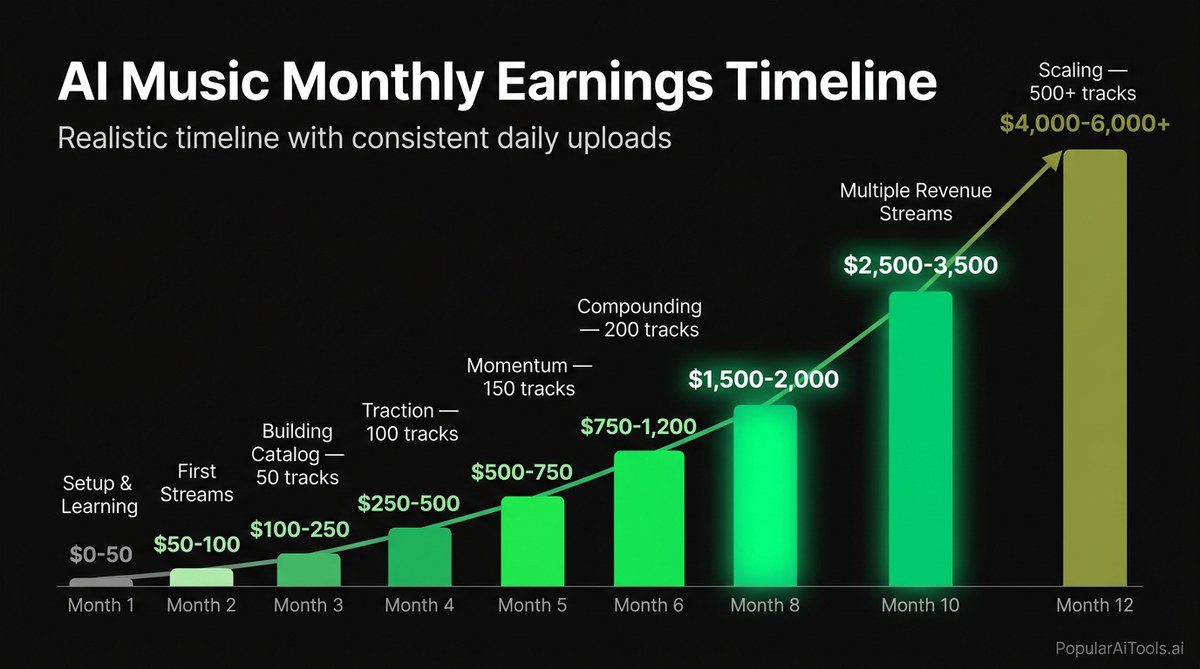
Month 1-3 (The Grind Phase): You are building your catalog, learning what works, and setting up distribution channels. Expect $0-$200/month. Most of this comes from freelance gigs if you hustle on Fiverr, or small beat sales. Streaming revenue is negligible because your catalog is too small and too new.
Month 3-6 (The Traction Phase): Your catalog has 50-100 tracks distributed across platforms. Playlist placements start trickling in. Beat sales become more consistent. Streaming revenue hits $100-$500/month. Freelance income stabilizes at $500-$1,500/month if you are actively taking orders. Total: $500-$2,000/month.
Month 6-12 (The Compound Phase): This is where the magic of a growing catalog kicks in. With 200+ tracks in distribution, streaming revenue compounds as older tracks continue to accumulate plays. Sync placements start landing. Your reputation on freelance platforms brings repeat clients. Total: $2,000-$5,000/month is realistic for someone treating this seriously.
Month 12+ (The Scale Phase): Producers who stick with it and reach 500+ tracks with strong metadata, playlist presence, and multiple revenue channels report $5,000-$15,000/month. At this stage, a large portion of the income is passive — streaming royalties and sync licensing fees that arrive whether you create new music that week or not.
The critical variable is volume. AI music monetization is a catalog game. Every track you create is a micro-asset that earns independently. One track might generate $2/month. But 500 tracks generating $2/month each is $1,000/month in pure passive income — and that is a conservative floor, not a ceiling.
The Legal Landscape
This is the section most guides skip, and it is the section that matters most. The legal framework around AI-generated music is still evolving, but here is where things stand in 2026.
Copyright ownership. Under current U.S. Copyright Office guidance, purely AI-generated content without meaningful human creative input is not eligible for copyright registration. However — and this is crucial — if you use Suno AI as a tool within a creative process that involves substantial human authorship (writing lyrics, arranging sections, directing the creative output, mixing and mastering the result), the resulting work can qualify for copyright protection. The key is demonstrable human creative involvement.
Distribution rights. When you generate music with a Suno AI paid subscription (Pro or Premier), Suno’s terms of service grant you full commercial rights to the output. You own the music and can distribute, sell, license, and monetize it however you choose. Free-tier generations have more restrictive terms — always use a paid plan for commercial work.
Platform policies. Major distributors including DistroKid, TuneCore, and CD Baby currently accept AI-generated music, but they have increasingly strict policies about disclosure and quality. Some require you to indicate that AI tools were used in production. Spotify and Apple Music have not banned AI music, but they have implemented detection systems to flag and sometimes remove content that appears to be low-quality AI spam.
Mechanical and performance royalties. AI-generated music is eligible for mechanical royalties (from streaming) and performance royalties (from radio, TV, public performance) if you register your works with a PRO (performing rights organization) like ASCAP, BMI, or SESAC. You should register every track you intend to monetize seriously.
The bottom line: the legal landscape favors creators who treat AI as a production tool rather than a replacement for human creativity. Add your own lyrics, arrange the structure, mix and master the output, and document your creative process. This protects your rights and positions your music as human-directed AI-assisted work.
The Detection Hurdle
Here is the uncomfortable truth that most “make money with AI music” guides conveniently ignore: raw Suno AI output gets flagged and rejected by distributors.
Streaming platforms and distribution services have deployed AI detection systems that analyze audio for patterns characteristic of AI generation. These systems check for specific artifacts in the frequency spectrum, repetitive micro-patterns in the arrangement, and telltale signs in the vocal synthesis. When your track gets flagged, one of three things happens: it gets rejected before it ever hits the platform, it gets removed after a manual review, or it gets suppressed in algorithmic recommendations so it never reaches listeners.
This is the single biggest bottleneck in the AI music monetization pipeline. You can generate beautiful tracks, set up all your distribution channels, optimize your metadata perfectly — and still earn nothing because your music never makes it past the gatekeepers.
The solution is Undetectr — the first technology specifically built to ensure your Suno AI tracks pass distributor verification checks. Undetectr processes your AI-generated audio to remove the detectable artifacts that trigger platform flags, while preserving the musical quality of the original track. It works with DistroKid, TuneCore, CD Baby, and every other major distributor.
Without clearing the detection hurdle, your streaming revenue pipeline is fundamentally broken. You can generate a thousand tracks, but if they get flagged and pulled, the catalog you built is worthless. This is not a hypothetical risk — it is the number one reason AI music creators fail to monetize. Undetectr solves this problem and is an essential part of any serious AI music monetization strategy.
Frequently Asked Questions
Is it legal to sell music made with Suno AI?
Yes. Suno AI’s paid subscription plans (Pro and Premier) grant you full commercial rights to the music you generate. You can sell it, stream it, license it, and use it in any commercial project. The key requirement is that you are on a paid plan — free-tier generations have restrictions. We recommend adding human creative input (lyrics, arrangement, mixing) to strengthen your copyright position and comply with evolving platform policies.
How much can you realistically earn per month with Suno AI music?
Realistic earnings range from $500-$2,000/month in the first six months for someone who is consistently creating and distributing music. After 12 months of dedicated catalog building across multiple channels (streaming, beats, freelance, sync), $3,000-$8,000/month is achievable. The top earners in this space report $10,000-$20,000/month, but that requires large catalogs (500+ tracks), strong playlist placement, and multiple revenue streams working simultaneously.
Do streaming platforms like Spotify accept AI-generated music?
Spotify, Apple Music, YouTube Music, and Amazon Music all currently accept AI-generated music distributed through standard distributors like DistroKid and TuneCore. However, these platforms have implemented detection systems that flag low-quality or unprocessed AI output. Tracks that get flagged may be removed or suppressed. Processing your tracks through Undetectr before distribution ensures they pass platform checks and reach listeners without issues.
What equipment or software do I need besides Suno AI?
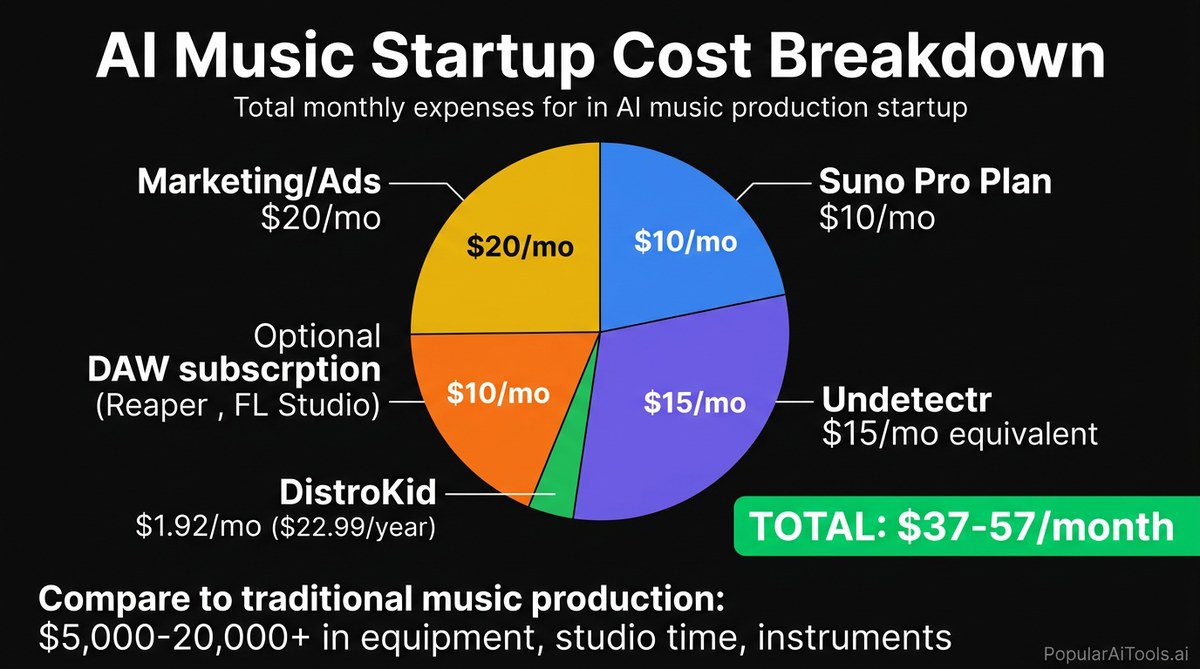
At minimum, you need a Suno AI paid subscription ($10-$30/month), a distribution account like DistroKid ($22/year) or TuneCore ($15-$30/year), and a basic audio editor like Audacity (free) or GarageBand (free on Mac) for any post-production tweaks. Optional but recommended: a DAW like FL Studio or Ableton for mixing and mastering, Canva for cover art, and a BeatStars account if you plan to sell beats. Total startup cost: under $50.
Will AI music replace human musicians?
No — and framing it that way misses the point entirely. AI music tools like Suno are expanding the music market, not replacing the existing one. They enable people who could never afford studio time or years of musical training to create and monetize music. Meanwhile, human musicians are using AI as a collaborative tool to speed up production, explore new styles, and generate ideas. The market is growing, not shrinking. The opportunity is in riding that growth, not debating whether it should exist.
The AI music gold rush is happening right now, and Suno AI is the pickaxe. The seven methods in this guide are not theoretical — they are actively generating income for thousands of creators who got started when most people were still debating whether AI music was “real.” The tools are ready, the platforms are open, and the demand is insatiable. The only question is whether you start building your catalog today or wish you had six months from now.