
The Anthropic Institute: What Their AI Jobs Research Means for Your Career
On March 11, 2026, Anthropic quietly did something that should have every working professional paying attention. They launched the Anthropic Institute — a dedicated research body studying exactly how AI is reshaping jobs, security, and society. And their first major labor market report doesn’t just theorize about which jobs AI could replace. It measures which ones it’s already changing, right now, based on real usage data from millions of Claude conversations.
We dug into the findings, cross-referenced them with other major AI labor studies, and put together everything you need to know — including what you should actually do about it.
Table of Contents
- What Is the Anthropic Institute?
- Who Is Leading It?
- The Key Findings: Observed Exposure vs. Theoretical Exposure
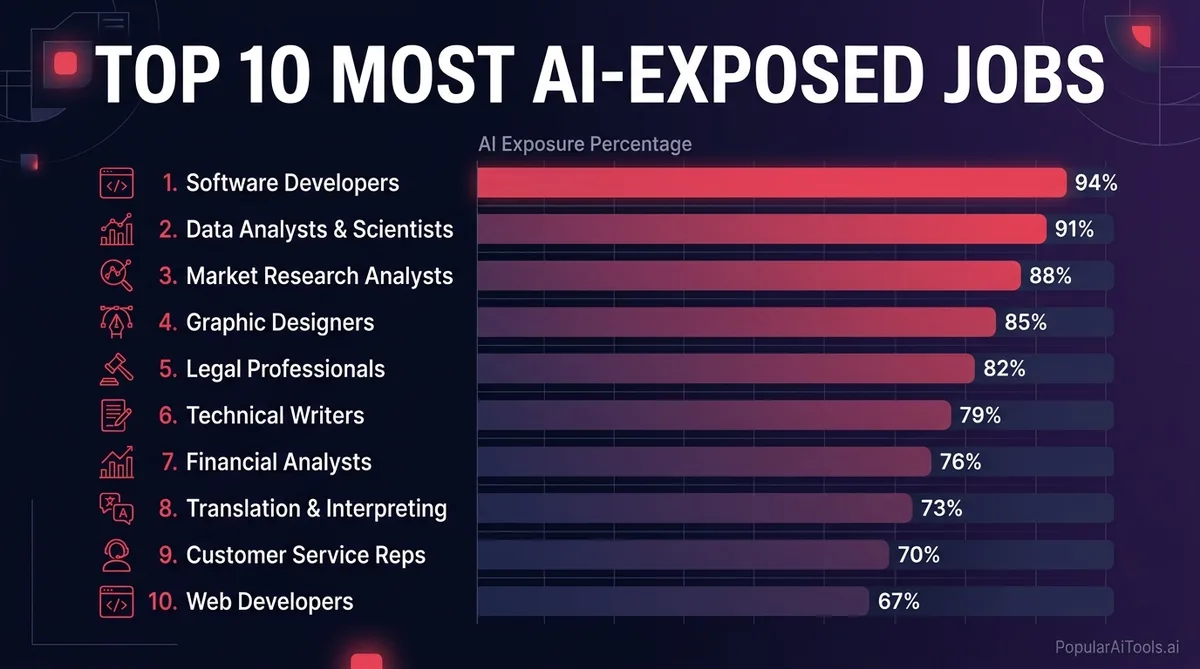
- The 10 Most AI-Exposed Jobs
- The Jobs AI Can’t Touch (Yet)
- The Hiring Slowdown Nobody Is Talking About
- Who Is Most Affected? The Demographics Might Surprise You
- How This Compares to Other AI Labor Studies
- What You Should Actually Do About This
- FAQ
What Is the Anthropic Institute?
The Anthropic Institute is a new research division within Anthropic — the company behind the Claude AI model — dedicated to studying the real-world societal impacts of powerful AI systems. It consolidates three previously separate teams into one unified operation:
Get Your AI Tool in Front of Thousands of Buyers
Join 500+ AI tools already listed on PopularAiTools.ai — DR 50+ backlinks, expert verification, and real traffic from people actively searching for AI solutions.
Starter
$39/mo
Directory listing + backlink
- DR 50+ backlink
- Expert verification badge
- Cancel anytime
Premium
$69/mo
Featured + homepage placement
- Everything in Starter
- Featured on category pages
- Homepage placement (2 days/mo)
- 24/7 support
Ultimate
$99/mo
Premium banner + Reddit promo
- Everything in Premium
- Banner on every page (5 days/mo)
- Elite Verified badge
- Reddit promotion + CTA
No credit card required · Cancel anytime
- The Frontier Red Team — stress-tests AI capabilities to find dangerous edge cases
- The Societal Impacts Team — studies how AI is actually being used in the real world
- The Economic Research Team — tracks AI’s effects on jobs, wages, and the broader economy
The Institute launched with approximately 30 members and is adding new staff across machine learning, economics, and social science. Anthropic is also opening its first Washington DC office alongside this initiative — a signal that they’re positioning this work as much for policymakers as for the tech community.
What makes this different from a typical corporate PR move is the caliber of the hires. The Institute brought in Matt Botvinick (formerly of Google DeepMind), Anton Korinek (economics professor on leave from the University of Virginia), and Zoe Hitzig (a researcher who departed OpenAI). These are serious researchers, not marketing hires.
Who Is Leading It?
Jack Clark, Anthropic’s co-founder, is stepping into a new role as Head of Public Benefit to lead the Institute. Clark previously served as Anthropic’s Head of Public Policy for over five years and has been one of the most vocal voices in AI policy circles. His transition from policy to running a full research institute signals that Anthropic views this work as existentially important — not just for society, but for their own legitimacy as a company building increasingly powerful AI.
Clark’s background matters here. Before Anthropic, he was the Policy Director at OpenAI and the author of the influential Import AI newsletter. He understands both the technical capabilities of these systems and the political landscape surrounding them.
The Key Findings: Observed Exposure vs. Theoretical Exposure
This is where Anthropic’s research gets genuinely interesting — and diverges from every other AI jobs study you’ve seen.
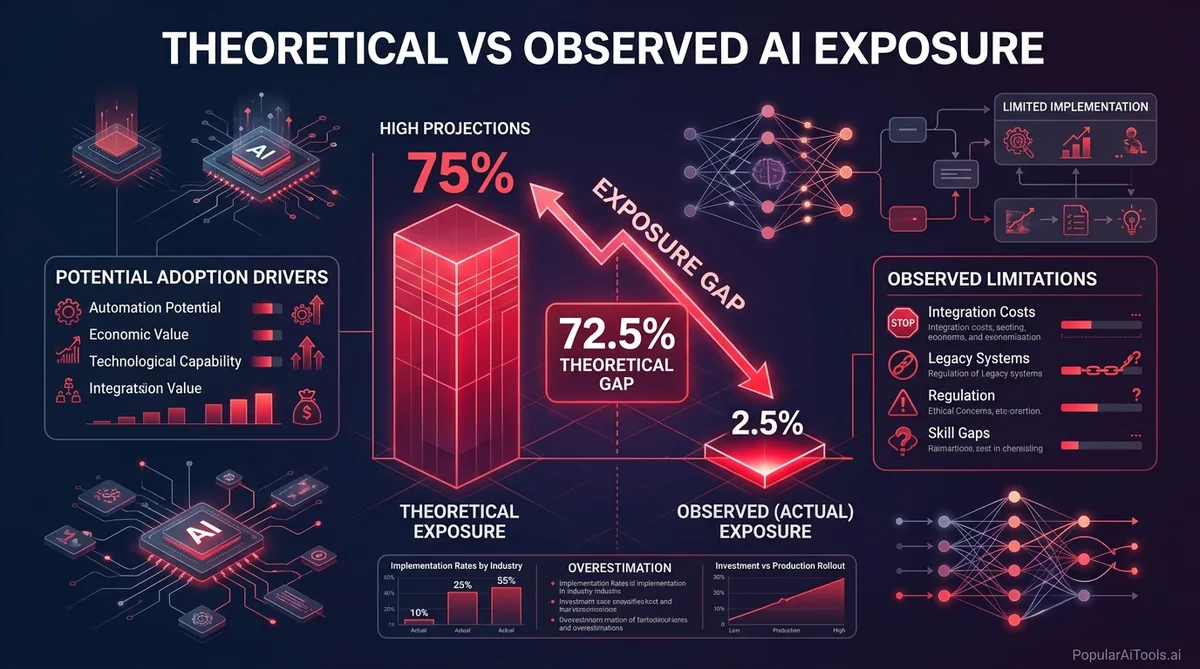
Most previous studies (including the widely-cited work by Eloundou et al.) measured theoretical exposure: could an AI theoretically make this task twice as fast? Anthropic’s team, led by researchers Maxim Massenkoff and Peter McCrory, introduced a new metric called observed exposure — what AI is actually being used for in professional settings, based on real Claude usage data mapped against roughly 800 occupations.
The gap between theory and reality is enormous:
The takeaway: AI could theoretically automate far more than it currently does. The 94% theoretical exposure for computer and math occupations drops to just 35.8% in observed reality. That’s both reassuring (most jobs aren’t being automated yet) and ominous (there’s massive room for adoption to grow).
Their weighting methodology is also worth understanding. Fully automated AI uses receive full weight, while augmentative use (where a human is still involved in the loop) receives half weight. This means the observed exposure numbers reflect a blend of full automation and AI-assisted work.
The 10 Most AI-Exposed Jobs
Based on Anthropic’s observed exposure data, here are the occupations seeing the most real-world AI usage against their task profiles:
The number one spot is striking: 74.5% of programming tasks are already covered by real AI usage. Not theoretically possible — actually happening. If you’re a programmer and you’re not using AI tools daily, you’re competing against people who are getting three-quarters of their task load augmented or automated.
Marketing specialists at 64.8% shouldn’t surprise anyone who’s watched AI transform content creation, audience research, and campaign analytics over the past two years. The same goes for customer service, where AI chatbots and automated response systems have gone from experimental to standard.
The Jobs AI Can’t Touch (Yet)
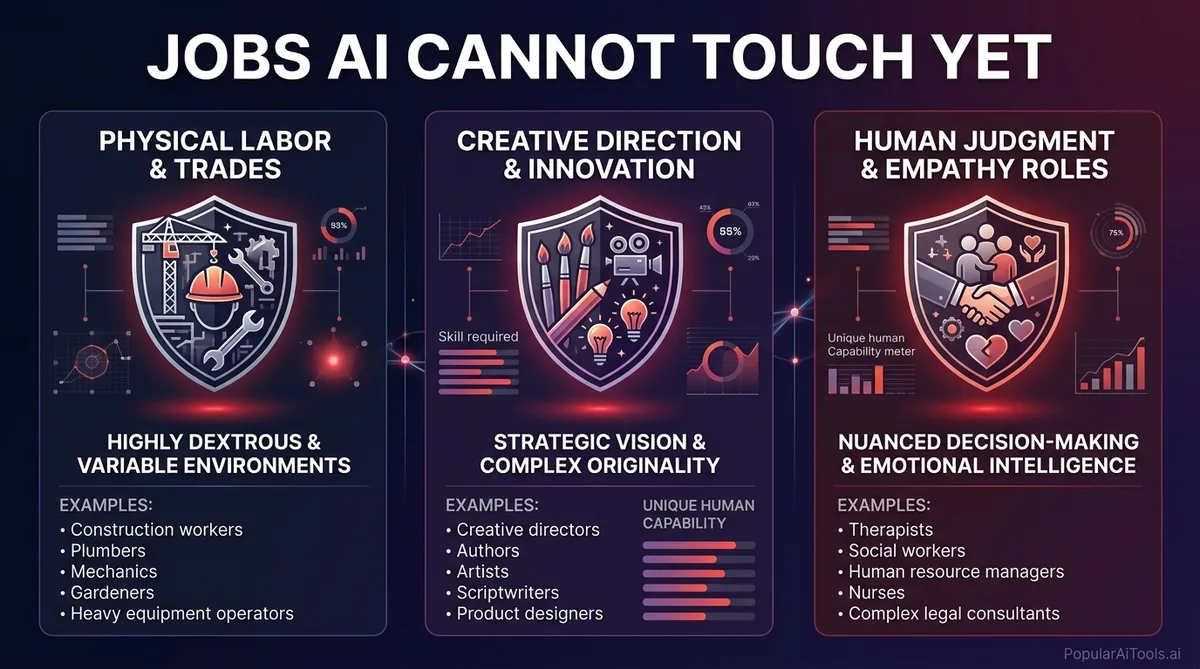
The flip side of the data is equally revealing. The least AI-exposed occupations share a common trait: they require physical presence, manual dexterity, or real-world environmental awareness.
Specific low-exposure jobs include cooks, motorcycle mechanics, lifeguards, bartenders, and dishwashers. The pattern is clear: if your job requires you to physically manipulate objects, navigate unpredictable environments, or provide hands-on human care, AI has very little foothold.
This aligns with a broader truth we keep seeing in the data: AI is a white-collar disruption tool. The trades, physical services, and skilled manual labor remain remarkably insulated. If anything, these occupations may see increased demand as the economic landscape shifts.
The Hiring Slowdown Nobody Is Talking About
Here’s the finding that should genuinely alarm anyone entering the workforce in 2026: hiring of workers aged 22 to 25 has slowed by an estimated 6-16% in AI-exposed occupations.
The averaged estimate across the post-ChatGPT era shows a 14% drop in the job finding rate for young workers in exposed fields compared to 2022 levels. While this is just barely statistically significant, the direction is unmistakable.
Critically, this isn’t showing up as a spike in unemployment — and that’s what makes it insidious. Young workers who can’t find entry-level positions in exposed fields aren’t filing for unemployment. They’re:
- Staying in school longer
- Taking jobs in unrelated fields
- Leaving the labor force entirely
- Working gig or contract jobs that don’t show up in traditional employment data
The report explicitly notes that “slowed hiring may not necessarily manifest as increased unemployment, since many young workers are labor market entrants without a listed occupation” in the Current Population Survey data.
This is the hidden cost of AI automation that headline unemployment numbers won’t capture. A generation of workers may be getting quietly rerouted away from the career paths they trained for, with no visible crisis to trigger a policy response.
Who Is Most Affected? The Demographics Might Surprise You
Contrary to the assumption that AI mostly threatens low-wage workers, Anthropic’s data reveals the opposite profile. Workers in the most AI-exposed occupations tend to be:
- Older (not younger — though younger workers face the hiring slowdown)
- More educated (bachelor’s degree or higher)
- Higher-paid (knowledge workers earning above-median wages)
- More likely to be women (due to concentration in administrative, marketing, and support roles)
This flips the usual automation narrative on its head. Previous waves of automation (manufacturing robots, self-checkout kiosks) hit blue-collar workers hardest. AI is targeting the college-educated middle class — the demographic that was supposed to be “safe” from automation.
How This Compares to Other AI Labor Studies
Anthropic’s research doesn’t exist in a vacuum. Here’s how it stacks up against the other major AI labor studies:
What sets Anthropic’s work apart is the real usage data. Every other study asks “what could AI do?” Anthropic measured what it’s actually doing. And the answer is sobering: 97% of the tasks observed in Claude’s economic data fall into categories rated as theoretically feasible. AI is being used exactly where researchers predicted — it’s just not being used as extensively as it could be. Yet.
The WEF’s projection of net job creation (+78 million by 2030) offers some hope, but those new roles overwhelmingly require skills that today’s displaced workers don’t have — AI ethics officers, prompt engineers, and human-AI collaboration specialists are not natural transitions for a laid-off data entry clerk.
What You Should Actually Do About This
We’re not going to sugarcoat this. The data is clear: AI is already reshaping the labor market, and the pace of adoption is accelerating. Here’s our practical framework for responding.
If You’re in a High-Exposure Field (Programming, Marketing, Admin, Finance)
- Become the person who uses AI, not the person AI replaces. The 74.5% programming exposure number doesn’t mean 74.5% of programmers are losing their jobs. It means programmers who use AI are dramatically more productive than those who don’t. The gap between “AI-augmented professional” and “traditional professional” is widening every month.
- Move up the abstraction ladder. AI handles execution. Humans still drive strategy, client relationships, creative direction, and complex problem-solving. If your job is primarily execution-based (writing code to spec, producing routine reports, handling standard customer queries), you need to add higher-order skills to your profile.
- Document your AI workflow. Companies are starting to value employees who can build and optimize AI-augmented workflows for their teams. Become the person who shows others how to 3x their output.
If You’re 22-25 and Entering the Workforce
- Hybrid skills are your moat. The safest career profiles combine technical knowledge with something AI struggles with — interpersonal skills, physical-world expertise, domain-specific judgment, or creative vision.
- Don’t skip entry-level learning. The temptation to use AI to bypass foundational skill-building is real. Resist it. The people who’ll thrive in 5 years are the ones who understand what AI is doing, not just that it can do it.
- Consider the trades seriously. The data is unambiguous: skilled physical work is the most AI-resistant category. Electricians, plumbers, and HVAC technicians aren’t just safe — they’re seeing increased demand and rising wages.
If You’re a Manager or Business Owner
- Audit your team’s task profiles. Map your employees’ responsibilities against Anthropic’s exposure data. Where are the biggest automation opportunities? Where do humans add irreplaceable value?
- Invest in reskilling now. The IMF’s research shows that AI benefits accrue disproportionately to workers with digital and analytical skills. Training your existing workforce is cheaper than perpetual hiring cycles.
- Watch the observed exposure trends. Anthropic’s Economic Index is updated regularly. The gap between theoretical and observed exposure is closing. Plan accordingly.
Built an AI tool? Get it in front of thousands of qualified buyers on PopularAiTools.ai
FAQ
What is the Anthropic Institute?
The Anthropic Institute is a research division launched on March 11, 2026, by Anthropic (the company behind Claude AI). Led by co-founder Jack Clark, it consolidates Anthropic’s Frontier Red Team, Societal Impacts Team, and Economic Research Team into a single body focused on studying how powerful AI affects jobs, security, and society. It launched with approximately 30 researchers including hires from Google DeepMind and OpenAI.
Which jobs are most at risk from AI according to Anthropic’s data?
Computer programmers top the list with 74.5% observed AI exposure, followed by market research analysts (64.8%), sales representatives (62.8%), customer service representatives, and data entry keyers. The common thread is that these roles involve tasks that are primarily digital, text-based, and pattern-driven — exactly the territory where large language models excel.
Are people actually losing jobs to AI right now?
Not in the way you might expect. Anthropic’s research found no systematic increase in unemployment among workers in heavily AI-exposed occupations. However, they did find a 6-16% decline in hiring rates for workers aged 22-25 in those same fields. The effect is a “hiring chill” rather than mass layoffs — companies are simply filling fewer entry-level positions, which doesn’t show up in headline unemployment data.
What jobs are safest from AI automation?
Jobs requiring physical presence, manual dexterity, and real-world navigation remain highly insulated. Ground maintenance workers (3.9% theoretical exposure), transportation workers, agricultural workers, construction workers, and personal care providers are among the least affected. Skilled trades like electricians, plumbers, mechanics, and HVAC technicians are particularly well-positioned.
How is Anthropic’s research different from other AI jobs studies?
Most AI labor studies (from the IMF, McKinsey, WEF, and academic researchers) measure theoretical exposure — what AI could automate. Anthropic’s Economic Index measures observed exposure — what AI is actually being used for, based on real usage data from millions of Claude conversations mapped against 800 occupations. This makes their findings uniquely grounded in reality rather than speculation, revealing that actual AI adoption is currently a fraction of what’s theoretically possible.
The Anthropic Institute’s research is a wake-up call, but not a death sentence. The gap between theoretical and observed exposure tells us we’re still in the early innings of AI’s labor market transformation. That gap is closing — and when it does, the workers who prepared will thrive while those who ignored the data will scramble.
The best time to adapt was two years ago. The second best time is today.
Want to stay ahead of AI’s impact on work and discover the best AI tools for your career? Subscribe to our newsletter for weekly breakdowns of the research, tools, and strategies that matter.
External Sources: