
AI Content Empire Toolkit: The Complete System for Creating 50+ Pieces of Content Per Month Without Burning Out
Key Takeaways
- Content demands are overwhelming solo creators and small teams. The average brand needs to publish across 4-6 platforms weekly just to stay visible, and most creators burn out within 6 months of trying to keep up.
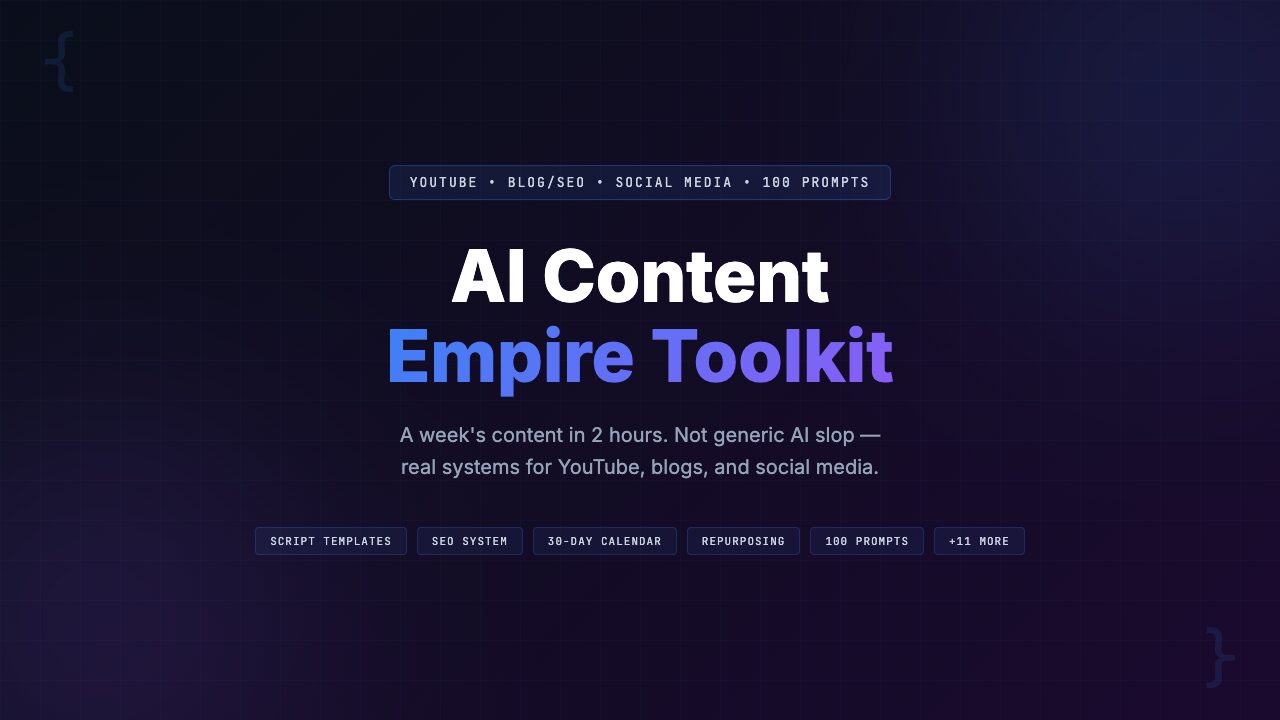
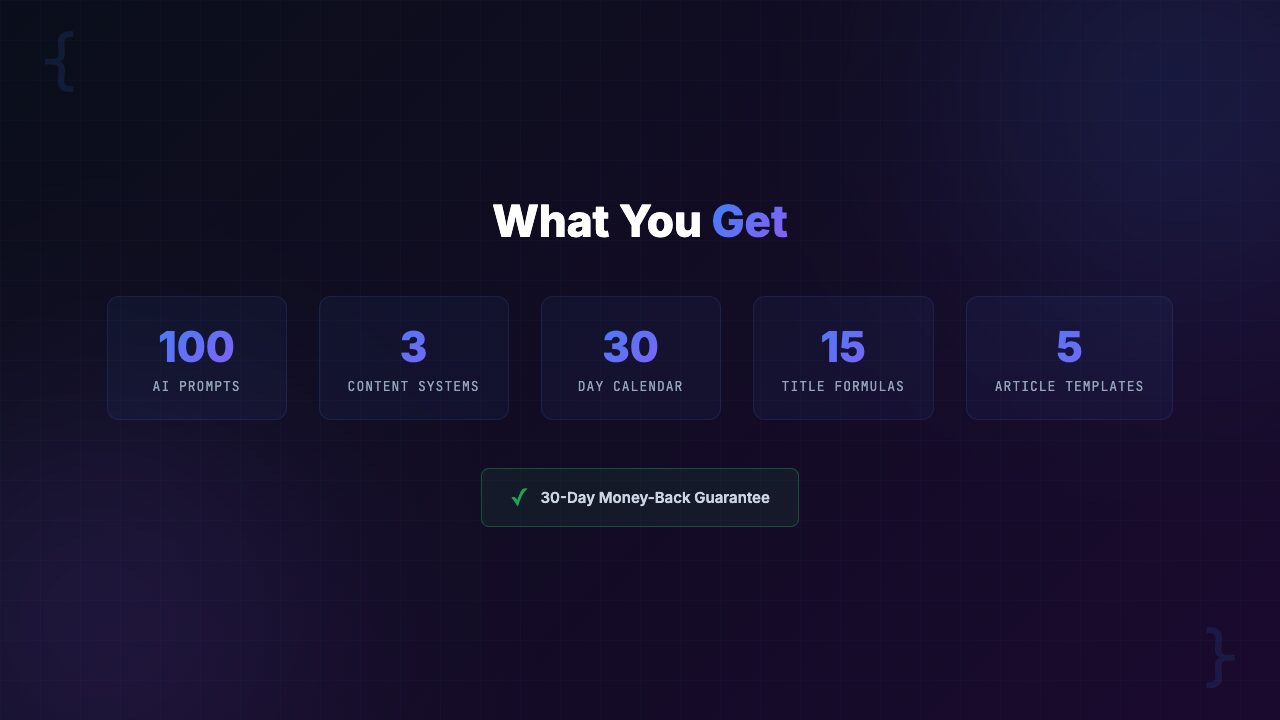
- The AI Content Empire Toolkit is a 16-file system that covers YouTube production, Blog/SEO, Social Media, and an AI Prompts Master Library with 100+ ready-to-use prompts.
- The toolkit is built around a content repurposing engine: create one pillar piece, then use the workflows to generate 8-12 derivative pieces across platforms automatically.
- Price: $29 (pay-what-you-want, suggested $49) with instant delivery, lifetime access, and a 30-day money-back guarantee.
- Works with any AI tool (ChatGPT, Claude, Gemini, Perplexity, etc.) because the frameworks are tool-agnostic.
We are going to be honest about something: the content game in 2026 is brutal. It is not enough to be good at creating content. You need to be good at creating content everywhere, consistently, on schedule, and at a quality level that actually moves the needle. YouTube wants weekly uploads. Google wants 2,000-word blog posts with proper SEO. LinkedIn wants daily thought leadership. Twitter/X wants multiple posts per day. Instagram wants carousels and stories.
Most creators and marketers we talk to are drowning. They know they should be doing more, but they are stuck in one of two traps: they either spend 40+ hours per week manually creating content for every platform, or they turn to AI tools and end up publishing generic, robotic-sounding content that damages their brand more than it helps.
The AI Content Empire Toolkit claims to solve both problems. It is a 16-file system designed to help creators produce 50+ pieces of content per month across every major platform without the burnout or the generic AI slop. We spent three weeks testing every file in the toolkit across real content workflows. This is our complete breakdown.
TL;DR
The AI Content Empire Toolkit is a $29 bundle of 16 files organized into four systems: YouTube Production, Blog & SEO, Social Media, and an AI Prompts Master Library. It is built around content repurposing, meaning you create one core piece and use the workflows to spin it into 8-12 pieces across platforms. The voice calibration and quality control files are what separate this from random free prompt lists. Works with any AI tool. 30-day money-back guarantee.
The Problem: Content Demands Are Crushing Creators and Small Teams
Let us paint the picture with real numbers. According to HubSpot’s State of Marketing report, brands that publish 16+ blog posts per month get 3.5x more traffic than those that publish 0-4. Buffer’s research shows that the optimal posting frequency on Twitter/X is 3-5 times per day. YouTube’s algorithm rewards weekly uploads at minimum. LinkedIn’s algorithm favors daily posts.
Add it up. If you want to show up competitively on just four platforms, you are looking at roughly 80-100+ pieces of content per month.
For a solo creator, that is simply not possible through manual effort. For a small team, it means content production dominates every other business activity. For an agency managing multiple clients, the math becomes nightmarish.
So people turn to AI. And here is where the second problem begins: AI-generated content without a system behind it is almost always generic. We have all seen it. The same bland tone. The same predictable structure. The same phrases that scream “a chatbot wrote this.” Audiences can smell it instantly, and it erodes trust faster than publishing nothing at all.
The root cause is not the AI tools themselves. ChatGPT, Claude, and Gemini are all capable of producing excellent content. The problem is that most people use them wrong. They open a chat window, type “write me a blog post about X,” and paste whatever comes out. There is no voice calibration. No content strategy. No quality control. No repurposing workflow. No system.
The AI Content Empire Toolkit is designed to be that system. [INTERNAL LINK: /category/ai-content-creation/]
The Landscape: What Creators Are Currently Doing (and Why It Falls Short)
Before we break down the toolkit, let us be fair about what is already available. If you have recognized the content volume problem, you have probably explored at least one of these approaches.
Option 1: Free AI Prompt Lists
There are hundreds of free prompt lists floating around the internet. “500 ChatGPT Prompts for Content Creators!” They are everywhere on Medium, Pinterest, and Reddit. The problem: they are isolated prompts with no system behind them.
- No strategy for how prompts connect to each other
- No guidance on maintaining a consistent voice across outputs
- No system for turning one piece of content into many
- It is like getting a bag of random ingredients with no recipe
We tested five of the most popular free prompt lists. The output was usable roughly 30% of the time. The rest required so much editing that you might as well have written it from scratch.
Option 2: Scattered YouTube Tutorials
YouTube is full of “how I use AI to create content” videos. Some are genuinely useful. But they all share the same limitation: they show you one person’s workflow for one platform.
- A video about using ChatGPT for Twitter/X threads does not help you with YouTube scripts
- A tutorial about AI blog posts does not address social media repurposing
- You end up stitching together advice from 20 different creators, none of which were designed to work together
Option 3: Doing It All Manually
The most common approach, and the one that leads directly to burnout.
- You research keywords, outline, draft, edit, publish, and promote manually
- The quality is high because it is authentically yours, but the volume is unsustainable
- Most creators who try this approach hit a wall within 3-6 months
Option 4: Expensive AI Content Platforms ($50-$300/month)
Tools like Jasper, Copy.ai, and Writesonic offer full-featured AI content platforms. They work, but they have significant drawbacks:
- Recurring monthly costs that add up quickly ($588-$3,600/year)
- Lock you into their proprietary ecosystem
- If you already have ChatGPT, Claude, or another AI tool, paying for another subscription is hard to justify
- You still need a strategy — the platform gives you the engine, but you still need the roadmap
[INTERNAL LINK: /category/ai-writing-tools/]
The Solution: AI Content Empire Toolkit
The AI Content Empire Toolkit is a one-time-purchase system of 16 files that gives you the complete roadmap for producing high-quality, multi-platform content at scale using any AI tool you already have access to.
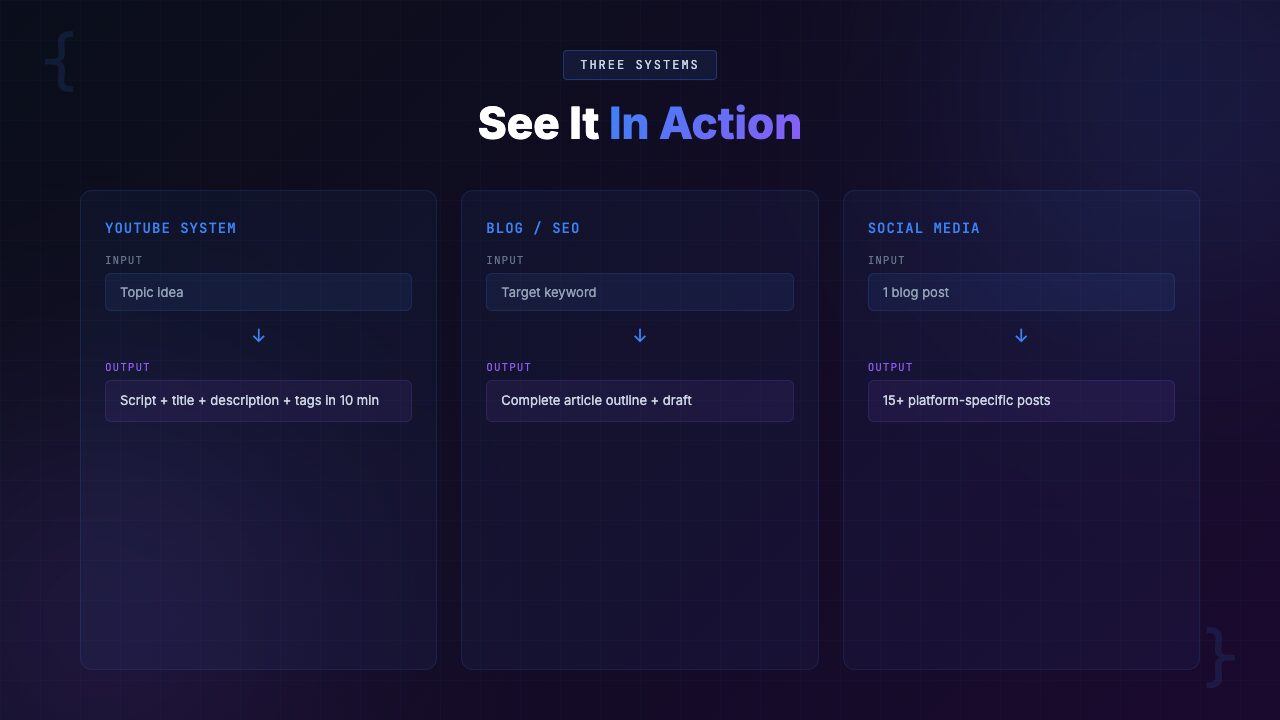
The key concept behind the toolkit is content repurposing by design. Instead of creating every piece of content from scratch, you create one pillar piece (a YouTube video, a long-form blog post, or a podcast episode), and then use the toolkit’s workflows to systematically break it down into 8-12 derivative pieces across Twitter/X, LinkedIn, Instagram, email newsletters, and more.
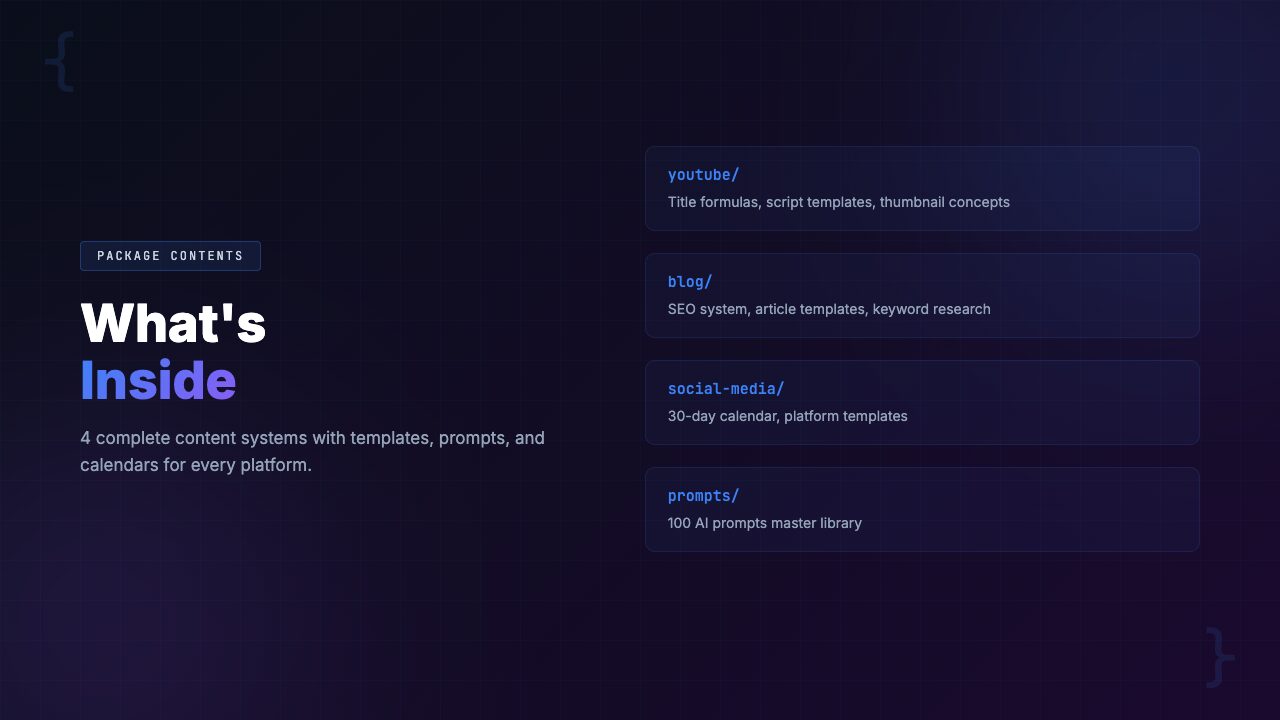
It is not a prompt list. It is not a course. It is a production system with templates, frameworks, calendars, and quality controls that fit together as a single, cohesive workflow. The 16 files are organized into four systems:
- YouTube Production System (4 files)
- Blog & SEO System (4 files)
- Social Media System (4 files)
- AI Prompts Master Library (4 files)
Let us break down each one.
What’s Inside: A Complete Feature Breakdown of All 16 Files
System 1: YouTube Production System (4 Files)
YouTube is the highest-leverage content platform for most creators. A single well-performing video can drive traffic, build authority, and generate leads for months or years. But YouTube production is also one of the most time-intensive content formats. The YouTube Production System breaks the entire process into repeatable, AI-assisted steps.
File 1: Title Formulas — A library of proven YouTube title structures organized by content type. Each formula includes:
- Psychological triggers: curiosity gap, specificity, urgency, social proof
- AI prompts to generate 10-20 title variations per topic
- Covers tutorials, listicles, comparisons, opinion pieces, case studies, and more
- Go from 30 minutes agonizing over titles to picking the best option in under 2 minutes
File 2: Script Templates — Full script outlines for the most common YouTube formats. Each template includes:
- Hook structure (the first 30 seconds that determine whether viewers stay)
- Section transitions, retention cues, and CTA placement
- Covers how-to tutorials, tool reviews, comparison videos, story-driven content, and talking-head opinion pieces
- AI prompt blocks built directly in so you can generate a full draft script in minutes
File 3: Description & Metadata Templates — YouTube descriptions are one of the most underutilized SEO opportunities on the platform. This file includes:
- Templates for keyword-optimized descriptions
- Tag strategies and hashtag placement
- Timestamps formatting and end screen/card suggestions
- Placeholder prompts to generate descriptions tailored to your specific video in under a minute
File 4: Thumbnail Frameworks — A visual framework for high-CTR thumbnails organized by video type. Includes:
- Composition guidelines and text overlay rules (font size, word count, contrast ratios)
- Face expression references and color psychology notes
- A checklist for A/B testing
- Clear blueprints so every thumbnail follows proven patterns
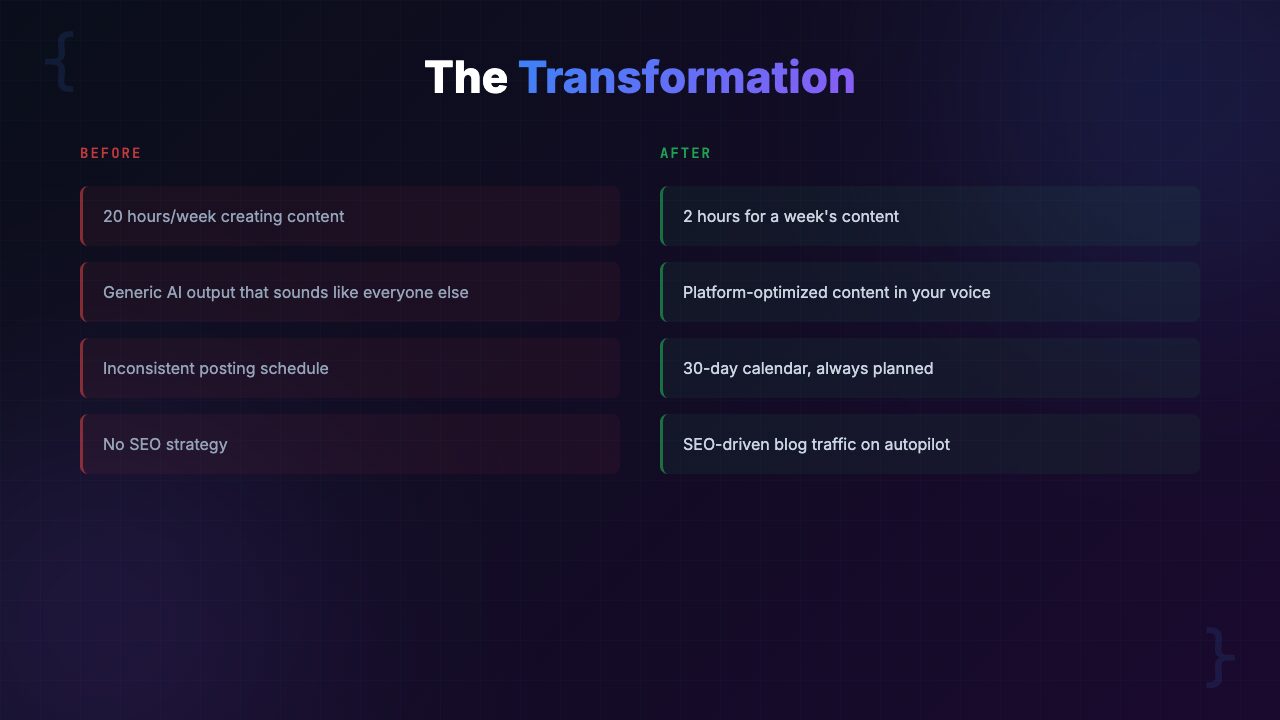
BEFORE: Staring at a blank document trying to outline a YouTube video. Spending 45 minutes writing a title. Forgetting to optimize descriptions. Thumbnails feel random.
AFTER: Plug your topic into the script template, generate a title using the formulas, fill in the description template, follow the thumbnail framework. Total time from idea to production-ready script: under 30 minutes.
System 2: Blog & SEO System (4 Files)
Blogging is not dead. Search-driven content is still one of the most reliable and compounding traffic sources available, but only if you do SEO properly. The Blog & SEO System gives you the frameworks to consistently produce search-optimized content that ranks and converts.
File 5: Keyword Research Templates — A structured approach to finding keywords that are actually worth targeting. Includes:
- Templates for seed keyword expansion and long-tail identification
- Competitor keyword gap analysis
- Search intent classification
- Walkthrough of using free tools (Google Search Console, Google Trends, AnswerThePublic) alongside AI to build a keyword bank organized by priority and difficulty
File 6: Article Templates — Pre-structured outlines for the blog post formats that perform best in search. Each template includes:
- Heading hierarchy and word count targets per section
- Internal and external link placement
- Featured snippet optimization notes
- AI prompts for drafting each section while maintaining your voice
- Covers ultimate guides, how-to posts, comparison articles, listicles, tool roundups, and case studies
File 7: Internal Linking Strategy — Internal linking is one of the highest-impact, lowest-effort SEO tactics, and most creators completely neglect it. This file provides:
- A framework for mapping your content clusters
- Methods for identifying linking opportunities between posts
- Pillar/cluster content architecture structure
- AI prompts to generate contextual internal links that feel natural
- A tracking template to ensure every new post connects properly to your existing content
File 8: Content Briefs — If you work with writers, freelancers, or use AI as your primary drafting tool, content briefs are essential. Each brief template includes:
- Target keyword and secondary keywords
- Search intent and competitor analysis summary
- Outline requirements and word count targets
- Tone, voice guidelines, and CTA specifications
- One brief, one consistent output, every time
BEFORE: Publishing blog posts without keyword research. Random internal linking. No consistent structure. Posts that take 4-6 hours each and do not rank.
AFTER: A keyword-driven content calendar, structured briefs, optimized article templates, and a linking strategy that strengthens your entire site with every new post. Time per article drops to 1-2 hours with AI drafting from the templates.
System 3: Social Media System (4 Files)
Social media is where most creators feel the most pressure and see the most inconsistency. The Social Media System eliminates the “what should I post today?” problem entirely by giving you a pre-built calendar and platform-specific templates.
File 9: 30-Day Content Calendar — A complete month-long content calendar with daily post themes, content types, and platform assignments already mapped out. Features include:
- Strategic rhythm: pillar content days, repurposing days, engagement days, and promotional days
- Seasonal hooks and trending topic integration slots
- “Evergreen bank” days for content that works any time
- Customize it once per month, then execution becomes a matter of following the plan
File 10: Twitter/X Templates — Thread structures, single tweet frameworks, engagement tweet formulas, and quote tweet templates. Includes:
- Formats that consistently perform: hot takes, contrarian opinions, personal stories, tactical tips, curated insight threads
- AI prompts calibrated for Twitter’s character limits and conversational tone
- A daily posting schedule with optimal timing notes
File 11: LinkedIn Post Templates — LinkedIn has its own language, format, and audience expectations. This file provides:
- Templates for thought leadership posts, carousel-style text posts, storytelling posts, data-driven insights, and engagement-bait openers
- Hook in the first two lines, line breaks for readability, and CTA placement that drives profile visits and connection requests
- Each template accounts for LinkedIn’s specific algorithm preferences
File 12: Instagram Carousel Templates — Carousel posts are Instagram’s highest-engagement format. This file includes:
- Slide-by-slide frameworks for educational carousels, listicle carousels, before/after carousels, step-by-step tutorials, and myth-busting carousels
- Text per slide, visual layout suggestions, and caption templates with hashtag strategies
- AI prompts for generating carousel copy and caption text from your pillar content
BEFORE: Opening Twitter at 2 PM with no idea what to post. Copying the same content format to every platform. Going dark for days when life gets busy.
AFTER: A 30-day calendar tells you exactly what to post and where. Platform-specific templates ensure every post is optimized for its audience. Batch content creation in 2-3 hours per week covers the entire month.
System 4: AI Prompts Master Library (4 Files)
This is the engine that powers everything else in the toolkit. The AI Prompts Master Library is not a random list of prompts. It is a curated, categorized, and interconnected prompt system designed to work with the other three systems.
File 13: 100+ Content Creation Prompts — Organized by content type and platform, not randomly dumped into a list. Categories include:
- Ideation prompts: generate topic ideas from your niche
- Research prompts: gather data and angles
- Drafting prompts: create first drafts in your voice
- Editing prompts: refine drafts for clarity and engagement
- Distribution prompts: create platform-specific variations
- Each prompt includes a usage note explaining when and how to use it within the broader system
File 14: Voice Calibration Guide — This is arguably the most valuable file in the entire toolkit. It walks you through defining your unique brand voice in a format that AI tools can actually use. You will document:
- Your tone (formal vs. casual, playful vs. serious)
- Your vocabulary preferences (words you use, words you never use)
- Your sentence structure patterns and storytelling style
- Your audience’s expectations
The result is a “voice profile” that you paste into any AI tool before generating content, ensuring every piece sounds like you.
File 15: Repurposing Workflows — The heart of the “empire” concept. This file provides step-by-step workflows for turning one piece of content into many. Example workflow from a single 2,000-word blog post:
- A Twitter/X thread (5-7 tweets)
- A LinkedIn post
- Three Instagram carousel slides
- A YouTube script outline
- Two email newsletter sections
- A Pinterest pin description
Each workflow includes the specific AI prompts to use at each step, with instructions for adapting the tone and format for each platform.
File 16: Quality Control Checklist — The anti-slop filter. A detailed checklist for reviewing every piece of AI-assisted content before it goes live. Checks for:
- Brand voice consistency
- Factual accuracy
- AI-typical phrases and cliches to remove
- Readability score and engagement hooks
- CTA presence and SEO optimization (for blog content)
- Platform-specific formatting
This file is the difference between content that sounds human and content that sounds like it was generated by a chatbot.
BEFORE: Using random prompts with no voice guidance. Generating content that sounds generic. No system for repurposing. No quality control beyond “does this look okay?”
AFTER: Voice-calibrated prompts that produce on-brand content. Repurposing workflows that multiply every piece 8-12x. A checklist that catches every AI artifact before publishing.
How to Get Started with the AI Content Empire Toolkit
One of the toolkit’s strongest points is how quickly you can go from purchase to producing content. Here is the recommended setup process.
Step 1: Complete the Voice Calibration Guide (20-30 minutes)
This is the most important step and the one you should do first. Open File 14 (Voice Calibration Guide) and work through the exercises.
- Define your tone, vocabulary, sentence patterns, and audience expectations
- Save the resulting voice profile
- You will use it every time you generate content with AI
Step 2: Set Up Your 30-Day Content Calendar (15-20 minutes)
- Open File 9 (30-Day Content Calendar)
- Customize it for your niche, platforms, and publishing frequency
- Mark your pillar content days and repurposing days
- This becomes your operational plan for the month
Step 3: Choose Your Pillar Content Format
- Decide whether your primary pillar content will be YouTube videos, blog posts, or something else
- Grab the corresponding system files (YouTube Production System or Blog & SEO System)
- Familiarize yourself with the templates before creating your first piece
Step 4: Create Your First Pillar Piece
- Use the script templates or article templates to create your first piece of pillar content
- Paste your voice profile into the AI tool first
- Use the prompts from File 13 to draft
- Run the output through the Quality Control Checklist (File 16) before publishing
Step 5: Run the Repurposing Workflow
- Take your published pillar piece and open File 15 (Repurposing Workflows)
- Follow the workflow to generate derivative content for Twitter/X, LinkedIn, Instagram, email, and any other platforms on your calendar
- In under an hour, one pillar piece becomes 8-12 published posts
Who Is the AI Content Empire Toolkit For?
This Is For You If…
- You are a content creator, marketer, or entrepreneur who needs to publish consistently across multiple platforms
- You have tried using AI for content but the output sounds generic and robotic
- You are burned out from manual content creation and need a sustainable system
- You already use ChatGPT, Claude, Gemini, or another AI tool and want to get dramatically better results from it
- You want a content repurposing strategy that turns 1 piece into 8-12 without starting from scratch each time
- You value a one-time purchase over yet another monthly SaaS subscription
Not For You If…
- You do not create or publish content of any kind
- You are looking for a fully automated, “push button” content system that requires zero human input (this toolkit still requires your judgment and editing)
- You already have a mature, documented content production workflow that is producing the volume and quality you need
- You are philosophically opposed to using AI in content creation
- You need platform-specific tools (video editing software, social media scheduling, etc.) rather than content strategy and templates
Real-World Use Cases: Three Scenarios Where This Toolkit Delivers
Let us walk through three specific scenarios to show how the toolkit works in practice for different types of users.
Scenario 1: YouTube Creator Who Needs to Grow Beyond Video
The situation: A tech review YouTuber with 25,000 subscribers. Posts one video per week. Gets decent views but has zero blog presence, minimal social media, and no email list. Knows that diversifying platforms would reduce risk and grow the audience, but creating content for each platform from scratch feels impossible.
How the toolkit helps:
- Uses the Title Formulas and Script Templates to streamline video production (cutting script time from 3 hours to 45 minutes)
- Follows the Repurposing Workflow after each video to turn the script into a blog post, a Twitter/X thread, two LinkedIn posts, and an Instagram carousel
- The 30-Day Content Calendar keeps everything on schedule
Result: One video per week now generates 8-10 additional pieces of content across four platforms. Total weekly content time goes from 8 hours (video only) to 10 hours (video + all platforms). Net gain: presence on four additional platforms for just 2 extra hours per week.
Scenario 2: Solopreneur Blogger Trying to Rank on Google
The situation: A personal finance blogger who publishes 2-3 articles per month. Traffic is stagnant because articles are not keyword-optimized, internal linking is nonexistent, and there is no content strategy beyond “write about whatever seems interesting this week.”
How the toolkit helps:
- Starts with the Keyword Research Templates to build a 3-month content plan based on actual search demand
- Uses the Article Templates to structure every post for SEO
- Implements the Internal Linking Strategy to connect all existing posts into topic clusters
- Uses the Content Briefs to plan each article before writing
- The Voice Calibration Guide ensures AI-assisted drafts still sound personal and authentic
Result: Monthly output increases from 2-3 unfocused articles to 6-8 keyword-targeted, SEO-optimized posts. The internal linking strategy strengthens the entire site’s authority with each new post. Within 2-3 months, organic traffic begins compounding as Google recognizes the topical authority.
Scenario 3: Agency Content Manager Handling Multiple Clients
The situation: A content manager at a digital marketing agency responsible for 5 client accounts, each requiring weekly blog posts, daily social media, and monthly reporting. The team is small. Content quality is inconsistent across clients because there is no standardized production process.
How the toolkit helps:
- Creates a Voice Calibration profile for each client (one-time setup)
- Uses the Content Briefs to standardize assignments for freelance writers and AI-generated drafts
- The 30-Day Content Calendar template is duplicated and customized per client
- The Quality Control Checklist becomes the final review step for every piece of content, regardless of who (or what) created it
Result: Content production becomes systematized. Each client has a consistent voice profile, a monthly calendar, and a quality standard. The team produces 40% more content per month with the same headcount because the templates eliminate the “start from blank page” time sink for every piece.
[INTERNAL LINK: /category/ai-content-creation/]
Comparison: AI Content Empire Toolkit vs. Alternatives
Here is an honest side-by-side comparison of the AI Content Empire Toolkit against the alternatives available to content creators in 2026.
| Feature | AI Content Empire ($29) | Free Prompt Lists | YouTube Tutorials | SaaS Platforms ($50-300/mo) |
|---|---|---|---|---|
| Multi-platform system | YouTube + Blog + Social (all 4) | Usually 1 platform | 1 platform per video | Blog + social (varies) |
| Content repurposing workflows | Step-by-step included | Not included | Sometimes mentioned | Basic features |
| Voice calibration | Full guide + profile template | Not included | Rarely covered | Basic brand voice settings |
| Quality control system | Detailed checklist | Not included | Not included | AI detection scores (some) |
| SEO keyword research | Templates + AI prompts | Not included | Varies by video | Built-in (paid tier) |
| 30-day content calendar | Pre-built + customizable | Not included | Not included | Calendar feature (paid tier) |
| Works with any AI tool | Yes (tool-agnostic) | Usually ChatGPT-specific | Varies | Locked to platform’s AI |
| Total cost (year 1) | $29 one-time | $0 | $0 (+ time investment) | $600-$3,600 |
| Money-back guarantee | 30 days | N/A | N/A | Varies (usually 7-14 days) |
Pricing & Value Breakdown
The AI Content Empire Toolkit is priced at $29 (pay-what-you-want, suggested price $49). Let us put that in perspective.
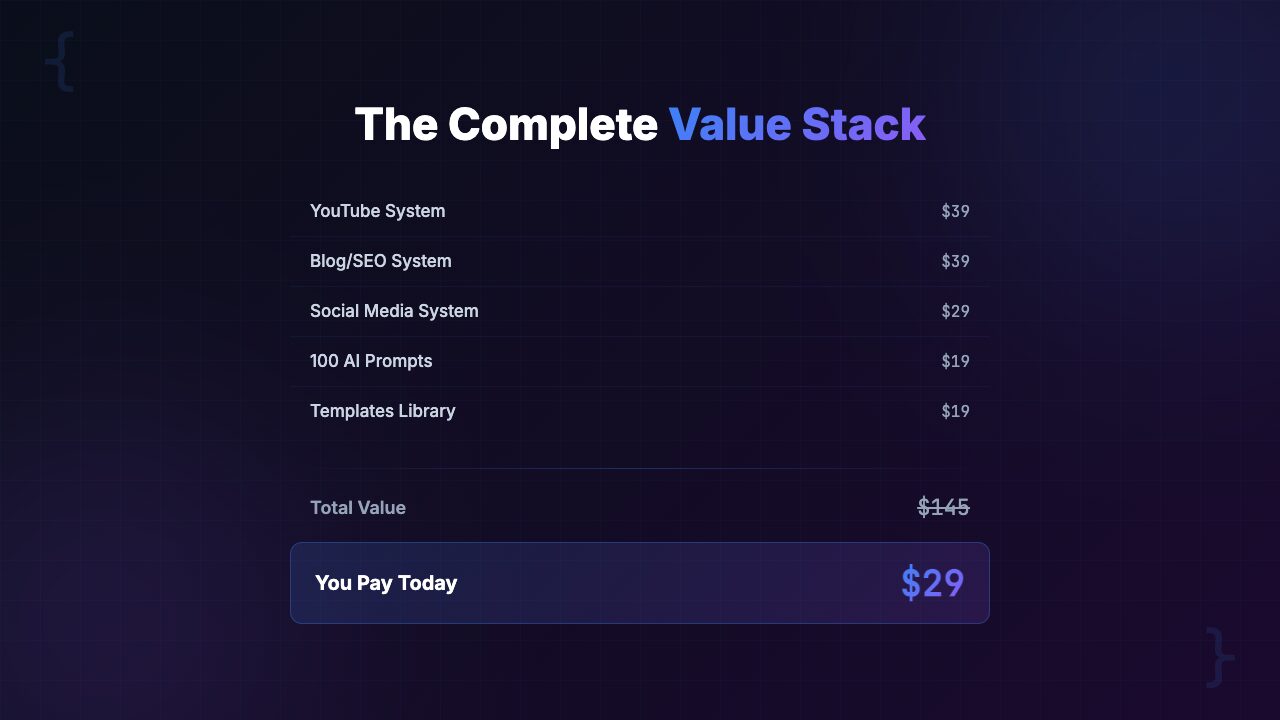
- YouTube Production System (4 files: titles, scripts, descriptions, thumbnails) — $200+ value
- Blog & SEO System (4 files: keywords, articles, linking, briefs) — $200+ value
- Social Media System (4 files: calendar, Twitter/X, LinkedIn, Instagram) — $200+ value
- AI Prompts Master Library (4 files: 100+ prompts, voice, repurposing, QC) — $300+ value
- Total value (conservatively): $900+
- Your price: $29
But here is the more practical calculation. If you currently spend 15-20 hours per week creating content manually and the toolkit reduces that to 8-10 hours through templates, repurposing workflows, and AI-assisted drafting, that is 7-10 hours saved per week. At even a modest value of $30/hour, that is $210-$300 per week in recovered time. The toolkit pays for itself in its first two days of use.
Compare that to SaaS content platforms:
- Jasper starts at $49/month ($588/year)
- Copy.ai’s Pro plan is $49/month ($588/year)
- Writesonic’s Creator plan is $49/month ($588/year)
The AI Content Empire Toolkit costs less than a single month of any of those services, and it is a one-time purchase with no recurring fees.
There is also the 30-day money-back guarantee. If the toolkit does not deliver value, you get your money back. That makes the purchase risk-free.
Frequently Asked Questions
What exactly do I get when I purchase the AI Content Empire Toolkit?
You get 16 ready-to-use files organized into four systems. The YouTube Production System includes title formulas, script templates, description/metadata templates, and thumbnail frameworks. The Blog & SEO System includes keyword research templates, article templates, an internal linking strategy, and content briefs. The Social Media System includes a 30-day content calendar, Twitter/X templates, LinkedIn post templates, and Instagram carousel templates. The AI Prompts Master Library includes 100+ prompts, a voice calibration guide, repurposing workflows, and a quality control checklist. Everything is delivered instantly via Gumroad after purchase.
Do I need to be an experienced content creator to use this?
Not at all. The toolkit is designed for creators at every level. If you are a beginner, the templates and frameworks give you a proven structure to follow so you are never staring at a blank page. If you are experienced, the AI prompt library, repurposing workflows, and voice calibration system will multiply your output while maintaining the quality your audience expects. Every file includes clear instructions and examples.
Which AI tools does this work with?
The prompts and templates are designed to work with any major AI tool, including ChatGPT (GPT-4o, GPT-4), Claude (Sonnet, Opus), Gemini, Perplexity, Copilot, and others. The toolkit is tool-agnostic because the frameworks focus on strategy, structure, and voice, not on any single platform’s interface. If your AI tool can accept text prompts, these files will work with it.
Can I really create 50+ pieces of content per month with this?
Yes. The math works like this: the system is built around content repurposing. You create one pillar piece of content (a long-form YouTube video, a comprehensive blog post, or a podcast episode), and then use the repurposing workflows to turn it into 8-12 derivative pieces across platforms. With just one pillar piece per week (4 per month), that is 32-48 derivative pieces plus the 4 originals, putting you at 36-52 pieces per month. Creators who produce two pillar pieces per week easily exceed 80+ pieces per month.
Will this make my content sound robotic or generic?
This is the concern we hear most often, and it is the exact problem the toolkit is designed to solve. The Voice Calibration Guide (File 14) walks you through defining your unique brand voice in a format that AI tools can actually use. You document your tone, vocabulary, sentence patterns, and personality before generating any content. The Quality Control Checklist (File 16) then catches any AI-typical phrases, cliches, and robotic-sounding patterns before you publish. The result is content that sounds like you, accelerated by AI, not replaced by it.
How is this different from free prompt lists I can find online?
Free prompt lists give you isolated prompts with no system behind them. The AI Content Empire Toolkit is an integrated production system. The prompts are connected to content calendars, repurposing workflows, voice calibration, and quality control processes. It is the difference between having a pile of random ingredients and having a recipe book with weekly meal plans, a shopping list, and prep instructions. The toolkit also includes platform-specific templates for YouTube, blog, Twitter/X, LinkedIn, and Instagram that free prompt lists never cover.
Is there a refund policy?
Yes. The toolkit comes with a 30-day money-back guarantee. If the system does not help you produce more content, improve your workflow, or save you time, you get a full refund through Gumroad. No questions asked, no hoops to jump through. We are confident the toolkit delivers, but we want you to feel zero risk in trying it.
What is the price, and is it a one-time purchase?
The AI Content Empire Toolkit is $29 (pay-what-you-want, suggested price $49). It is a one-time purchase with lifetime access. There are no monthly subscriptions, no annual renewals, no upsells, and no hidden fees. You pay once, download all 16 files instantly, and use them forever. Compare that to SaaS content platforms that charge $49-$300 per month for similar (and often less comprehensive) functionality.
Final Verdict: Is the AI Content Empire Toolkit Worth $29?
Here is our honest assessment after three weeks of testing.
The AI Content Empire Toolkit fills a gap that we have not seen addressed well by any other product at this price point. There are plenty of free prompt lists, but they lack structure. There are expensive SaaS platforms, but they lock you into monthly payments and proprietary tools. There are scattered tutorials, but they cover one platform at a time and rarely address the system-level problem of producing content at scale.
What the toolkit does right:
- It is a genuine system, not a collection of prompts
- The four systems (YouTube, Blog/SEO, Social Media, AI Prompts) are designed to work together
- The content calendar drives the schedule, the templates drive the format, the voice calibration drives the quality, the repurposing workflows drive the volume
- The quality control checklist catches problems before they go live
- Each piece reinforces the others
The Voice Calibration Guide is, in our opinion, the standout file. Most AI-assisted content fails because creators skip this step entirely. They paste a raw prompt, get generic output, and conclude that “AI content doesn’t work.” The voice calibration process takes 20-30 minutes to set up and permanently solves that problem. Every AI-generated draft sounds like the creator, not like a chatbot.
Where the toolkit could improve:
- The thumbnail frameworks in the YouTube system are useful but necessarily limited since thumbnails are a visual medium and text-based frameworks can only go so far
- We would like to see a podcast-specific module in a future version, given how well the repurposing model would work for podcast content
- Some of the social media templates could benefit from more niche-specific variations (B2B vs. B2C vs. personal brand)
But at $29 with a 30-day money-back guarantee, the risk-to-reward ratio is heavily tilted in the buyer’s favor. If even one of the four systems saves you meaningful time, the toolkit has paid for itself multiple times over. Based on our testing, most creators will find value across all four systems.
Our Rating: 4.6 / 5
The most comprehensive, affordable content production system we have reviewed. Minor deductions for limited visual thumbnail guidance and the absence of a podcast module. Excellent value at $29.
[INTERNAL LINK: /category/ai-content-creation/]
About PopularAiTools.ai
PopularAiTools.ai is an independent AI tool directory and review site. We test, review, and rank AI tools across categories including content creation, AI writing, image generation, AI coding productivity, and business automation. Our reviews are based on hands-on testing, not press releases or affiliate incentives.
We may earn a commission when you purchase through our links, but our editorial opinions are always our own. We only recommend products we have actually tested and believe provide genuine value. [INTERNAL LINK: /about/]
Related reviews: [INTERNAL LINK: /category/ai-content-creation/] | [INTERNAL LINK: /category/ai-writing-tools/] | [INTERNAL LINK: /category/ai-marketing-tools/]