
AI Tools Directory Starter Kit: The Complete Playbook for Building, Ranking, and Monetizing an AI Tools Directory Website
The AI tools directory niche is projected to grow through 2027+, with thousands of new AI tools launching every month and users actively searching for curated recommendations. Most people who try to build a directory fail because they treat it like a blog instead of a structured, monetizable content engine with directory-specific SEO.
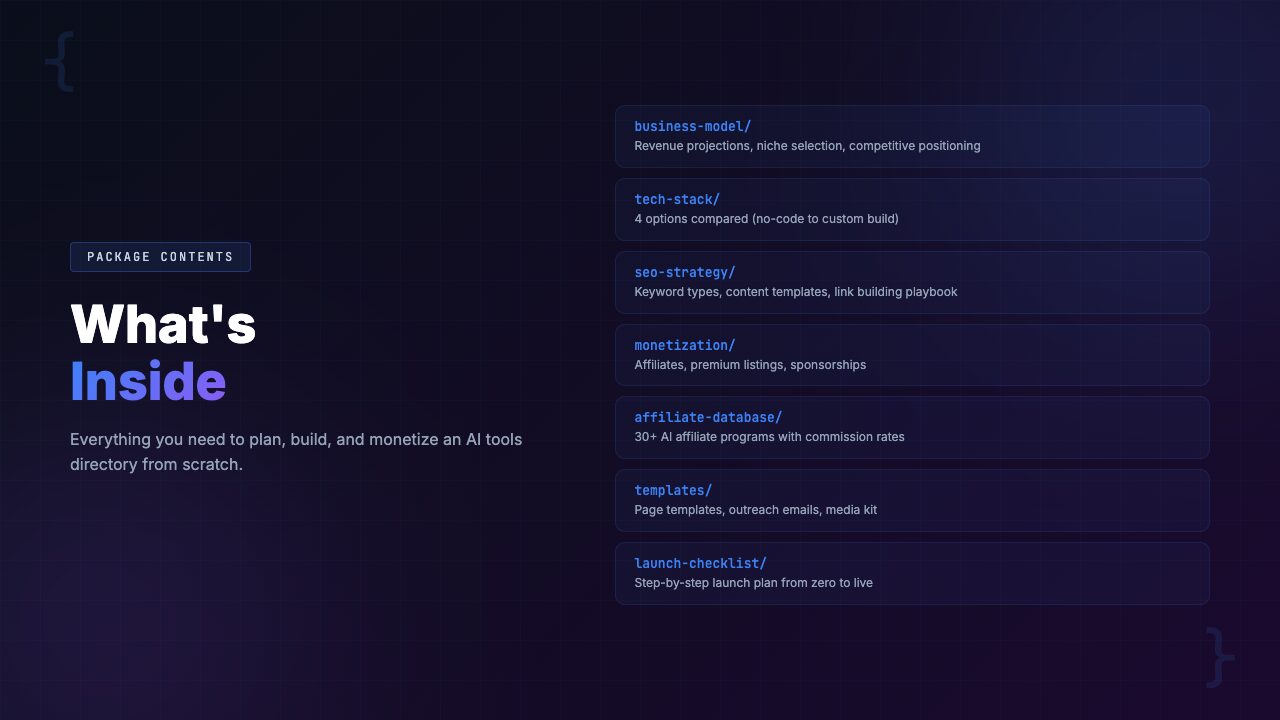
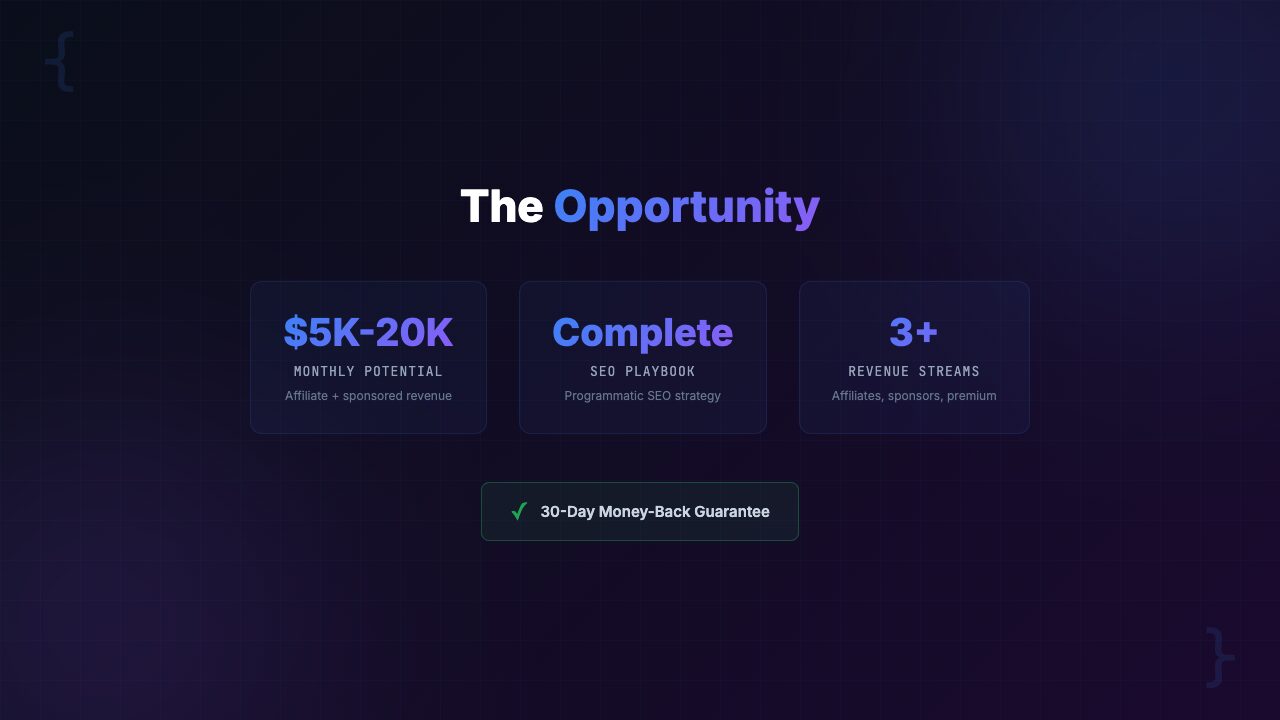
The AI Tools Directory Starter Kit includes 13 files covering business model, tech stack, SEO, content sourcing, 30+ affiliate programs, premium listing sales, a 90-day launch plan, and a media kit template. Three tech paths are covered: WordPress (no code), no-code builders, and Next.js for developers, with 6 page type templates for each.
Price: $79 (pay-what-you-want, suggested $129) with a 30-day money-back guarantee and instant delivery.
Every week, we hear the same question from readers: “I want to build an AI tools directory like yours. Where do I start?” It is one of the most common requests we get at PopularAiTools.ai, and the honest answer until now has been: it is complicated.
Building an AI tools directory is not the same as starting a blog or launching a SaaS product. It sits at the intersection of content strategy, SEO, affiliate marketing, database management, and media sales. Get one of those pillars wrong and your directory either never ranks, never monetizes, or both.
We have been running PopularAiTools.ai long enough to know what works and what does not. And when we came across the AI Tools Directory Starter Kit, a 13-file playbook that claims to give you everything you need to build, rank, and monetize an AI tools directory, we had to take it apart and see if it delivers.
This review is the result. We went through every file, tested the strategies against our own experience, and mapped the kit’s advice against what actually works in the real world. Whether you buy this kit or not, this post will give you a clear-eyed look at what it takes to build a successful AI tools directory in 2026.
TL;DR
The AI Tools Directory Starter Kit ($79, PWYW) is a 13-file playbook that covers every aspect of launching an AI tools directory: business model and niche selection across 20 subcategories, tech stack options for coders and non-coders, a complete SEO strategy including programmatic SEO, a tool sourcing playbook with listing templates, a database of 30+ affiliate programs, a premium listing sales system, a 90-day launch plan, and a media kit template. It is the most comprehensive directory-building resource we have reviewed.
The Problem: You Want to Build an AI Tools Directory but Have No Idea Where to Start
The appeal of an AI tools directory is obvious. New AI tools launch every single day. Millions of people search Google for phrases like “best AI writing tools,” “AI image generators,” and “AI tools for marketing.” Those searches carry high commercial intent, which means affiliate commissions, premium listing revenue, and display ad income for whoever ranks on page one.
Over 2,000+ new AI tools launch every month — and users need help finding the right ones.
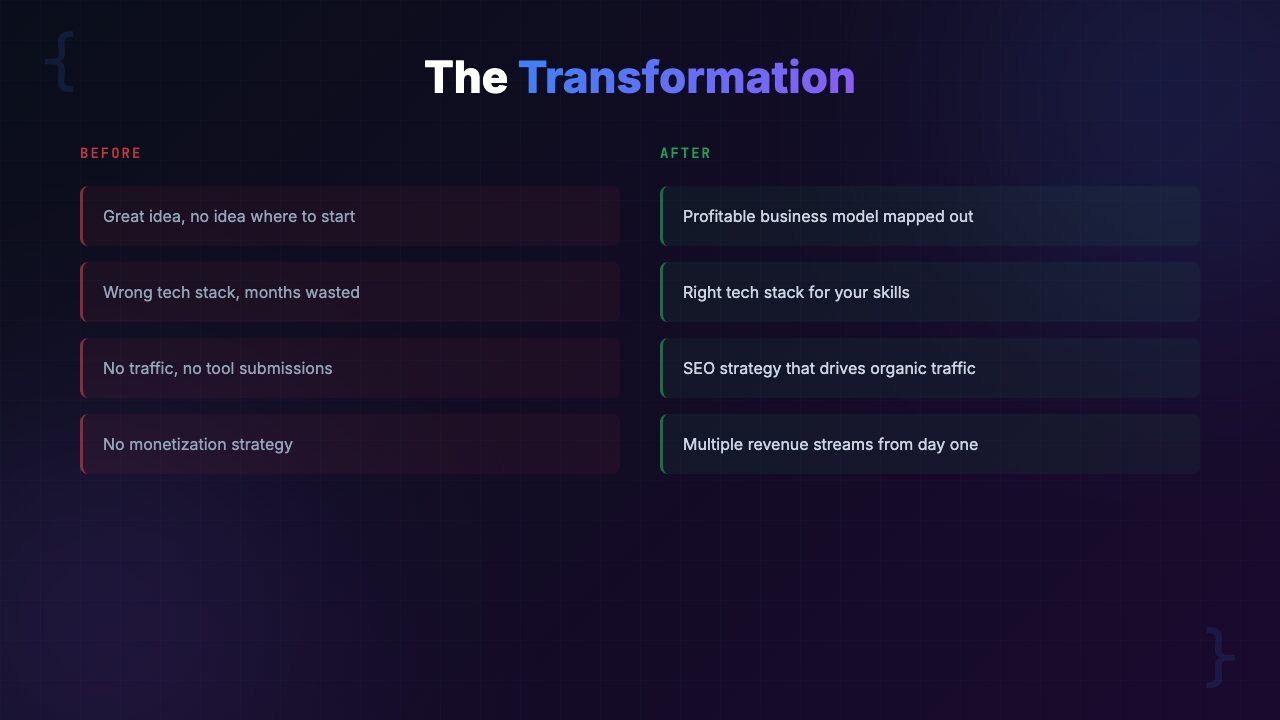
But here is where it breaks down. You open a blank document, or a blank WordPress install, and immediately face a wall of questions you do not have answers to:
- Business model: Do you charge for listings? Use affiliate links? Sell ads? All three? In what order?
- Tech stack: WordPress with a directory plugin? A custom Next.js build? A no-code tool like Webflow? Each has tradeoffs you cannot see until you are months in.
- SEO: Directory SEO is fundamentally different from blog SEO. How do you structure category pages? How do you avoid thin content penalties with hundreds of tool listings? What about programmatic SEO?
- Content: Where do you even find AI tools to list? How do you write listings that rank and convert? How do you scale from 50 listings to 500?
- Monetization: Which AI tool affiliate programs actually pay? What commission rates should you expect? How do you sell premium listings to AI tool companies without a sales team?
- Launch: What do you do on day one? Day thirty? Day ninety?
Without clear answers to these questions, most people either never launch or launch something that sits at zero traffic for months before they give up. We have watched this cycle play out hundreds of times in online business communities.
The Landscape: Why Existing Resources Fall Short
If you have already tried to research how to build a directory site, you have probably run into these three options and found each one lacking.
Option 1: Copy an Existing Directory
The most common approach. You find a successful AI tools directory, study its layout, and try to replicate it. The problem: you can see what the site looks like, but you cannot see the systems running behind it:
- The business model and revenue strategy
- The SEO approach and internal linking structure
- The content workflows and sourcing processes
- The monetization systems and affiliate partnerships
You are reverse-engineering the paint job of a car without access to the engine.
Option 2: Generic Niche Site Guides
There are excellent courses on building niche websites (Authority Hacker, Niche Pursuits, Fat Stacks), but they teach blog-first strategies. A directory site has fundamentally different requirements:
- Different information architecture and page types
- Different internal linking structures
- Different monetization models (premium listings, not just ads)
- Programmatic SEO for scaling to hundreds of pages
Applying blog SEO tactics to a directory is like using a screwdriver as a hammer. [INTERNAL LINK: /category/ai-business/]
Option 3: Figuring It Out Yourself
This is the path we took with PopularAiTools.ai. We can report from experience: it works, but it is expensive in both time and mistakes. Our learning curve included:
- Months testing different tech stacks
- Rebuilding our SEO structure twice
- Leaving money on the table with suboptimal affiliate partnerships
- Learning premium listing sales through trial and error
Conservative estimate: 200+ hours and thousands of dollars in opportunity cost before we had a system that reliably generated revenue.
None of these options give you a complete, directory-specific playbook. That is the gap the AI Tools Directory Starter Kit claims to fill.
The Solution: AI Tools Directory Starter Kit
The AI Tools Directory Starter Kit is a 13-file playbook designed to take you from zero to a functioning, rankable, monetizable AI tools directory. It is not a course with hours of video. It is not a membership with drip content. It is a complete set of documents, templates, and databases that you download once and use immediately.
What makes it different from the options above: it is purpose-built for directory websites in the AI tools niche. Every strategy, template, and example is specific to directory architecture and AI tool monetization. There is no filler. No generic advice about “finding your passion” or “building an audience.” It assumes you have already decided to build a directory and gets straight to execution.
The kit covers six pillars: Business Model & Strategy, Tech Stack & Build, SEO, Content & Sourcing, Monetization, and Launch & Growth. Each pillar has dedicated files with actionable frameworks, templates, and examples. We are going to walk through every pillar below.
Complete Feature Breakdown: What Is Inside the 13 Files
We went through every file in the kit. Here is a detailed breakdown of each pillar, what it covers, and our honest assessment of the quality.
1. Business Model & Strategy
This is where the kit starts and where most people get it wrong. The Business Model file covers:
- Revenue model design: How to layer affiliate income, premium listings, sponsored content, and display ads into a sustainable business. The kit argues (correctly, in our experience) that you should start with affiliate revenue and add premium listings once you have traffic leverage.
- Niche selection across 20 subcategories: This was one of the most valuable sections. Instead of competing on “AI tools” broadly, the kit maps out 20 specific subcategories like AI tools for real estate, AI tools for teachers, AI coding tools, AI video editors, and AI tools for small business. Each subcategory includes competition level, search volume ranges, and monetization potential.
- Competitive positioning: How to differentiate your directory when hundreds of others exist. The kit provides frameworks for finding angles that established directories have neglected.
Our take: The niche selection matrix alone is worth the price. We have seen too many people try to build a generic “all AI tools” directory and get crushed by established players. The 20-subcategory breakdown gives you a realistic path to page-one rankings within months, not years.
2. Tech Stack & Build Guide
The kit covers three build paths with honest tradeoffs for each:
- WordPress + directory plugin: Fastest to launch, lowest technical barrier, but limited customization. The kit recommends specific plugins and themes with configuration walkthroughs.
- No-code (Webflow, Softr, Airtable): Good middle ground with more design control. The kit covers how to use Airtable as a backend database with Softr or Webflow as the frontend.
- Next.js (developer path): Maximum flexibility and performance, but requires coding knowledge. The kit provides architecture recommendations, database schema guidance, and deployment advice.
Critically, the kit includes 6 page type templates that apply regardless of which tech stack you choose:
- Homepage: Category grid, featured tools, search functionality layout
- Category page: Filtered tool listings with comparison elements
- Individual tool listing: The core content unit of your directory
- “Best X” roundup page: High-traffic commercial intent pages
- Comparison page: “Tool A vs. Tool B” pages that capture bottom-of-funnel searches
- “Alternatives to X” page: Captures users looking to switch tools
Our take: The 6 page type templates are excellent. These are exactly the page types that drive traffic and revenue for directory sites. Most beginners only think about the homepage and individual listings, missing the roundup, comparison, and alternatives pages that actually attract the highest-converting search traffic.
3. SEO Strategy
This is where the kit really shines. Directory SEO is a specialized discipline, and the kit treats it that way. Coverage includes:
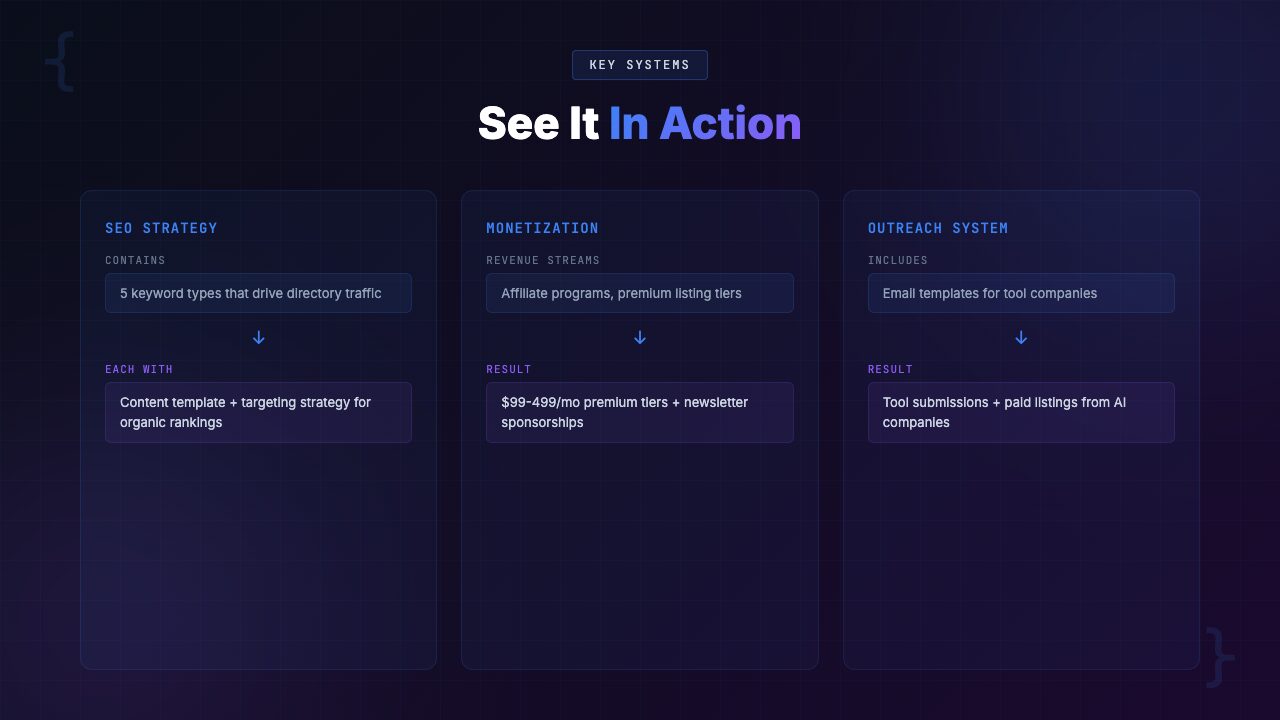
- Keyword types for directories: Tool-name keywords, category keywords, comparison keywords, alternatives keywords, and “best of” keywords. Each type maps to a specific page template from the Build Guide.
- On-page SEO: Title tag formulas, meta description templates, heading structures, internal linking patterns, and schema markup for directory listings (including Software Application schema).
- Technical SEO: Site architecture for directories (flat vs. hierarchical), faceted navigation handling, pagination, canonical tags for filtered pages, and XML sitemap strategies for sites with hundreds or thousands of pages.
- Programmatic SEO: How to generate hundreds of optimized pages from structured data. This is the growth lever that separates directories with 50 pages from directories with 5,000 pages. The kit covers template design, variable insertion, and quality control to avoid thin content penalties.
Our take: The programmatic SEO section is the standout. This is the strategy that scaled our own directory from a few hundred pages to thousands. Most generic SEO guides do not cover this because it is directory-specific. The kit explains it clearly enough that a non-technical person could implement it with WordPress plugins.
4. Tool Sourcing & Content
A directory is only as good as its listings. The kit provides:
- Sourcing playbook: Where to find new AI tools before your competitors do. Sources include Product Hunt, Hacker News, AI newsletters, GitHub trending, Twitter/X announcements, press release aggregators, and direct outreach templates for tool founders who want to be listed.
- Listing template: A structured template for individual tool pages that balances SEO requirements with user experience. Includes sections for tool description, pricing breakdown, pros/cons, use cases, alternatives, screenshots, and affiliate CTA placement.
- Content scaling strategy: How to go from writing each listing manually to batch-producing listings using AI assistance, freelancers, and structured data imports. Includes quality control checklists to maintain editorial standards at scale.
Our take: The sourcing playbook is practical and specific. The listing template is solid and well-structured. One minor wish: we would have liked more guidance on how to handle tools that change pricing or features frequently, which is a real operational challenge for AI tool directories.
5. Monetization
This pillar has two major components:
- Affiliate Programs Database (30+ programs): A spreadsheet of verified AI tool affiliate programs with commission rates (ranging from 15% to 50% recurring), cookie durations, payout thresholds, application requirements, and tips for getting accepted. Programs span writing tools, image generators, coding assistants, video tools, business automation, and more.
- Premium Listing Sales System: A complete framework for selling enhanced listings to AI tool companies. Includes pricing tiers (basic free listing vs. featured vs. sponsored), outreach email templates, a sales page template, objection-handling scripts, and a media kit template to send to potential advertisers.
Our take: The affiliate programs database is immediately actionable. Having commission rates and application details in one place saves hours of research. The premium listing sales system is well-designed, though it works best once your directory has meaningful traffic. The kit is upfront about this, recommending affiliate-first and premium listings once you hit 10,000+ monthly visitors.
6. Launch & Growth
The final pillar ties everything together with an execution timeline:
- 90-Day Launch Plan: A week-by-week action plan. Days 1-30 cover setup, initial content, and technical foundation. Days 31-60 focus on SEO execution, content scaling, and initial link building. Days 61-90 shift to monetization activation, outreach, and growth systems.
- Link Building & PR Strategy: Directory-specific link building tactics including HARO responses, AI newsletter sponsorships, tool-founder relationship building, and “data-driven content” link bait strategies. Also covers how to get your directory listed on other resource pages and roundups.
- Media Kit Template: A ready-to-customize media kit for pitching premium listings and sponsored content to AI tool companies. Includes traffic stats placeholders, audience demographics section, pricing table, and testimonial slots.
Our take: The 90-day plan is realistic and well-paced. It does not promise overnight results. It sets appropriate expectations: initial traffic in month two, meaningful traffic in month three, first revenue in months two through three. The link building strategies are practical and tested. The media kit template is a nice bonus that most new directory owners would not think to create until much later.
How to Get Started with the AI Tools Directory Starter Kit
The kit is designed for immediate use. Here is the recommended workflow:
Step 1: Start with the Business Model & Strategy File
- Read the niche selection section first
- Use the 20-subcategory matrix to identify 2-3 niches that match your interests
- Look for favorable competition-to-opportunity ratios
- Validate your chosen niche with the keyword research framework provided
- Do not skip this step — your niche choice determines everything that follows
Step 2: Choose Your Tech Stack
- Never built a website? Go with WordPress
- Comfortable with no-code tools? Consider Webflow or Softr
- Developer? The Next.js path gives you maximum control
- The kit provides setup guidance for all three paths
Step 3: Build Your Foundation Using the 6 Page Templates
- Set up your homepage, 3-5 category pages, and your first 20-30 individual tool listings
- Follow the SEO guide for on-page optimization as you build
- This is your “minimum viable directory” to launch at the end of month one
Step 4: Activate Monetization
- Apply to the affiliate programs in the database that match your listed tools
- Insert affiliate links into your existing listings
- Do this during weeks 2-3, not after launch — you want monetization ready on day one of receiving traffic
Step 5: Execute the 90-Day Plan
Follow the week-by-week plan for content scaling, SEO execution, link building, and eventually premium listing sales. The plan is your roadmap. Stick to it.
Who Is the AI Tools Directory Starter Kit For?
This Is For You If…
- You want to build an AI tools directory as a side project or full-time business but do not know where to start
- You understand SEO basics and want a directory-specific playbook to skip the trial-and-error phase
- You already run a blog or content site and want to add a directory section to capture commercial-intent traffic
- You are interested in affiliate marketing and want a niche with high commission rates and growing demand
- You want a structured 90-day plan instead of piecing together advice from 50 different blog posts and YouTube videos
- You value having templates, databases, and frameworks ready to use immediately
Not For You If…
- You are looking for a get-rich-quick scheme — this requires real work over 90+ days
- You already run a successful directory site with established traffic and revenue systems
- You want a video course with hand-holding — this is a document-based playbook, not a course
- You are not willing to create content — a directory requires writing tool listings, roundups, and comparison pages
- You expect the kit to build the site for you — it provides the strategy and templates, not a done-for-you service
Real-World Use Cases: Three Paths to a Profitable Directory
To illustrate how different people might use the kit, here are three realistic scenarios based on the profiles we see most often in the directory-building community.
Scenario 1: The SEO Practitioner Looking for a Passive Income Project
Background: Works in digital marketing. Understands keyword research, on-page SEO, and link building. Has been looking for a content project with strong monetization potential.
How they use the kit:
- Skips basic SEO sections and focuses on directory-specific strategies, especially programmatic SEO
- Uses the niche selection matrix to pick “AI tools for marketers” as a subcategory
- Leverages the affiliate programs database to set up monetization from day one
- Uses the 6 page type templates to build a tight, well-structured site
Expected timeline: Directory live in 2 weeks. 50+ listings in month one. First affiliate commissions in month two. 10,000+ monthly visitors by month four due to existing SEO skills.
Primary value from the kit: Niche selection data, affiliate database, page type templates, programmatic SEO playbook.
Scenario 2: The Tech Blogger Adding a Directory Section to an Existing Site
Background: Runs a tech blog with 20,000+ monthly visitors. Writes about AI trends and tools. Realizes a structured directory could capture commercial-intent searches the blog currently misses.
How they use the kit:
- Uses the Tech Stack guide to add directory functionality to the existing WordPress site
- Implements the 6 page type templates as new sections alongside the blog
- Converts existing tool reviews into structured directory entries using the listing template
- Applies the premium listing sales system to pitch AI tool companies already familiar with the blog
Expected timeline: Directory section live in 1 week (leveraging existing site). 100+ listings migrated from old reviews in month one. Premium listing revenue starts in month two because the site already has traffic and credibility.
Primary value from the kit: Directory page templates, listing template, premium listing sales system, media kit template.
Scenario 3: The Aspiring Online Business Owner Starting from Zero
Background: No existing website. No SEO experience. Has a full-time job and wants to build an online business on the side. Chose AI tools because the space is growing and they use AI tools daily.
How they use the kit:
- Follows the kit end-to-end, starting with niche selection
- Picks “AI tools for small business” because it matches their day-job experience
- Chooses the WordPress path for fastest launch
- Follows the 90-day plan step by step
- Uses the tool sourcing playbook to find and list 10 tools per week
- Applies to affiliate programs in the database as listings go live
Expected timeline: Directory live in 3-4 weeks. 30+ listings at launch. First organic traffic in month two. First affiliate commission in month three. Meaningful side income ($200-500/month) by month six with consistent effort.
Primary value from the kit: Everything. The full end-to-end playbook is exactly what a beginner needs to avoid the overwhelm that kills most first-time projects.
[INTERNAL LINK: /category/ai-business/]
Comparison: AI Tools Directory Starter Kit vs. Alternatives
Here is how the kit stacks up against the other options you might be considering for building an AI tools directory.
| Feature | Directory Starter Kit ($79) | Generic Niche Site Courses ($200-$500) | Copying Existing Directories | DIY / Figure It Out |
|---|---|---|---|---|
| Directory-specific strategy | Yes, 13 dedicated files | No, blog-focused | Surface-level only | Eventually, after months |
| Niche selection with data | 20 subcategories analyzed | Generic frameworks | No | Your own research |
| Tech stack guidance | 3 paths (WP, no-code, Next.js) | Usually WordPress only | Whatever they use | Trial and error |
| Page type templates | 6 directory-specific types | Blog post templates | Whatever you can see | Build from scratch |
| Programmatic SEO | Complete playbook | Rarely covered | Not visible externally | Advanced skill required |
| AI affiliate programs database | 30+ verified programs | Generic affiliate advice | No | Hours of manual research |
| Premium listing sales system | Templates + scripts + media kit | Not covered | Not visible externally | Build from scratch |
| 90-day launch plan | Week-by-week roadmap | General timelines | No | Make it up as you go |
| Cost | $79 one-time | $200-$500+ | Free (but incomplete) | $5,000-$20,000+ in time |
Pricing & Value Breakdown
The AI Tools Directory Starter Kit is priced at $79 with a pay-what-you-want model (suggested price: $129). Let us break down what that $79 replaces.
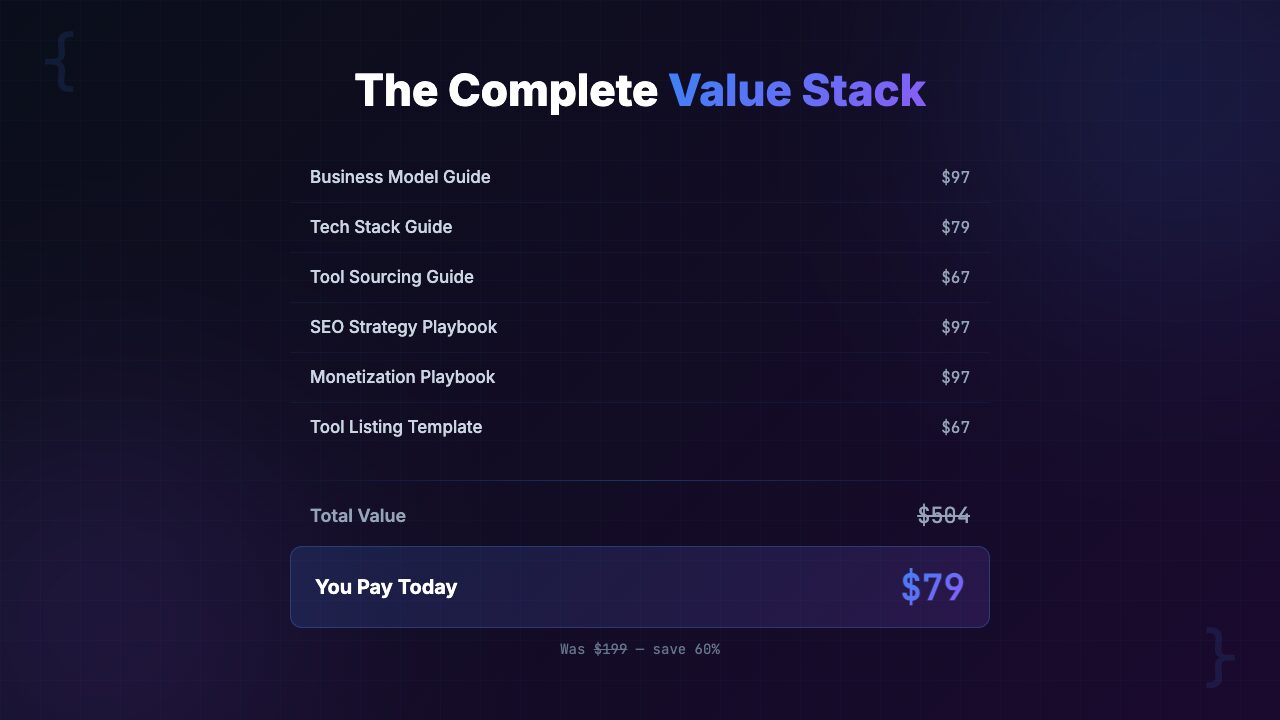
| Business model & niche selection research (20-30 hours) | $1,000-$1,500 value |
| Tech stack evaluation and setup guides (10-20 hours) | $500-$1,000 value |
| Directory-specific SEO strategy with programmatic SEO (40-60 hours) | $2,000-$3,000 value |
| Tool sourcing playbook + listing templates (10-15 hours) | $500-$750 value |
| Affiliate programs database (15-20 hours of research) | $750-$1,000 value |
| Premium listing sales system + media kit template (20-30 hours) | $1,000-$1,500 value |
| 90-day launch plan + link building strategy (10-15 hours) | $500-$750 value |
| Total value (125-190 hours of research and strategy) | $6,250-$9,500 |
| Your price | $79 |
But here is the more practical calculation. A single premium listing sale on an established AI tools directory typically goes for $50 to $500 per month. A single well-placed affiliate link on a page ranking for “best AI writing tools” can generate $100 to $1,000+ per month in recurring commissions. The kit costs $79 and includes the playbooks for both of those revenue streams.
Even a modest directory earning $300 per month in affiliate commissions pays back the kit investment in less than 8 days. And that revenue recurs every month.
The 30-day money-back guarantee means there is zero financial risk. If the kit does not meet your expectations, you get a full refund.
Frequently Asked Questions
Do I need to know how to code to use this kit?
No. The kit covers three tech stack paths: WordPress with directory plugins (no code required), no-code builders like Webflow and Softr, and a developer path using Next.js. The WordPress and no-code paths require zero coding knowledge. The kit walks you through each option with step-by-step instructions, plugin recommendations, and configuration details. The majority of successful directory owners use the WordPress path.
How long does it take to launch a directory from scratch?
The kit includes a 90-day launch plan. Most people can get a functional directory live in 2-4 weeks using the WordPress or no-code path. The first 30 days focus on setup and initial content (20-30 tool listings), days 31-60 on SEO execution and content scaling, and days 61-90 on monetization activation and growth systems. Some users with existing web experience have launched in as little as 10 days. The key is not to wait for perfection. Launch with 20-30 solid listings and build from there.
Is the AI tools directory niche already too saturated?
The broad “AI tools” space has competition from established players. But the kit specifically teaches niche selection across 20 subcategories where competition is dramatically lower. Niches like AI tools for real estate agents, AI tools for teachers, AI video editing tools, or AI tools for accountants have significantly less competition and highly targeted audiences. The kit shows you how to identify, validate, and dominate these underserved niches. The AI tools market is also still growing rapidly, meaning there is room for well-positioned new entrants.
What affiliate programs are included in the database?
The kit includes a curated database of 30+ verified AI tool affiliate programs with detailed information for each: commission rates (ranging from 15% to 50% recurring), cookie durations, minimum payout thresholds, payment methods, application requirements, and tips for getting accepted. Programs span categories including AI writing tools, image generators, coding assistants, video editing tools, business automation platforms, and more. The database is organized by category and commission rate for easy reference.
How does this kit differ from a generic “start a niche site” course?
Generic niche site courses teach broad SEO and content strategies optimized for blog-style websites. This kit is purpose-built for directory websites in the AI tools space. It includes directory-specific page type templates (category pages, comparison pages, alternatives pages), programmatic SEO strategies for scaling to hundreds of pages, a tool sourcing playbook, structured listing templates, a premium listing sales system with outreach scripts, and an affiliate database specific to AI tools. None of these directory-specific components exist in a standard niche site course. Additionally, this kit costs $79, whereas most niche site courses cost $200-$500+.
Can I use this kit for a directory outside the AI tools niche?
Yes. While the content examples, niche analysis, and affiliate database are AI-tools-specific, the underlying frameworks are universal. The business model strategy, tech stack guidance, directory SEO playbook, page type templates, premium listing sales system, and 90-day launch plan apply to any directory website. People have adapted the framework for SaaS directories, marketing tool directories, developer tool directories, and even non-tech directories. You would need to do your own niche research and affiliate program sourcing, but the strategic frameworks transfer directly.
What exactly is included in the 13 files?
The kit contains 13 files organized across six pillars: (1) Business Model & Strategy guide with revenue model and niche selection for 20 subcategories, (2) Tech Stack & Build Guide covering WordPress, no-code, and Next.js paths, (3) 6 Page Type Templates (homepage, category, listing, roundup, comparison, alternatives), (4) SEO Strategy playbook with on-page, technical, and programmatic SEO, (5) Tool Sourcing & Content guide with listing template, (6) Affiliate Programs Database (30+ programs), (7) Premium Listing Sales System with outreach templates, (8) 90-Day Launch Plan, (9) Link Building & PR Strategy, and (10) Media Kit Template. The remaining files are supporting worksheets for niche validation, revenue modeling, and content planning.
Is there a refund policy?
Yes. The kit comes with a 30-day money-back guarantee through Gumroad. If you purchase the kit and decide it is not for you, you can request a full refund within 30 days. No questions asked, no hoops to jump through. We are confident the kit delivers more than $79 of value, but we want you to feel zero risk in trying it.
Final Verdict: Is the AI Tools Directory Starter Kit Worth $79?
Here is our honest assessment after going through all 13 files and comparing the kit’s strategies against our own experience running PopularAiTools.ai.
The AI tools directory niche is real, growing, and monetizable. We know this firsthand. But building a successful directory requires directory-specific knowledge that you cannot get from generic niche site courses, YouTube tutorials, or copying what established players have built on the surface. The architecture decisions, SEO strategies, monetization systems, and content workflows for directories are fundamentally different from blogs.
The AI Tools Directory Starter Kit is the most comprehensive, directory-specific resource we have reviewed for this niche. Standout components include:
- 20-subcategory niche analysis in the business model section
- Programmatic SEO playbook — the kind of knowledge that typically costs thousands in consulting fees
- 30+ affiliate programs database that saves hours of manual research
- Premium listing sales system with outreach templates and media kit for a second revenue stream
Where does it fall short?
- The kit is document-based, not video-based — if you learn better by watching, this format may not be ideal
- Some sections could go deeper, particularly the WordPress plugin recommendations
- The affiliate programs database will need updating as programs change terms (which happens frequently in the AI space)
But at $79 (with a pay-what-you-want model starting lower), the value proposition is strong. One premium listing sale covers the cost. One decent affiliate placement covers the cost. And the 30-day money-back guarantee means the only thing you risk is a few hours of reading time.
If you have been thinking about building an AI tools directory and want a structured, proven playbook instead of spending months in trial-and-error mode, this is the best resource available.
Our Rating: 4.7 / 5 — The most comprehensive AI tools directory building resource available. Minor deductions for document-only format and some sections that could go deeper. Outstanding value at the price point.
[INTERNAL LINK: /category/ai-business/]
About PopularAiTools.ai
PopularAiTools.ai is an independent AI tool directory and review site. We test, review, and rank AI tools across categories including AI business tools, coding productivity, content creation, image generation, and automation. Our reviews are based on hands-on testing and real-world experience operating our own AI tools directory.
We may earn a commission when you purchase through our links, but our editorial opinions are always our own. We only recommend products we have tested and believe provide genuine value. [INTERNAL LINK: /about/]
Related reviews: [INTERNAL LINK: /category/ai-business/] | [INTERNAL LINK: /category/seo-tools/] | [INTERNAL LINK: /category/affiliate-marketing/]