AI Job Loss Statistics 2026: The Real Numbers on AI Taking Over Jobs

Head of AI Research
⚡ Key Takeaways
- 54,836 US job cuts were attributed to AI in 2025 — about 5% of the year's 1M+ announced layoffs. In Jan–May 2026 alone: 87,714.
- AI became the leading stated reason for US layoffs in 2026 — cited in ~40% of May's announced cuts, up from 7% in January.
- Entry-level workers are hit first: employment for 22–25-year-olds in AI-exposed occupations fell 13%; young software developers fell ~20% (Stanford, 2025).
- The projections still point net-positive: WEF expects 92M jobs displaced but 170M created by 2030 — a net gain of 78M.
AI job loss statistics are quoted everywhere right now — usually the scariest projection available, usually without a source or a date. This page collects the measured data on AI taking over jobs: actual layoff filings that name AI, payroll-level studies of who is losing work, and the big institutional projections — each figure attributed, current as of August 2026. The honest headline: the apocalypse predictions have not happened, but 2026 is the first year AI shows up as the leading stated reason for US job cuts, and the damage concentrates heavily at entry level.
The headline numbers
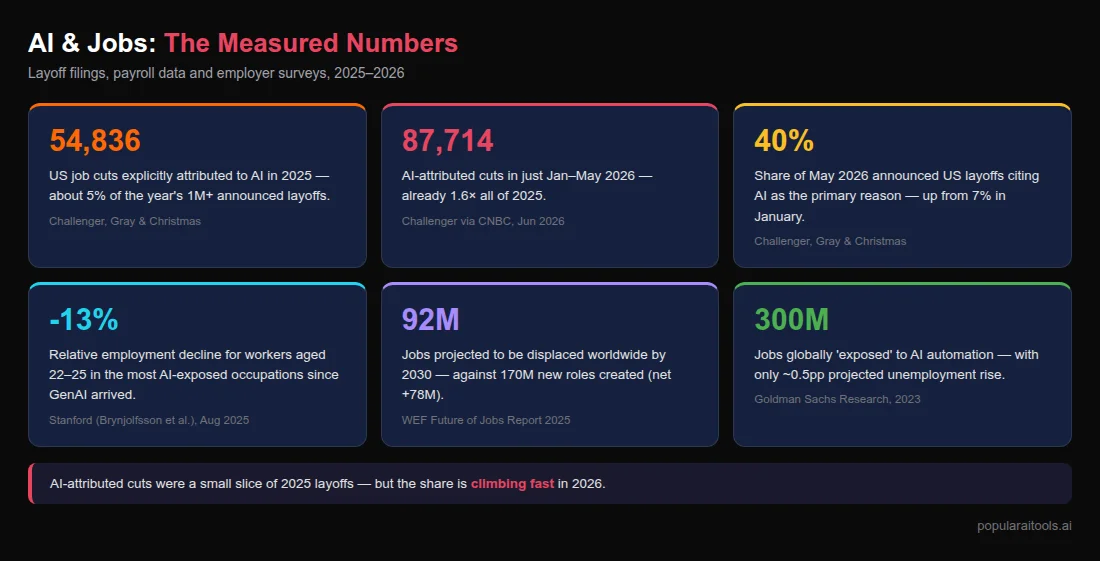
Start with what is actually counted. Challenger, Gray & Christmas — the firm that has tracked US layoff announcements for decades — recorded 54,836 announced job cuts explicitly attributed to AI in 2025. That sounds enormous until you see the denominator: total announced cuts topped 1 million in 2025, the highest since 2020, so AI's named share was roughly 5%. Amazon's October 2025 restructuring — 14,000 roles, its largest layoff ever — was the emblematic case, with leadership explicitly tying the reshaping to AI investment.
Then 2026 changed the slope. AI-attributed cuts reached 87,714 in just the first five months of 2026 — already 1.6× all of 2025 — and by May, employers cited AI as the primary reason for almost 40% of announced cuts, up from 7% in January. Challenger's own reports now list AI as the leading reason companies give for cutting jobs, five months running.
Where the losses actually show up
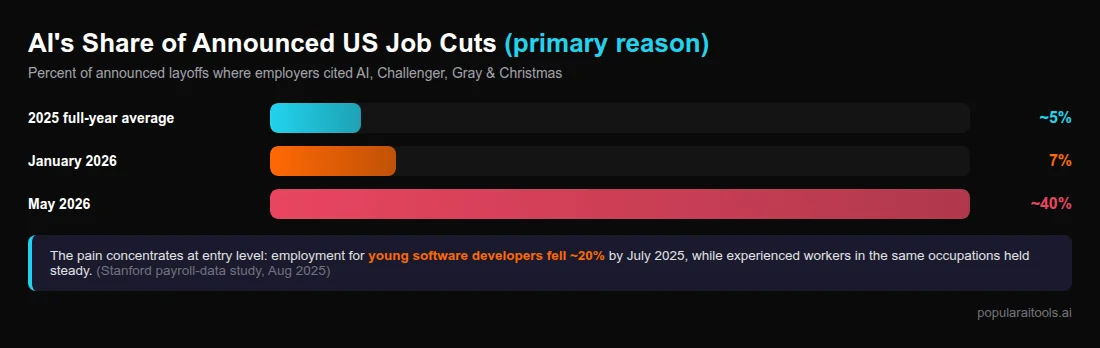
The most rigorous measurement so far is the August 2025 Stanford study by Erik Brynjolfsson, Bharat Chandar and Ruyu Chen, which analyzed payroll records for millions of US workers. Its finding: workers aged 22–25 in the most AI-exposed occupations saw a 13% relative decline in employment since generative AI's arrival, while experienced workers in the same occupations held steady or grew. The sharpest case: employment for young software developers fell nearly 20% by July 2025. The study's key distinction — where AI automates tasks, entry-level hiring falls; where it augments workers, employment holds or rises — explains why the same technology reads as a job-killer in one team and a productivity tool in the next.
In other words, "job displacement due to AI" in 2026 is not mass unemployment — US unemployment sat around 4.3% in January 2026, forecast to drift to ~4.5% — it is a narrowing of the career ladder's bottom rung, concentrated in software, customer service and other exposed white-collar entry points.
Predictions vs reality
The famous projections deserve honest scoring. Goldman Sachs' 2023 estimate — 300 million jobs globally exposed to AI automation, roughly 9% of the world's workers — became the "AI will take your job" headline. Less quoted is the same research's conclusion: an expected unemployment rise of only ~0.5 percentage points, much of it temporary as new roles absorb displaced workers. The World Economic Forum's Future of Jobs Report 2025 (1,000+ employers, 55 economies, 14M workers represented) projects 92 million jobs displaced by 2030 but 170 million created — a net gain of 78 million — while warning that 39% of workers' core skills will change or become obsolete by 2030. McKinsey estimates roughly 12 million Americans will need to switch occupations by 2030.
Score it against the measured data: three years into generative AI, cumulative AI-attributed US layoffs are in the low hundreds of thousands, not the tens of millions — the doomsday predictions have run well ahead of reality. But the direction of every 2026 indicator (AI's share of cuts, entry-level hiring, employer intent — 86% of employers told the WEF that AI will transform their business by 2030) says the effect is compounding, not fading. The likeliest future in the data is not "no jobs" but different jobs — with a brutal transition for whoever is entry-level when the ladder gets pulled up.
The 2026 equilibrium: mass unemployment predictions unfulfilled, unemployment near 4.5% — yet AI is now the number-one stated reason for US layoffs, and the entry-level rung is measurably disappearing.
Frequently Asked Questions
Recommended AI Tools
played.fm
Sell your music and keep 100%: played.fm is a direct-to-fan store + sync marketplace with 0% commission, no gatekeepers, and no bans — a strong fit for AI musicians.
View Review →OpenCode
The open-source AI coding agent: terminal-first TUI, 75+ model providers, LSP context, subagents, and privacy-first design. Free software, ~180K GitHub stars.
View Review →Exa
The neural web search API for AI agents: embeddings-based retrieval, cited highlights, sub-180ms latency, and an MCP server. 20,000 free requests/month.
View Review →Google Antigravity
Google's agent-first IDE: run a fleet of AI agents from a Manager surface, on Gemini 3 Pro, Claude Sonnet 4.5, or OpenAI models. Free in public preview.
View Review →