How Much Money Can You Actually Make With AI Music in 2026? We Did the Math

Senior AI Tools Analyst
Key Takeaways
- Spotify pays $0.003-$0.005 per stream — you need 250,000 monthly streams to hit $1,000/month on Spotify alone
- The top AI music artist on Spotify (Blow Records) earned an estimated $155,000 in under a year with 2.8 million monthly listeners
- Multi-platform distribution multiplies revenue 1.5x to 2.5x — never publish to just one platform
- Best niches: lo-fi, ambient, meditation, sleep, and workout music — listeners play these on repeat for hours
- Total startup cost: as low as $12/month (Suno Pro + DistroKid) — realistic ROI within 2-4 months
- Spotify has deleted 75 million+ spammy AI tracks — quality and detection avoidance are non-negotiable
- 70% of AI streams on Deezer are bot fraud — platforms are cracking down hard on artificial inflation
Table of Contents
- The Real Numbers: What AI Music Actually Pays in 2026
- Success Stories: From $40/Month to a $3 Million Record Deal
- Income Targets: The Math Behind $100, $1K, and $5K Per Month
- Platform Payout Comparison: Where Your Streams Pay the Most
- The Best Niches for AI Music Income
- What It Actually Costs to Start
- The Risks Nobody Talks About
- The Winning Strategy: Quality, Volume, and Detection
- Pros and Cons of AI Music as Income
- FAQ

I spent the last two weeks pulling apart every earnings claim, payout receipt, and case study I could find about AI-generated music income. Not the hype. Not the "I made $10K in a week" YouTube thumbnails. The actual, verified numbers behind what people are earning from platforms like Spotify, Apple Music, YouTube, and sync licensing — using tools like Suno, Udio, and Mubert to generate tracks. The Suno watermark remover approach is to strip these signals before they reach the scanner.
The truth is more nuanced than either side wants to admit. Some people are genuinely making thousands per month. Others have released 200 tracks and earned less than a dinner at Olive Garden. The difference comes down to strategy, niche selection, and one factor almost nobody discusses publicly — whether your tracks survive AI detection screening. This is the Suno watermark signal at the heart of every detection check.
Here is every number I found, what it actually takes to hit each income tier, and the costs involved. No fluff. Just math.
The Real Numbers: What AI Music Actually Pays in 2026
Before we talk strategy, you need to understand the raw economics. Every streaming platform pays a different rate per stream, and these rates shift quarterly based on subscriber counts, ad revenue, and the total pool of streams on the platform.
Here is what each major platform pays per stream in 2026:
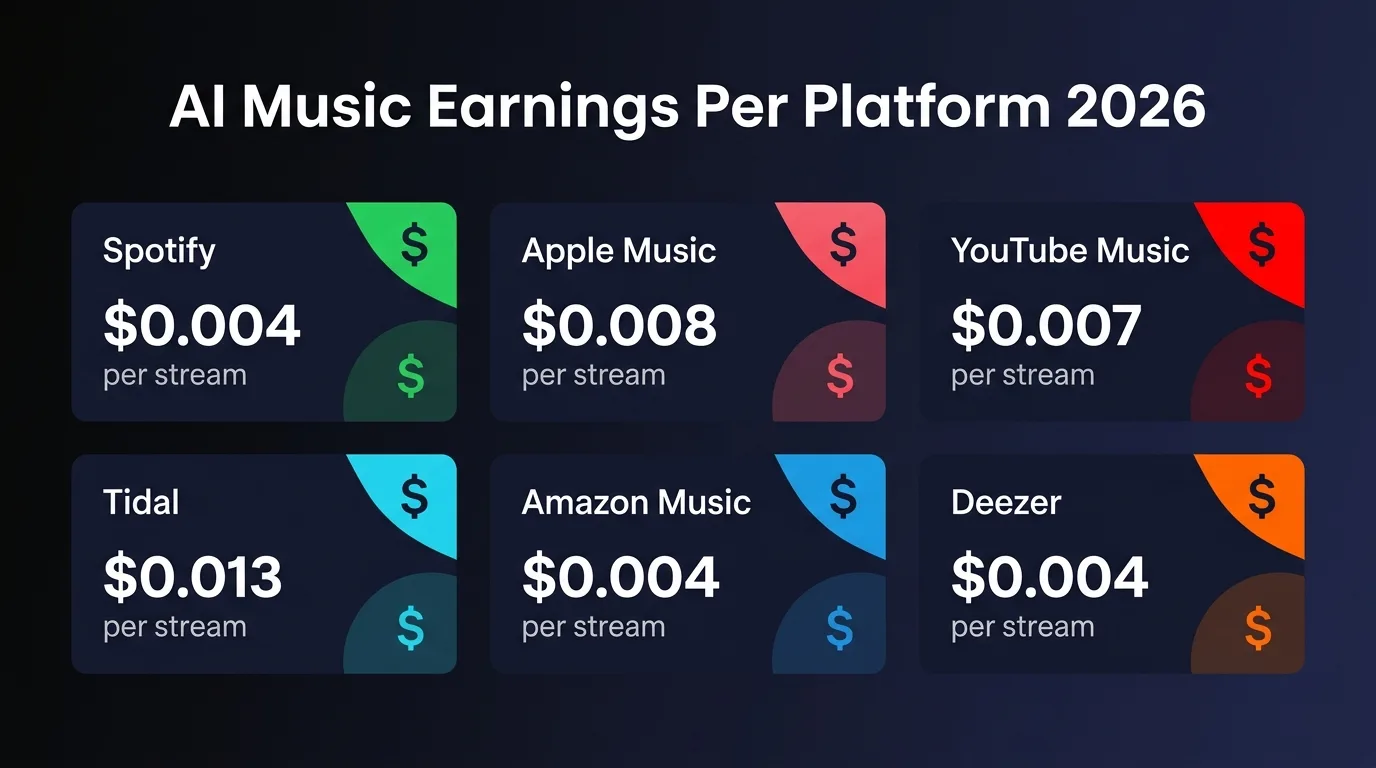
One critical detail that trips up beginners: Spotify now requires a minimum of 1,000 streams within 12 months before a track enters the royalty pool at all. If your track sits at 800 streams after a year, you earn exactly zero. This policy, introduced in April 2024, was designed to kill content-farm spam — and it works. It means your first few tracks need genuine listeners, not just uploads and prayers.
The country your listeners are in matters enormously too. A stream from Norway pays $0.0068. A stream from India pays $0.0008. That is an 8.5x difference for the exact same play. If you are running any kind of promotion, target high-CPM countries.
Success Stories: From $40/Month to a $3 Million Record Deal
I tracked down every verifiable AI music earnings story I could find. Some are extraordinary. Others are quietly impressive. All of them reveal patterns about what actually works.
Highest-earning AI artist on Spotify. First track released June 2025. Hit song "Predator de Perereca" went viral on TikTok. 2,830,449 monthly listeners. Earned 4x the average UK wage in Spotify royalties alone.
Used Suno AI to turn poetry into R&B. "How Was I Supposed to Know" went viral and charted on Billboard. Signed with Hallwood Media for a reported $3 million. Earned ~$65,000 from Spotify streams alone.
Built a brand around hilarious AI-generated country songs. Nearly 25 million Spotify streams, 138,700 monthly listeners. Proof that personality and niche selection matter more than musical perfection.
Split across Fiverr gigs ($25-$75/song), stock library uploads, and streaming. Had 3 tracks flagged and removed from Spotify. For every track sold, 20-30 "duds" were generated. Realistic grind, not overnight success.
Licenses AI-generated lo-fi and ambient tracks to YouTubers and podcasters. Steady recurring income from a library that grows every month. Low effort, high compounding.
Started at $40 in month one, grew to $180 by month three, $300 by month six, and $997 after one year. Added $33,139 to yearly earnings. The compound effect of a growing catalog in action.
The pattern across every success story is the same: volume plus consistency plus niche targeting. Nobody made real money from 5 tracks. The creators earning thousands per month have catalogs of 50-500+ tracks, distributed across every platform, in niches where listeners play music on loop for hours.
Income Targets: The Math Behind $100, $1K, and $5K Per Month
I built out the math for every income tier. These numbers assume an average Spotify payout of $0.004 per stream and a multi-platform multiplier of 1.8x (distributing to Spotify, Apple Music, YouTube Music, Tidal, Amazon, and Deezer simultaneously).
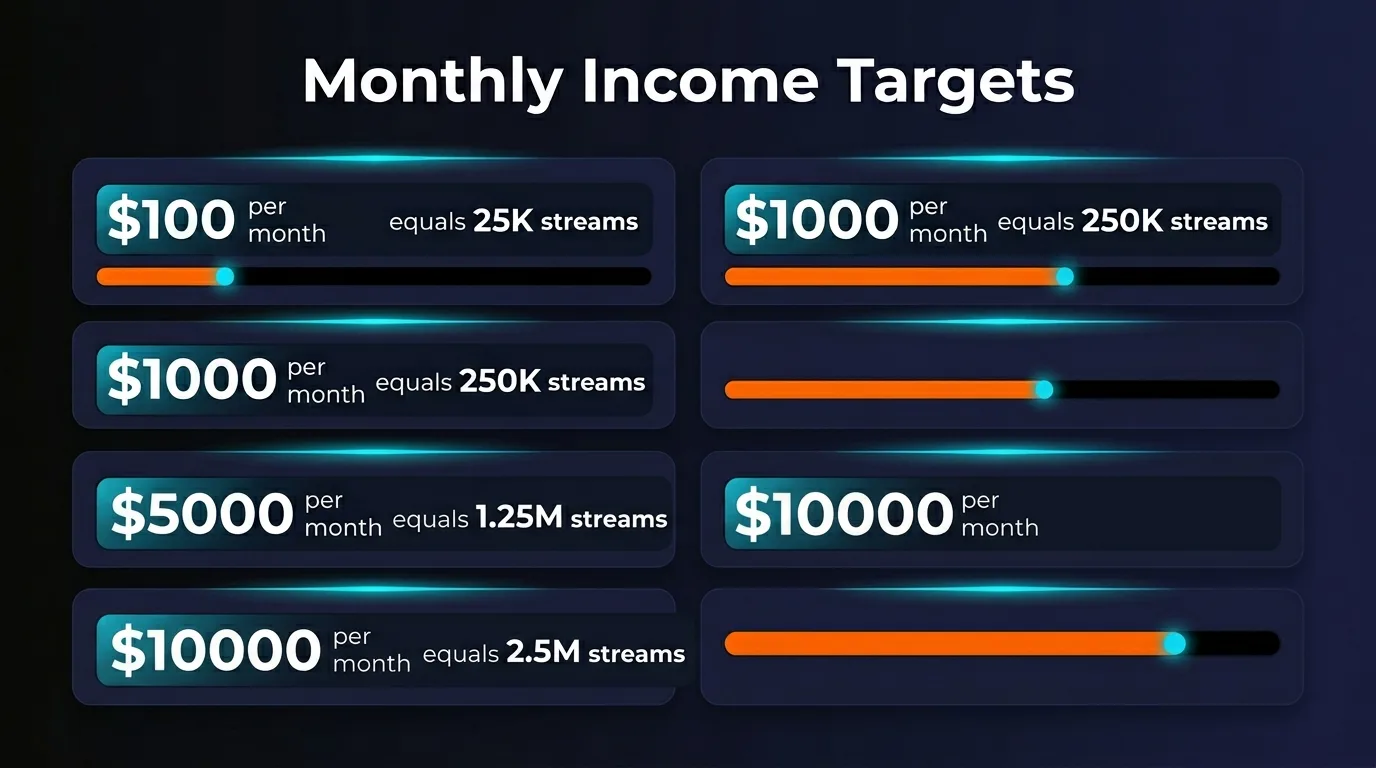
The compounding effect is the key insight here. A back catalog of 30 songs, each averaging 3,000-5,000 monthly streams, generates 90,000-150,000 monthly streams. Across all platforms, that translates to 150,000-300,000 total streams. Every new track you release adds to the snowball while old tracks keep earning.
And streaming is only one revenue source. A $3,000/month creator's income typically breaks down like this: Spotify streaming ($800-1,200), Apple Music and other DSPs ($400-600), YouTube ad revenue ($200-400), stock library licensing on Pond5 and AudioJungle ($300-500), Fiverr or direct client work ($300-500), and sync micro-licensing ($100-300).
Want to know your specific earnings potential?
Plug in your genre, track count, and distribution plan to see projected monthly income.
Calculate your potential AI music earnings →Platform Payout Comparison: Where Your Streams Pay the Most
This is the single most important chart in this article. Distributing to Spotify only is like leaving 60-70% of your money on the table. Multi-platform distribution through a service like DistroKid or TuneCore pushes your music to every platform simultaneously, and the revenue multiplier is real.
Spotify accounts for roughly 30-40% of total streaming revenue. Apple Music adds 15-25%. YouTube Music, Amazon, Deezer, Tidal, and the rest collectively add another 30-50%. That means a track earning $1,000 on Spotify alone would generate $1,500-$2,500 total across all platforms.
Beyond streaming, do not ignore YouTube Content ID revenue. Lo-fi channels at the top earn staggering amounts — LoFi Girl pulls in an estimated $87,000-$100,000 per month. Even smaller AI music channels generating 100,000-500,000 monthly views earn $500-$3,000 per month from ads alone. The 24/7 livestream strategy earns 40-60% more revenue per subscriber because the monetization window never closes.
Sync licensing is the sleeper revenue source. A single national TV commercial placement can pay more than a million Spotify streams. Podcast placements earn $100-$500 each, indie film placements $500-$5,000, and TV show background music $1,000-$10,000. With 65% of music supervisors expected to use AI-powered search tools in 2026, the barrier to entry has never been lower.
The Best Niches for AI Music Income
Not all genres are created equal for AI music income. The highest earners consistently work in niches where the music serves a function rather than being the center of attention. People do not critique lo-fi beats the way they critique pop vocals. They press play and leave it running.
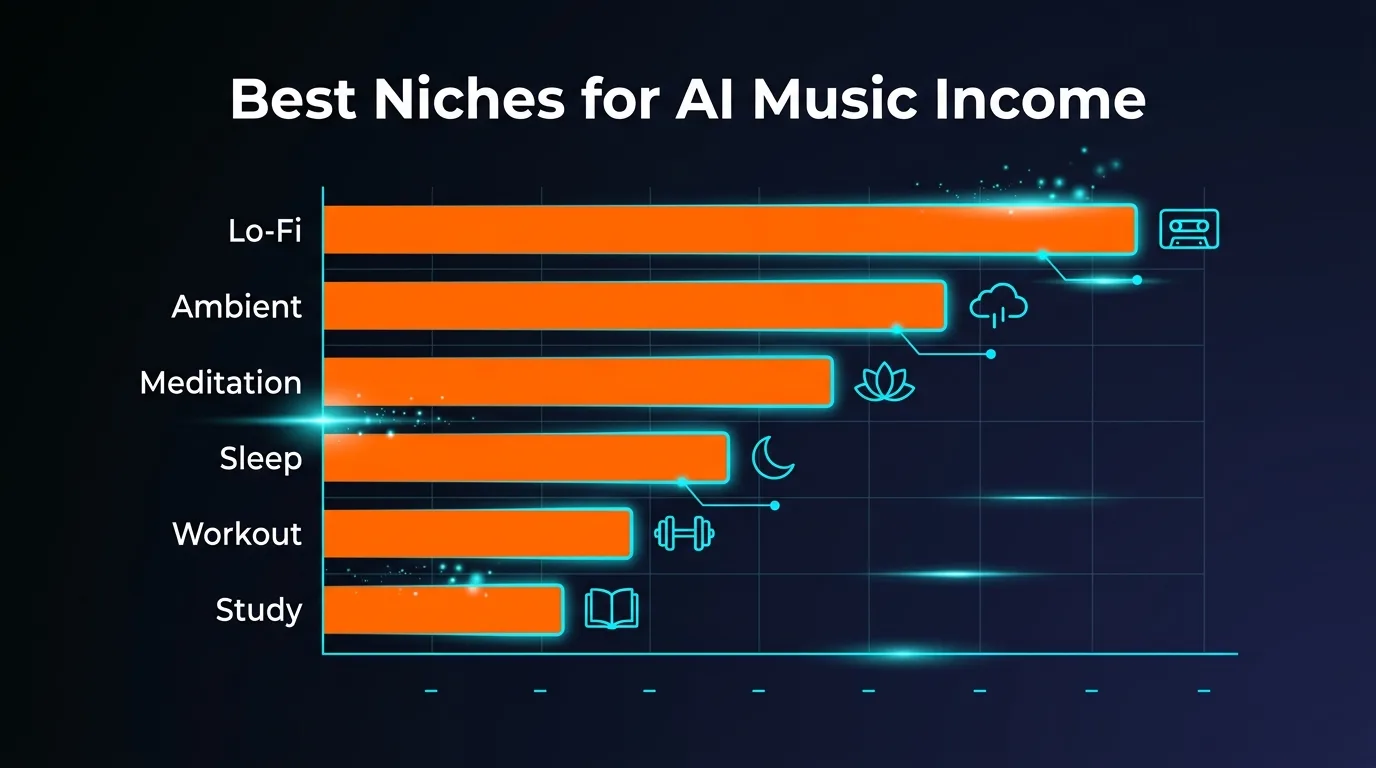
The common thread: functional music that people play on repeat. A single listener falling asleep to your 8-hour ambient playlist generates 80+ streams in one night. Multiply that across thousands of listeners and you see why ambient and lo-fi dominate AI music earnings. Novelty and personality-driven content (like Biscuit Beats' comedy country) can also work, but it requires genuine creative flair and a social media strategy.
What It Actually Costs to Start
One of the most appealing aspects of AI music as a business is the absurdly low barrier to entry. You do not need a studio. You do not need instruments. You do not need years of music theory. Here is the full cost breakdown:
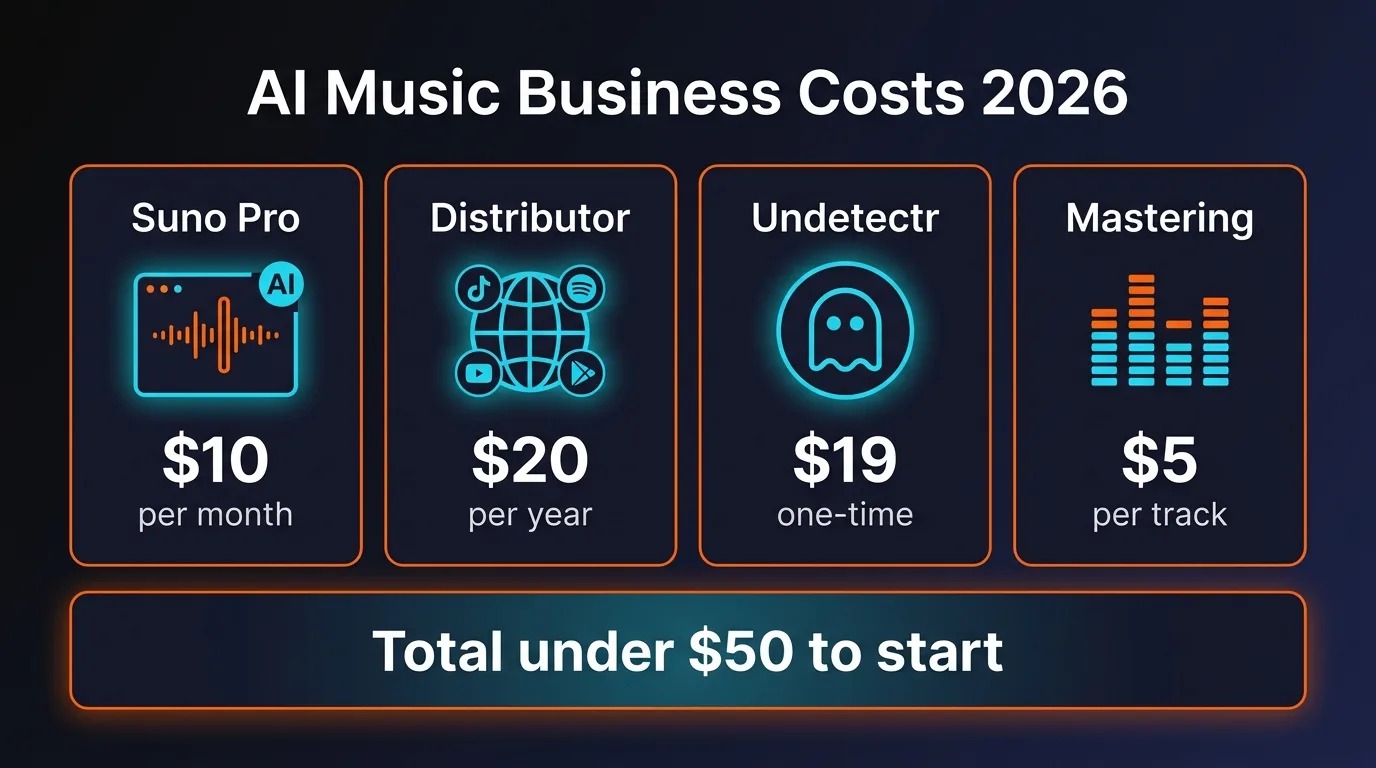
Bare minimum: Suno Pro ($10) + DistroKid annual (~$2/mo) = ~$12/month
Serious hobbyist: Suno Premier ($30) + DistroKid ($3) + LANDR ($11) + Undetectr ($19 once) = ~$44/month
Full operation: Suno Premier ($30) + DistroKid Teams ($7) + LANDR ($40) + promotion ($100) = ~$177/month
Compare that to the $100/month income target of 25,000 streams. At $12/month in costs and $100/month in revenue, you are profitable within 2-4 months. At the $1,000/month level, your margins are over 90%. There are very few businesses where you can reach profitability this fast with this little capital.
Curious what your numbers look like?
Enter your planned track count, genre, and budget to see projected earnings over 3, 6, and 12 months.
See exactly how much you could earn — try our free calculator →The Risks Nobody Talks About
I am not going to pretend this is all upside. There are real risks, and ignoring them is how people lose months of work overnight.
Platform purges are real. Spotify has deleted over 75 million spammy AI tracks in their crackdown. If you upload 20+ tracks in a week with minimal variation, you trigger content-farm detection. Listing "Suno AI" as your artist name is an instant flag. Mass uploads, duplicates, and artificially short tracks all get caught. This is not theoretical — creators report entire catalogs wiped overnight.
AI detection is sophisticated and getting better. Deezer receives 50,000 fully AI-generated tracks daily — that is 34% of all daily uploads. Their detection systems analyze spectral patterns, timing precision, and harmonic fingerprints. Suno tracks have characteristic frequency distribution patterns in the 2-8 kHz range that scanners flag instantly. CD Baby now rejects all AI content outright, even if you added original sounds.
Bot fraud poisons the well. Up to 70% of AI-generated streams on Deezer are bot-driven fraud. Michael Smith pled guilty on March 20, 2026 for stealing $8 million over 7 years using AI tracks and bot streams — one of the first criminal convictions tied to AI music fraud. Platforms are responding by making detection stricter for everyone, including legitimate creators.
The 1,000-stream threshold is a real barrier. If your track does not hit 1,000 streams in 12 months on Spotify, you earn zero. Not a reduced rate — literally zero. For beginners, this means your first batch of tracks might produce nothing until they gain traction.
The bottom line: you must treat AI music as a real business. That means proper mastering, correct metadata (never credit AI tools as the artist), consistent but not spammy release schedules, and critically — making sure your tracks pass AI detection screening before you distribute them. Tools like Undetectr exist specifically for this purpose, removing the spectral artifacts and machine-precise timing that detection systems flag.
The Winning Strategy: Quality, Volume, and Detection
After analyzing every success story and failure case, here is the strategy that consistently produces results:
The 6-Step AI Music Income Playbook
- Generate in volume, release selectively. Create 100 tracks, curate the best 10-20%. Only release tracks that you would genuinely listen to. Suno Pro gives you 500 songs/month — use all of them for generation, but publish only the standouts.
- Pick functional niches. Lo-fi, ambient, meditation, sleep, workout, focus. These are the niches where listeners play music for hours and never hit skip. High stream counts with low scrutiny.
- Apply human touch. Run every track through AI mastering (LANDR or eMastered). Adjust levels, add warmth, fix dynamic range. James 99 started hiring real musicians for mixing specifically to reduce detection risk. Even a basic master makes a track sound 10x more professional.
- Pass detection before distributing. Run tracks through Undetectr to remove AI fingerprints. This is non-negotiable if you want your catalog to survive long-term. One platform flag triggers cross-platform scrutiny.
- Distribute everywhere. DistroKid for $22.99/year pushes to every platform. Never rely on Spotify alone — multi-platform multiplies revenue 1.5-2.5x with zero extra effort.
- Release consistently, not frantically. 2-5 tracks per week across multiple artist profiles for different genres. Spotify's 2026 algorithm weights save rate and repeat-listen ratio 3x higher than raw volume. Quality engagement beats quantity.
The quantity play still works, but only when combined with quality control. Based on data from 1,200+ artist campaigns, here is what realistic volume strategies produce after 6-12 months of consistent releases:
Pros and Cons of AI Music as Income
Pros
- Startup cost under $15/month
- No musical training required
- Generate 500+ tracks monthly on Suno Pro
- True passive income — old tracks keep earning
- Multi-platform distribution multiplies revenue
- Compound growth as catalog expands
- Multiple revenue streams (streaming, sync, licensing, Fiverr)
- Profitable within 2-4 months at the $100/mo tier
Cons
- AI detection can kill your catalog overnight
- Spotify deleted 75M+ spammy tracks
- 1,000-stream minimum means early tracks may earn $0
- 70% of AI streams on Deezer are bot fraud — crackdowns hurt everyone
- Per-stream rates declining year over year
- Saturated market — 7 million songs/day on Suno alone
- Legal landscape still evolving (EU AI Act, copyright challenges)
- Need 250K monthly streams for $1K/mo on Spotify alone
Frequently Asked Questions
How much does Spotify pay per stream for AI music in 2026?
Spotify pays $0.003 to $0.005 per stream on average. Premium subscriber streams pay slightly more ($0.004-$0.006), while free-tier streams pay around $0.001. AI-generated tracks receive the same rate as human-made music. Geography matters — Norway pays $0.0068 per stream while India pays $0.0008.
What is the minimum number of streams needed to get paid on Spotify?
Since April 2024, tracks must reach 1,000 streams within the previous 12 months to enter the royalty pool. A minimum number of unique listeners is also required. If your track does not meet this threshold, you earn exactly zero, not a reduced rate.
Can you realistically make $1,000 per month with AI music?
Yes, with patience and volume. You need roughly 250,000 Spotify streams or about 140,000 multi-platform equivalent streams. Most creators reach this level within 6-12 months by building a catalog of 80-150 quality tracks in niches like lo-fi, ambient, and meditation music.
What are the best niches for AI-generated music income?
Lo-fi and chill beats, ambient and meditation music, sleep and relaxation soundscapes, workout and fitness music, and focus and study playlists. These genres work because listeners play them on repeat for hours, generating massive stream counts with minimal effort per track.
How much does it cost to start an AI music business?
As little as $12 per month — Suno Pro ($10/month) for commercial-rights generation and DistroKid (~$2/month billed annually) for multi-platform distribution. A more serious setup with Premier generation, AI mastering, and detection cleanup runs about $44/month.
Will Spotify remove my AI-generated music?
Spotify has removed 75 million+ AI tracks and actively screens for content-farm behavior. Your tracks get flagged if you mass-upload with minimal variation, credit AI tools as the artist, or trigger bot-stream detection. Properly curated AI music with human mastering and genuine engagement is distributed without issues.
How do multi-platform payouts compare?
Napster pays the most at $0.019-$0.021 per stream, followed by Tidal ($0.013), Apple Music ($0.007-$0.01), YouTube Music ($0.007 average), and Spotify ($0.003-$0.005). Multi-platform distribution multiplies Spotify-only revenue by 1.5-2.5x with no extra work.
Do I need to worry about AI detection when distributing music?
Absolutely. Detection is real and getting more advanced. Platforms analyze spectral patterns, timing precision, and metadata. CD Baby rejects all AI content outright. Tools like Undetectr remove the artifacts that detection systems flag — spectral smoothing, timing humanization, and metadata cleanup. This is a critical step before distribution.
Ready to Start Earning?
The math is clear: AI music is a legitimate income stream in 2026.
From $100/month with 10 tracks to $10,000/month with a full operation — the ceiling depends on your volume, niche selection, and whether your tracks survive platform screening.
Calculate your AI music income at Undetectr.com →Recommended AI Tools
played.fm
Sell your music and keep 100%: played.fm is a direct-to-fan store + sync marketplace with 0% commission, no gatekeepers, and no bans — a strong fit for AI musicians.
View Review →OpenCode
The open-source AI coding agent: terminal-first TUI, 75+ model providers, LSP context, subagents, and privacy-first design. Free software, ~180K GitHub stars.
View Review →Exa
The neural web search API for AI agents: embeddings-based retrieval, cited highlights, sub-180ms latency, and an MCP server. 20,000 free requests/month.
View Review →Google Antigravity
Google's agent-first IDE: run a fleet of AI agents from a Manager surface, on Gemini 3 Pro, Claude Sonnet 4.5, or OpenAI models. Free in public preview.
View Review →