Claude Marketplace: Anthropic’s New App Store for Enterprise AI

Head of AI Research

Claude Marketplace: Anthropic’s New App Store for Enterprise AI Tools
Anthropic just changed the game for enterprise AI procurement. On March 6, 2026, the company launched Claude Marketplace — a curated app store where businesses can discover, purchase, and deploy third-party tools built on Claude’s AI models. Think of it as an enterprise-grade software catalog, but every product runs on Claude under the hood, and you pay for it all through a single Anthropic invoice.
We have been watching AI companies race to build ecosystems around their models for years now. OpenAI has its GPT Store. Google has Gemini integrations across Workspace. But Claude Marketplace takes a fundamentally different approach — one aimed squarely at the Fortune 500, not individual consumers tinkering with chatbot plugins.
In this deep dive, we break down exactly what Claude Marketplace is, who it is for, how the economics work, and why it could reshape how enterprises buy AI-powered software.
Get Your AI Tool in Front of Thousands of Buyers
Join 500+ AI tools already listed on PopularAiTools.ai — DR 50+ backlinks, expert verification, and real traffic from people actively searching for AI solutions.
Starter
$39/mo
Directory listing + backlink
- DR 50+ backlink
- Expert verification badge
- Cancel anytime
Premium
$69/mo
Featured + homepage placement
- Everything in Starter
- Featured on category pages
- Homepage placement (2 days/mo)
- 24/7 support
Ultimate
$99/mo
Premium banner + Reddit promo
- Everything in Premium
- Banner on every page (5 days/mo)
- Elite Verified badge
- Reddit promotion + CTA
No credit card required · Cancel anytime
Table of Contents
- What Is Claude Marketplace?
- How Claude Marketplace Works
- Launch Partners and Integrations
- Enterprise Use Cases
- How Credits and Billing Work
- Claude Marketplace vs. the GPT Store
- What This Means for the AI Industry
- Getting Started With Claude Marketplace
- FAQ
What Is Claude Marketplace?
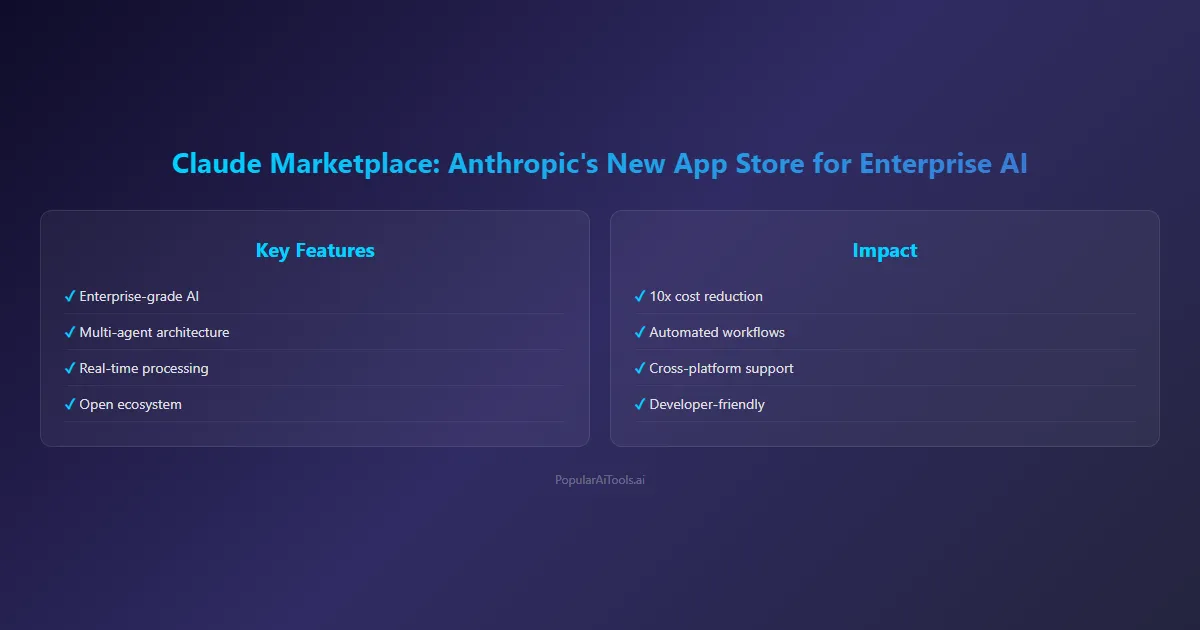
Claude Marketplace is Anthropic’s enterprise procurement platform for third-party AI applications. It allows businesses that already have an annual spending commitment with Anthropic to use a portion of that commitment to purchase software tools from vetted partners — all built on Claude’s large language models.
The key word here is enterprise. This is not a consumer app store where anyone can browse and download. Claude Marketplace is designed for organizations that are already investing heavily in Claude’s API and services. If your company is spending six or seven figures annually with Anthropic, you can now fold partner tools into that same budget line without spinning up a separate procurement cycle for each vendor.
The Marketplace launched on March 6, 2026, in limited preview. Enterprises interested in access need to reach out to their Anthropic account team directly. There is no self-serve signup yet — which reinforces just how enterprise-focused this play is.
At its core, Claude Marketplace solves a real pain point: procurement complexity. Large organizations typically deal with dozens of software vendors, each requiring separate contracts, invoices, security reviews, and budget approvals. By consolidating Claude-powered tools under one umbrella, Anthropic eliminates much of that friction.
How Claude Marketplace Works
The mechanics of Claude Marketplace are straightforward, which is part of its appeal.
Step 1: Have an existing Anthropic commitment. Your organization needs an annual spend agreement with Anthropic for API access and services. This is the entry ticket.
Step 2: Browse the curated catalog. The Marketplace presents a vetted selection of third-party tools, each built on Claude’s models. These are not random side projects — they are established software companies offering production-grade products.
Step 3: Purchase using your existing commitment. Here is where it gets interesting. A portion of your existing Anthropic spend can be redirected toward partner purchases. You do not need a new budget. You do not need a new contract. The dollars you have already committed to Anthropic can flow to partner tools.
Step 4: Anthropic handles all invoicing. One vendor, one invoice, one relationship. Anthropic manages billing for both its own services and third-party Marketplace purchases. This alone is a massive win for enterprise finance teams.
And here is the detail that caught our attention: Anthropic takes zero commission on Marketplace transactions. According to Bloomberg’s reporting, the company is not skimming a percentage off partner sales. The revenue play is indirect — every time a Harvey user runs a legal workflow or a Rogo analyst generates a financial model through a Marketplace tool, Claude processes those tokens. The real money is in API consumption, not transaction fees.
Launch Partners and Integrations
Claude Marketplace debuted with six carefully chosen launch partners. Each one targets a distinct enterprise vertical, which tells us a lot about Anthropic’s strategy: they are not just building a developer playground, they are going after mission-critical business workflows.
What stands out about this partner lineup is the vertical diversity. We see legal (Harvey), finance (Rogo), data infrastructure (Snowflake), development (GitLab, Replit), and no-code creation (Lovable). Anthropic is clearly signaling that Claude Marketplace is not limited to one industry or use case — it is a horizontal platform serving multiple enterprise functions. (See also: our exploration of Claude AI consciousness.) (See also: our guide to Claude Code loops and skills.) (See also: our Microsoft Copilot Cowork review.)
We also expect this catalog to grow significantly. Anthropic has indicated that more partners will be added over time, and the limited preview period is likely a testing ground for the curation and onboarding process.
Enterprise Use Cases
So who actually benefits from Claude Marketplace, and how? We see four primary use cases driving adoption.
1. Consolidated AI Procurement
This is the headline use case. Large enterprises are drowning in AI vendor relationships. A typical Fortune 500 company might use one tool for legal AI, another for code assistance, another for data analysis, and yet another for content generation — each with its own contract, billing cycle, and security review.
Claude Marketplace collapses all of that into a single procurement relationship. Your legal team gets Harvey. Your engineering team gets GitLab’s AI features. Your data team gets Snowflake’s AI agents. And it all shows up on one Anthropic invoice.
For CFOs and procurement leaders, this is not a nice-to-have. It is a genuine operational improvement.
2. Budget Flexibility and Spend Optimization
Here is a scenario we think will be common: an enterprise signs a substantial annual commitment with Anthropic, then realizes partway through the year that it is not fully utilizing its API allocation. Without the Marketplace, that unused commitment is essentially wasted spend.
With Claude Marketplace, those dollars can be redirected toward partner tools. It transforms a rigid API commitment into a flexible AI budget that can be deployed wherever the organization sees the most value. This significantly reduces the risk of overcommitment on the API side.
3. Shadow IT Prevention
Every enterprise IT leader knows the problem: individual teams adopt AI tools on their own, using corporate credit cards, without security review or IT approval. This “shadow procurement” creates compliance risks, data governance gaps, and budget blind spots.
Claude Marketplace provides a sanctioned channel. When employees need an AI tool, there is now an approved catalog to shop from — tools that have been vetted by Anthropic and purchased through official channels. IT stays in the loop. Security gets their review. Finance sees the spend.
4. Faster Time to Value
Traditional enterprise software procurement takes weeks or months. Requirements gathering, vendor evaluation, security questionnaire, legal review, contract negotiation, budget approval. By the time a tool is approved, the team that needed it has already moved on to the next fire.
Claude Marketplace compresses this timeline dramatically. The tools are pre-vetted. The billing is handled. The contract umbrella already exists. A team can go from “we need a legal AI tool” to “Harvey is deployed” in a fraction of the normal time.
How Credits and Billing Work
The financial model behind Claude Marketplace is one of its most compelling features, and it is worth understanding the details.
Existing Commitment Allocation: When your organization signs an annual spending commitment with Anthropic (for API access, Claude for Enterprise, etc.), a portion of that commitment becomes eligible for Marketplace purchases. You are not spending new money — you are reallocating money you have already committed.
Unified Invoicing: Anthropic manages all billing. When you purchase a partner tool through the Marketplace, it appears on your existing Anthropic invoice. No separate vendor payments. No additional accounts payable workflows. One relationship handles everything.
Zero Commission: Anthropic does not take a cut of partner transactions. The partners receive their full price. Anthropic’s incentive is downstream — every Marketplace tool runs on Claude, which means every user interaction generates API token consumption. The more people use Harvey, Rogo, or GitLab through the Marketplace, the more Claude API usage Anthropic records.
Usage-Based Economics: The underlying engine is token consumption. When a Harvey user drafts a contract, Claude processes those tokens. When a Snowflake analyst queries data through an AI agent, Claude handles the inference. This means Anthropic’s revenue from the Marketplace is proportional to how much value the partner tools deliver — a healthy alignment of incentives.
This billing model is genuinely different from what we see in other platform marketplaces. Apple takes 30%. Google takes 30%. Even enterprise marketplaces like Salesforce AppExchange and AWS Marketplace take meaningful percentages. Anthropic taking zero commission is a strategic move to attract high-quality partners quickly and build ecosystem density.
Claude Marketplace vs. the GPT Store
The inevitable comparison is with OpenAI’s GPT Store and App Directory, which launched its expanded third-party app integrations in December 2025. But the two platforms are solving fundamentally different problems.
Target audience: Claude Marketplace is built for enterprise procurement teams at large organizations. The GPT Store targets individual consumers and small teams. These are different buyers with different needs.
Curation: Claude Marketplace launched with six carefully vetted partners. The GPT Store has thousands of community-created GPTs. Anthropic is going for quality and trust. OpenAI is going for breadth and discovery.
Commission structure: Anthropic takes zero commission. OpenAI operates a revenue-sharing model with its GPT Store partners. This makes Anthropic more attractive to high-end software vendors who do not want to give up margin.
Procurement integration: Claude Marketplace is designed to plug into existing enterprise spending commitments and billing relationships. The GPT Store operates on standard consumer subscription models.
Strategic direction: OpenAI has been evolving ChatGPT into a consumer “super-app” with integrations for travel, shopping, and lifestyle services. Anthropic is doubling down on professional infrastructure — financial terminals, developer tools, legal workflows, and data operations.
Neither approach is wrong. They are simply targeting different markets. But for enterprise buyers specifically, Claude Marketplace addresses procurement pain points that the GPT Store was never designed to solve.
What This Means for the AI Industry
Claude Marketplace is more than a product launch. It signals a strategic shift in how AI companies think about monetization and ecosystem building.
The Platform Play Is Here
For the past three years, AI companies have competed primarily on model performance — benchmarks, context windows, reasoning capabilities. Claude Marketplace marks Anthropic’s move from model provider to platform provider. The most defensible position in technology is not having the best product; it is having the ecosystem that everyone builds on.
Procurement as a Moat
By positioning itself as the single vendor for an enterprise’s entire AI toolkit, Anthropic creates meaningful switching costs. If your legal team uses Harvey through the Marketplace, your engineering team uses GitLab, and your analysts use Rogo — all billed through your Anthropic commitment — migrating to a competitor means disrupting every one of those workflows simultaneously. That is a powerful retention mechanism.
The SaaS Distribution Shakeup
Traditional SaaS companies sell direct or through cloud marketplaces like AWS Marketplace and Azure Marketplace. Claude Marketplace introduces a new distribution channel: the AI model provider marketplace. If this model succeeds, we could see Google launch a Gemini Marketplace and Meta offer something similar for Llama-powered tools. The AI provider becomes the new distribution layer for enterprise software.
Partner Economics Matter
Anthropic’s zero-commission model is a strong opening bid for partner recruitment. Software companies deciding where to build will notice that they keep 100% of their revenue on Claude Marketplace versus giving up significant percentages elsewhere. This could accelerate the rate at which new tools are built specifically for Claude, expanding the ecosystem faster than commission-charging competitors.
Getting Started With Claude Marketplace
If your organization is interested in Claude Marketplace, here is what we know about the onboarding process as of March 2026:
- You need an existing Anthropic relationship. Claude Marketplace is available to enterprises with annual spending commitments on Anthropic’s API or Claude for Enterprise.
- Contact your Anthropic account team. The Marketplace is currently in limited preview. Access is not self-serve — you need to express interest through your existing account relationship.
- Review the partner catalog. Once granted access, you can browse available tools and evaluate which ones align with your organization’s needs.
- Allocate commitment dollars. Work with your Anthropic account team to determine what portion of your existing commitment can be directed toward Marketplace purchases.
- Deploy and integrate. Partner tools are designed to work within your existing Claude infrastructure, minimizing setup time and technical overhead.
We recommend that enterprise AI leaders who are already spending significantly with Anthropic explore the Marketplace sooner rather than later. Early access means early influence — Anthropic is actively shaping the platform based on preview customer feedback, and getting your needs heard now could shape the catalog and features that arrive in the general availability launch.
Built an AI tool? Get it in front of thousands of qualified buyers on PopularAiTools.ai
FAQ
What is Claude Marketplace?
Claude Marketplace is Anthropic’s enterprise procurement platform, launched on March 6, 2026, that lets businesses purchase third-party AI tools built on Claude’s models. It is designed for organizations with existing Anthropic annual spending commitments who want to consolidate their AI tool purchases under a single vendor and invoice. The Marketplace launched with six partners: Snowflake, GitLab, Harvey, Replit, Rogo, and Lovable.
How much does Claude Marketplace cost?
There is no separate fee to access Claude Marketplace. Enterprises use a portion of their existing Anthropic spending commitment to purchase partner tools. Anthropic handles all invoicing and does not charge a commission on partner transactions. The actual cost of individual partner tools varies by product and usage level — contact your Anthropic account team for specific pricing.
Can anyone access Claude Marketplace?
No. Claude Marketplace is currently in limited preview and is restricted to enterprises with existing annual spending commitments with Anthropic. There is no self-serve signup. Interested organizations need to reach out to their Anthropic account team to request access. Anthropic has not announced a timeline for general availability or consumer access.
How is Claude Marketplace different from the OpenAI GPT Store?
The two platforms serve different markets. Claude Marketplace targets enterprise procurement teams at large organizations, offering a curated catalog of vetted professional tools with unified billing and zero commission for partners. The GPT Store is primarily consumer-facing with thousands of community-built GPTs and a revenue-sharing model. Claude Marketplace integrates with existing enterprise spending commitments, while the GPT Store operates on standard subscription models.
What tools are available on Claude Marketplace?
At launch, Claude Marketplace includes six partners: Snowflake for enterprise data analysis, GitLab for software development lifecycle management, Harvey for legal AI workflows, Replit for AI-driven software development, Rogo for financial modeling and investment research, and Lovable for no-code application creation. Anthropic has indicated that additional partners will be added over time as the platform moves beyond its limited preview phase.
The Bottom Line
Claude Marketplace represents Anthropic’s clearest signal yet that it is playing the long game in enterprise AI. While competitors chase consumer engagement and benchmark bragging rights, Anthropic is quietly building the infrastructure that makes it the default vendor for an enterprise’s entire AI stack.
The zero-commission model attracts partners. The unified billing simplifies procurement. The existing commitment reallocation reduces budget risk. And every tool in the Marketplace generates Claude API usage, creating a self-reinforcing growth loop.
We think this is one of the most strategically significant moves in the AI industry so far in 2026. If you are an enterprise leader evaluating your AI vendor strategy, Claude Marketplace deserves a serious look.
Ready to explore what Claude Marketplace can do for your organization? Visit claude.com/platform/marketplace to learn more, or reach out to your Anthropic account team to request early access.
Sources: VentureBeat, SiliconANGLE, TechRadar
Recommended AI Tools
played.fm
Sell your music and keep 100%: played.fm is a direct-to-fan store + sync marketplace with 0% commission, no gatekeepers, and no bans — a strong fit for AI musicians.
View Review →OpenCode
The open-source AI coding agent: terminal-first TUI, 75+ model providers, LSP context, subagents, and privacy-first design. Free software, ~180K GitHub stars.
View Review →Exa
The neural web search API for AI agents: embeddings-based retrieval, cited highlights, sub-180ms latency, and an MCP server. 20,000 free requests/month.
View Review →Google Antigravity
Google's agent-first IDE: run a fleet of AI agents from a Manager surface, on Gemini 3 Pro, Claude Sonnet 4.5, or OpenAI models. Free in public preview.
View Review →