Elicit AI Review 2026: The Research Assistant Scientists Actually Trust

Head of AI Research
Key Takeaways
- Massive scholarly corpus. Elicit AI searches 138 million academic papers and 545,000 clinical trials through Semantic Scholar with semantic, not keyword, matching.
- Citation-grounded answers. Every summary, table cell, and report sentence links to the source paper with extracted supporting quotes, sharply reducing hallucination risk.
- Systematic review automation. The Pro tier handles screening, inclusion decisions, and PICO data extraction at a fraction of the manual time cost.
- Trusted by 5 million plus researchers. Used inside universities, pharmaceutical R&D teams, and policy think tanks as of 2026.
- Free tier is real but tight. You can test the workflow without payment, but heavy review work pushes you to Plus ($12) or Pro ($42) plans fast.
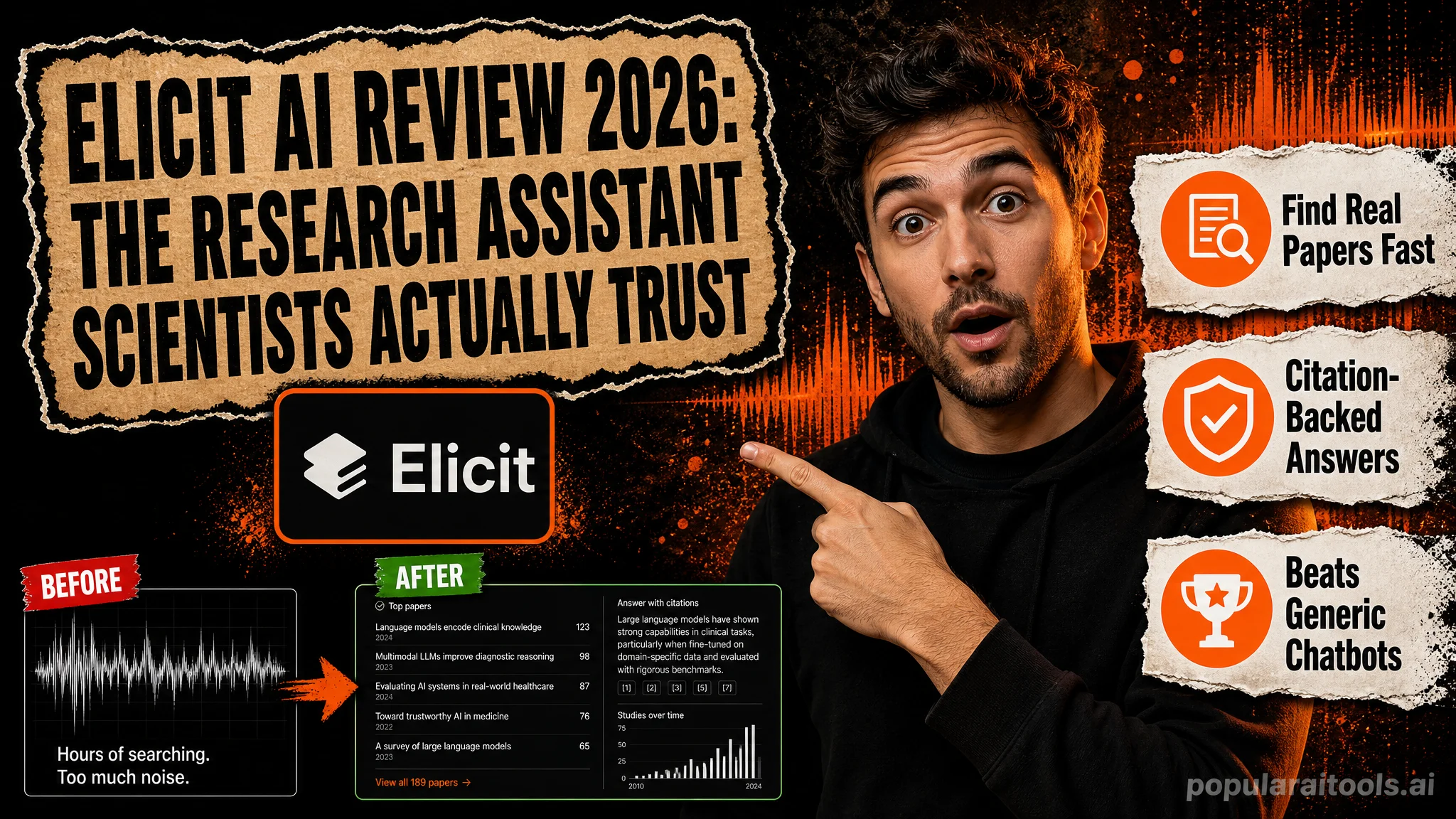
Most researchers do not have a problem finding papers. They have a problem reading them. A systematic review that should take six weeks ends up taking six months because someone has to screen 4,000 abstracts, extract sample sizes from 80 PDFs, and chase down full texts that may or may not actually answer the question. Elicit AI is the tool that quietly took over that grunt work for more than 5 million researchers, and as of 2026 it has matured into the closest thing the academic world has to a default AI research assistant.
This review walks through what Elicit AI actually does, how it compares to ChatGPT and Consensus for scientific research, where the 2026 pricing lands, and where the tool still falls short. I have used it for literature reviews, evidence synthesis tasks, and structured data extraction across biomedicine and social science papers. The goal here is a clear answer to a practical question: is Elicit worth your money and your trust for serious research work this year?
What Is Elicit AI?
Elicit AI is a research assistant built by Ought, a nonprofit AI lab, that uses large language models on top of an indexed corpus of academic literature. The pitch in the company tagline, that Elicit helps researchers be 10x more evidence-based, is actually a fair summary of what the product optimizes for. Unlike a general chatbot, it does not generate freeform prose from training data. It searches Semantic Scholar, ranks papers by semantic relevance, and then runs structured extraction tasks against the actual PDFs.
The short answer to the common question of what is Elicit AI: it is a workflow tool that automates the painful middle of research. Search, screen, summarize, extract, synthesize. Where ChatGPT will happily invent a plausible-sounding citation, Elicit will only return claims it can tie back to a real paper with a quote. That single design decision is why it has become the default elicit ai research tool for graduate students, evidence synthesis teams, and clinical reviewers.
How Elicit AI Works Under the Hood
When you type a research question into Elicit, the system runs three layers. First, a semantic search layer translates your question into vector embeddings and queries the Semantic Scholar index of 138 million papers plus a 545,000-record clinical trials database. You do not need to guess the right keywords, which is the single biggest unlock for early-stage researchers who do not yet know the terminology of an unfamiliar field.
Second, a retrieval and ranking layer scores candidate papers by relevance, citation count, and study design quality. You can filter by year, study type, sample size, and peer-review status. Third, an extraction layer parses the PDFs of selected papers and pulls specific fields into a structured table: intervention, outcome, population, effect size, limitations, whatever columns you define. Each cell is hyperlinked back to the exact passage in the paper, which is the single feature that makes Elicit defensible for publication-grade work.
Core Features for Research
Semantic Paper Search
Type a question in plain English. Elicit returns the top papers ranked by semantic relevance, with one-sentence summaries, citation counts, and study type tags. This alone is faster than Google Scholar for exploratory work.
Research Reports
Ask a question and Elicit generates a structured brief modeled on systematic review methodology. The report includes a synthesis, a methodology section, included papers, and limitations. You can edit which papers are included and which columns get extracted, which is a level of control most AI research tools simply do not offer.
Systematic Literature Review
On Pro and Team plans, Elicit automates abstract screening against your PICO criteria, suggests inclusion or exclusion decisions with supporting quotes, and extracts full data tables. Teams I have spoken with report cutting screening time by roughly 80 percent versus manual review.
Data Extraction From PDFs
Upload your own PDFs or use Elicit's indexed copies. Define custom columns, run extraction, and export to CSV or Excel. The tool can pull data out of tables embedded in papers, which is the failure mode of almost every other elicit ai tool for research alternative.
Notebooks and Organization
Save searches, tag papers, write notes, and group findings into notebooks. For longitudinal projects this matters more than the AI features.
A Real Research Workflow With Elicit
Here is how a realistic session looks for the elicit ai research assistant. Suppose you are reviewing the literature on theanine and cognitive function. You type the question. Elicit returns 30 candidate papers in seconds, ranked by relevance. You skim summaries, deselect three that are commentary rather than primary research, and click Generate Report.
Elicit then proposes columns: intervention dose, sample size, outcome measure, effect direction, statistical significance, study design. You accept the schema, run extraction, and within a minute you have a populated table with hyperlinked source quotes for every cell. You spot a paper with a tiny sample, click through, verify the quote, and exclude it. The final report is exported to your reference manager. Total time, roughly 25 minutes. The same task by hand is two days minimum.
This kind of workflow is why I also recommend pairing Elicit with adjacent tools. For evidence-based question answering during writing, the Consensus AI evidence engine is a strong complement. For broader screen-aware research assistance while you read, see this Resea AI review of the research workflow tool.
Elicit vs ChatGPT, Consensus, and Perplexity
The category of elicit ai for scientific research alternatives has matured fast. Here is how the major options stack up on the dimensions that matter for academic work.
The honest takeaway: Elicit wins when the deliverable is a structured review or extraction table. Consensus wins when you want quick evidence-weighted answers to yes or no research questions. ChatGPT and Perplexity are general tools that should not be trusted for citation work without independent verification.
Pricing and Plan Comparison
Elicit's 2026 pricing is structured around credits for searches, summaries, and extractions. Here are the live tiers.
The Plus plan is the sweet spot for most graduate students and independent researchers. Pro becomes worth the jump the moment you commit to a real systematic review, where the time savings on screening pay back the subscription in a single afternoon.
Pros, Cons, and Honest Limitations
Pros
- Citations tied to real papers with extracted quotes
- Semantic search beats keyword guessing
- Structured extraction tables export cleanly
- Systematic review automation saves weeks
- Free tier is functional, not a demo
- 5 million plus active researchers signals stability
Cons
- Limited to Semantic Scholar coverage gaps in humanities
- Credit system can feel restrictive on free tier
- Extraction still needs human verification for publication
- No native reference manager replacement
- Pro tier price jump from Plus is steep
- Non-English papers underrepresented
The biggest honest limitation: Elicit is excellent for empirical fields with structured study designs. Biomedicine, psychology, education, public health. It is weaker for theory-heavy humanities and philosophy, where the literature is not amenable to PICO-style extraction. If you study Kant, this is not the tool for you.
Who Should Actually Use Elicit
Elicit is the right tool if you are a graduate student writing a thesis literature review, an evidence synthesis team running systematic reviews, a research analyst at a think tank, a pharma R&D scientist scanning for prior art, or a policy researcher synthesizing trial data. It is not the right tool if your primary need is freeform writing, code generation, or content creation. For those, pair it with general-purpose assistants.
If you are building a broader stack of AI productivity tools alongside research workflows, the comparison in Notion AI versus ClickUp AI for 2026 is worth a look, and our roundup of the best future tools AI in current use covers complementary picks. For researchers curious about the broader cognitive impact of these workflows, see the deep dive on what the latest research says about AI effects on the brain. And if you want to build research products on top of Elicit's output, the walkthrough on turning NotebookLM into a live app with Claude Code is a useful template.
Frequently Asked Questions
What is Elicit AI?
Elicit AI is a research assistant from Ought that searches 138 million academic papers and 545,000 clinical trials, automates literature reviews, and extracts structured data with citations.
Is Elicit AI free to use?
Yes, the Basic plan is free with 5,000 monthly credits. Paid plans start at $12 per month for Plus and scale to $42 for Pro and custom Team pricing.
How accurate is Elicit AI?
Independent evaluations show roughly 90 percent accuracy on data extraction tasks. Because every claim is tied to a source quote, hallucinations are rare, but human verification is still recommended for publication.
Is Elicit AI better than ChatGPT for research?
For literature review and citation work, yes. Elicit pulls from real indexed papers while ChatGPT generates from training data and frequently fabricates references.
Can Elicit AI do a systematic review?
Yes. The Pro plan automates screening, inclusion decisions, and PICO data extraction with PRISMA-compatible export.
What databases does Elicit search?
Primarily Semantic Scholar (138 million papers) plus a 545,000-record clinical trials database, with PubMed integration for biomedical workflows.
Final Verdict
Elicit AI in 2026 is the most reliable AI tool I have used for serious academic literature work. It is not the flashiest product in the AI category, and that is precisely why it has earned trust inside universities and research labs. The combination of semantic search over 138 million papers, citation-grounded summaries, and structured extraction tables solves a real problem that ChatGPT-style tools cannot. Start with the free tier, upgrade to Plus once you hit credit limits, and move to Pro the moment you commit to a systematic review. For elicit ai for research workflows, this is the new default.
Recommended AI Tools
played.fm
Sell your music and keep 100%: played.fm is a direct-to-fan store + sync marketplace with 0% commission, no gatekeepers, and no bans — a strong fit for AI musicians.
View Review →OpenCode
The open-source AI coding agent: terminal-first TUI, 75+ model providers, LSP context, subagents, and privacy-first design. Free software, ~180K GitHub stars.
View Review →Exa
The neural web search API for AI agents: embeddings-based retrieval, cited highlights, sub-180ms latency, and an MCP server. 20,000 free requests/month.
View Review →Google Antigravity
Google's agent-first IDE: run a fleet of AI agents from a Manager surface, on Gemini 3 Pro, Claude Sonnet 4.5, or OpenAI models. Free in public preview.
View Review →