GLM 5.2 vs Claude Sonnet 5 vs GPT-5.5: The $1.40 Model That Ties the $5 Ones (2026)

AI Infrastructure Lead
⚡ Key Takeaways
- GLM 5.2 is the value shock. At $1.40 input and $4.40 output per million tokens, it runs at roughly one sixth the cost of GPT-5.5 and still beats it on two of three coding benchmarks.
- Claude Sonnet 5 is the best all-rounder at $3/$15, with the top SWE-bench Pro score plus native vision and computer-use that GLM 5.2 lacks.
- GPT-5.5 is the priciest at $5/$30 and the hardest of the three to justify on pure coding price to performance.
- Watch the Sonnet 5 tokenizer tax. Its newer tokenizer uses up to 1.35 times more tokens, so per task it can cost more than the sticker suggests.
- The catch on GLM 5.2: it is text-only. No images, no computer-use.
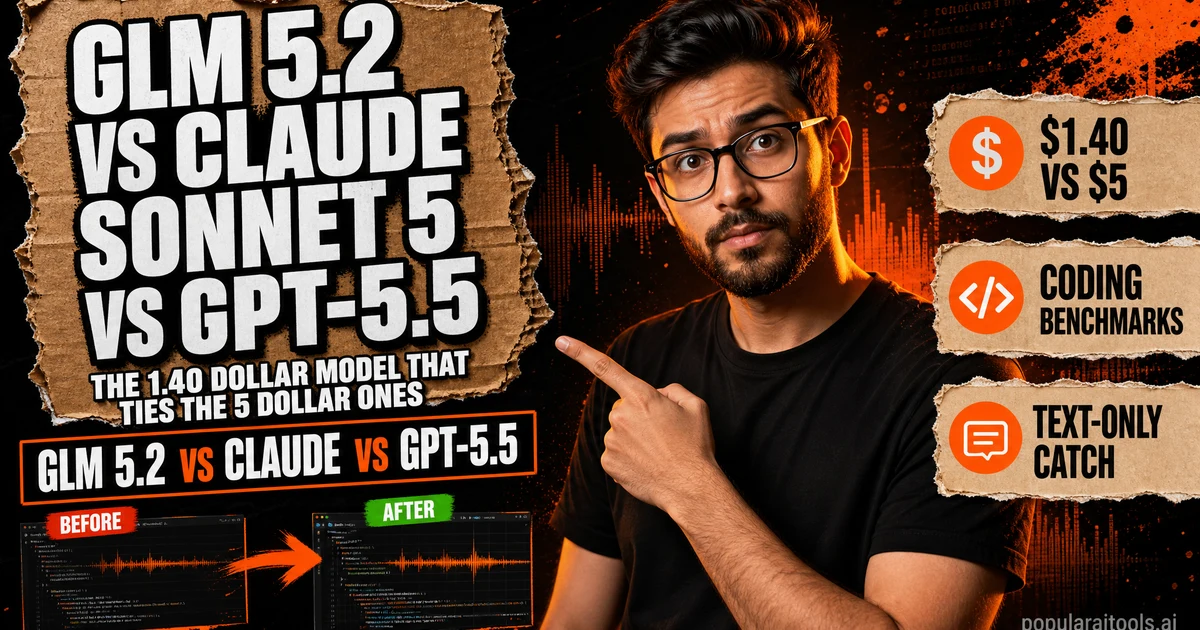
Here is a number that should not make sense. OpenAI's GPT-5.5 charges $30 per million output tokens. Anthropic's Claude Sonnet 5 charges $15. And GLM 5.2, an open-weight model from Chinese lab Z.ai, charges $4.40. Then you look at the coding benchmarks and the cheap one is winning two out of three.
We pulled the live pricing from all three vendors, cross-checked the published coding benchmarks, and dug into what developers are actually saying. This is the honest breakdown of GLM 5.2 vs Claude Sonnet 5 vs GPT-5.5: what each one really costs, where the benchmarks land, the pricing trap hiding inside Claude Sonnet 5, and the single feature gap that decides the whole thing for a lot of teams.
GLM 5.2 vs Claude Sonnet 5 vs GPT-5.5: pricing compared
Let's start with the raw Claude API pricing and how it stacks against the other two, per million tokens. These are the current published rates as of July 2026.
GLM 5.2
- ✓ Cached input $0.26
- ✓ 1M context window
- ✗ Text-only (no vision)
Claude Sonnet 5
- ✓ Intro $2 / $10 to Aug 31
- ✓ Vision + computer-use
- ✓ 1M context window
GPT-5.5
- ✓ Cached input $0.50
- ✓ Vision + tools
- ✓ 1M context window

Put the three side by side and the gap is not subtle. GLM 5.2 is roughly 2 times cheaper than Sonnet 5 on input and about 3.4 times cheaper on output. Against GPT-5.5 you are paying about one sixth. Same coding job, a fraction of the invoice.
| Model | Input / 1M | Output / 1M | Cached input | Vision |
|---|---|---|---|---|
| GLM 5.2 | $1.40 | $4.40 | $0.26 | No |
| Claude Sonnet 5 | $3.00 ($2 intro) | $15.00 ($10 intro) | Yes | Yes |
| GPT-5.5 | $5.00 | $30.00 | $0.50 | Yes |
One note on access. The prices above are the direct Z.ai rates for GLM 5.2. Third-party providers vary. On OpenRouter, for example, GLM 5.2 lands near $1 input and $4 output, so shop the provider if you are optimizing to the cent.

The Sonnet 5 tokenizer tax
Here is a catch that never shows up on a pricing page. Claude Sonnet 5's per-token price is lower than the Opus tier, but its real cost per finished task can be higher than the sticker implies. The reason is the tokenizer.
Sonnet 5 ships with an updated tokenizer that maps the same text to roughly 1.0 to 1.35 times more tokens. More tokens per prompt and per response means a task that looks cheap on the rate card can run about 15 percent more expensive than Claude Opus 4.8 and close to twice the cost of the older Sonnet 4.6, even though the headline per-token number went down.
Cheaper on paper, pricier in practice. If you are comparing Claude Sonnet 5 to GLM 5.2 or GPT-5.5 purely on the rate card, you are not comparing the real bill. Measure tokens per completed task, not the sticker.
This does not erase Sonnet 5's value. At low and medium effort it delivers quality that older Sonnet pricing could not buy. But it does mean the naive "Claude is cheaper than GPT" headline needs an asterisk, and it narrows the gap that separates it from GLM 5.2 on a real workload.
The August 31 price cliff
There is one more Sonnet 5 wrinkle worth budgeting around. The $3 input and $15 output rate is the standard price. Right now Anthropic is running an introductory rate of $2 input and $10 output that ends on August 31, 2026.
After that date the price jumps 50 percent back to standard. Developers on Reddit were quick to flag this as a quiet price increase. If you are pricing a long-running product on Sonnet 5, plan for the full $3/$15, not the promo. GLM 5.2 and GPT-5.5 have no such cliff.
Coding benchmarks: a statistical dead heat
Price only matters if the cheap model writes usable code. So here are the three coding benchmarks that matter most for agentic and software-engineering work. The short version: it is close enough to be a tie, and GLM 5.2 wins two of the three.
On SWE-bench Pro, Claude Sonnet 5 takes the top spot at 63.2, with GLM 5.2 right behind at 62.1. That 1.1 point gap is about 20 tasks on a benchmark of nearly 1,865. GPT-5.5 trails at 58.6.
On Terminal-Bench 2.1, the budget model flips it. GLM 5.2 leads at 81.0 versus Sonnet 5 at 80.4, a jump from GLM 5.1's 62.0 in a single generation. On FrontierSWE, GLM 5.2 lands at 74.4, ahead of GPT-5.5 at 72.6. So the $1.40 model beats the $5 model on two of three benchmarks.

Be fair about what these numbers mean, though. These are sub 1-point differences. It is basically a statistical dead heat on quality. And when quality is tied, the deciders become price, context size, and one big feature gap.
The catch: GLM 5.2 is text-only
Here is the real catch, and it is a big one. GLM 5.2 is text-only. No image input, no computer-use. If your workflow ever hands the model a screenshot, a diagram, or a UI capture, GLM 5.2 breaks. Any agent harness that sends an image will fail on it.
Where GLM 5.2 wins
- ✓Cost at scale. One sixth of GPT-5.5, roughly a third of Sonnet 5 on output.
- ✓Open weights. MIT license, self-hostable, no vendor lock-in.
- ✓Terminal and agentic coding. Tops Terminal-Bench 2.1.
Where GLM 5.2 loses
- ✗No vision. Breaks on screenshots and image inputs.
- ✗No computer-use. Rules out many browser and desktop agents.
- ✗Smaller ecosystem. Fewer first-party agent tools than Claude.
Claude Sonnet 5 and GPT-5.5 both handle vision natively. For a lot of modern agent setups, from computer-use to reading design mockups, that single gap is the whole decision. If you need eyes, GLM 5.2 is off the table no matter how good the price looks.
GLM Coding Plan vs pay-per-token
If you searched for the GLM Coding Plan, you already sensed where GLM's real edge is. Beyond raw token pricing, Z.ai sells a flat-rate coding subscription aimed squarely at developers who live in a coding agent all day. For heavy, steady usage, a flat plan often beats metered tokens by a wide margin.
The trade is predictability versus flexibility. Pay-per-token (direct Z.ai or via OpenRouter) is best for spiky or low-volume workloads and for slotting GLM 5.2 in as a Claude alternative for coding behind an existing API. The GLM Coding Plan is best when your usage is high and constant, and you want a bill that does not move. Either way, GLM 5.2 comes in well under what the same volume would cost on Claude Sonnet 5 or GPT-5.5.

Who should use which
There is no single winner here. There is a right pick for your constraints. Here is the honest call for each.
Pick GLM 5.2 if...
You do high-volume, text-based coding, cost is your top constraint, or you want to self-host under an open license. You are not sending images.
Pick Claude Sonnet 5 if...
You need the top coding score plus vision, computer-use, and a mature agent ecosystem. Just budget for the tokenizer tax and the August price cliff.
Pick GPT-5.5 if...
You are already committed to the OpenAI ecosystem. On pure coding price to performance, it is the hardest of the three to justify right now.
The bigger picture is the real headline. GLM 5.2 is the value king as long as you live in text. Sonnet 5 is the best all-rounder when you need eyes and hands. GPT-5.5 is now mostly an ecosystem play. The gap between budget-tier quality and flagship quality has never been this thin, and that is very good news for anyone paying the bill.
Frequently Asked Questions
Recommended AI Tools
played.fm
Sell your music and keep 100%: played.fm is a direct-to-fan store + sync marketplace with 0% commission, no gatekeepers, and no bans — a strong fit for AI musicians.
View Review →OpenCode
The open-source AI coding agent: terminal-first TUI, 75+ model providers, LSP context, subagents, and privacy-first design. Free software, ~180K GitHub stars.
View Review →Exa
The neural web search API for AI agents: embeddings-based retrieval, cited highlights, sub-180ms latency, and an MCP server. 20,000 free requests/month.
View Review →Google Antigravity
Google's agent-first IDE: run a fleet of AI agents from a Manager surface, on Gemini 3 Pro, Claude Sonnet 4.5, or OpenAI models. Free in public preview.
View Review →