Kimi K2 vs Claude Code: Which Is Best for Coding in 2026?

AI Infrastructure Lead
🎯 Key Takeaways
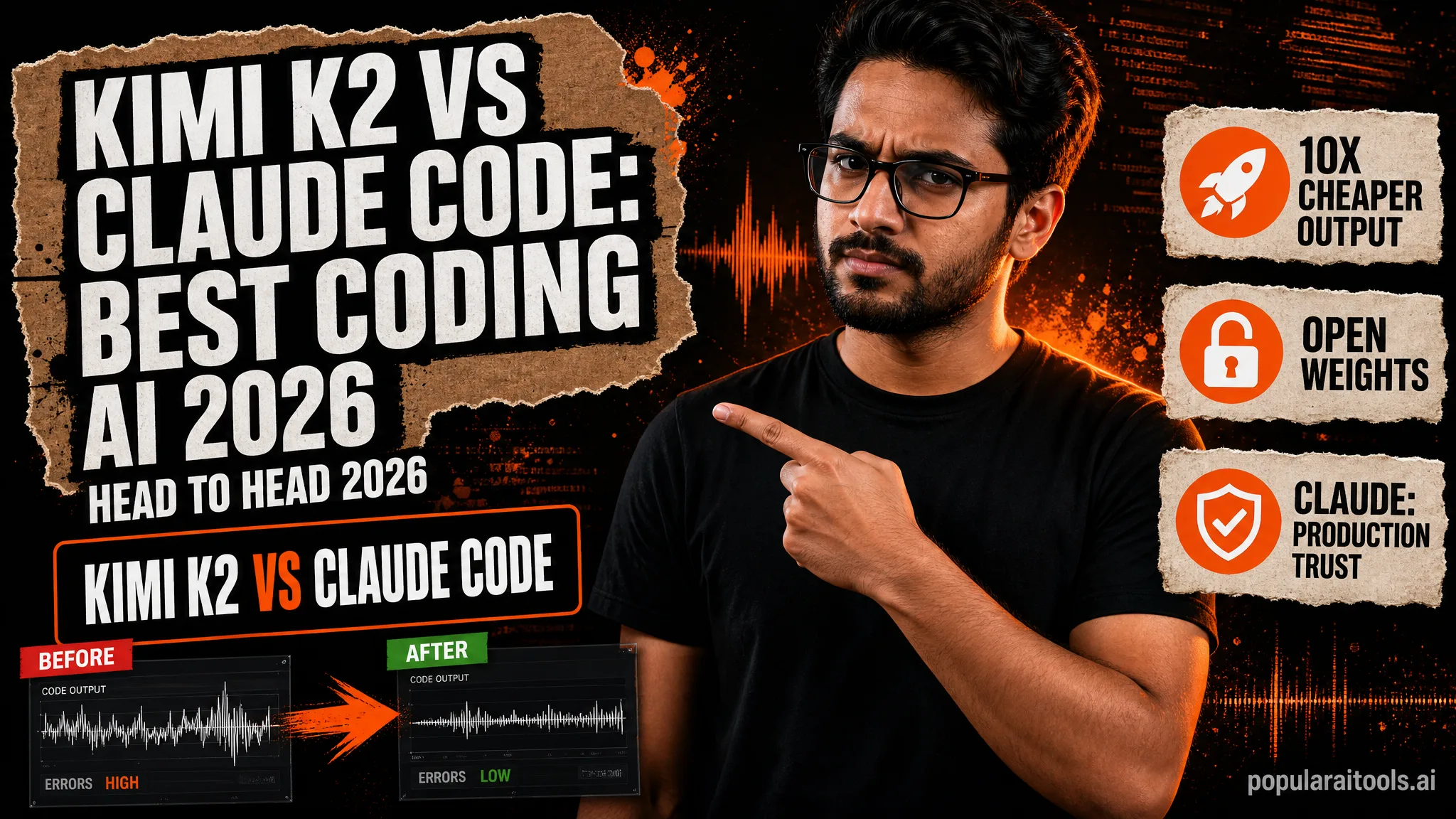
- Kimi K2 (Moonshot AI) is an open-weight coding model — roughly 10x cheaper on output than Claude's flagship, self-hostable, and strong on coding benchmarks (~74% SWE-bench Pro at ~$0.30 a run).
- Claude Code is Anthropic's polished agent on Claude models, with the deepest official ecosystem (VS Code, JetBrains, GitHub, Slack, skills, hooks, plugins) and the best production reliability.
- One is a model you run cheaply anywhere; the other is a tuned agent + model you pay a premium for. Kimi K2 powers tools like Kimi Code.
- Pick Kimi K2 for cost, openness, and throughput. Pick Claude Code for reliability, agentic depth, and integrations.
First, a clarification, because the matchup is a little apples-to-oranges: Kimi K2 is a model (Moonshot AI's open-weight coding model, used through tools like Kimi Code or OpenCode), while Claude Code is an agent (Anthropic's tool running Claude models). But developers really are choosing between them as two ways to code with AI — a cheap, open path versus a premium, polished one. Here's how they stack up.
At a Glance
| Dimension | Kimi K2 | Claude Code |
|---|---|---|
| Type | Open-weight model | Agent + Claude models |
| Input price / 1M | ~$0.60 | $5 (Opus 4.8) |
| Output price / 1M | ~$2.50 | $25 (Opus 4.8) |
| Weights | Open (self-hostable) | Closed |
| SWE-bench Pro | ~74% | ~76%+ |
| Ecosystem | BYO tool (Kimi Code, OpenCode) | Deep official surfaces |
| Best for | Cost + throughput | Reliability + polish |
Cost: the 10x gap
This is Kimi K2's headline. Kimi K2.6 runs about $0.60 per million input and $2.50 per million output tokens — roughly 8x cheaper on input and 10x cheaper on output than Claude's flagship Opus. In practice, a typical SWE-bench run costs around $0.30 on K2.6, versus many times that on Opus. For high-volume coding where output tokens dominate the bill, that difference compounds fast.

Claude Code doesn't compete on raw token price — it's sold as a polished experience. You pay through a Claude subscription (Pro $20, Max $100/$200 per month) or a pay-as-you-go API key, and the Opus 4.8 tokens underneath are premium. What you're buying is the harness, the reliability, and the ecosystem, not the cheapest inference.
Benchmarks: closer than the price gap suggests
On coding benchmarks, Kimi K2 is genuinely competitive. K2.6 hits roughly 74% on SWE-bench Pro, and Moonshot's newer K2.7-Code posts 81.1% on MCPMark Verified — a number Moonshot puts ahead of Claude Opus 4.8's 76.4%. That said, be a little skeptical of headline numbers: practitioners running K2.7-Code on real production repositories report the benchmark leads don't always replicate cleanly, and Moonshot hasn't published independent SWE-bench Verified figures for the newest model.

Where Claude Code still pulls ahead is production reliability and agentic depth — long-horizon, multi-step tasks where consistency matters more than a benchmark point. Anthropic tunes the model and the agent together, and it shows on the genuinely hard, sprawling work.
Openness and ecosystem
Two structural differences decide a lot of cases. Kimi K2 is open-weight — a roughly 1-trillion-parameter MoE model you can self-host, fine-tune, and run on private infrastructure. Claude cannot be self-deployed. For teams with data-residency needs or a desire to own the stack, that's decisive.
On the other side, Claude Code's ecosystem is unmatched: official terminal, VS Code, JetBrains, desktop, web, GitHub, GitLab, and Slack surfaces, plus skills, hooks, and a plugin system. Kimi K2, being a model, relies on a third-party tool — Kimi Code, OpenCode, or your own harness — to deliver the agent experience.

Which should you choose?
Choose Kimi K2 if…
- ✓ Cost is a primary constraint
- ✓ You want open weights or self-hosting
- ✓ You run high-volume coding workloads
- ✓ You want to fine-tune the model
- ✓ You're happy bringing your own tool
Choose Claude Code if…
- ✓ You need production-grade reliability
- ✓ You want the deepest official integrations
- ✓ Agentic depth beats raw token cost
- ✓ You want skills, hooks, and plugins
- ✓ Enterprise trust matters
The pragmatic answer is a split: route high-volume, routine coding to Kimi K2 (via Kimi Code or OpenCode) and reserve Claude Code for the hardest, long-horizon work. For more on the cheap-vs-premium model trade-off, see our GLM 5.2 vs Opus 4.8 comparison, and our Kimi Code review for the tool that puts K2 in your terminal.
Frequently Asked Questions
Recommended AI Tools
played.fm
Sell your music and keep 100%: played.fm is a direct-to-fan store + sync marketplace with 0% commission, no gatekeepers, and no bans — a strong fit for AI musicians.
View Review →OpenCode
The open-source AI coding agent: terminal-first TUI, 75+ model providers, LSP context, subagents, and privacy-first design. Free software, ~180K GitHub stars.
View Review →Exa
The neural web search API for AI agents: embeddings-based retrieval, cited highlights, sub-180ms latency, and an MCP server. 20,000 free requests/month.
View Review →Google Antigravity
Google's agent-first IDE: run a fleet of AI agents from a Manager surface, on Gemini 3 Pro, Claude Sonnet 4.5, or OpenAI models. Free in public preview.
View Review →