OpenCode vs Claude Code: Which AI Coding Agent Wins in 2026?

AI Infrastructure Lead
🎯 Key Takeaways
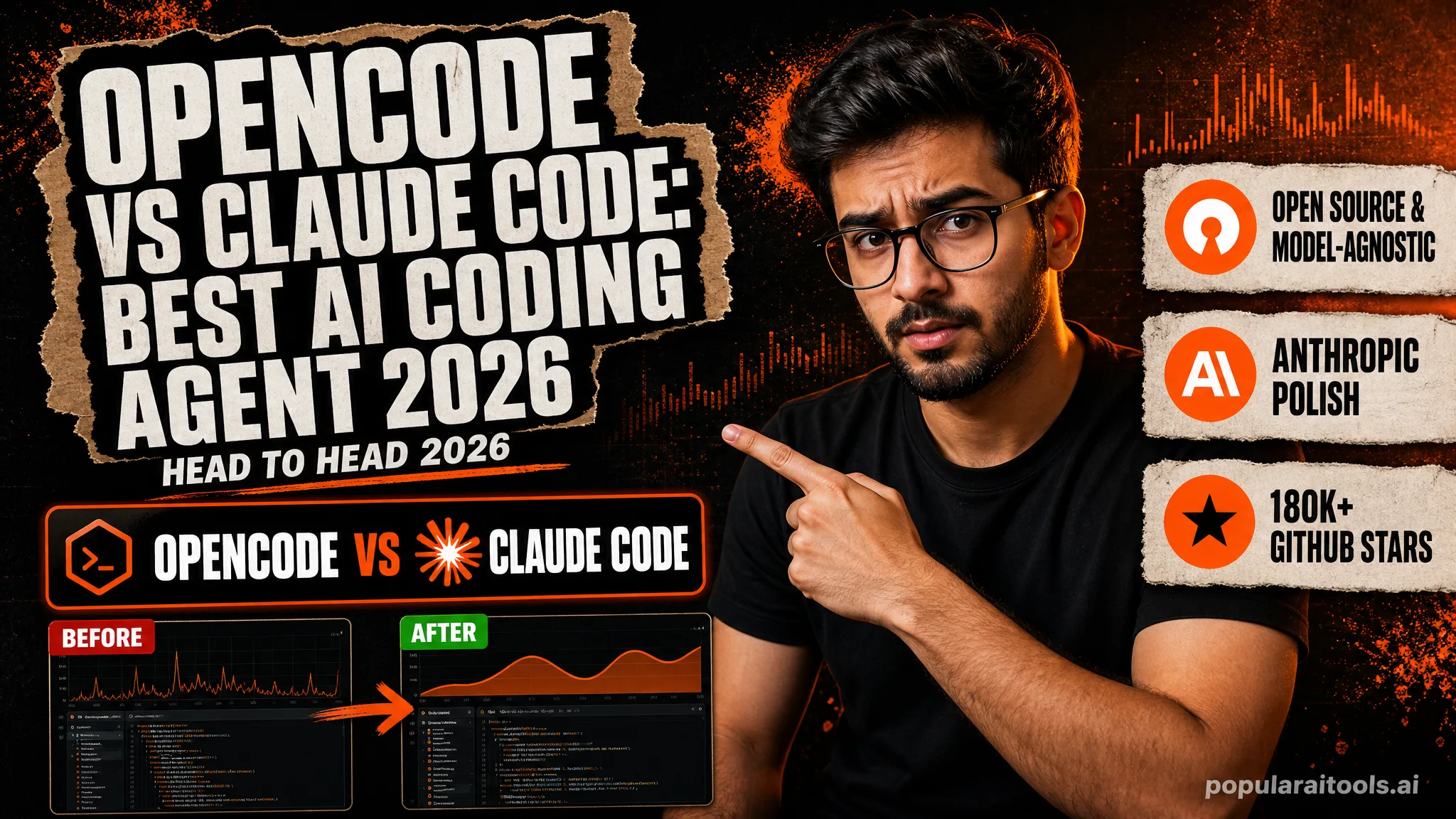
- OpenCode is the open-source, model-agnostic agent. It connects to any model from any provider (Claude, GPT, Gemini, local), keeps the terminal at the center, and the software is free — you pay providers directly. Around 180K GitHub stars.
- Claude Code is Anthropic's polished, model-locked agent. It's tuned for the best instruction-following and reasoning depth, ships official surfaces for VS Code, JetBrains, GitHub, Slack, and more, and has skills, hooks, and plugins.
- Cost: OpenCode charges nothing for the wrapper; Claude Code bills $20–$200/month or pay-as-you-go via API key. The model tokens cost the same either way.
- Pick OpenCode for freedom, privacy, and local models. Pick Claude Code for polish, ecosystem, and reasoning depth.
Terminal-native AI coding agents won 2026, and two of them define the category. Claude Code is Anthropic's closed, model-locked agent tuned for speed and instruction-following. OpenCode is the open-source, model-agnostic challenger that, sometime in mid-2026, quietly overtook Claude Code on GitHub stars. They solve the same problem from opposite philosophies — here's how they actually compare.
At a Glance
| Dimension | OpenCode | Claude Code |
|---|---|---|
| Source | Open source | Closed source |
| Models | Any provider (75+), local | Claude only (Opus 4.8) |
| Interface | Terminal TUI, desktop, IDE ext | Terminal, VS Code, JetBrains, web |
| Ecosystem | Subagents, LSP, MCP, sessions | Skills, hooks, plugins, GitHub, Slack |
| Software cost | Free (pay providers) | $20–$200/mo or API |
| GitHub stars | ~180K | ~135K |
| Terminal-Bench 2.1 | Model-dependent | 78.9% (Opus 4.8) |
Philosophy: open freedom vs polished lock-in
OpenCode's whole pitch is freedom. It's open source, it connects to any model from any provider, and it stores no code or context data — privacy-first by design. The terminal TUI is genuinely excellent, with LSP-aware context, multiple concurrent sessions, and built-in subagents for planning and build work. If you want to run a local model, route through your own API keys, or customize the agent's behavior, OpenCode gets out of your way.

Claude Code trades that freedom for polish. It's locked to Claude models, but in exchange you get an agent Anthropic tunes end-to-end for its own models, plus the deepest ecosystem in the category: official surfaces for terminal, VS Code, Cursor, JetBrains, desktop, web, GitHub, GitLab, and Slack, an Agent View fleet dashboard, a /goal command for autonomous tasks, and a full skills, hooks, and plugin system.

Models: any provider vs the best Claude experience
This is the sharpest divide. OpenCode is model-agnostic — it supports 75+ providers through Models.dev, so you can run Claude, GPT, Gemini, or a local open-weight model, and switch per task. That's huge if you want to avoid lock-in, use cheaper models for routine work, or keep code on-device. It even offers a curated model service ("Zen") and a $10/month "Go" tier for open-weight models.

Claude Code is model-locked to Claude (Opus 4.8 by default) — but that constraint is also its strength. Because Anthropic controls both the model and the harness, Claude Code delivers the category's best instruction-following and deep reasoning (69.2% on SWE-bench Pro). If Claude is the model you want anyway, no wrapper uses it better.

Pricing: free wrapper vs subscription
Here's the honest truth most comparisons bury: the model tokens cost the same either way — the difference is the wrapper. OpenCode charges nothing for the software; you bring your own provider keys (or use the free models it bundles). Claude Code bills through a Claude subscription — Pro at $20/month, Max at $100/month (5×) or $200/month (20×), with usage shared across Claude and Claude Code — or a pay-as-you-go Anthropic API key.

So if you already pay for Claude Max, Claude Code is effectively bundled. If you want to minimize spend, run local models, or mix cheap models for routine edits, OpenCode's free wrapper plus provider choice is the cheaper path. For a deeper look at squeezing Claude Code costs, see our take on the best AI coding tools.
Which should you choose?
Choose OpenCode if…
- ✓ You want model freedom and no lock-in
- ✓ You want to run local or open-weight models
- ✓ Privacy matters — no code stored
- ✓ You want the best pure-terminal experience, free
- ✓ You like open-source customization
Choose Claude Code if…
- ✓ You want the best reasoning and instruction-following
- ✓ You live in VS Code, JetBrains, or GitHub
- ✓ You want skills, hooks, and plugins
- ✓ You already pay for Claude Pro or Max
- ✓ You want a managed, polished experience
The best part: since OpenCode is free and installs with one command, there's no reason not to run both. Keep Claude Code for deep reasoning and its ecosystem, and reach for OpenCode when you want model freedom or a local model. If you're exploring the broader agent-IDE space, our Google Antigravity review covers a third, multi-agent approach.
Frequently Asked Questions
Recommended AI Tools
played.fm
Sell your music and keep 100%: played.fm is a direct-to-fan store + sync marketplace with 0% commission, no gatekeepers, and no bans — a strong fit for AI musicians.
View Review →OpenCode
The open-source AI coding agent: terminal-first TUI, 75+ model providers, LSP context, subagents, and privacy-first design. Free software, ~180K GitHub stars.
View Review →Exa
The neural web search API for AI agents: embeddings-based retrieval, cited highlights, sub-180ms latency, and an MCP server. 20,000 free requests/month.
View Review →Google Antigravity
Google's agent-first IDE: run a fleet of AI agents from a Manager surface, on Gemini 3 Pro, Claude Sonnet 4.5, or OpenAI models. Free in public preview.
View Review →