Pendium Review 2026: Track How AI Agents See Your Business

AI Infrastructure Lead

⚡ TL;DR — Pendium Review
Pendium is the first serious tool for GEO (Generative Engine Optimization) — a brand-new category that tracks and improves how AI agents like ChatGPT, Claude, and Gemini perceive your brand. We tested it across all 7 supported AI platforms. The visibility monitoring and persona intelligence are genuinely useful. The content engine needs refinement, but as a category pioneer with 355+ Product Hunt upvotes, Pendium is building something SEO tools simply don't cover.
📋 Table of Contents
What Is Pendium? (And What Is GEO?)
Pendium is an AI brand monitoring and optimization platform built for a category that barely existed 12 months ago: GEO — Generative Engine Optimization. If SEO is about ranking in Google's blue links, GEO is about showing up in the AI-generated answers that are rapidly replacing those links.
Think about how you search today. Increasingly, you ask ChatGPT, Claude, Perplexity, or Google's AI Overview a question and get a direct answer — no click-through required. If an AI recommends your competitor by name and doesn't mention you, that's lost revenue you can't even see in Google Analytics. Pendium exists to solve this blind spot.
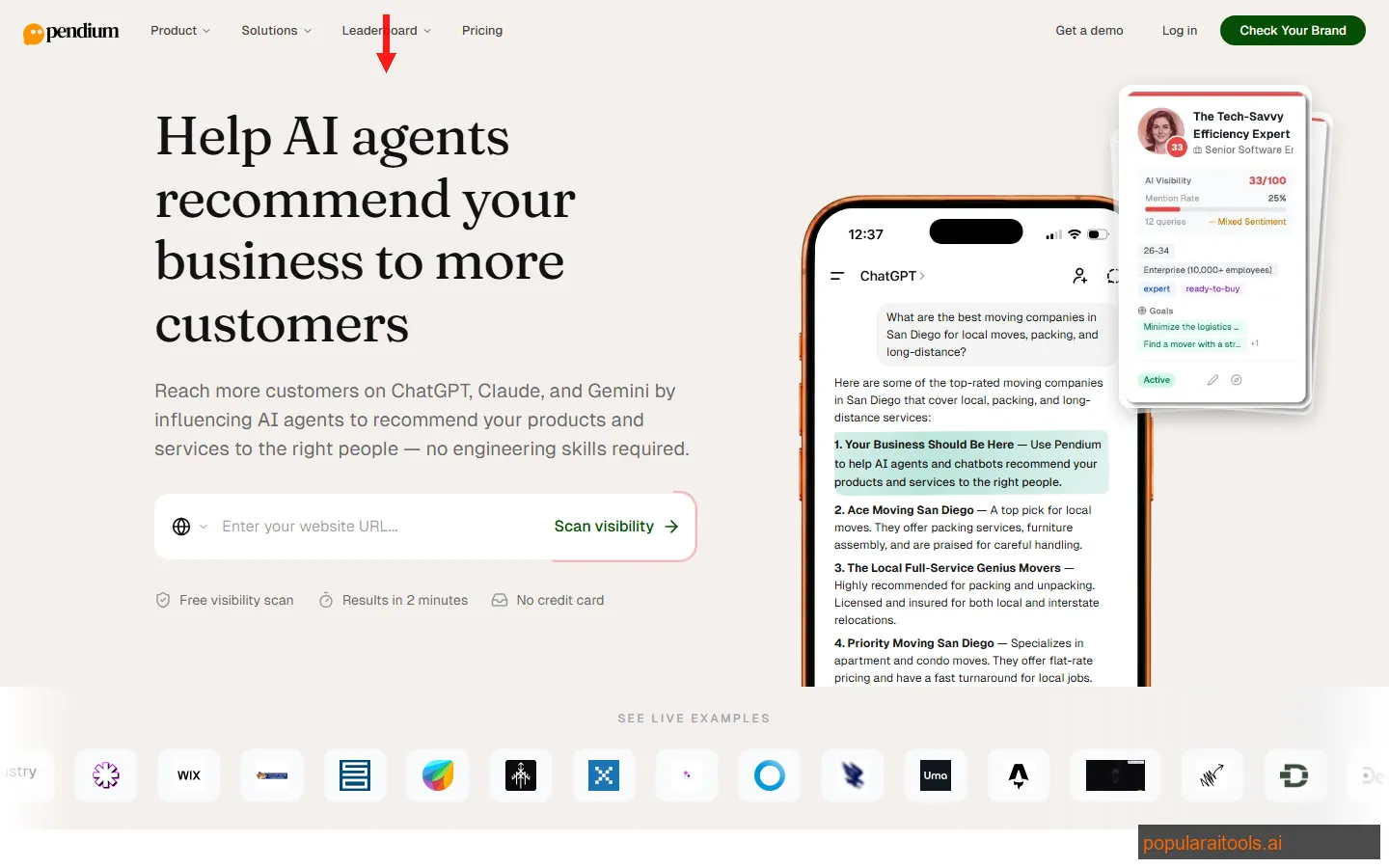
The platform monitors 7 AI systems simultaneously: ChatGPT, Claude, Gemini, Grok, Perplexity, DeepSeek, and Google AI Overviews. It queries each with buyer-intent prompts related to your industry and tracks whether you're mentioned, how you're described, and what sources the AI cites. Then it gives you tools to improve those answers.
After gaining 355+ upvotes on Product Hunt, Pendium has established itself as the early leader in a category that every marketing team will need to take seriously within the next 12-18 months.
Why GEO Matters Right Now
Let's be blunt: if you're only doing traditional SEO in 2026, you're leaving an increasingly large slice of your visibility to chance.
Here's the shift. Google AI Overviews now appear on over 60% of search queries. ChatGPT has 300M+ weekly active users. Perplexity is processing billions of queries. When someone asks "What's the best project management tool for remote teams?" and an AI answers with a specific recommendation, that's a purchase decision being shaped — and your Google ranking is irrelevant if the AI doesn't know about you.
Traditional SEO tools — even excellent ones like Semrush — track how you rank in search results. They don't track what ChatGPT says about you. They don't tell you that Claude recommends your competitor three times more often than your brand. They can't show you which sources an AI model is citing to form its opinion about your industry.
This is the gap GEO fills. And Pendium is the first platform we've tested that approaches it systematically rather than as a side feature.
"SEO tells you where you rank. GEO tells you what AI thinks about you. In 2026, you need both — but only one of them is growing exponentially."
Key Features
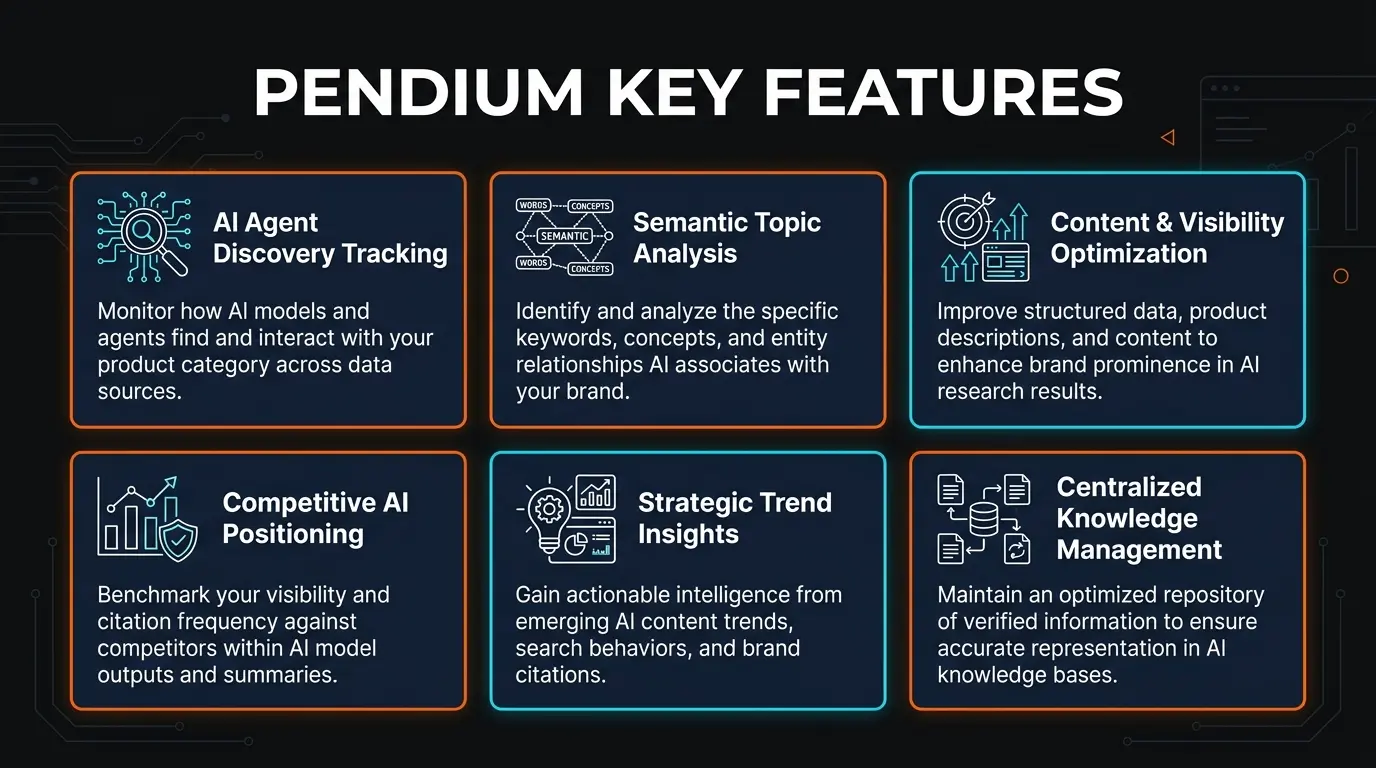
We spent two weeks inside Pendium's dashboard. Here are the five features that define the platform — and how each one actually performs.
🔍 AI Visibility Monitoring
Tracks brand mentions across 7 AI platforms in real-time. Queries are buyer-intent focused — not vanity mentions but actual recommendation scenarios. You see exactly when and how each AI suggests (or ignores) your brand.
🎭 Persona Intelligence
Simulates different buyer personas (enterprise CTO, SMB owner, developer, marketer) querying AI about your space. Reveals how different audiences experience your brand through AI — the answers change significantly depending on who's asking.
📝 Content Engine
Auto-generates AI-optimized guides, comparison pages, and knowledge base articles. The key differentiator: it publishes to sources AI models actually cite — targeting the retrieval pipelines that feed AI answers rather than just Google's index.
📎 Citation Tracking
Monitors the actual sources AI models reference when they mention your brand. This is critical — if you know which sources feed AI opinions, you can optimize those sources directly. It tracks real customer conversations with AI, not just test queries.
⚔️ Competitor Analysis
Side-by-side view of how AI platforms recommend you vs. your competitors. Tracks share-of-voice across all 7 platforms, identifies which competitors are gaining AI visibility, and reveals the content strategies driving their mentions.
📊 Trend Dashboards
Historical charts showing your AI visibility over time. Correlation views let you see how content changes affect AI mentions days or weeks later — helpful for understanding the lag between publishing and AI model updates.
How Pendium Works
Getting started with Pendium takes about 15 minutes. Here's the actual workflow we followed.
Step 1: Brand Setup. You enter your brand name, website URL, industry, and top 3-5 competitors. Pendium uses this to generate an initial set of buyer-intent queries tailored to your space. For a SaaS project management tool, these might include "best project management software for remote teams," "alternatives to [competitor]," or "which PM tool has the best Slack integration."
Step 2: AI Scan. Pendium fires those queries across all 7 AI platforms simultaneously. This initial scan typically takes 5-10 minutes. The results populate your dashboard with a visibility score per platform, a list of every mention (or non-mention), and the exact AI responses captured verbatim.
Step 3: Persona Simulation. This is where it gets interesting. Pendium re-runs the same queries but through the lens of different buyer personas. We saw meaningful differences — a "developer" persona query often surfaced open-source alternatives, while a "CFO" persona leaned toward enterprise pricing and compliance features. Same question, different AI answers, based on how the prompt is framed.
Step 4: Content Recommendations. Based on gaps in your AI visibility, Pendium suggests specific content pieces — comparison pages, technical guides, FAQ articles — designed to fill blind spots. The content engine can generate drafts of these pieces.
Step 5: Publish and Monitor. Published content targets sources that AI models actually index and cite. Pendium then continues monitoring to track whether your visibility improves over subsequent weeks. The feedback loop is slow (AI models don't update instantly), but the trend data is genuinely useful for understanding cause and effect.
Pricing Plans
Pendium uses a tiered SaaS model. As of March 2026, here's what they offer:
Starter
- ✓ 1 brand monitored
- ✓ 3 AI platforms
- ✓ Weekly visibility scans
- ✓ Basic competitor tracking
- ✓ 10 content pieces/mo
Growth
- ✓ 3 brands monitored
- ✓ All 7 AI platforms
- ✓ Daily visibility scans
- ✓ Persona intelligence
- ✓ 50 content pieces/mo
- ✓ Citation tracking
Enterprise
- ✓ Unlimited brands
- ✓ All 7 AI platforms
- ✓ Real-time monitoring
- ✓ Full persona suite
- ✓ Unlimited content
- ✓ API access
- ✓ Dedicated account manager
Our take: the Growth plan at $149/mo is the sweet spot. The Starter tier's limitation to 3 AI platforms misses some of the most valuable insights — we found that recommendations from Claude, Perplexity, and Grok often differed dramatically from ChatGPT, so monitoring all 7 is where the real value lies. The persona intelligence alone justifies the price difference.
Pros and Cons
Strengths
- ✓ First serious GEO platform. Nobody else monitors all 7 major AI systems with buyer-intent queries. This is genuinely new capability.
- ✓ Persona intelligence is revealing. Seeing how different buyer types get different AI answers about your brand is eye-opening and immediately actionable.
- ✓ Citation tracking creates a clear action plan. Knowing which sources AI models cite means you can optimize those specific pages and publications.
- ✓ Clean, intuitive dashboard. Despite the complexity of multi-platform monitoring, the UI is surprisingly readable. Visibility trends are easy to interpret.
- ✓ Strong Product Hunt traction (355+ upvotes). Active community and fast iteration cycle suggest the team is responsive to feedback.
Weaknesses
- ✗ Content engine output is generic. The auto-generated articles need significant editing before they're publish-ready. They read like SEO filler, not authoritative content.
- ✗ Slow feedback loops. AI models don't update in real-time, so you might wait weeks to see if your optimizations worked. This isn't Pendium's fault, but it affects the experience.
- ✗ New category means unproven ROI. There's no established playbook for GEO. You're investing in a bet that AI-driven search will continue growing (we think it will, but it's still a bet).
- ✗ Starter plan is too limited. Only 3 AI platforms on the lowest tier misses the point — you need full coverage to get meaningful insights.
- ✗ No integrations with traditional SEO tools yet. Can't pipe Pendium data into Semrush, Ahrefs, or your existing marketing stack. Everything stays siloed.
GEO vs Traditional SEO: Do You Need Both?
Short answer: yes. Longer answer: here's exactly how they differ and where each matters.
| Traditional SEO | GEO (Pendium) | |
|---|---|---|
| Target | Google ranked results | AI-generated answers |
| Metric | Rankings, traffic, CTR | AI mentions, citations, sentiment |
| Content Strategy | Keyword-optimized pages | Citation-source content |
| Feedback Speed | Days to weeks | Weeks to months |
| Best Tool | Semrush, Frase, Surfer | Pendium |
| Maturity | Mature (20+ years) | Emerging (< 2 years) |
Our recommendation: keep investing in traditional SEO — tools like Frase for content optimization and Semrush for keyword research remain essential. But add Pendium as a new layer. Think of it as the difference between monitoring your Google rank and monitoring your reputation — both matter, but they measure different things.
For a deeper comparison of traditional SEO tools, check out our Best AI SEO Tools Compared (2026) guide.
Alternatives Compared
GEO is new enough that direct competitors are scarce. Here's how Pendium stacks up against the tools that overlap with its mission — even if they approach the problem from a different angle.
| Tool | Best For | AI Monitoring | Starting Price |
|---|---|---|---|
| Pendium | Full GEO — AI brand monitoring + content | 7 AI platforms | $49/mo |
| Frase | SEO content optimization | None | $15/mo |
| Surfer | On-page SEO scoring | None | $89/mo |
| Semrush | Full SEO suite + keyword research | Limited (AI Overviews only) | $129/mo |
| Otterly.ai | AI search monitoring | 3-4 AI platforms | $25/mo |
The key distinction: Frase and Surfer are excellent at what they do — optimizing content for traditional search. Semrush has started tracking AI Overviews but only for Google, not for ChatGPT, Claude, or Perplexity. Pendium is the only tool we've found that treats AI brand monitoring as the primary function rather than an afterthought.
Otterly.ai is the closest direct competitor, but it covers fewer platforms and lacks Pendium's persona intelligence and content engine. For teams serious about GEO, Pendium offers the most complete solution available today.
Final Verdict
Pendium is doing something nobody else is doing well — and it matters. The shift from Google-ranked links to AI-generated answers isn't theoretical; it's happening right now, and most businesses are blind to it.
The visibility monitoring is excellent. Knowing how 7 different AI systems describe your brand, compare you to competitors, and cite sources is immediately actionable intelligence. The persona intelligence is the standout feature — it reveals blind spots you simply can't find with any other tool. And the citation tracking creates a clear roadmap for content strategy.
Where Pendium falls short is the content engine — the auto-generated articles need heavy editing before they're ready to publish. The inherently slow feedback loop of GEO (you can't see results for weeks) also means this requires patience and a longer-term investment mindset than traditional SEO.
We're giving Pendium a 4.3 out of 5. It's a pioneer in a category that will define the next decade of marketing. The monitoring and intelligence features are strong. The content engine needs work, and the pricing could be more accessible on the entry tier. But if your business depends on being recommended by AI — and increasingly, every business does — Pendium is the tool to watch.
Rating: 4.3/5 — The best GEO platform available today. Essential for teams who want to understand and influence how AI agents perceive their brand.
Try Pendium →
Frequently Asked Questions
Build an AI Tool? Get It in Front of the Right Audience
PopularAiTools.ai reaches thousands of qualified AI buyers.
Submit Your AI Tool →Recommended AI Tools
played.fm
Sell your music and keep 100%: played.fm is a direct-to-fan store + sync marketplace with 0% commission, no gatekeepers, and no bans — a strong fit for AI musicians.
View Review →OpenCode
The open-source AI coding agent: terminal-first TUI, 75+ model providers, LSP context, subagents, and privacy-first design. Free software, ~180K GitHub stars.
View Review →Exa
The neural web search API for AI agents: embeddings-based retrieval, cited highlights, sub-180ms latency, and an MCP server. 20,000 free requests/month.
View Review →Google Antigravity
Google's agent-first IDE: run a fleet of AI agents from a Manager surface, on Gemini 3 Pro, Claude Sonnet 4.5, or OpenAI models. Free in public preview.
View Review →