played.fm vs Bandcamp: Which Keeps You More in 2026?

AI Creative Tools Specialist
🎯 Key Takeaways
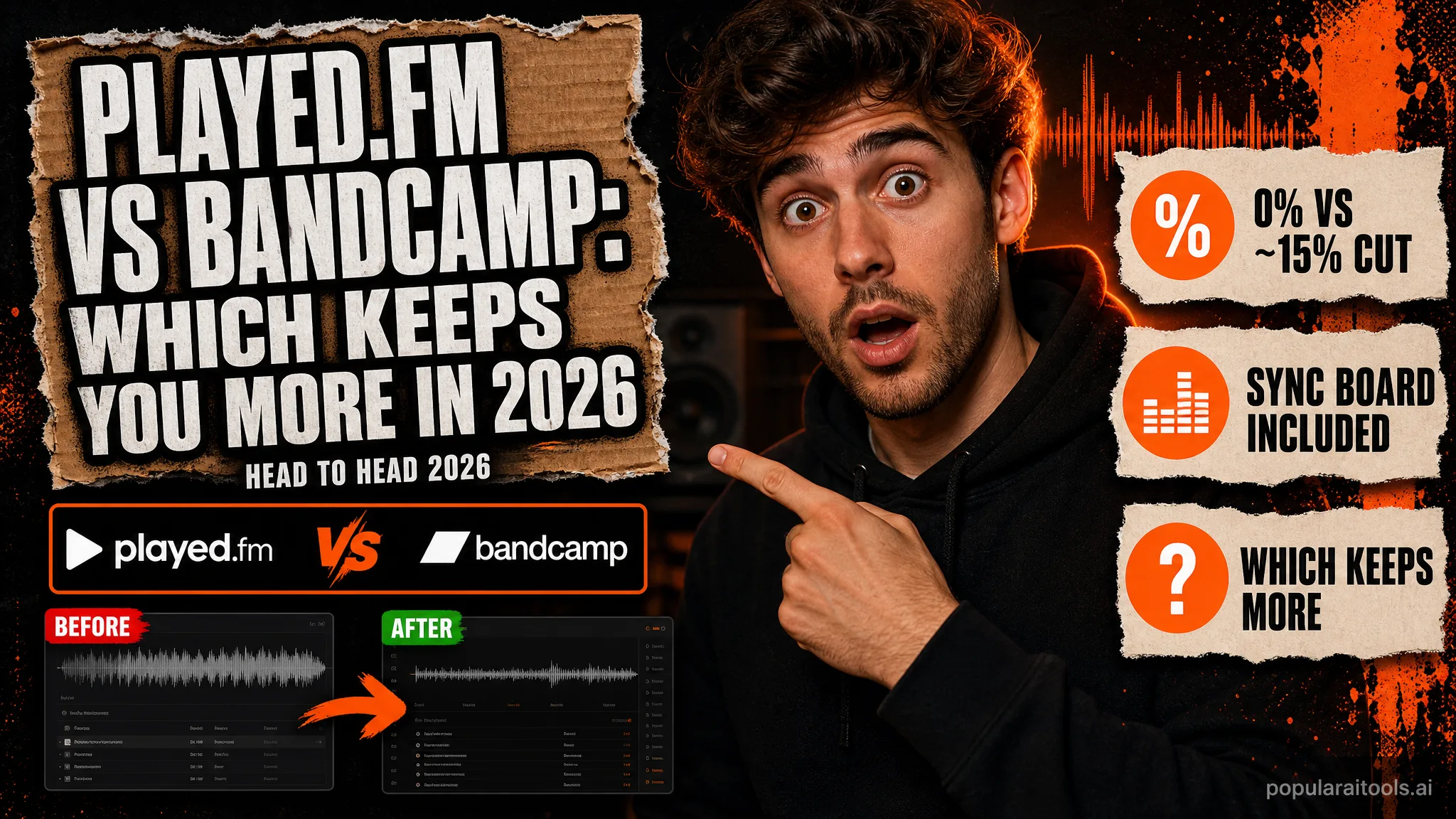
- played.fm takes 0% — fans pay via your own PayPal/Wise — and adds a sync board, for a flat monthly fee ($12.99–$29.99).
- Bandcamp takes ~10–15% of each sale but brings an established audience of music buyers and handles checkout for you.
- If you bring your own traffic, played.fm keeps more. If you rely on marketplace discovery, Bandcamp's audience can net more even after its cut.
- AI musicians: played.fm's "no bans" policy makes it the safer home for AI-generated tracks.
For over a decade, Bandcamp was the default answer to "where do I sell my music and keep most of it?" Then played.fm showed up with a sharper pitch: keep all of it. Both are direct-to-fan stores, but they make opposite trades — Bandcamp sells you an audience and takes a cut, while played.fm takes nothing and asks you to bring your own. Here's which one actually keeps you more in 2026.
At a Glance
| Dimension | played.fm | Bandcamp |
|---|---|---|
| Cut of sales | 0% | ~10–15% + fees |
| Cost model | Flat $12.99–$29.99/mo | Free + per-sale cut |
| Built-in audience | New / growing | Large, established |
| Sync board | ✓ Built-in | No self-serve board |
| Checkout | Your PayPal/Wise link | Handled for you |
| AI music | No bans | Content policies apply |
| Creative tools | Bundled (art, mastering) | None |
The core trade: audience vs margin
Bandcamp's cut is the price of its audience. Since 2008 it's built a genuine community of people who come specifically to buy music, browse tags, and follow artists. It handles the entire checkout, so a fan buys in two clicks and you never touch a payment link. That convenience and built-in discovery is real value — it just costs you 10–15% of every sale, plus payment fees.

played.fm's fee is the price of keeping everything. It takes 0% because fans pay through your own PayPal or Wise — the money never routes through played.fm. You trade Bandcamp's frictionless checkout for a payment link, and a large built-in audience for a newer, growing one. In return you keep every cent, plus you get a sync-gigs board and bundled creative tools Bandcamp doesn't offer.

Do the math: which keeps you more?
It comes down to where your sales come from. Say you sell $300 of music in a month:
- On Bandcamp: a ~15% cut plus payment fees leaves you roughly $250.
- On played.fm (Artist, $12.99/mo): you keep the full $300 minus the flat fee, or about $287.
- The gap widens as you sell more — at $1,000/month, played.fm keeps ~$987 vs Bandcamp's ~$850.
The catch is the "if you sell it" part. Bandcamp may generate more of those sales through its audience. So the honest rule: if you drive your own traffic (social, email, live shows), played.fm keeps far more. If you're relying on marketplace discovery to find buyers, Bandcamp's established audience can win on total dollars — for now, while played.fm's marketplace is still growing.

Which should you choose?
Choose played.fm if…
- ✓ You want to keep 100% of every sale
- ✓ You bring your own audience
- ✓ You want a built-in sync board
- ✓ You release AI music (no bans)
- ✓ You value bundled creative tools
Choose Bandcamp if…
- ✓ You want an established buyer audience
- ✓ You want checkout handled for you
- ✓ You have no traffic of your own yet
- ✓ You value its brand and community
- ✓ You'd rather pay nothing until you sell
Our take: as your own audience grows, played.fm's 0% cut and sync board make it the better long-term home for your revenue — and if you're selling AI music, it's the clear pick. Read the full breakdown in our played.fm review, and the wider strategy in how to sell your music and keep 100%.
Frequently Asked Questions
Keep 100% of your next release
Open a played.fm storefront, keep every cent of your sales and sync deals, and get banned by no one.
Try played.fm →Recommended AI Tools
played.fm
Sell your music and keep 100%: played.fm is a direct-to-fan store + sync marketplace with 0% commission, no gatekeepers, and no bans — a strong fit for AI musicians.
View Review →OpenCode
The open-source AI coding agent: terminal-first TUI, 75+ model providers, LSP context, subagents, and privacy-first design. Free software, ~180K GitHub stars.
View Review →Exa
The neural web search API for AI agents: embeddings-based retrieval, cited highlights, sub-180ms latency, and an MCP server. 20,000 free requests/month.
View Review →Google Antigravity
Google's agent-first IDE: run a fleet of AI agents from a Manager surface, on Gemini 3 Pro, Claude Sonnet 4.5, or OpenAI models. Free in public preview.
View Review →