Where to Sell AI Music in 2026: 24 Platforms Compared (The August Matrix)

AI Creative Tools Specialist
⚡ Key Takeaways — the matrix in five numbers
- Of the 24 platforms we audited (August 2026): 9 refuse fully-AI music, 9 accept it on paper but screen it in practice, and only 6 take it openly.
- Commission on a direct sale ranges from 0% (played.fm) to ~15% (Bandcamp); traditional sync libraries take 30–65% — where they accept AI at all.
- Streaming pays ~$0.003–0.005 per play, and Spotify pays $0 below 1,000 streams/year per track — it deleted 75M+ spammy AI tracks in its crackdown.
- Live sync briefs on played.fm's board pay $120–$3,000 each — 23 briefs and $21,720 in combined budgets at last check.
- Suno's terms changed on March 26, 2026: paid subscribers now hold a perpetual commercial licence, not "ownership" — and the free tier still can't sell at all.
We read the current terms and policy pages of 24 platforms — every storefront, streaming distributor, and sync library where you could plausibly sell AI music — and the score as of August 2026 is: 9 say no to fully-AI work, 9 say yes on paper but screen it in practice, and 6 genuinely take it openly. That gap between policy and practice is where most "why was my track rejected?" posts come from, and it's why this page is a matrix rather than an opinion piece. Below: every platform, its cut, its written AI policy with a source link, whether a human reviews your submission, and what the payout actually looks like — plus the three questions underneath it all: can you legally sell it, how do you sell it, and what does it realistically earn. Each table is dated; we re-verify when policies move.
Can I legally sell music I made with AI?
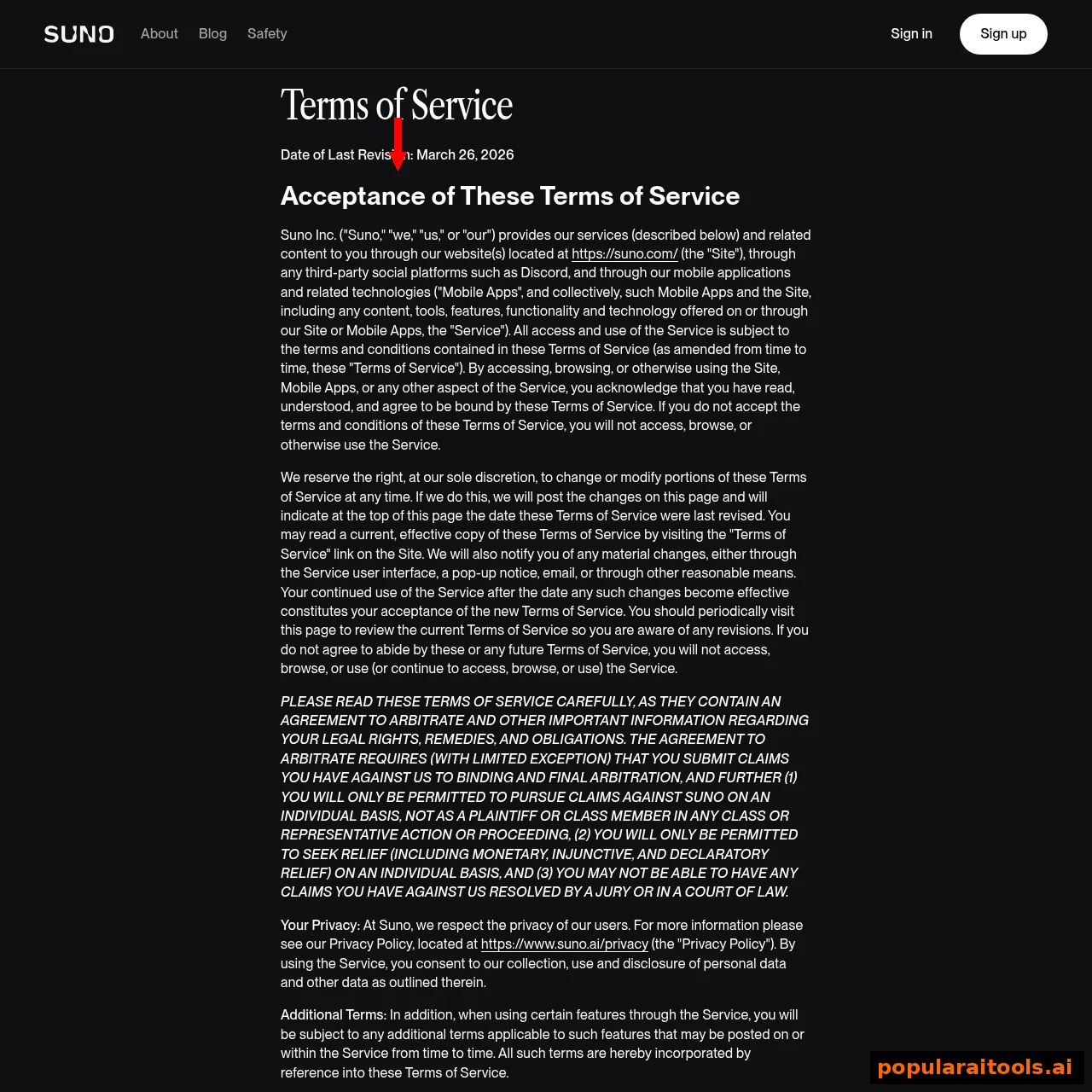
Yes — with two separate questions hiding inside the one. Question one: does your generator let you sell? That's contract law, and the answer lives in the terms. Suno's Terms of Service (last revised March 26, 2026) grant paid subscribers — Pro at $10/mo and Premier at $30/mo — commercial rights to their outputs. Worth knowing: after Suno's November 2025 settlement and licensing deal with Warner Music (Music Week's coverage), the language shifted from user ownership to a perpetual commercial licence — you can sell, stream and license your tracks, but Suno's framing of who "authors" the audio changed. The free tier remains personal-use only: if you generated on free credits, you cannot legally sell that track.
Question two: do you own a copyright? That's a different answer. Under the US Copyright Office's guidance, wholly AI-generated work has no copyright — human authorship is required. You can sell an uncopyrightable track (people sell public-domain recordings every day); what you can't easily do is stop someone else from copying it. The practical move is to add real human authorship — your own lyrics, arrangement, editing, added instrumentation — which makes the human contributions protectable. And the litigation backdrop is genuinely unsettled: Warner settled, but Sony and UMG were still litigating against Suno as of mid-2026, moving to expand their case to 61,000+ recordings. Nothing in that fight has touched a paid user's right to sell their outputs — but it's why we date this page and re-verify it.
The matrix: where to sell Suno music, platform by platform
Three tables, three kinds of door. Every policy was checked in August 2026 against the platform's own published terms; the graphics are free to reuse. Green means openly accepts AI; amber means accepted on paper with screening in practice; red means refused. The practice column matters: data shared with us by AI-music processing service Undetectr, drawn from its customer support tickets, shows rejections clustering at SoundCloud, Amuse, RouteNote and LANDR even where written policy nominally accepts AI — the "yes on paper" middle of the matrix.
1. Direct-to-fan storefronts — you keep the most, you bring the audience
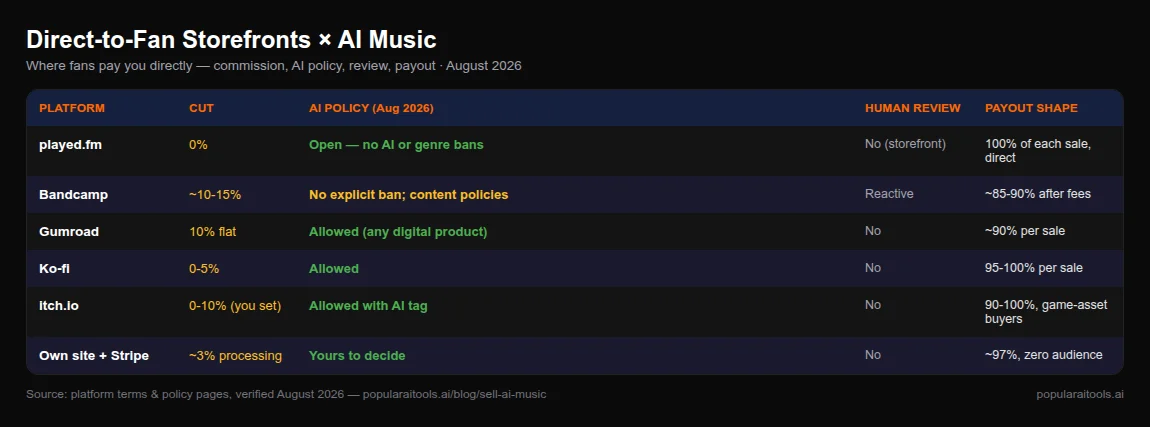
The zero in played.fm's commission column is why it tops this table — fans pay your PayPal or Wise directly and the platform never touches the money — and its written policy has no AI or genre bans, which none of the marketplace stores can say as cleanly. But read the honest rows too: Bandcamp's 10–15% buys you an audience of music buyers you don't have to bring yourself, and if your buyers are game developers, itch.io's asset-pack model (with its mandatory AI tag) is genuinely the better door — a use case where played.fm isn't the answer. The mechanics of running a 0% storefront — checkout, pricing, fan list — are covered on played.fm's seller guide.
2. Streaming distributors — policy on paper vs screening in practice
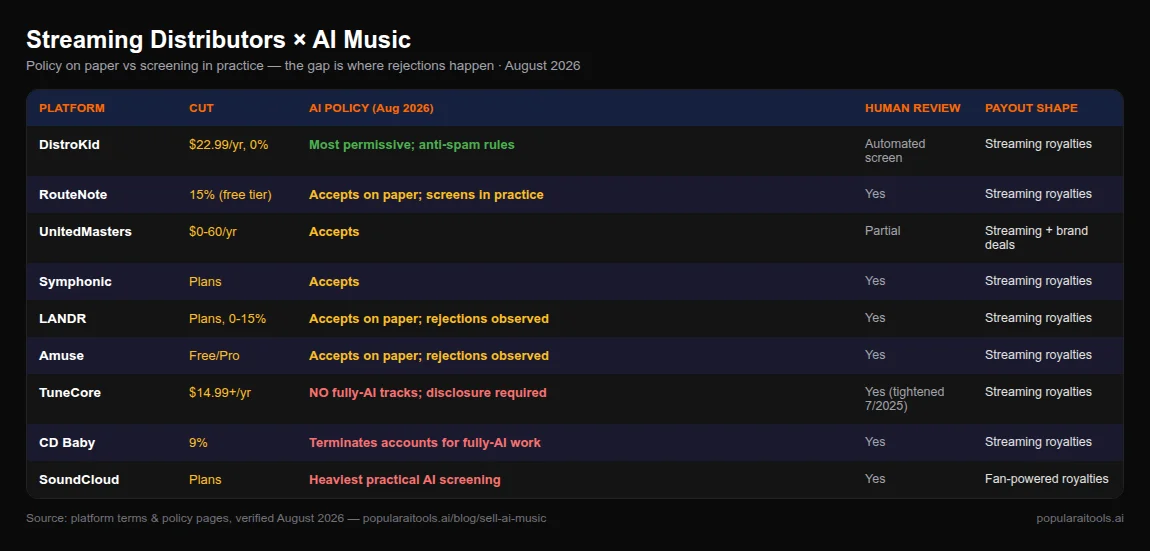
The distributor picture split three ways in 2025–26. DistroKid stayed the permissive flat-fee door ($22.99/yr, no AI ban, hard anti-spam rules). TuneCore tightened in July 2025 and now refuses 100%-AI tracks while requiring disclosure of AI's role in composition and production. CD Baby went strictest — its terms allow terminating accounts tied to fully-AI catalogues. And everything in the amber middle — RouteNote, LANDR, Amuse — accepts AI in writing but screens uploads in practice, which is exactly where the Undetectr support-ticket rejections cluster. Whichever door you pick, the AI-disclosure fields now feed store metadata (industry-wide AI labels rolled out in July 2026): answer them honestly, because misdeclaring is grounds for takedown everywhere. Step-by-step store delivery is in our Suno-to-Spotify walkthrough.
3. Sync & stock libraries — a wall of NOs with two open doors
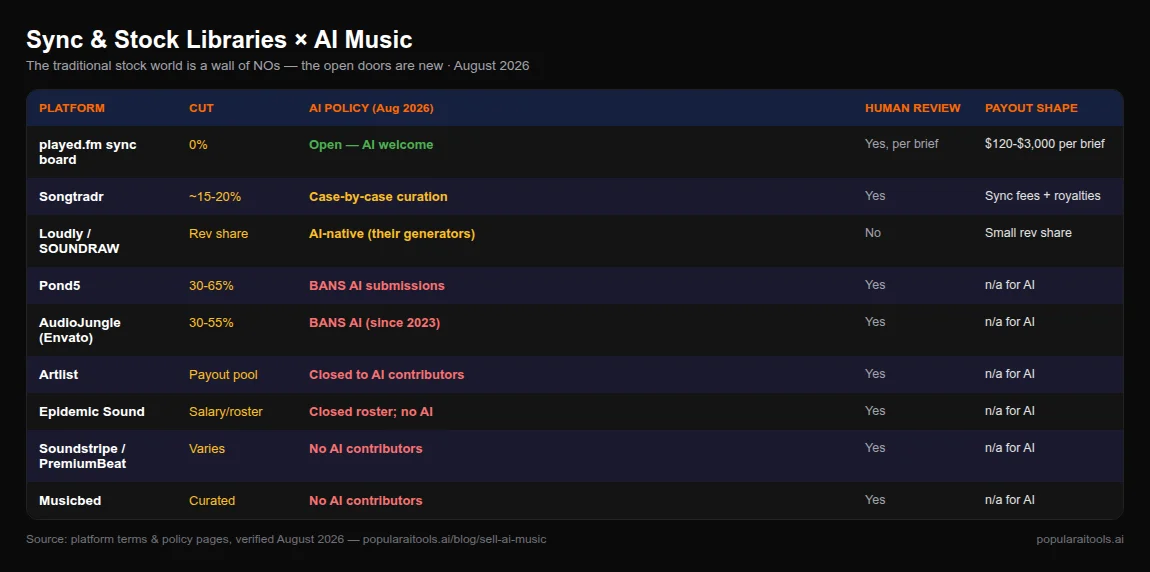
This is the table that surprises people. The entire traditional stock world — Pond5, AudioJungle, Artlist, Epidemic Sound, Soundstripe, PremiumBeat, Musicbed — bans or excludes AI submissions, and repeat attempts risk account termination. Songtradr sits in the curated middle (one row here on purpose; it's been reviewed in depth elsewhere and its AI stance is case-by-case human curation). The open doors are structural newcomers: played.fm's brief board, where productions post paid briefs ($120–$3,000; 23 live with $21,720 in combined budgets at last check) and a human reviews every pitch — AI explicitly welcome — and the AI-native libraries (Loudly, SOUNDRAW), which only monetise their own generators' output at small revenue shares. Deeper strategy on pitching lives in our sync licensing for AI music guide.
How to sell Suno songs: what a release actually needs
The mechanical checklist, in order. (1) Rights: confirm the track was generated on a paid plan — screenshot your subscription status and keep your prompt history; it's your provenance trail. (2) Master: export at maximum quality and fix artifacts — glassy cymbals and vocal warble are the tell that gets tracks screened out. (3) Assets: 3000×3000 artwork, complete metadata, writer credits (you, for lyrics/arrangement where true). (4) Disclosure: answer the AI fields honestly — AI vocals, AI instrumentals, or fully AI — they travel with the track. (5) Pricing: direct-sale norms run $1–$3 per single and $7–$12 per album; underpricing signals low effort to buyers who came to support you. (6) Sync-ready means: an instrumental version, stems on request, and honest genre/mood tags — briefs are matched on fit, not genius. If your catalogue is Suno-heavy, our Suno money guide covers workflow; the storefront-versus-marketplace decision in depth is in how to sell your music and keep 100%.
How to make money from Suno music: every route ranked
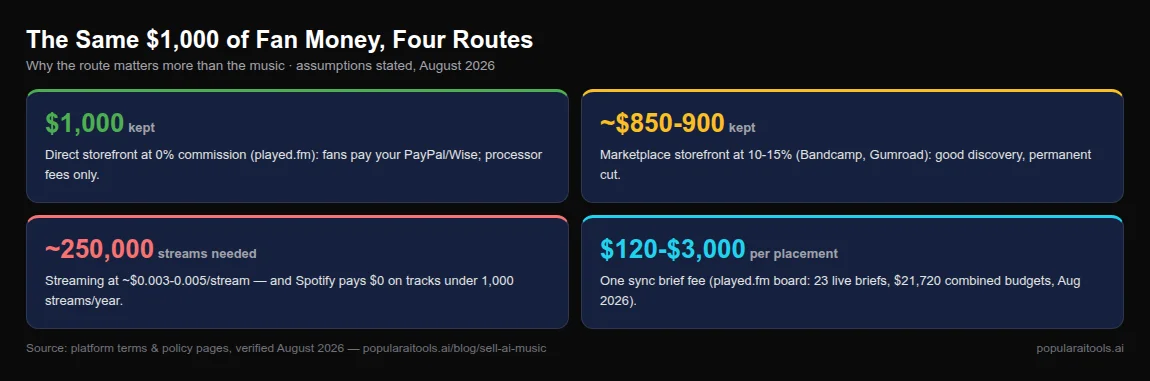
Ranked by realistic return per unit of effort: (1) Sync placements — one $500 brief equals roughly 125,000 streams of income; the catch is competition and patience, and a pitch is a submission, never a guarantee. (2) Direct sales — highest margin (0–15% commission), works at any audience size above literally zero, compounds through a fan list you own. (3) Custom commissions — personalised tracks routinely sell for $50–$300; underrated and AI-accelerated. (4) Game-asset packs — steady niche demand on itch.io, buyers who care about usage rights rather than authorship. (5) Streaming, last on purpose — at ~$0.003–0.005 per play, with Spotify's 75M-track purge and its $0-below-1,000-streams rule, streaming is marketing that occasionally pays, not income. The honest play for most AI musicians is direct sales plus sync pitching, with streaming as the discovery layer.
If you want to test the top two routes without committing money first: the 7-day trial lets you run the full Pro plan against your own catalogue — open the storefront, release up to 3 tracks, and pitch one live sync brief. Honestly stated terms: $0 today with a card verified but not charged, $19.99/month after the week unless you cancel (one click), and your tracks and fan list stay yours either way.
Suno monetization: what changes as you scale
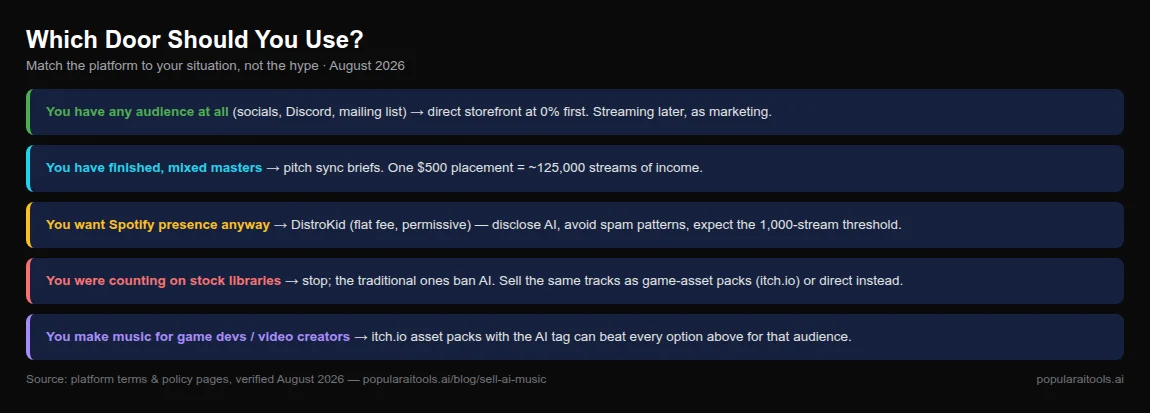
Four things change as a catalogue grows. Thresholds: Spotify's 1,000-stream floor means a 200-track catalogue of small tracks can earn exactly $0 in royalties while a 10-track catalogue with a real audience earns steadily — depth beats breadth. Screening: distributors' anti-spam systems watch upload velocity; hundred-track dumps are what gets accounts flagged, whatever the AI policy says. Dilution: your own releases start competing with each other for the same listeners; releasing less, better, is usually the fix. Rights admin: PRO registration (performance royalties) requires human authorship — register the tracks where your writing is real, skip the ones where it isn't, and keep the paper trail. The scale game rewards artists who treat AI as the instrument and themselves as the catalogue manager.
Frequently Asked Questions
Last verified: August 8, 2026. Platform policies in this matrix change; we re-check and update this page when they do. Corrections: hi@popularaitools.ai.
Recommended AI Tools
played.fm
Sell your music and keep 100%: played.fm is a direct-to-fan store + sync marketplace with 0% commission, no gatekeepers, and no bans — a strong fit for AI musicians.
View Review →OpenCode
The open-source AI coding agent: terminal-first TUI, 75+ model providers, LSP context, subagents, and privacy-first design. Free software, ~180K GitHub stars.
View Review →Exa
The neural web search API for AI agents: embeddings-based retrieval, cited highlights, sub-180ms latency, and an MCP server. 20,000 free requests/month.
View Review →Google Antigravity
Google's agent-first IDE: run a fleet of AI agents from a Manager surface, on Gemini 3 Pro, Claude Sonnet 4.5, or OpenAI models. Free in public preview.
View Review →