Is AI Rewiring Your Brain? What the Latest Research Says About AI’s Effects on Cognition
By the PopularAiTools.ai Editorial Team | March 15, 2026
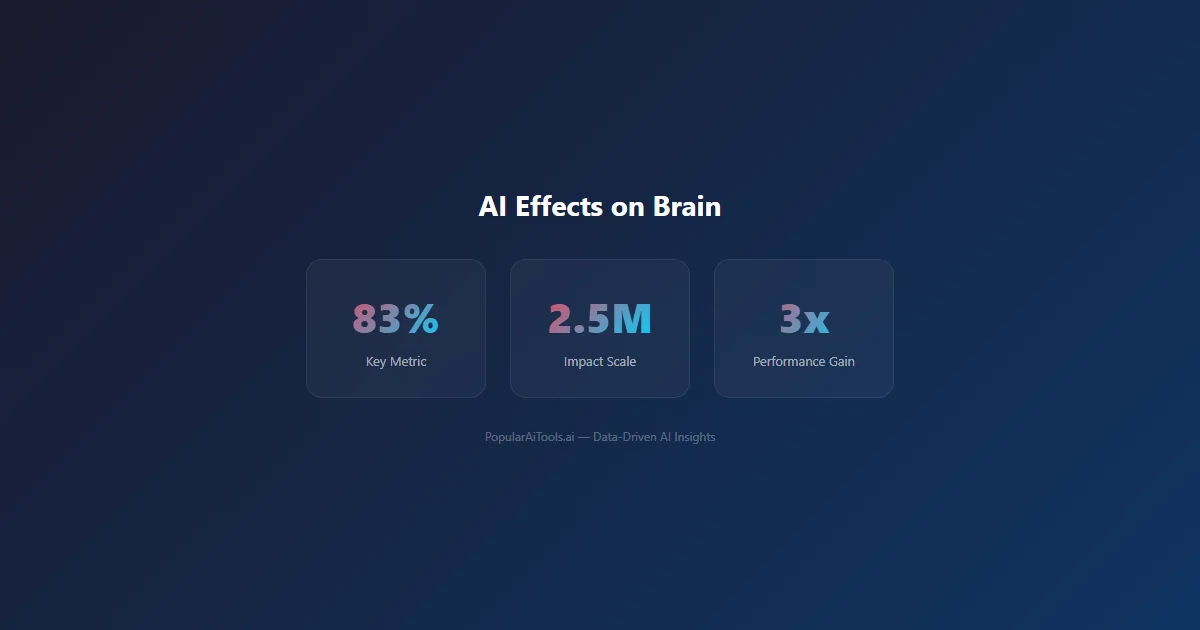
Here is a stat that should make every AI user pause: in a recent MIT Media Lab study, 83% of participants who used ChatGPT to write essays could not remember a passage they had just written moments earlier. Their brain connectivity — measured via EEG — dropped by nearly half.
We are living through the fastest adoption of a cognitive tool in human history. Over 100 million people now use AI assistants weekly for everything from drafting emails to making decisions. But a growing body of research from Harvard, MIT, Microsoft, and Carnegie Mellon is raising an uncomfortable question: what is all this AI usage actually doing to our brains?
The answer, as we will explore in this article, is more nuanced than the headlines suggest. AI is neither a guaranteed brain-killer nor a harmless convenience. How it affects your cognition depends almost entirely on how you use it.
Table of Contents
- The “Brain Fry” Phenomenon: What Harvard Found
- Your Brain on ChatGPT: The MIT Media Lab Study
- Cognitive Offloading: When AI Becomes a Crutch
- The Critical Thinking Crisis
- The Other Side: How AI Can Actually Enhance Cognition
- 7 Practical Tips for Healthy AI Usage
- FAQ
The “Brain Fry” Phenomenon: What Harvard Found
In March 2026, Harvard Business Review published a landmark study introducing a concept that quickly entered the mainstream vocabulary: AI brain fry.
The researchers defined it as “mental fatigue from excessive use or oversight of AI tools beyond one’s cognitive capacity.” Think of it as having too many browser tabs open in your head — except the tabs are AI-generated outputs you need to evaluate, verify, edit, and integrate into your actual work.
The study’s findings were stark:
A companion HBR piece from February 2026, titled “AI Doesn’t Reduce Work — It Intensifies It,” reinforced a counterintuitive finding: rather than lightening cognitive load, AI often multiplies it. Workers are not doing less thinking — they are doing different thinking, often more demanding thinking, as they evaluate, fact-check, and integrate AI outputs.
The paradox is real. We adopted AI tools to reduce mental effort, and in many cases, we have inadvertently increased it.
Your Brain on ChatGPT: The MIT Media Lab Study
The most alarming data on AI’s cognitive effects comes from the MIT Media Lab’s “Your Brain on ChatGPT” study, which used EEG measurements to track what happens inside your brain when you rely on AI.
The researchers divided participants into groups: those who wrote essays entirely on their own, those who used search engines for assistance, and those who used ChatGPT. The results were striking:
- Writing speed: ChatGPT users wrote 60% faster
- Cognitive load: Relevant cognitive load fell by 32% in the AI group
- Brain connectivity: EEG measurements showed brain connectivity was almost halved (alpha and theta waves) in AI users compared to the brain-only group
- Memory retention: 83% of AI users could not remember a passage they had just written
- Sense of ownership: AI users reported a significantly diminished sense of authorship over their own work
Perhaps most concerning: the cognitive declines persisted after the study ended. Even after participants stopped using ChatGPT, they still showed sluggish brain activity. The neural pathways that were bypassed during AI-assisted work did not immediately bounce back.
This echoes what neuroscientists call activity-dependent brain plasticity — the principle that neural circuits strengthen with use and weaken with disuse. When we outsource thinking to AI, the brain regions responsible for that thinking literally get less exercise.

Cognitive Offloading: When AI Becomes a Crutch
The concept at the heart of this research is cognitive offloading — the use of external tools to reduce the mental effort required for a task. We have always done this. Writing things down is cognitive offloading. Using a calculator is cognitive offloading. But AI represents an unprecedented leap in what we can offload.
A 2025 study published in MDPI’s Societies journal surveyed 666 participants across diverse age groups and found:
- A significant negative correlation between AI tool usage and critical thinking scores (r = -0.68, p < 0.001)
- Cognitive offloading was strongly correlated with AI tool usage (r = +0.72)
- Cognitive offloading was inversely related to critical thinking (r = -0.75)
- Younger participants showed higher dependence on AI tools and lower critical thinking scores compared to older participants
- Higher education levels partially buffered the negative effects
A 2025 paper from Frontiers in Psychology framed the dilemma precisely: AI enables cognitive offloading that can support adaptive coping and help individuals regulate stress. But the same tools may create cognitive overload — an erosion of introspection, over-reliance on algorithmic feedback, and anxiety induced by constant optimization.
The concept of AICICA (AI Chatbot-Induced Cognitive Atrophy) has emerged in academic literature to describe the potential deterioration of essential cognitive abilities — critical thinking, analytical skills, and creativity — resulting from overreliance on AI chatbots.
The Critical Thinking Crisis
A joint Microsoft and Carnegie Mellon University survey added further weight to these concerns. Their research found that workers who most trusted the accuracy of AI assistants thought less critically about those tools’ conclusions.
This creates a dangerous feedback loop:
- You trust AI output
- You engage less critically with it
- Your critical thinking skills weaken
- You trust AI output even more (because independent evaluation feels harder)
- Repeat
The Harvard Gazette convened experts from across Harvard’s faculties in November 2025 to address the question: “Is AI dulling our minds?” Their consensus was nuanced but clear:
- AI can be a helpful partner in analyzing and inferring, and with certain types of problem-solving
- AI is not always successful at evaluating — and reflecting cannot yet be outsourced
- Human minds are “better than Bayesian” in many ways, with somatic markers enabling intuitive leaps that AI cannot replicate
- AI can be used in ways that are good for learning and in ways that hinder it — the critical variable is how we use it
The Other Side: How AI Can Actually Enhance Cognition
Before you delete every AI app on your phone, it is important to acknowledge the research that points in the other direction.
Creativity enhancement is real — with caveats. A study published in Science Advances found that participants with access to generative AI produced stories evaluated as better written, more creative, and more enjoyable. Research from Frontiers in Computer Science demonstrated that human-AI collaborative design enhances creative performance across experience levels.
Cognitive augmentation works for some workers. A January 2026 HBR article found that AI boosts creativity primarily for employees with strong metacognition — the ability to plan, monitor, and refine their own thinking. Workers who already thought well about their own thinking used AI as an amplifier rather than a replacement.
Targeted offloading reduces burnout. The same HBR “brain fry” study found a critical distinction: workers who used AI specifically to automate routine, low-value tasks (data entry, formatting, scheduling) saw lower burnout scores. Their mental energy shifted to more meaningful work. The problem arises when AI is used to replace high-value cognitive tasks like analysis, strategy, and creative problem-solving.
Older adults and specific populations benefit. A 2025 systematic review found positive effects of chatbot interactions on executive skills including working memory, cognitive flexibility, and reasoning in general learners, those with ADHD, and older adults.
The pattern is clear: AI enhances cognition when used as a scaffold, and erodes it when used as a substitute.