
AI Music Side Hustle: How Creators Are Earning $200/Day in 2026
We never thought we would see the day when someone with zero music theory, zero instrument skills, and zero studio time could generate a legitimate income from music. But here we are in 2026, and the AI music side hustle has become one of the most accessible and scalable online income streams available.
The creators who figured this out early are not just making pocket change. They are earning $100, $200, even $500 per day by generating AI music, cleaning it for distribution, and uploading it to streaming platforms at scale. And the barrier to entry is shockingly low — we are talking about a total startup cost under $50/month.
In this guide, we are breaking down exactly how the $200/day AI music side hustle works, what tools you need, and the step-by-step daily workflow that real creators are using right now.
Have an AI tool? Get it listed on PopularAiTools.ai — DR 50+ backlinks, featured placement, expert verification.
Table of Contents
- Why 2026 Is the Breakthrough Year for AI Music Income
- Real Creator Case Studies and Earnings Breakdowns
- The $200/Day Math: Tracks, Platforms, and Genres
- Daily Workflow: Generate, Clean, Upload, Promote
- Best Platforms for AI Music Revenue
- Genre Strategy: Which Genres Pay the Most Per Stream
- The Volume Game: How Many Tracks You Need
- Tools Needed and Total Startup Cost
- Scaling Strategies That Actually Work
- Common Mistakes That Kill AI Music Businesses
- Tax and Legal Considerations
- Frequently Asked Questions
Why 2026 Is the Breakthrough Year for AI Music Income
The AI music landscape in 2026 is fundamentally different from what it was even 12 months ago. Three things changed that blew the doors open for creators.
AI music quality hit a tipping point. Tools like Suno v4 and Udio now generate tracks that are genuinely indistinguishable from human-produced music in blind listening tests. We are not talking about robotic-sounding loops anymore. We are talking about full arrangements with dynamic vocals, realistic instrumentation, and professional-level mastering built in.
Distribution barriers fell. The biggest obstacle for AI music creators used to be getting tracks accepted by distributors. Platforms like DistroKid and TuneCore started flagging and rejecting AI-generated content because of detectable artifacts in the audio. That single bottleneck killed thousands of would-be AI music businesses. But that problem now has a solution — and we will get to it shortly.
Streaming payouts stabilized. After years of declining per-stream rates, Spotify, Apple Music, and Amazon Music locked in their 2026 royalty structures. Creators now have predictable, calculable income per stream, which makes the math on this side hustle reliable for the first time.
The window is open right now. The creators who build their catalogs in 2026 will compound their royalties for years. The ones who wait until 2027 will be competing against catalogs that already have millions of streams and algorithmic momentum.
Real Creator Case Studies and Earnings Breakdowns
Let us look at what actual creators are doing with this model.
Case Study 1: The Lo-Fi Producer
A creator running three artist profiles focused exclusively on lo-fi study beats. Started in January 2026 with zero following. After uploading 15 tracks per week for 10 weeks, they reached a catalog of 150 tracks. Monthly streaming revenue as of March 2026: approximately $4,200/month ($140/day). Their top-performing track alone pulls 12,000 streams per day across Spotify and Apple Music.
Case Study 2: The Ambient Sleep Channel
This creator targets the sleep and relaxation niche with long-form ambient tracks (30-60 minutes each). They upload just 5 tracks per week but each track is longer, which means more per-stream value since listeners play them on repeat overnight. Monthly revenue: $5,800/month ($193/day) from 85 total tracks.
Case Study 3: The Multi-Genre Machine
The most aggressive approach we have seen. This creator runs seven artist profiles across genres including lo-fi, cinematic orchestral, jazz café, and workout EDM. They upload 30+ tracks per week using a team workflow. Monthly revenue: $9,400/month ($313/day), with the catalog growing every single day.
The common thread in every successful case: high volume, strategic genre selection, and — critically — every single track passes through an AI artifact removal tool before distribution. Without that step, half these tracks would get flagged and rejected before they ever reach a listener.
The $200/Day Math: Tracks, Platforms, and Genres
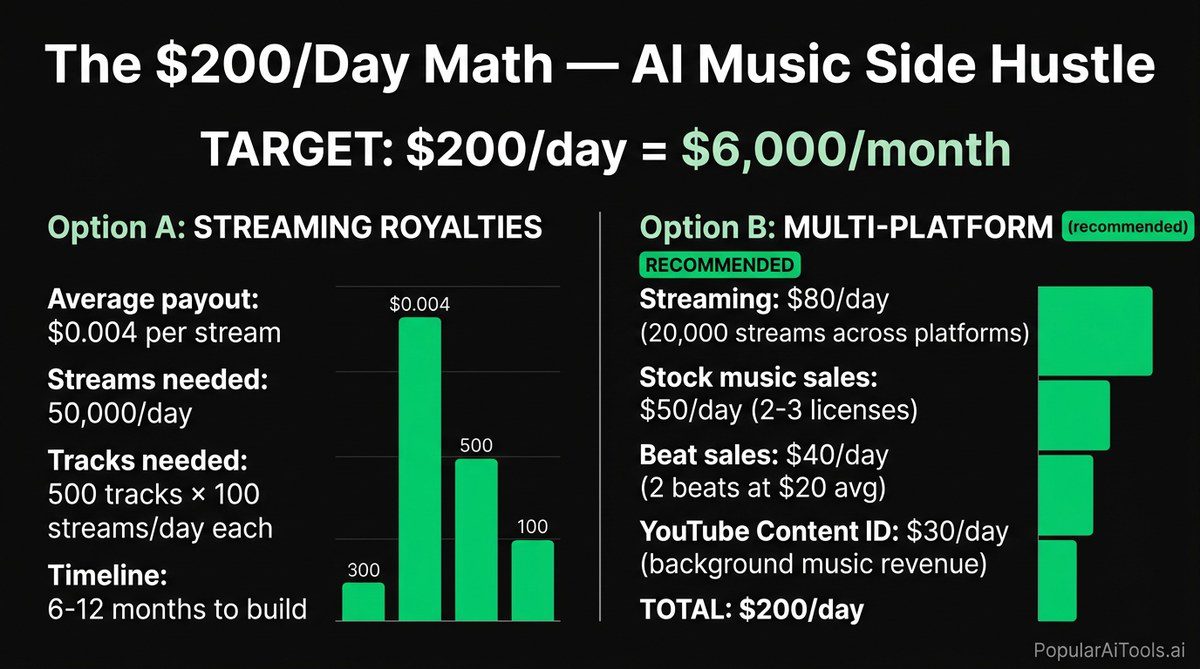
Let us make the math concrete.
The reality for most creators falls somewhere in between. A catalog of 200-300 tracks in a well-chosen genre, built over 3-5 months of consistent uploading, is the realistic path to $200/day. The key insight is that this is a compounding game. Every track you upload continues earning indefinitely. You are building an asset, not trading time for money.
The math also shifts dramatically based on genre. A lo-fi track that lands on a popular Spotify playlist can pull 1,000+ streams per day by itself. A single viral placement can shortcut months of grinding.
Daily Workflow: Generate, Clean, Upload, Promote
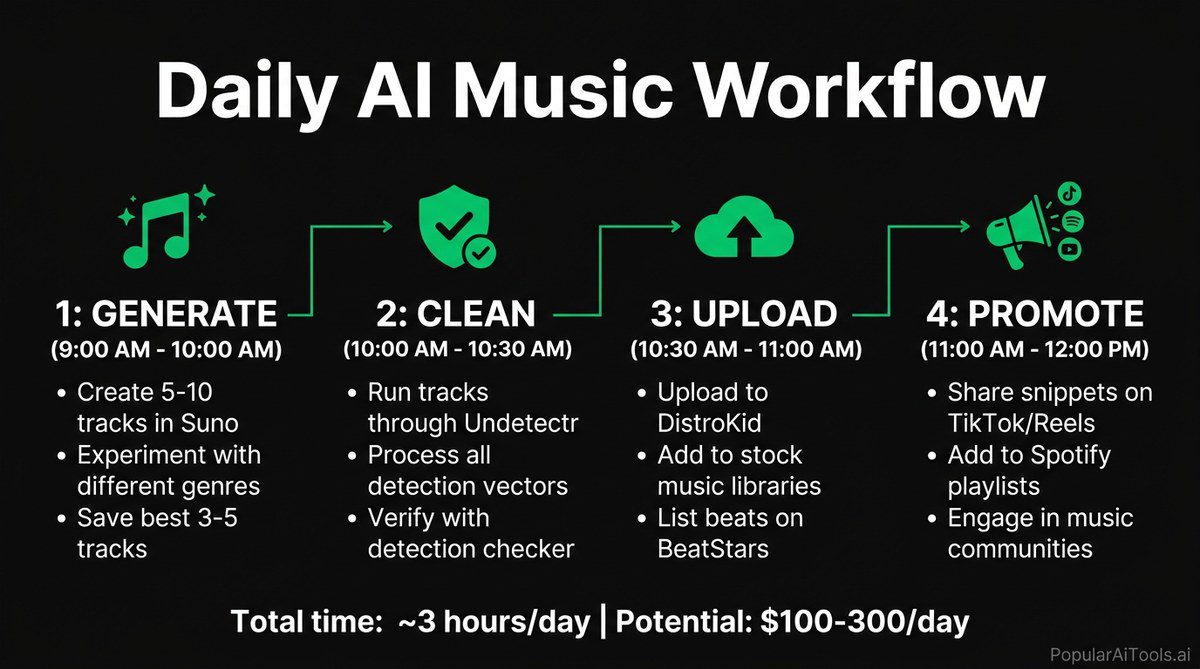
Here is the exact daily workflow that successful AI music creators follow. This takes 2-3 hours once you have it dialed in.
Step 1: Generate Tracks (45-60 minutes)
Open Suno or your AI music tool of choice. Generate 8-12 raw tracks using carefully crafted prompts. The prompt is everything — specificity matters. Do not just type “lo-fi beat.” Instead, write something like: “mellow lo-fi hip-hop beat, dusty vinyl texture, soft piano chords, tape hiss, 75 BPM, rainy day mood, no vocals.”
Generate multiple variations of each concept. Out of 12 generations, you will typically keep 5-7 that meet your quality bar.
Step 2: Clean and Process (30-45 minutes)
This is the step that separates creators who earn money from creators who get their tracks rejected.
Raw AI-generated music contains subtle artifacts — tiny digital fingerprints that distribution platforms and detection algorithms can identify. If you skip this step, DistroKid, TuneCore, and other distributors will flag your uploads. Your tracks will sit in limbo or get pulled entirely. No distribution means zero streams means zero income.
Run every track through Undetectr before uploading anywhere. Undetectr is purpose-built to remove AI artifacts from generated music while preserving the audio quality. It is the only tool we have found that reliably solves the distribution rejection problem. Upload your batch, process it, download the cleaned files. The entire step takes minutes for a full batch.
After cleaning, do a quick quality check. Listen to each track start to finish. Reject anything that sounds off, has weird transitions, or does not meet your brand standard.
Step 3: Upload to Distributors (30 minutes)
Upload your cleaned tracks to your distribution platform. For each track you need:
- Track title (use keyword-rich, searchable titles like “Rainy Evening Study Session” rather than “Track_047”)
- Artist name (your pen name for this genre)
- Album artwork (create templates in Canva so this takes seconds)
- Genre tags and metadata
- Release date (schedule 2-3 days out so platforms have time to process)
Batch uploading makes this fast. Most distributors let you upload an entire album or EP at once.
Step 4: Promote (30 minutes)
Do not just upload and pray. Active promotion accelerates the compounding effect.
- Submit tracks to Spotify playlist curators via SubmitHub or PlaylistPush
- Share snippets on TikTok and Instagram Reels (the algorithm loves music content)
- Post in relevant Reddit communities and Discord servers
- Add tracks to your own curated playlists (this is a secret weapon we cover in the scaling section)
Best Platforms for AI Music Revenue
Not all streaming platforms pay equally. Here is how they stack up for AI music creators in 2026.
The strategy most successful creators use: distribute to all platforms simultaneously (your distributor handles this), but focus your promotion efforts on Spotify for volume and Apple Music for higher per-stream payouts. Spotify’s algorithmic playlists like Discover Weekly and Release Radar are where the real compounding happens — one placement can send thousands of streams your way overnight.
Important note: Spotify has the strictest AI content detection of any major platform. This is exactly why running tracks through Undetectr is non-negotiable. Creators who skip this step find their tracks pulled from Spotify weeks after upload, wiping out streams they had already earned.
Genre Strategy: Which Genres Pay the Most Per Stream
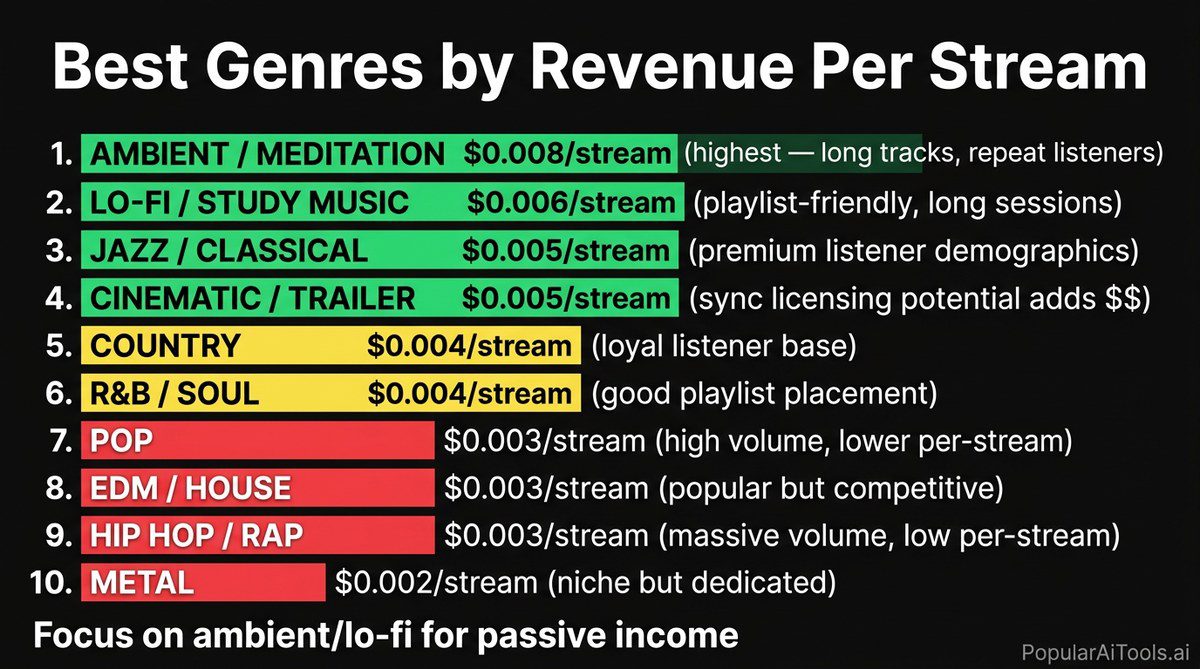
Genre selection is the single highest-leverage decision you will make. The wrong genre means grinding for pennies. The right genre means faster compounding and higher per-stream value.
The sweet spots are ambient/sleep, meditation, and jazz café. Here is why:
- These genres have massive passive listening audiences (people stream them for hours while sleeping, studying, or working)
- Longer listen times mean more streams counted per session
- AI generates these genres at near-perfect quality — no vocal artifacts to worry about
- Competition from human producers is lower because these genres are less glamorous
- Playlist placement is easier because curators always need fresh content
Avoid genres that require complex, emotionally nuanced vocals (pop, R&B, country) unless you are specifically enhancing AI output with human vocal elements. The technology is good, but discerning listeners in vocal-heavy genres can still spot the difference.
The Volume Game: How Many Tracks You Need
There is no way around this: the AI music side hustle is a volume play. One track will not make you rich. A catalog of 200+ tracks creates a revenue flywheel that grows on its own.
Here is a realistic timeline to $200/day:
Month 1 (60 tracks): $5-15/day. Your tracks are fresh, have minimal algorithmic traction, and have not landed on playlists yet. This is the grind phase.
Month 2 (120 tracks): $25-50/day. Early tracks start gaining momentum. A few land on algorithmic playlists. You start seeing which genres and styles perform best for your profiles.
Month 3 (180 tracks): $75-120/day. Compounding kicks in. Your best-performing tracks are snowballing. Playlist curators start noticing your profiles.
Month 4-5 (240-300 tracks): $150-250/day. You have hit critical mass. Multiple tracks are pulling 500+ streams daily. Your monthly revenue is predictable and growing.
The creators who fail are the ones who quit during Month 1 when the numbers look discouraging. The ones who succeed understand that they are building an asset that compounds over time. Every track you upload today will still be earning in 2027, 2028, and beyond.
Tools Needed and Total Startup Cost
One of the best things about this side hustle is the low startup cost. Here is everything you need:
That is it. Under $62/month for a complete music production and distribution pipeline. Compare that to the thousands of dollars traditional musicians spend on studio time, instruments, mixing engineers, and marketing. The ROI math on AI music is absurd.
The critical tool in this stack is Undetectr. Without it, you are generating music that never earns a single cent. Your tracks get flagged by distributors, rejected by platforms, or pulled after upload. Undetectr is the bridge between “AI-generated audio file on your hard drive” and “revenue-generating track on Spotify.” It is the missing link that makes the entire pipeline viable.
Scaling Strategies That Actually Work
Once you have the basic workflow running and revenue coming in, here is how to accelerate growth.
Build Your Own Playlists
Create curated playlists on Spotify that include your tracks alongside popular tracks in the same genre. A playlist called “Deep Focus Study Beats 2026” that mixes your lo-fi tracks with well-known lo-fi artists will attract followers organically. As the playlist grows, your tracks get more streams. Some creators report that their self-curated playlists drive 30-40% of their total streams.
Run Multiple Artist Profiles
Do not put lo-fi beats and cinematic orchestral music under the same artist name. Create separate artist profiles for each genre. This keeps your branding clean, improves algorithmic recommendations (Spotify’s algorithm works better when an artist profile is genre-consistent), and lets you target different listener demographics simultaneously.
Leverage Seasonal Content
Create tracks tied to seasonal moments: holiday music in November, spooky ambient for Halloween, romantic jazz for Valentine’s Day, upbeat summer tracks in June. Seasonal content gets massive playlist placement during its peak and earns recurring revenue every year when the season comes back around.
Cross-Promote on YouTube
Upload your tracks to YouTube as visualizer videos (simple animated backgrounds synced to the music). YouTube Music streams count toward your revenue, and YouTube’s recommendation algorithm can send massive traffic to your music. A single “3 Hours of Rain Sounds for Sleep” video can generate thousands of daily streams indefinitely.
License Your Catalog
Once you have a substantial catalog, explore sync licensing for content creators. Platforms like Epidemic Sound, Artlist, and Pond5 pay creators for music used in YouTube videos, podcasts, and advertisements. This creates a second revenue stream from the same catalog.
Common Mistakes That Kill AI Music Businesses
We have watched dozens of AI music creators fail. These are the patterns we see over and over.
Skipping artifact removal. This is the number one killer. Creators generate great-sounding tracks, upload them directly to DistroKid, and get rejected or flagged. They lose time, momentum, and sometimes get their distributor accounts penalized. Always clean your tracks before uploading. Always.
Chasing trends instead of niches. Trying to create the next viral pop hit with AI is a losing strategy. The creators who earn $200/day are not making chart-toppers — they are making functional music that serves a purpose (studying, sleeping, working out, meditating). Functional music has reliable, year-round demand.
Inconsistent uploading. The algorithm rewards consistency. Uploading 50 tracks in one week and then disappearing for a month is worse than uploading 10 tracks per week every week. Streaming platforms give preferential algorithmic treatment to artists who release on a regular schedule.
Ignoring metadata and titles. Your track title is SEO for music platforms. “Track 47” will never get discovered. “Midnight Rain Lo-Fi Study Beat” tells the algorithm exactly which listeners to show it to. Spend 30 seconds on every title and make it searchable.
Using only one distributor. Different distributors have different strengths. DistroKid is great for unlimited uploads. TuneCore offers better analytics. CD Baby provides more granular royalty splits. Some creators use multiple distributors for different artist profiles to maximize coverage and features.
Not reinvesting. The creators who scale fastest reinvest a portion of their early earnings into playlist promotion services, upgraded AI music subscriptions for more generation credits, and better artwork for their releases.
Tax and Legal Considerations
The money from AI music streaming is real income, and the IRS (or your country’s tax authority) treats it as such. Here is what you need to know.
Self-employment income. Streaming royalties are classified as self-employment income in the United States. You will need to pay both income tax and self-employment tax (15.3% for Social Security and Medicare) on your net earnings. If you expect to owe $1,000 or more in taxes, you are required to make quarterly estimated tax payments.
Deductible expenses. The good news: your tools are tax-deductible business expenses. Your Suno subscription, Undetectr subscription, DistroKid fees, playlist promotion costs, home office expenses, and even the portion of your internet bill used for this business can all reduce your taxable income.
Business structure. Once you are earning consistently, consider forming an LLC. It provides liability protection, simplifies tax filing, and looks more professional if you ever want to license your music to larger entities. Formation costs vary by state but typically range from $50-500.
Copyright ownership. As of 2026, the legal landscape for AI-generated music copyright remains nuanced. Suno’s terms of service grant commercial rights to Pro and Premier subscribers. However, AI-generated works without meaningful human creative input may not qualify for full copyright protection under current U.S. law. The safest approach: use AI as a tool in your creative process, add your own creative decisions (arrangement choices, prompt engineering, post-processing, curation), and document your process.
Platform compliance. Each streaming platform has its own policies on AI-generated content. Spotify requires disclosure of AI-generated content in certain contexts. Staying compliant means understanding each platform’s current terms and updating your approach as policies evolve.
Frequently Asked Questions
Is the AI music side hustle legal in 2026?
Yes. Generating music with AI tools like Suno and distributing it through licensed distributors is completely legal. The key requirements are that you hold a commercial license from your AI music tool (included with paid subscriptions), you do not infringe on existing copyrighted works, and you comply with each streaming platform’s content policies. Where the legal gray area exists is around copyright ownership of the output — but this does not affect your ability to earn revenue from streaming.
How long does it take to reach $200 per day?
Most creators reach $200/day within 4-6 months of consistent daily uploading. The biggest variable is genre selection and whether your tracks land on algorithmic playlists early. Creators in high-demand niches like ambient sleep and lo-fi study beats tend to reach the milestone faster because of the massive passive listening audience in those genres. The creators who fail to reach it almost always quit too early or skip critical steps like artifact removal.
Will streaming platforms ban AI music?
The trend is actually moving in the opposite direction. Spotify, Apple Music, and Amazon Music have all established frameworks for AI-generated content rather than banning it outright. What they do ban is low-quality, repetitive, or deceptive AI content — tracks that are clearly spam. High-quality AI music that listeners genuinely enjoy is being treated the same as any other content. The platforms care about listener satisfaction, not how the music was made.
Can I really start with no music experience?
Absolutely. The entire point of AI music tools is that they handle composition, arrangement, instrumentation, and even mastering. Your job is creative direction — choosing genres, writing effective prompts, curating the best outputs, and handling the business side (distribution, promotion, metadata). Some of the most successful AI music creators we have spoken to had zero musical background before starting.
What happens if my tracks get flagged as AI-generated?
If a track gets flagged by a distributor or streaming platform, it can be rejected, removed, or held in review — and repeated flags can put your entire distributor account at risk. This is why processing tracks through an AI artifact removal tool before uploading is essential, not optional. Prevention is dramatically easier than dealing with takedowns and account warnings after the fact.
The AI music side hustle is not a get-rich-quick scheme. It is a legitimate digital asset business that rewards consistency, strategic thinking, and smart tool selection. The creators earning $200/day in 2026 are the ones who showed up every day, uploaded clean tracks to the right platforms, and let the compound effect do its work.
The tools exist. The demand exists. The math works. The only question is whether you are going to start building your catalog today or wish you had six months from now.
Ready to turn AI-generated music into a real income stream? The first step is making sure your tracks actually reach listeners. Visit Undetectr.com to remove AI artifacts from your music so every track you create passes distribution checks and starts earning from day one. Stop generating music that sits on your hard drive — start generating music that pays.