AI News: The Anthropic Leak Is Bigger Than You Think

Head of AI Research
⚡ Key Takeaways
- Anthropic's Claude Code source leaked via an npm registry error — revealing a secret background AI agent called Kairos and a three-layer memory system
- OpenAI raised $122 billion at an $852B valuation (the largest raise in history) and announced plans for a unified "super app"
- Sora was losing $1M/day before shutdown — the Wall Street Journal investigation put hard numbers on what went wrong
- Four new LLMs dropped this week: Google's Gemma 4, Alibaba's Qwen 3.5 Omni + Qwen 3.6 Plus, and Arcee's Trinity Large Thinking
- Slack is going agentic with 30 new AI capabilities including meeting transcription, MCP client, and deep research
This was one of those weeks where every story felt like it could have been its own headline. An accidental source code leak exposed Anthropic's secret roadmap. OpenAI closed the biggest funding round any company has ever raised. And we learned that Sora was hemorrhaging a million dollars every single day before they pulled the plug.
We watched Matt Wolfe's weekly AI news breakdown so you don't have to — and pulled in additional reporting to give you the full picture on everything that matters. Here's the signal from the noise.
AI News Roundup — April 4, 2026
The Claude Code Leak: What Anthropic Didn't Want You to See
The biggest story this week wasn't a product launch — it was an accident. Anthropic's Claude Code source code was leaked onto the internet via a map file left in their npm registry. A developer on X (Fried Rice) spotted it first, shared the download link, and it spread across GitHub before Anthropic could react with DMCA takedowns.
For a company that keeps its cards close to its chest, this was a big deal. Not because customer data was exposed — it wasn't — but because the code revealed exactly where Anthropic is headed.
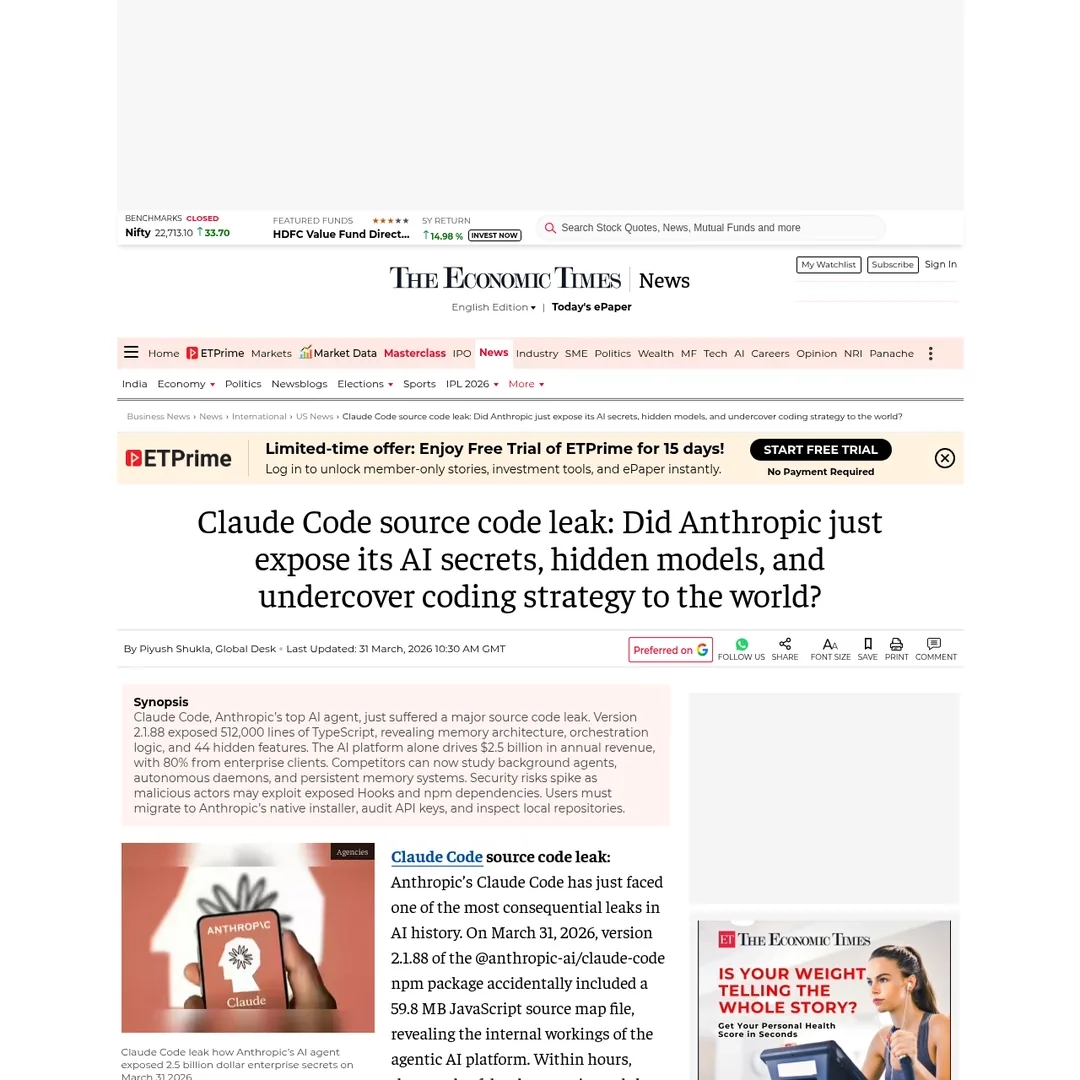
The Claude Code leak made headlines across major tech publications — Screenshot by PopularAiTools.ai
A VentureBeat deep-dive did the best job of breaking down what researchers found in the code. The highlights:
- A three-layer self-healing memory architecture — At its core is a file called
memory.md, a lightweight index of pointers that's always loaded into context. It doesn't store data. It stores locations. Transcripts and prior conversations are never fully read back — they're searched (grep'd) for specific identifiers on demand. - Evidence of "Capybara" / "Mythos" — references to what appears to be Anthropic's next-generation model, the successor to Claude Opus.
- A hidden "Buddy" system — a Tamagotchi-style terminal pet with stats like "chaos" and "snark." Most people believe this was a planned April Fools' joke that got sidelined by the leak.
Boris Cherny, who leads Claude Code, responded publicly: "Mistakes happen. As a team, the important thing is to recognize it's never an individual's fault. It's the process, the culture, or the infrastructure." He confirmed it was a manual deploy step that should have been automated, and improvements are already underway.
Nobody was fired. No customer data was compromised. But the cat is very much out of the bag — and the most interesting thing in the bag was Kairos.
Kairos: The Background AI Agent That Never Sleeps
If you only take one thing from this week's news, make it this: Anthropic is building an autonomous background agent called Kairos.
A daemon — in computer terms — is a process that runs in the background, waiting for events to trigger actions. Kairos would let Claude Code operate as an always-on agent that works while you're idle, asleep, or just doing other things.
How Kairos Works (From the Leaked Source)
Every few seconds, Kairos gets a "heartbeat" — a prompt that essentially asks: "Anything worth doing right now?" It evaluates the current state and either acts or stays quiet.
When it acts, it can fix code errors, respond to messages, update files, and run tasks — anything Claude Code can already do, just without you telling it to.
What makes Kairos different from regular Claude Code are three exclusive capabilities:
- Push notifications — It can reach you on your phone or desktop even when you're not in the terminal
- File delivery — It can send you files it created without being asked
- Pull request subscriptions — It watches your GitHub and reacts to code changes on its own
Think about what this means in practice. Your website goes down at 3 AM — Kairos detects it, restarts the server, sends you a notification. By the time you see it, it's already fixed. A customer complaint comes in at 2 AM — Kairos reads it, drafts a reply, logs everything. Your Stripe page has a typo — Kairos spots it, pushes the fix.
This is what Matt Wolfe called the "post-prompting era" — and we agree. The days of sitting there typing prompts to get AI to do things are numbered. The future is AI that learns what you need and handles it before you even know there's a problem.
Kairos isn't in Claude Code yet. It was found in the source code as something Anthropic is actively developing. But the direction is clear — and it mirrors what we're seeing with OpenClaw's cron jobs and heartbeat system.
OpenAI Raises $122 Billion — And Buries the Real News
This week, OpenAI closed a $122 billion funding round at an $852 billion valuation. That's the largest raise by any company in history. Microsoft is still in — despite all the falling-out speculation — and OpenAI now generates $2 billion in revenue per month.
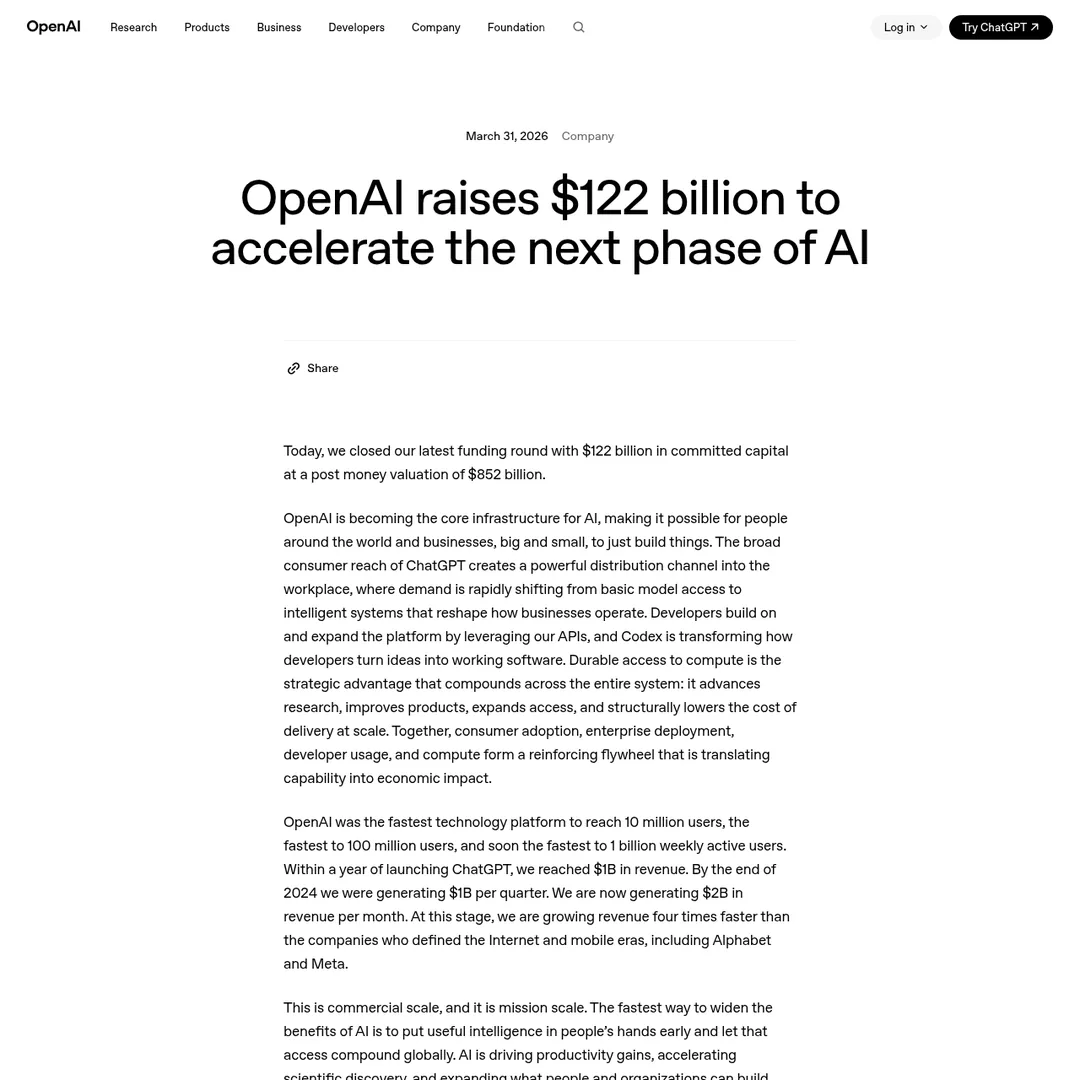
OpenAI's funding announcement — Screenshot by PopularAiTools.ai
They bragged about it, too: "We are growing revenue four times faster than the companies who defined the internet and mobile eras, including Alphabet and Meta."
But the real news was buried at the bottom of the blog post. OpenAI quietly announced they're building a unified AI "super app":
"We're building a unified AI super app. Users do not want disconnected tools. They want a single system that can understand intent, take action, and operate across applications, data, and workflows. Our super app will bring together chat, GPTs, Codex, browsing, and our broader agentic capabilities into one agent-first experience."
Sound familiar? Anthropic already has this — Claude Chat, Claude Co-work, and Claude Code all under one roof. OpenAI is playing catch-up here. And with Peter Steinberger (the OpenClaw creator) now on the OpenAI team, they're clearly thinking about proactive, background AI agents too.
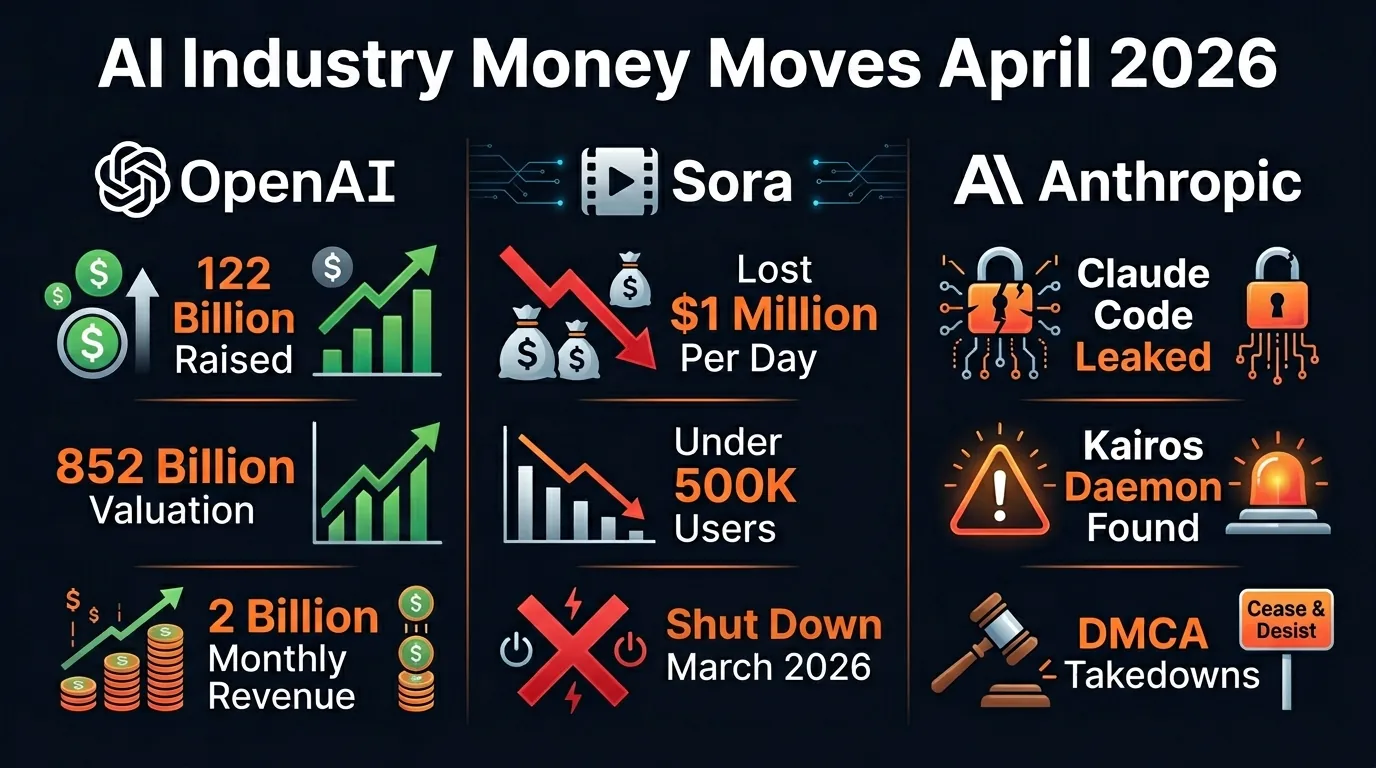
The money side of AI this week — big numbers all around
Sora Was Losing $1 Million Per Day
We covered Sora's shutdown in a previous roundup, but the Wall Street Journal investigation this week put hard numbers on the disaster.
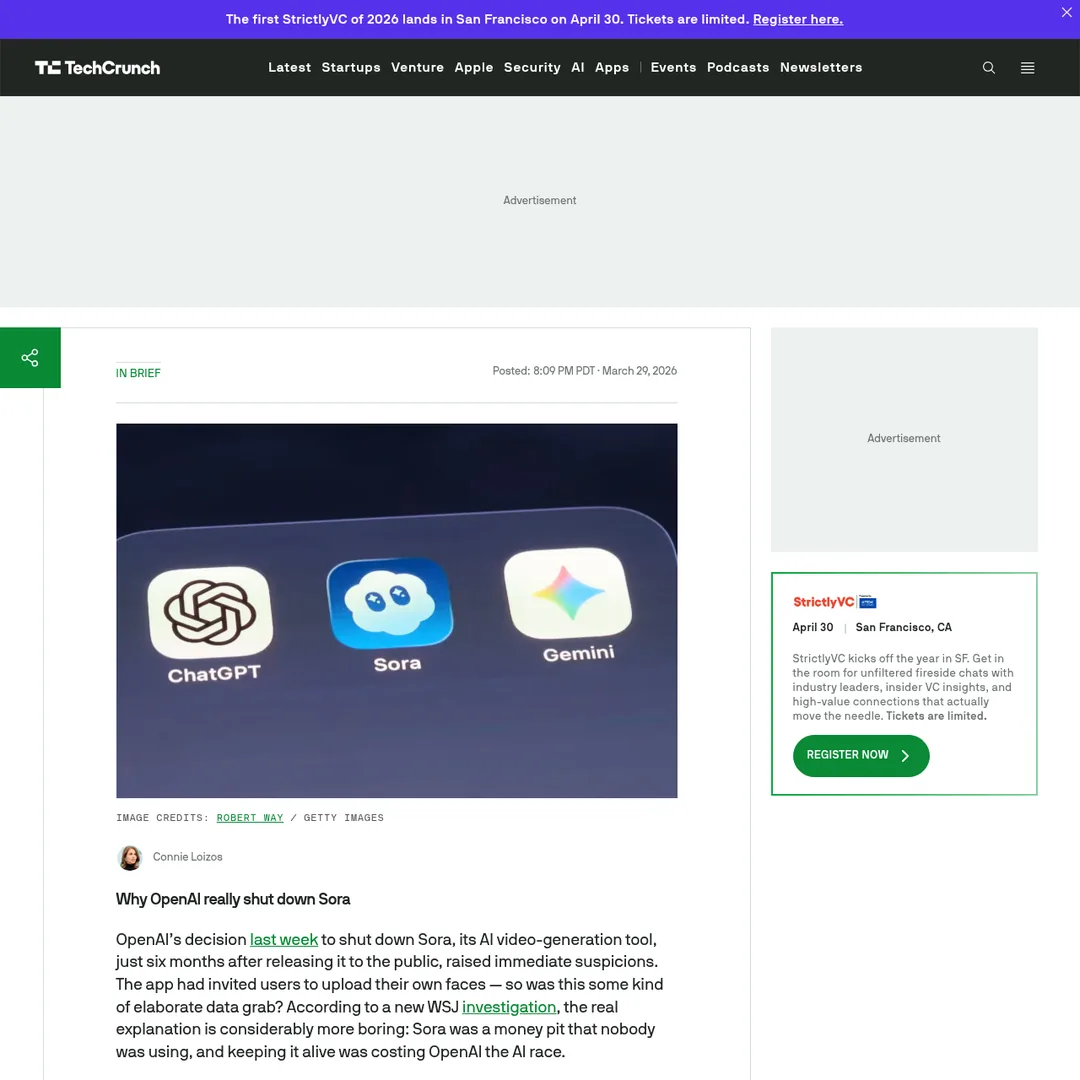
TechCrunch's breakdown of the Sora shutdown — Screenshot by PopularAiTools.ai
Sora was burning roughly $1 million per day in compute costs. Its user base peaked at about 1 million, then cratered to under 500,000 active users. That's over $365 million per year in losses on a product that wasn't generating meaningful revenue.
With that context, the shutdown is obvious. OpenAI scrapped Sora and the planned "adult mode," and is redirecting those GPU resources toward what's actually working: intelligent models for coding, reasoning, and agentic use cases. That's where the revenue is.
Microsoft's MAI Transcribe 1 Crushes the Competition
Microsoft quietly dropped MAI Transcribe 1, a new speech recognition model that achieves best-in-class accuracy across 25 languages. The benchmarks are impressive — it significantly outperforms GPT Transcribe, Scribe V2, Gemini 3.1 Flash, and OpenAI's Whisper on word error rate (WER).
Matt Wolfe got early access and tested it with homonyms — words that sound the same but have different meanings. "I can see the sea from here" and "our snacks cost $8 / I ate the evidence already." The model nailed every one, understanding context to choose the right spelling.
MAI Transcribe 1 is now available in Microsoft Foundry alongside MAI Voice 1 (text-to-speech) and MAI Image 2, so developers can build on all three models.
Google's Veo 3.1 Lite: Cheaper AI Video
Google released Veo 3.1 Lite, a more cost-effective video generation model. The pricing breakdown:
Logan Kilpatrick from Google also mentioned that Veo 3.1 Fast prices are dropping further on April 7th. Whether there's more news coming that day is anyone's guess — but the pricing trend is clear. AI video generation is getting cheap fast.
Also from Google this week: AI Inbox, which offers smart email prioritization and daily personalized briefings. The catch? It's currently beta-only for Google AI Ultra subscribers ($250/month). You get suggested to-dos from your inbox and topic summaries — useful, but pricey.
Four New LLMs: Gemma 4, Qwen 3.5/3.6, and Trinity
The model releases came fast this week. Four noteworthy ones:
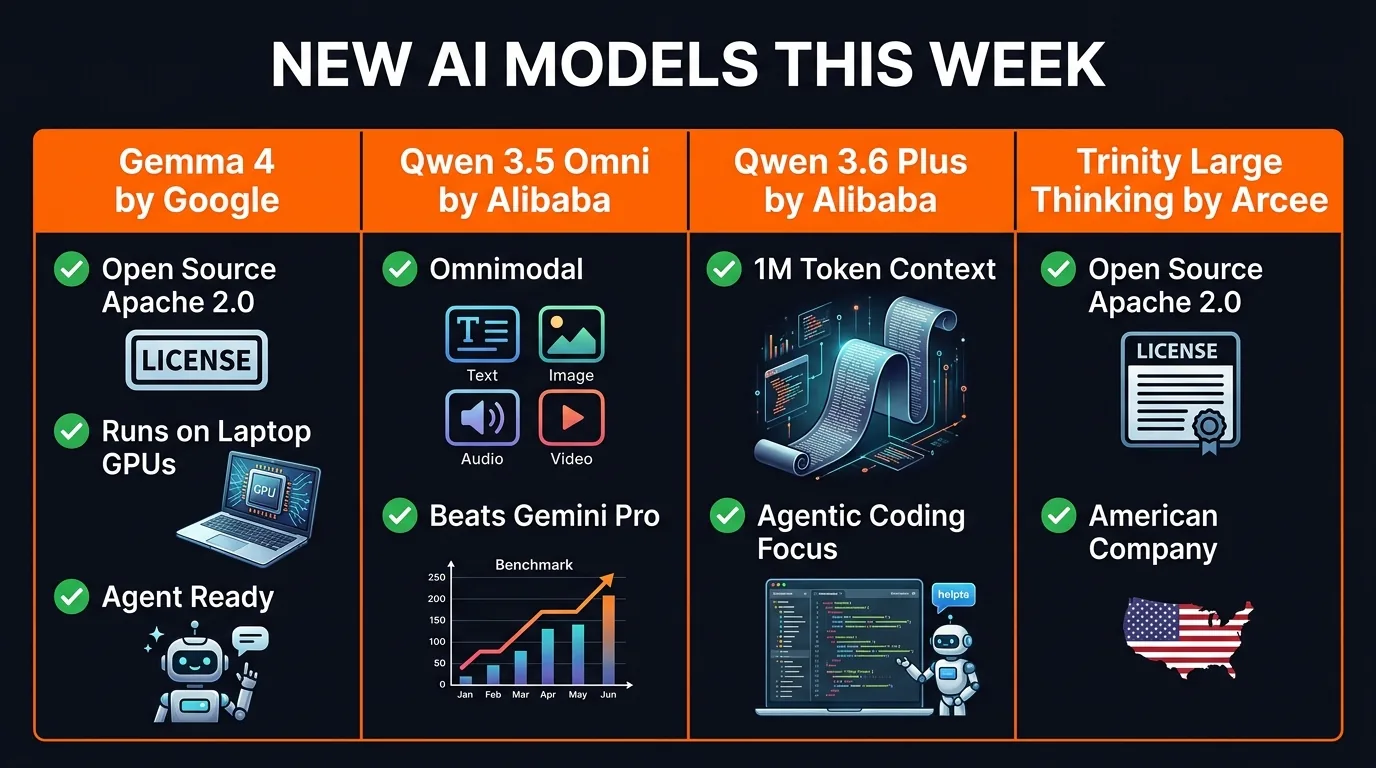
This week's new AI models at a glance
1. Google Gemma 4
The standout release. Gemma 4 is an open-weight model released under the Apache 2.0 license — meaning you can run it, fine-tune it, and commercialize it freely. It's designed for Android devices and laptop GPUs, making it a serious option for local AI agents.
If you're running something like OpenClaw and want everything local, Gemma 4 on an Nvidia Spark or Apple Mac Studio with decent memory looks like a strong fit.
2. Alibaba Qwen 3.5 Omni
An omnimodal model that handles text, image, audio, and video. Alibaba's pitch: describe your vision to a camera and Qwen 3.5 Omni builds a functional website or game for you — "audiovisual vibe coding." It claims to outperform Gemini 3.1 Pro in audio tasks and match it in audiovisual understanding.
3. Alibaba Qwen 3.6 Plus
Dropped just days after 3.5 Omni. This one is built for real-world agents and agentic coding, with a 1 million token context window enabled by default. On SWE-Bench Pro, it matches Opus 4.5. It's not open-source yet, but Alibaba says more models will be open-sourced soon.
4. Arcee Trinity Large Thinking
A new entrant: Arcee, an American company releasing open-source models under Apache 2.0. Trinity Large Thinking benchmarks roughly on par with Opus 4.6, Kimmy K 2.5, and GLM5. Another signal that open-weight models are closing the gap with frontier closed-source ones.
As Matt Wolfe pointed out, the closed-source models stay a few steps ahead — but the open models keep gaining ground, week after week.
Rapid Fire: Claude Computer Use, Codex Plugin, CarPlay, and More
Claude Computer Use in Claude Code — Anthropic added their browser/mouse/keyboard control feature directly into Claude Code. Available for Pro and Max plan users.
Codex Plugin for Claude Code — Surprisingly, you can now use OpenAI's Codex inside Claude Code via a plugin. Use your OpenAI key to let Codex review code and delegate tasks while staying in the Claude Code UI.
ChatGPT in Apple CarPlay — ChatGPT is now available in CarPlay. Talk to it while driving.
OpenAI Acquires TBPN — OpenAI bought Tech Business Production Network, a daily 3-hour live tech show on X and YouTube. A strange move for a company that said "no more side quests." Questions remain about editorial independence.
Perplexity Computer for Taxes — Perplexity is using its computer model to help draft federal tax returns on official IRS forms, review professionally prepared returns, and build tax code dashboards.
Slack Goes Agentic — Salesforce announced 30 new AI capabilities for Slackbot: meeting transcription (even Zoom calls), reusable AI skills, MCP client integration, native CRM, deep research, and voice input. Currently Business+ and Enterprise, but expanding to free/pro plans in April.
GM Using AI for Car Design — General Motors is using AI to transform hand-drawn sketches into concept videos, suggest design changes, and run early-stage aerodynamic testing. Dramatic compression of their design timeline.
Instacart AI Shopping Carts — Physical shopping carts with touchscreens, cameras, location sensors, and Nvidia Jetson chips. They process what's happening in the aisle in real time and recommend products while you shop. Whether shoppers will love or hate this is... debatable.
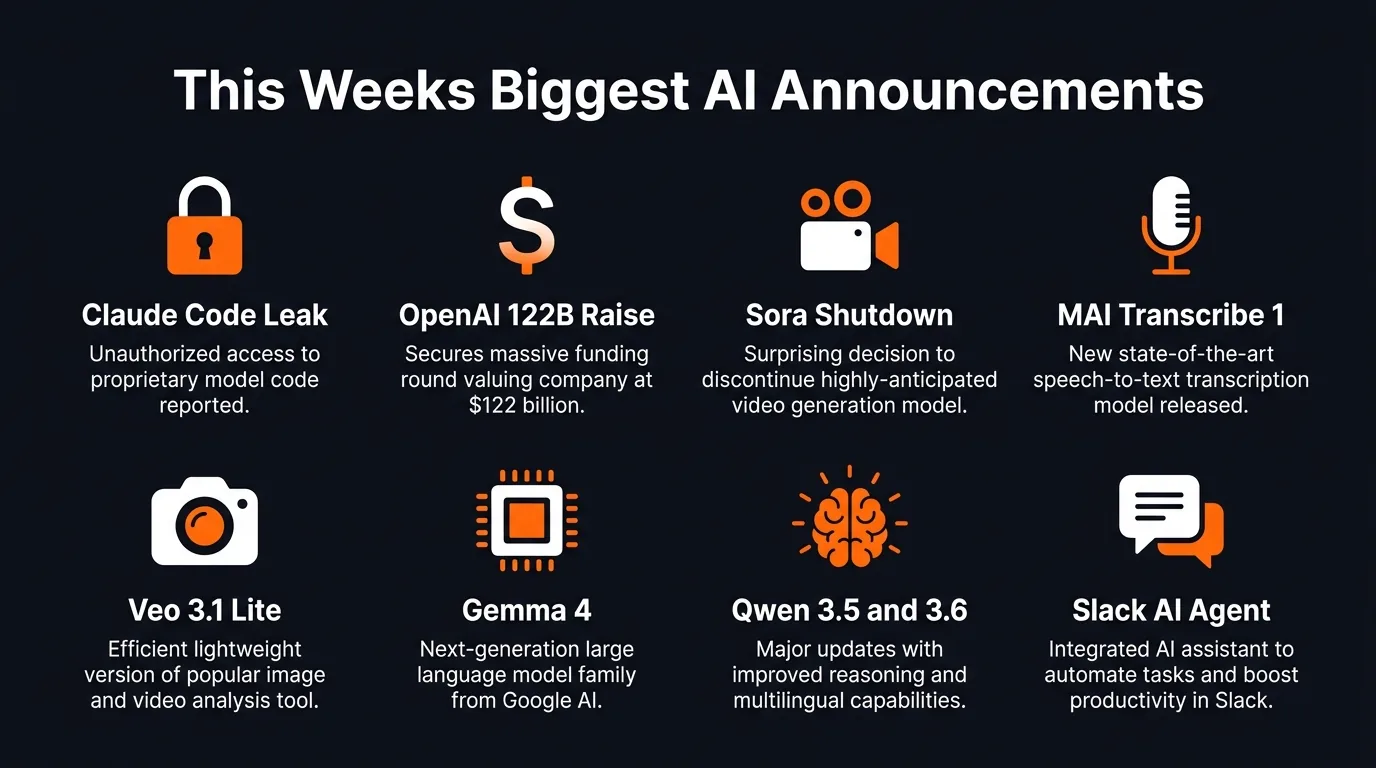
This week's biggest AI announcements at a glance
The Bottom Line
If you zoom out, this week's news tells one story: AI is moving from "tool you talk to" to "agent that acts for you."
Anthropic is building Kairos — a daemon that works while you sleep. OpenAI is building a super app with agentic capabilities baked in. Slack is turning its bot into an autonomous teammate. Even shopping carts are getting agentic.
The prompting era isn't dead yet. But the post-prompting era? It's already being built. The companies that figure out proactive, background AI first are going to own the next decade of this industry.
And while the frontier labs race ahead, open-source models like Gemma 4 and Trinity are making sure you don't need a subscription to any of them if you're willing to run things locally.
We'll keep watching. See you next week.
Build an AI Tool? Get It in Front of the Right Audience
PopularAiTools.ai reaches thousands of qualified AI buyers.
Submit Your AI Tool →Frequently Asked Questions
What was leaked in the Anthropic Claude Code source code?
The leaked source code revealed a three-layer self-healing memory architecture, a background daemon agent called Kairos that can operate autonomously while users are idle, evidence of Anthropic's next-gen model codenamed Capybara/Mythos, and a hidden Tamagotchi-style terminal pet called Buddy.
How much did OpenAI raise in its latest funding round?
OpenAI raised $122 billion at an $852 billion post-money valuation, making it the largest funding round by any company in history. Microsoft participated in the round, and OpenAI now generates $2 billion in monthly revenue.
Why did OpenAI shut down Sora?
According to the Wall Street Journal, Sora was losing roughly $1 million per day in compute costs. Its user base dropped from about 1 million to under 500,000 active users, making it unsustainable despite Disney's $1 billion investment in OpenAI.
What is Kairos in Claude Code?
Kairos is an autonomous background daemon found in the leaked Claude Code source. It can operate 24/7 while users work or sleep, performing memory consolidation, fixing code errors, responding to messages, and monitoring GitHub pull requests — all without being prompted.
What is Google Gemma 4?
Gemma 4 is Google's new open-weight AI model released under the Apache 2.0 license. It's designed to run on Android devices and laptop GPUs, making it suitable for local AI agents and fine-tuning without cloud dependency.
What is OpenAI's super app plan?
OpenAI announced plans to build a unified "super app" that combines ChatGPT, Codex, browsing, and agentic capabilities into one agent-first experience, eliminating the need to switch between disconnected tools.
What new models did Alibaba release this week?
Alibaba released two models: Qwen 3.5 Omni (an omnimodal model handling text, image, audio, and video) and Qwen 3.6 Plus (focused on agentic coding with a 1 million token context window by default).
What is Microsoft MAI Transcribe 1?
MAI Transcribe 1 is Microsoft's new speech recognition model that achieves best-in-class accuracy across 25 languages. It significantly outperforms GPT Transcribe, Scribe V2, Gemini 3.1 Flash, and OpenAI's Whisper on word error rate benchmarks, especially in noisy environments.

Watch the full breakdown: Matt Wolfe — AI News: Anthropic Leak is Bigger Than You Think
Recommended AI Tools
played.fm
Sell your music and keep 100%: played.fm is a direct-to-fan store + sync marketplace with 0% commission, no gatekeepers, and no bans — a strong fit for AI musicians.
View Review →OpenCode
The open-source AI coding agent: terminal-first TUI, 75+ model providers, LSP context, subagents, and privacy-first design. Free software, ~180K GitHub stars.
View Review →Exa
The neural web search API for AI agents: embeddings-based retrieval, cited highlights, sub-180ms latency, and an MCP server. 20,000 free requests/month.
View Review →Google Antigravity
Google's agent-first IDE: run a fleet of AI agents from a Manager surface, on Gemini 3 Pro, Claude Sonnet 4.5, or OpenAI models. Free in public preview.
View Review →