ChatGPT Usage Statistics 2026: Users, Growth, Revenue & Habits

Head of AI Research
⚡ Key Takeaways
- 900 million weekly active users (OpenAI, Feb 2026) — up from 400M a year earlier.
- 1 billion monthly actives crossed in June 2026 — the fastest app ever to the milestone (Sensor Tower via Reuters).
- $25B+ annualized revenue by Feb 2026, up from $10B in June 2025; ~$2B/month today.
- 50M+ paying consumers and 9M+ paying business users — but daily-use surveys show most usage is still casual, not habitual.
ChatGPT usage statistics age fast — user counts that were accurate in January are embarrassing by July. This page holds the current, sourced numbers as of July 17, 2026: OpenAI's own announced milestones, Reuters-reported app data, and survey research on who actually uses the thing daily versus who tried it once at Thanksgiving. Every figure is dated and attributed so you can cite it without inheriting someone's stale estimate.
How many people use ChatGPT in 2026?
The two numbers that matter: 900 million weekly active users — OpenAI's official figure, announced February 2026 and unchanged since — and 1 billion monthly active users on the app, crossed in June 2026 per Sensor Tower estimates reported by Reuters. That made ChatGPT the fastest app in history to a billion monthly actives, beating the early trajectories of TikTok, Instagram, YouTube, and Google Maps.
The reality check inside those numbers: weekly ≠ daily. Surveys consistently find daily ChatGPT use is a single-digit-to-low-teens percentage of adults, while about 52% of US adults now use LLMs at least occasionally (Elon University). The habit gap — a billion people who visit monthly, far fewer who depend on it daily — is where the next phase of this market gets decided.
The growth timeline
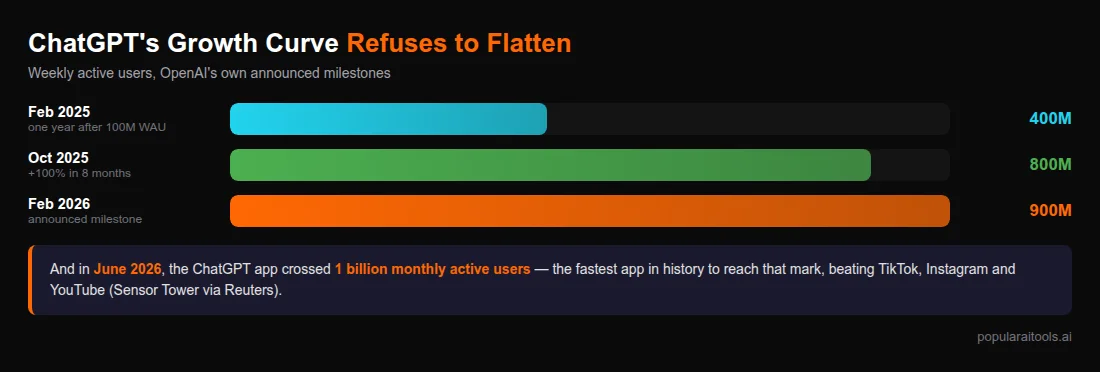
The pattern worth noticing: growth hasn't saturated. WAUs doubled from 400M to 800M during 2025 and added another hundred million by February 2026. The competitive context — including the churn we documented in the great ChatGPT exodus and the QuitGPT movement — has so far been noise against the adoption curve, not a dent in it.
Revenue and paying users
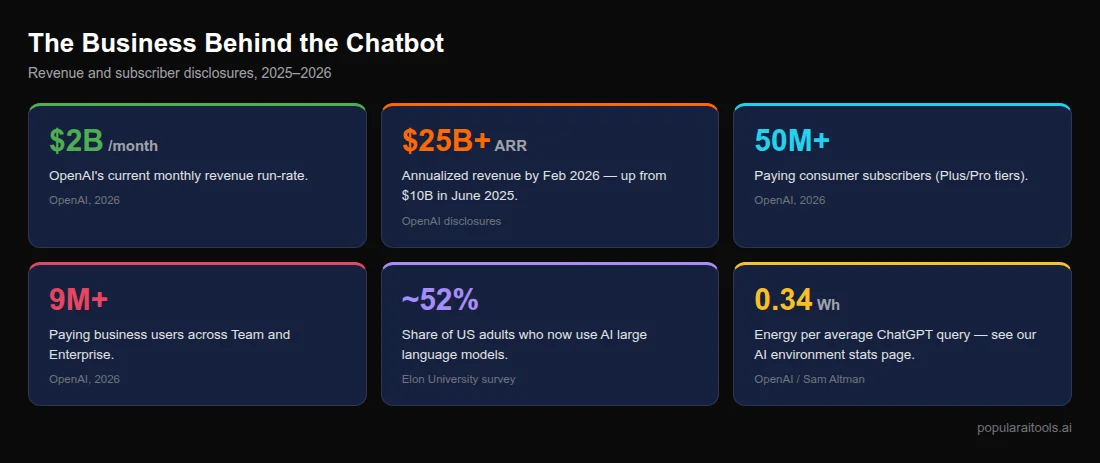
OpenAI's disclosed run-rate is roughly $2 billion a month, with annualized revenue jumping from $10B (June 2025) to $25B+ (February 2026) — a 2.5× in nine months. Behind it: 50+ million consumer subscribers and 9+ million paying business users. Do the division and the conversion story is the interesting part — about 5–6% of weekly actives pay. That's simultaneously an enormous business and a long runway, which explains both the valuation and the ads experiments we covered in ChatGPT's sponsored responses.
How people actually use ChatGPT
OpenAI's own usage research (the "How people are using ChatGPT" study) found non-work usage dominates — roughly three-quarters of consumer messages — led by practical guidance, information-seeking, and writing help. Work usage concentrates in writing and coding. Two implications we'd flag for anyone building on these numbers: first, ChatGPT's competition is increasingly Google, not other chatbots; second, per-query environmental costs (~0.34 Wh each — see our AI environmental impact statistics) multiply against billions of daily casual queries, which is exactly why the infrastructure buildout looks the way it does.
FAQ + citing this page
Recommended AI Tools
played.fm
Sell your music and keep 100%: played.fm is a direct-to-fan store + sync marketplace with 0% commission, no gatekeepers, and no bans — a strong fit for AI musicians.
View Review →OpenCode
The open-source AI coding agent: terminal-first TUI, 75+ model providers, LSP context, subagents, and privacy-first design. Free software, ~180K GitHub stars.
View Review →Exa
The neural web search API for AI agents: embeddings-based retrieval, cited highlights, sub-180ms latency, and an MCP server. 20,000 free requests/month.
View Review →Google Antigravity
Google's agent-first IDE: run a fleet of AI agents from a Manager surface, on Gemini 3 Pro, Claude Sonnet 4.5, or OpenAI models. Free in public preview.
View Review →