Digital Optimus: Elon Musk’s Bold New Vision for AGI

Head of AI Research

Digital Optimus: Elon Musk’s Bold New AGI Vision That Could Replace Entire Companies
We explored Elon Musk’s latest bombshell announcement — Digital Optimus — a joint Tesla-xAI project that merges real-time AI agents with Grok’s reasoning to automate complex office work. Here is everything we found.
Table of Contents
- What Is Digital Optimus?
- How Digital Optimus Works: The Dual-Brain Architecture
- Digital Optimus vs. Tesla Optimus Robot: Key Differences
- Elon Musk’s AGI Timeline and xAI’s Strategy
- Tesla AI4 Hardware and the Supercharger Compute Grid
- Where Digital Optimus Fits in the 2026 AGI Race
- Expert Reactions and Criticisms
- FAQ
- What This Means Going Forward
What Is Digital Optimus?
On March 11, 2026, Elon Musk confirmed what many had suspected: Tesla and xAI are building a joint AI agent system called Digital Optimus. The project, also cheekily nicknamed “Macrohard” (a deliberate jab at Microsoft), represents the first major product to emerge from Tesla’s $2 billion investment into xAI.
We found that Digital Optimus is not a robot. It is a software system designed to watch a computer screen in real time, understand what it sees, and execute complex office tasks — from accounting and HR workflows to repetitive digital operations. Musk described it as a system capable, in principle, of “emulating the function of entire companies.”
Get Your AI Tool in Front of Thousands of Buyers
Join 500+ AI tools already listed on PopularAiTools.ai — DR 50+ backlinks, expert verification, and real traffic from people actively searching for AI solutions.
Starter
$39/mo
Directory listing + backlink
- DR 50+ backlink
- Expert verification badge
- Cancel anytime
Premium
$69/mo
Featured + homepage placement
- Everything in Starter
- Featured on category pages
- Homepage placement (2 days/mo)
- 24/7 support
Ultimate
$99/mo
Premium banner + Reddit promo
- Everything in Premium
- Banner on every page (5 days/mo)
- Elite Verified badge
- Reddit promotion + CTA
No credit card required · Cancel anytime
That is a staggering claim. But the underlying architecture suggests this is more than just hype.
How Digital Optimus Works: The Dual-Brain Architecture
What makes Digital Optimus technically interesting is its dual-process architecture, inspired by psychologist Daniel Kahneman’s Thinking, Fast and Slow framework.
Here is how it breaks down:
- System 1 (Tesla’s AI): A fast, instinctive executor that processes the past five seconds of real-time screen video along with keyboard and mouse actions. It handles immediate, reflexive tasks — clicking buttons, filling forms, navigating interfaces. Think of it as the “hands” of the operation.
- System 2 (xAI’s Grok): The strategic “master conductor” that provides high-level reasoning, world understanding, and directional oversight. Grok acts as the navigator — deciding what to do and why, while Tesla’s AI decides how to do it right now.
This split is deliberate. Running Grok’s full reasoning engine on every millisecond of screen activity would be prohibitively expensive. By letting Tesla’s leaner AI handle real-time execution and calling on Grok only for higher-order decisions, Digital Optimus keeps costs manageable while maintaining intelligence.
We think this is the most practical AI agent architecture we have seen announced to date.

Digital Optimus vs. Tesla Optimus Robot: Key Differences
The naming is intentionally connected, but the products are very different:
Musk has explicitly stated he believes Tesla will be the first company to achieve AGI in humanoid, physical form through the Optimus robot. Digital Optimus is the software counterpart — pursuing the same goal but in the digital realm. (See also: our NVIDIA GTC 2026 coverage.) (See also: our AI news roundup for March 2026.)
Together, they form a pincer strategy: physical automation through robots, digital automation through AI agents.
Elon Musk’s AGI Timeline and xAI’s Strategy

During a recent company-wide meeting, Musk told xAI employees that the company must “survive the next two to three years” to emerge as a dominant force in advanced AI. He framed this period as an intense survival test.
The numbers behind xAI’s strategy are striking:
- ~$30 billion per year in available funding
- 200,000 GPUs currently operational, scaling to 1 million GPUs
- 7 gigawatts of available power at Supercharger stations for distributed AI compute
- $650 per unit cost for Tesla AI4 hardware (vs. thousands for Nvidia alternatives)
Musk argues that whoever ramps GPU infrastructure fastest wins the AGI race. His playbook: use Tesla’s manufacturing scale to drive hardware costs down, use xAI’s Grok for the intelligence layer, and use the Supercharger network as a distributed compute grid.
It is worth noting that Musk predicted AGI by 2025 last year. When that did not materialize, the goalpost moved to 2026. Healthy skepticism is warranted.
Tesla AI4 Hardware and the Supercharger Compute Grid
One of the most overlooked aspects of the Digital Optimus announcement is the hardware strategy.
Tesla’s AI4 chip costs approximately $650 — a fraction of what comparable Nvidia hardware runs. Digital Optimus is designed to run primarily on AI4, using more expensive Nvidia GPUs from xAI’s data centers only when necessary for heavy reasoning tasks.
Here is where it gets genuinely creative: Musk plans to deploy millions of dedicated AI4 units at Tesla Supercharger stations worldwide. These stations already have substantial power infrastructure — roughly 7 gigawatts combined. By turning Superchargers into distributed AI compute nodes, Tesla creates an entirely new revenue stream separate from vehicle sales or energy products.
Even parked Tesla vehicles equipped with AI4 hardware could contribute compute cycles, effectively turning every AI4-equipped car into a node in a massive distributed AI network.
Where Digital Optimus Fits in the 2026 AGI Race
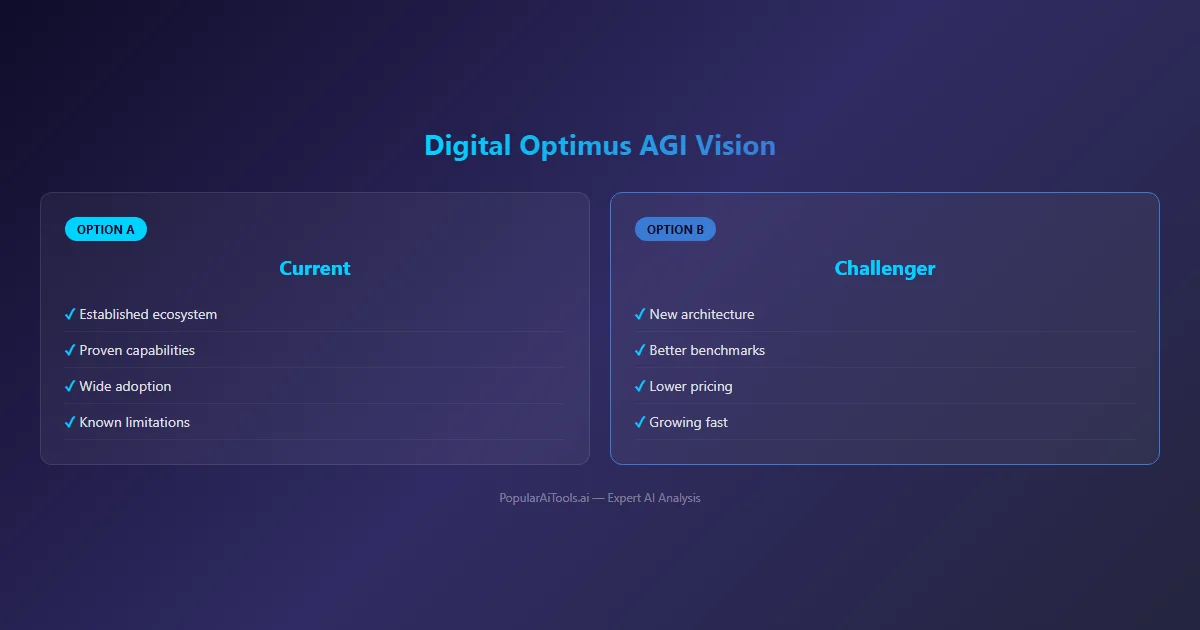
We are tracking four major players in the 2026 AGI race, each with a distinct strategy:
Musk / xAI + Tesla: Hardware cost advantage through AI4, distributed compute via Superchargers, Grok as the reasoning engine. Digital Optimus is the first consumer-facing agent product.
OpenAI: Evolving into a consumer “super-app” with travel, shopping, and food services. Making headline-grabbing $1.4 trillion compute commitments. Massive scale, but questions about focus.
Anthropic: Taking the opposite approach — “do more with less.” Winning 70% of new enterprise deals, on track to surpass OpenAI’s revenue by end of 2026. Claude Cowork is already disrupting software workflows. Annualized revenue from coding agents topped $2.5 billion by February 2026.
Google: Quietly expanding Pentagon work and growing users faster than rivals while competitors publicly spar over defense contracts.
Anthropic CEO Dario Amodei recently stated that AI systems matching or exceeding human expert performance across most cognitive tasks are likely within two to three years. AGI timelines from credible insiders are now measured in years, not decades.
Digital Optimus enters this race with a unique angle: instead of building the best model, Musk is building the cheapest and most distributed infrastructure to run models at scale.
Expert Reactions and Criticisms
The announcement has drawn both excitement and sharp criticism.
The bull case: Market reactions were overwhelmingly positive. Tesla shares rose on the news, with investors optimistic that combining Grok’s reasoning with Digital Optimus’s real-time execution could create genuine enterprise value. The $650 AI4 hardware cost is a real competitive advantage if the software delivers.
The bear case: Electrek noted that every time Musk publicly ties xAI and Tesla closer together, he strengthens the plaintiffs’ case in an ongoing shareholder lawsuit. If xAI’s technology is essential for Tesla’s ambitions, Musk arguably had a fiduciary duty to build it at Tesla — not at a private company where he captures the upside personally.
The skeptic case: Musk’s track record includes promising fully autonomous self-driving vehicles by 2015, 500,000 Cybertrucks per year, humans on Mars by 2026, and DOGE savings that have not materialized. The project remains pre-product with a six-month timeline that many expect to slip.
The technical case: The dual-process architecture is sound in theory, but no one has demonstrated a real-time AI agent that can reliably emulate complex office work at scale. The gap between a demo and a product that handles the messiness of real enterprise workflows is enormous.
Built an AI tool? Get it in front of thousands of qualified buyers on PopularAiTools.ai
FAQ
What is Digital Optimus?
Digital Optimus is a joint Tesla-xAI software project that uses AI to watch computer screens in real time and automate complex office tasks. It combines Tesla’s fast real-time AI (System 1) with xAI’s Grok reasoning engine (System 2) to create an AI agent capable of performing digital work autonomously.
How does Digital Optimus differ from the Tesla Optimus robot?
Tesla Optimus is a physical humanoid robot designed for manual labor. Digital Optimus is a software-only AI agent designed for digital office work. They share the Optimus branding but serve completely different domains — one handles physical tasks, the other handles computer-based tasks.
When will Digital Optimus be available?
Elon Musk has targeted a rollout window of approximately September to October 2026, roughly six months from the March 2026 announcement. However, given Musk’s history of optimistic timelines, delays are possible.
What is Macrohard?
Macrohard is the internal codename (and likely a joke aimed at Microsoft) for the Digital Optimus project. It reflects the project’s ambition to disrupt enterprise software — doing what Microsoft does, but with AI agents instead of traditional software applications.
Can Digital Optimus really run an entire company?
Musk claims Digital Optimus can, in principle, emulate the functions of entire companies — handling accounting, HR, and repetitive digital operations. In practice, this remains unproven. The system is still pre-product and has not been demonstrated at enterprise scale.
What This Means Going Forward
Digital Optimus is the most ambitious AI agent project we have tracked in 2026. The dual-process architecture is clever. The hardware cost strategy is genuinely differentiated. The Supercharger compute grid idea is creative.
But ambition and execution are different things. We will be watching three milestones closely:
- A public demo showing Digital Optimus handling real, messy office workflows (not cherry-picked demos)
- The September 2026 target — does Musk hit it, or does it slip?
- Enterprise adoption signals — do real companies sign up, or does this remain a Tesla ecosystem play?
The AGI race is accelerating. Whether Digital Optimus becomes a defining product or another overpromised Musk venture depends entirely on what happens in the next six months.
We will keep tracking this story. Bookmark this page and check back for updates as Digital Optimus develops.
Recommended AI Tools
played.fm
Sell your music and keep 100%: played.fm is a direct-to-fan store + sync marketplace with 0% commission, no gatekeepers, and no bans — a strong fit for AI musicians.
View Review →OpenCode
The open-source AI coding agent: terminal-first TUI, 75+ model providers, LSP context, subagents, and privacy-first design. Free software, ~180K GitHub stars.
View Review →Exa
The neural web search API for AI agents: embeddings-based retrieval, cited highlights, sub-180ms latency, and an MCP server. 20,000 free requests/month.
View Review →Google Antigravity
Google's agent-first IDE: run a fleet of AI agents from a Manager surface, on Gemini 3 Pro, Claude Sonnet 4.5, or OpenAI models. Free in public preview.
View Review →