GLM 5.2 vs Claude Opus 4.8: Which AI Coding Model Wins in 2026?

AI Infrastructure Lead
🎯 Key Takeaways
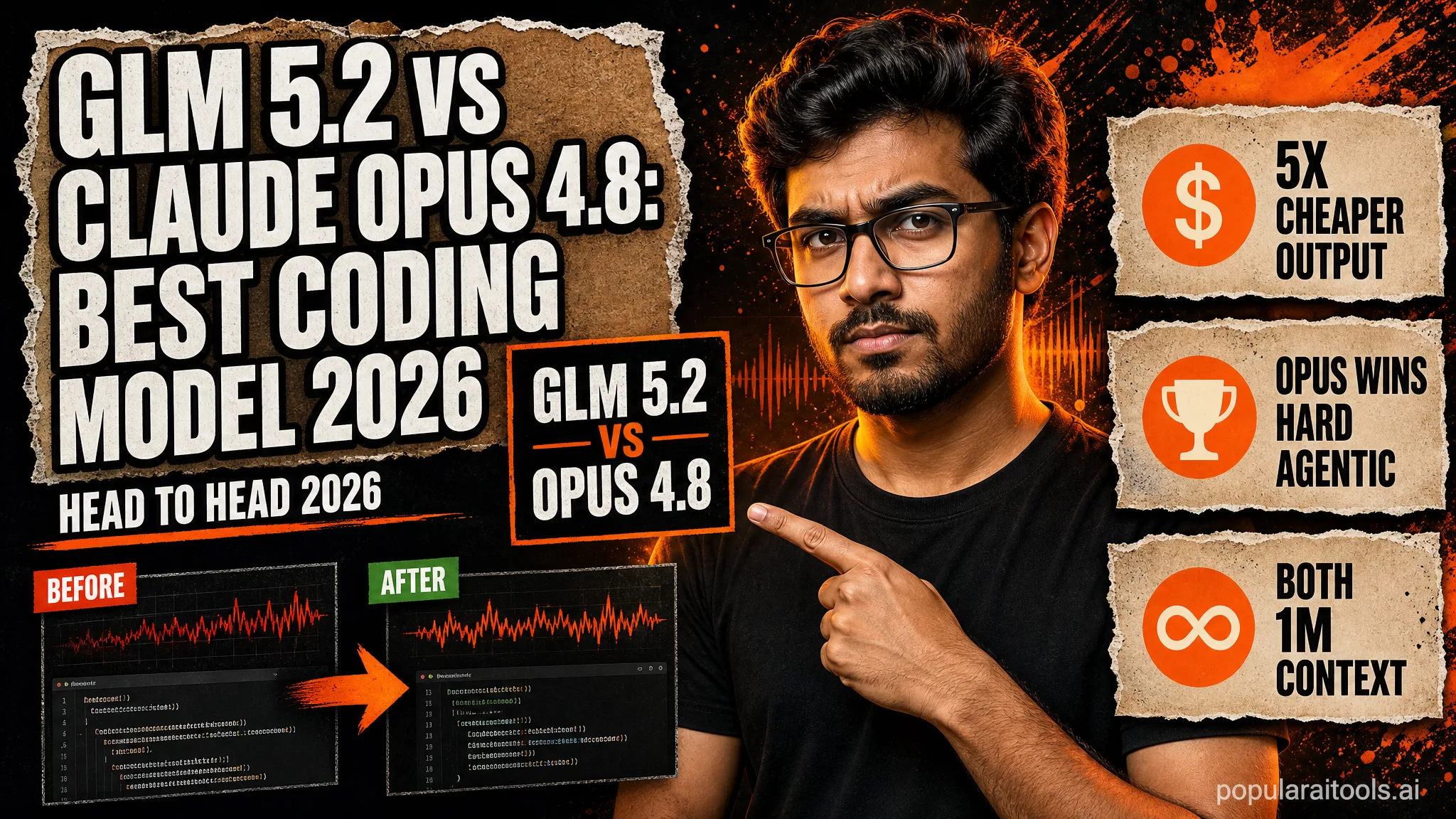
- Claude Opus 4.8 still wins the hardest work — long-horizon agentic coding (SWE-bench Pro 69.2% vs 62.1%, NL2Repo, SWE-Marathon) and multimodal (vision, PDFs, computer use).
- GLM 5.2 is roughly 3.6x cheaper on input and 5.7x cheaper on output, is open-weights and self-hostable, and actually beats Opus on some benchmarks (Terminal-Bench 2.1, AIME 2026, IMOAnswerBench).
- Both offer a 1M-token context window and ~128K max output. GLM 5.2 is text-only; Opus 4.8 is multimodal.
- Pick Opus 4.8 for the toughest agentic and multimodal jobs. Pick GLM 5.2 when cost, open weights, or self-hosting matter most.
For the first time, an open-weights model makes Anthropic's flagship look expensive without making it look slow. GLM 5.2 from Zhipu AI lands within striking distance of Claude Opus 4.8 on coding while costing a fraction of the price. So is the premium still worth it? We put the two head to head on benchmarks, pricing, context, and the practical question that actually matters: which should you code with in 2026?
At a Glance
| Spec | GLM 5.2 | Claude Opus 4.8 |
|---|---|---|
| Input price / 1M | $1.40 | $5.00 |
| Output price / 1M | $4.40 | $25.00 |
| Context window | 1M tokens | 1M tokens |
| Max output | ~128K | ~128K |
| Weights | Open (self-hostable) | Closed |
| Modality | Text only | Vision + PDFs + computer use |
| SWE-bench Pro | 62.1% | 69.2% |

Benchmarks: Opus leads the hard stuff, GLM keeps it close
On paper, Claude Opus 4.8 wins the majority of coding benchmarks — and its lead is widest exactly where it matters most: long-horizon, multi-step software engineering. NL2Repo (69.7 vs 48.9), SWE-Marathon (26.0 vs 13.0), Tool-Decathlon (59.9 vs 48.2), and SWE-bench Pro (69.2% vs 62.1%) all go to Opus. If your work is sprawling, multi-file, agentic tasks that run for a long time, Opus is measurably more reliable.
But GLM 5.2 is closer than the price gap suggests. It comes within a point on FrontierSWE (74.4 vs 75.1) and MCP-Atlas (76.8 vs 77.8), and it actually wins AIME 2026, IMOAnswerBench, and Terminal-Bench 2.1 under its best harness. On security testing it even edged Claude Code on IDOR detection (39% vs 32% F1) at roughly $0.17 per vulnerability found. For a model costing a fifth as much on output, that's remarkable.

Pricing: the 5x factor
This is where the decision gets real. GLM 5.2 runs about $1.40 per million input tokens and $4.40 per million output, against Opus 4.8's $5 and $25. That's roughly 3.6x cheaper on input and 5.7x cheaper on output — and output tokens dominate the bill for agentic coding, where the model writes far more than it reads.
In practice, a heavy agentic workload that costs $100 a day on Opus can drop toward $20 on GLM 5.2 for broadly similar output quality. Multiply that across a team and the open-weights option starts to look less like a compromise and more like the default, with Opus reserved for the genuinely hard tasks.

Open weights and multimodal: the real differentiators
Two features decide most edge cases. First, GLM 5.2 is open-weights — you can self-host it, run it in a private VPC, or fine-tune it. For teams with data-residency or air-gap requirements, that alone can be the whole decision; Opus 4.8 is API-only.
Second, Opus 4.8 is multimodal — it handles images, PDFs, and computer use, while GLM 5.2 is text-only. If your workflow involves reading screenshots, design mockups, or driving a UI, Opus is the only one of the two that can do it. For pure code-in, code-out work, that gap doesn't matter.

Which should you choose?
Choose GLM 5.2 if…
- ✓ Cost is a primary constraint
- ✓ You need open weights or self-hosting
- ✓ You have data-residency requirements
- ✓ Your work is text/code, not multimodal
- ✓ You run high-volume agentic workloads
Choose Opus 4.8 if…
- ✓ You need the best long-horizon agentic coding
- ✓ You work with images, PDFs, or computer use
- ✓ Reliability on hard tasks beats cost
- ✓ You want the top of the benchmarks
- ✓ You're already in the Claude ecosystem
The smart play for many teams is both: route routine, high-volume work to GLM 5.2 and escalate the genuinely hard, long-horizon, or multimodal tasks to Opus 4.8. Tools like Google Antigravity and OpenCode make per-task model switching easy. Curious how a third contender fits in? See our GLM 5.2 vs Opus 4.8 vs GPT-5.5 cost comparison.
Frequently Asked Questions
Recommended AI Tools
played.fm
Sell your music and keep 100%: played.fm is a direct-to-fan store + sync marketplace with 0% commission, no gatekeepers, and no bans — a strong fit for AI musicians.
View Review →OpenCode
The open-source AI coding agent: terminal-first TUI, 75+ model providers, LSP context, subagents, and privacy-first design. Free software, ~180K GitHub stars.
View Review →Exa
The neural web search API for AI agents: embeddings-based retrieval, cited highlights, sub-180ms latency, and an MCP server. 20,000 free requests/month.
View Review →Google Antigravity
Google's agent-first IDE: run a fleet of AI agents from a Manager surface, on Gemini 3 Pro, Claude Sonnet 4.5, or OpenAI models. Free in public preview.
View Review →