Hermes Agent vs OpenClaw: Which AI Agent Should You Use (Or Both)?

AI Infrastructure Lead
⚡ Key Takeaways
- Hermes Agent is a self-improving AI agent from Nous Research that gets better the more you use it — it builds its own reusable skills automatically
- It's significantly faster than OpenClaw on the same model and more lightweight
- Don't pick one — use them together. OpenClaw as orchestrator, Hermes as specialist. Connect them via ACP.
- Hermes is built for tinkerers with ML/RL tools and strong open model support
- OpenClaw has the bigger team (OpenAI + Nvidia), more stability, and larger plugin ecosystem
- Running two agents means if one goes down, the other can fix it
There's a new autonomous AI agent taking the developer community by storm, and a lot of people are claiming it's better than OpenClaw. After weeks of testing both extensively, we can say this: they're right about some things, wrong about others, and missing the most important insight entirely.
Hermes Agent isn't an OpenClaw replacement. It's an OpenClaw complement. And running them together has been the single biggest productivity unlock we've found this year.

What is Hermes Agent?
Hermes Agent is an open-source autonomous AI agent built by Nous Research — the same team behind the Hermes model family and the Atropos reinforcement learning framework. Like OpenClaw, it can control your entire computer: running commands, editing files, browsing the web, and automating complex workflows.
You can interact with it through your CLI terminal, but also through Telegram, Discord, WhatsApp, and iMessage. That cross-platform access is one of its strengths — you can fire off tasks from your phone and have Hermes execute them on your workstation.
Hermes Agent on GitHub — built by Nous Research
The first thing you notice is speed. Running Opus 4.6 on both agents side by side, Hermes moves noticeably faster. It's more lightweight and performant — tasks that make OpenClaw pause feel instant on Hermes. That's not a small thing when you're running agents all day.
But speed isn't the killer feature. That would be the self-improvement loop.
The Self-Improvement Loop (Hermes' Killer Feature)
Hermes' self-improvement loop — the more you use it, the better it gets
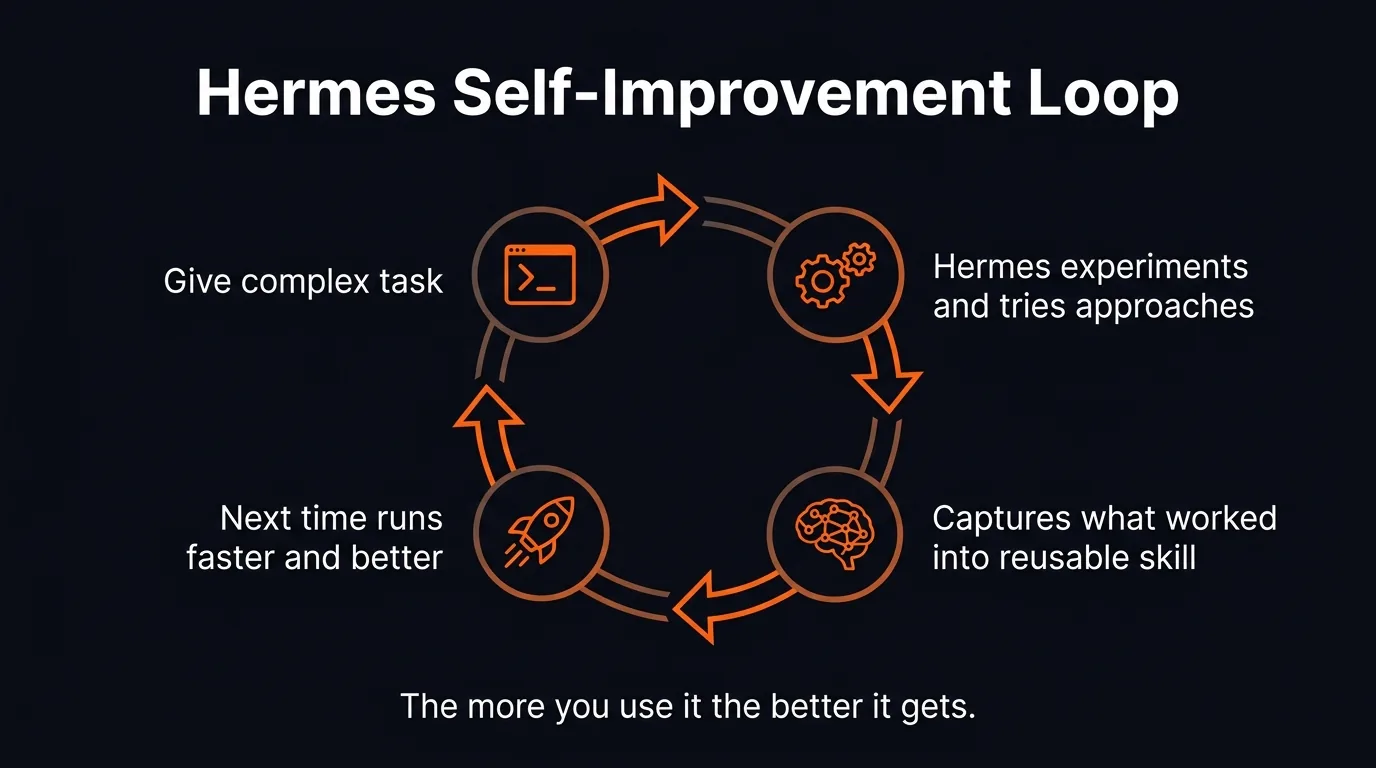
When you give Hermes a complex task, something interesting happens. It tries different approaches, figures out what works, and then automatically captures everything it learned into a reusable skill. Next time a similar task comes up, it doesn't start from scratch — it pulls the skill and executes faster.
Here's a real example: we asked Hermes to pull the top 5 Hacker News stories every morning at 9 AM, fetch the actual articles, summarize them, score them for relevance to AI/startups, generate an audio briefing of the top 3, and deliver it via Telegram with text summaries alongside the audio.
Hermes worked through the task step by step — completely transparent about every tool call and decision. Then it did something OpenClaw doesn't: it captured everything it learned and created a "Hacker News daily AI briefing" skill. It updated the cron job to reference the new skill. From that point on, the briefing runs automatically, faster, and more reliably.
Hermes delivers personalized audio briefings directly to Telegram
The result? A personal daily podcast delivered to Telegram every morning — custom-made from Hacker News stories ranked by your interests, with audio you can listen to on your commute. OpenClaw can do similar things, but Hermes' emphasis on cementing solutions into reusable skills is genuinely impressive.
Hermes Agent vs OpenClaw: Full Comparison
The key differences at a glance
OpenClaw — the incumbent with massive backing and ecosystem
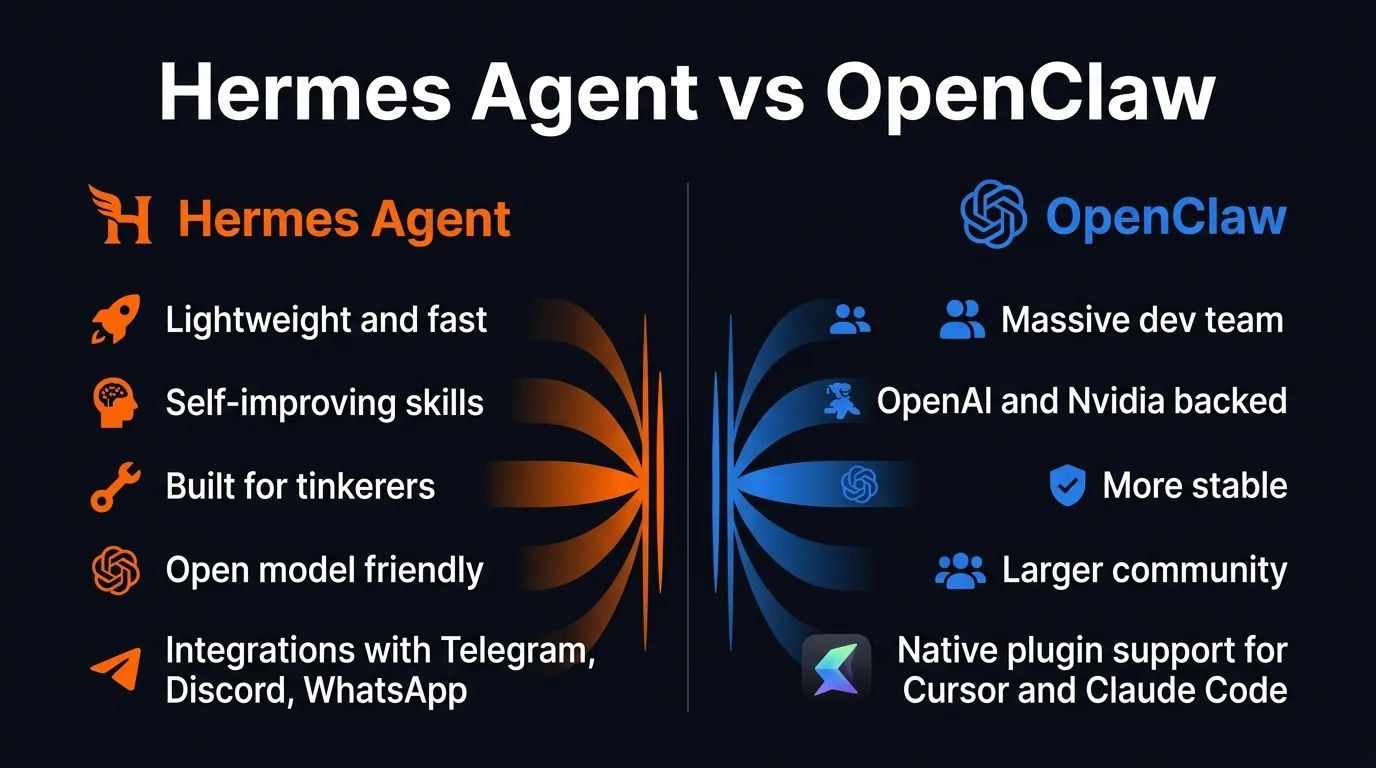
In short: Hermes optimizes for depth of learning. OpenClaw optimizes for breadth of ecosystem. Hermes treats an agent as a mind to be developed. OpenClaw treats an agent as a system to be orchestrated.
The Multi-Agent Workflow: Using Both Together
Here's the insight most people are missing: you should be running both agents simultaneously.
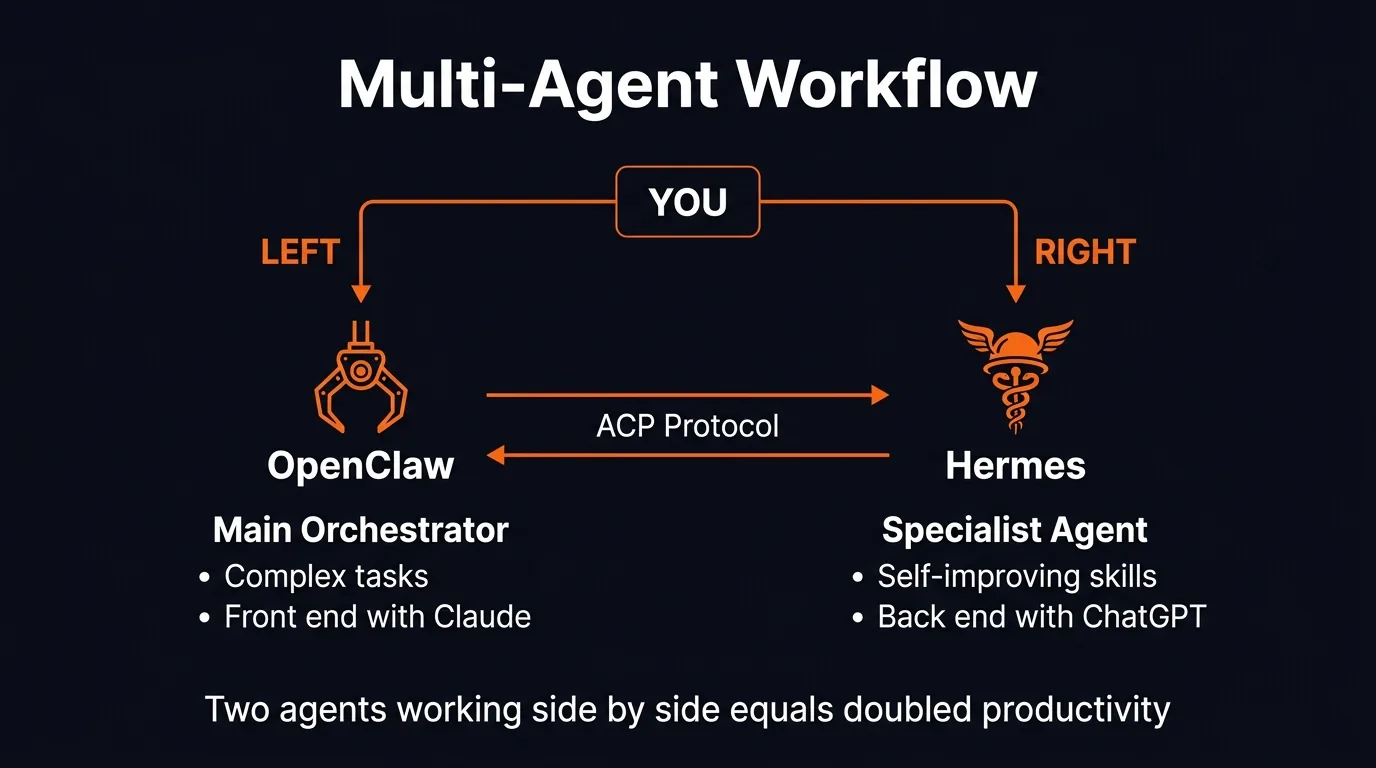
The ideal multi-agent workflow
Workflow 1: Orchestrator + Specialist
Use OpenClaw as your main orchestrator. When you have a complex task, tell OpenClaw: "Here's what I need — feel free to spin up Hermes as well." OpenClaw figures out which parts it handles best and delegates the rest to Hermes via ACP (Agent Communication Protocol).
Setting up ACP is simple — just tell OpenClaw: "Please set up ACP with Hermes Agent." It handles the configuration automatically.
Workflow 2: Side-by-Side Multitasking
Run both agents in separate terminals side by side. Give them different commands, have them work on different parts of a codebase simultaneously. One real-world example: Hermes running on ChatGPT handles the backend while OpenClaw running on Claude handles the frontend — each using the model that's strongest for their task.
This eliminates the biggest productivity killer with agent workflows: waiting. Instead of doom-scrolling while one agent processes, you have two agents working in parallel.
Workflow 3: Insurance Policy
This one's underrated. When you're running a single agent and it breaks — a config issue, a bad update, a memory corruption — you're stuck manually debugging. With two agents, if one goes down, the other can fix it. "Hey Hermes, OpenClaw crashed. Can you check the config and restart it?" That extra layer of reliability is surprisingly valuable in practice.
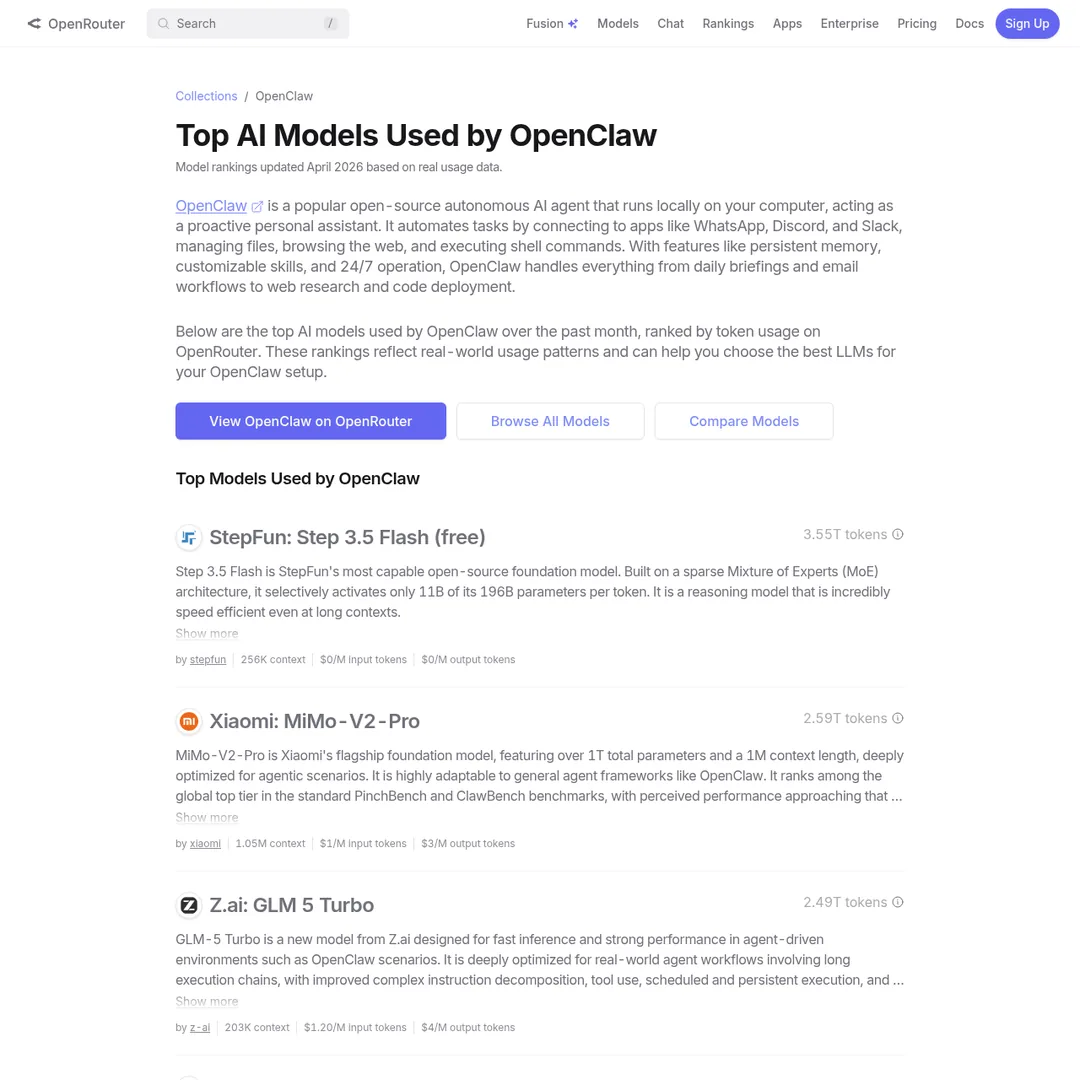
Both agents support the same models via OpenRouter
Which Models to Use
Both Hermes and OpenClaw support the same model providers. Here's what works best:
- Claude Opus 4.6 — The most agentic model available. Best at figuring out complex multi-step tasks. Use for your primary agent.
- ChatGPT (GPT-5.4) — Strong alternative, especially for backend code. Good cost savings if Claude isn't in the budget.
- Qwen 3.5 (local) — The local AI community has reported great results running Qwen with Hermes. Free to run if you have the hardware.
- Open models — Hermes officially supports open models and is building dedicated tools for them. If you're into fine-tuning and local inference, Hermes is the better choice.
A powerful combo: OpenClaw on Claude for frontend, Hermes on ChatGPT for backend. Each model plays to its strengths.
The Verdict: Should You Switch?
No. You should add, not switch.
Hermes Agent is genuinely impressive. The self-improvement loop is the real deal — it noticeably gets better over time. It's faster and more lightweight than OpenClaw. And if you're a tinkerer who wants to experiment with open models, ML tools, and reinforcement learning, Hermes was built for you.
But OpenClaw isn't going anywhere. It has OpenAI and Nvidia pouring resources into it. It ships daily updates. It has a massive community and native plugins for Cursor and Claude Code. It's the more mature, stable choice for production workflows.
The real unlock is running them together. Two agents, two models, two terminals. One orchestrates, one specializes. If one breaks, the other fixes it. You never wait, you never doom-scroll, and your productivity genuinely doubles.
If you're using AI agents and you're only running one, you're leaving performance on the table.
Build an AI Tool? Get It in Front of the Right Audience
PopularAiTools.ai reaches thousands of qualified AI buyers.
Submit Your AI Tool →Frequently Asked Questions
What is Hermes Agent?
Hermes Agent is an open-source autonomous AI agent built by Nous Research. Like OpenClaw, it can control your entire computer — running commands, editing files, browsing the web, and automating workflows. What makes it unique is its self-improving learning loop: it creates reusable skills from experience and gets better the more you use it.
Is Hermes Agent better than OpenClaw?
They excel at different things. Hermes is faster, more lightweight, and has a superior self-improvement system that builds reusable skills automatically. OpenClaw has a larger team (backed by OpenAI and Nvidia), more stability, a bigger community, and native plugin support for Cursor and Claude Code. The recommended approach is to use both together.
Can Hermes Agent and OpenClaw work together?
Yes. You can set up ACP (Agent Communication Protocol) between them so OpenClaw can delegate tasks to Hermes. The recommended workflow is using OpenClaw as the main orchestrator and Hermes as a specialist agent. You can also run them side by side on different parts of a project simultaneously.
What models work with Hermes Agent?
Hermes is compatible with all major AI models including Claude Opus 4.6, GPT-5, Qwen 3.5, and open-source models you run locally. The Hermes team actively supports open models, unlike OpenClaw which does not officially recommend them.
What platforms does Hermes Agent work on?
Hermes runs in your CLI terminal and can also integrate with Telegram, Discord, WhatsApp, and iMessage. You can control it from any of these platforms, making it feel like a personal AI employee you can message from your phone.
What is the self-improvement feature in Hermes Agent?
When you give Hermes a complex task, it experiments with different approaches, figures out what works, and automatically captures the solution as a reusable "skill." Next time it encounters a similar task, it uses the skill instead of figuring it out from scratch. The more you use it, the faster and more capable it becomes.
Recommended AI Tools
played.fm
Sell your music and keep 100%: played.fm is a direct-to-fan store + sync marketplace with 0% commission, no gatekeepers, and no bans — a strong fit for AI musicians.
View Review →OpenCode
The open-source AI coding agent: terminal-first TUI, 75+ model providers, LSP context, subagents, and privacy-first design. Free software, ~180K GitHub stars.
View Review →Exa
The neural web search API for AI agents: embeddings-based retrieval, cited highlights, sub-180ms latency, and an MCP server. 20,000 free requests/month.
View Review →Google Antigravity
Google's agent-first IDE: run a fleet of AI agents from a Manager surface, on Gemini 3 Pro, Claude Sonnet 4.5, or OpenAI models. Free in public preview.
View Review →