
Try Kie.ai today
⚡ TL;DR — Kie.ai Review
One API key, every frontier model. Kie.ai aggregates Veo 3.1, Suno V4.5, Midjourney, Flux, Nano Banana Pro, Runway Aleph and a dozen more behind a single REST endpoint — at 30-80% off the official rates. If you're building anything that touches more than one model, this is the shortcut that actually works.
📋 Table of Contents
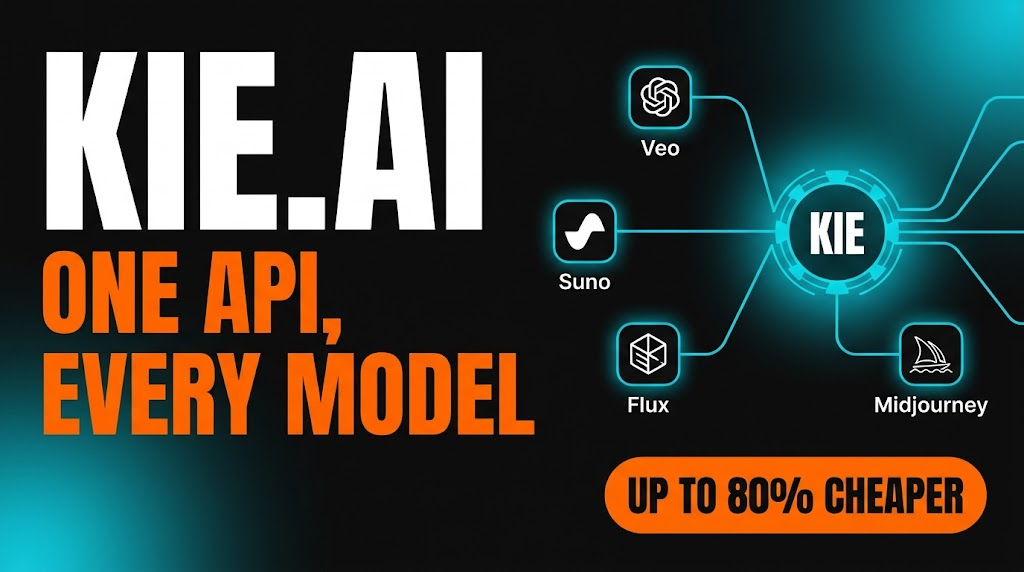
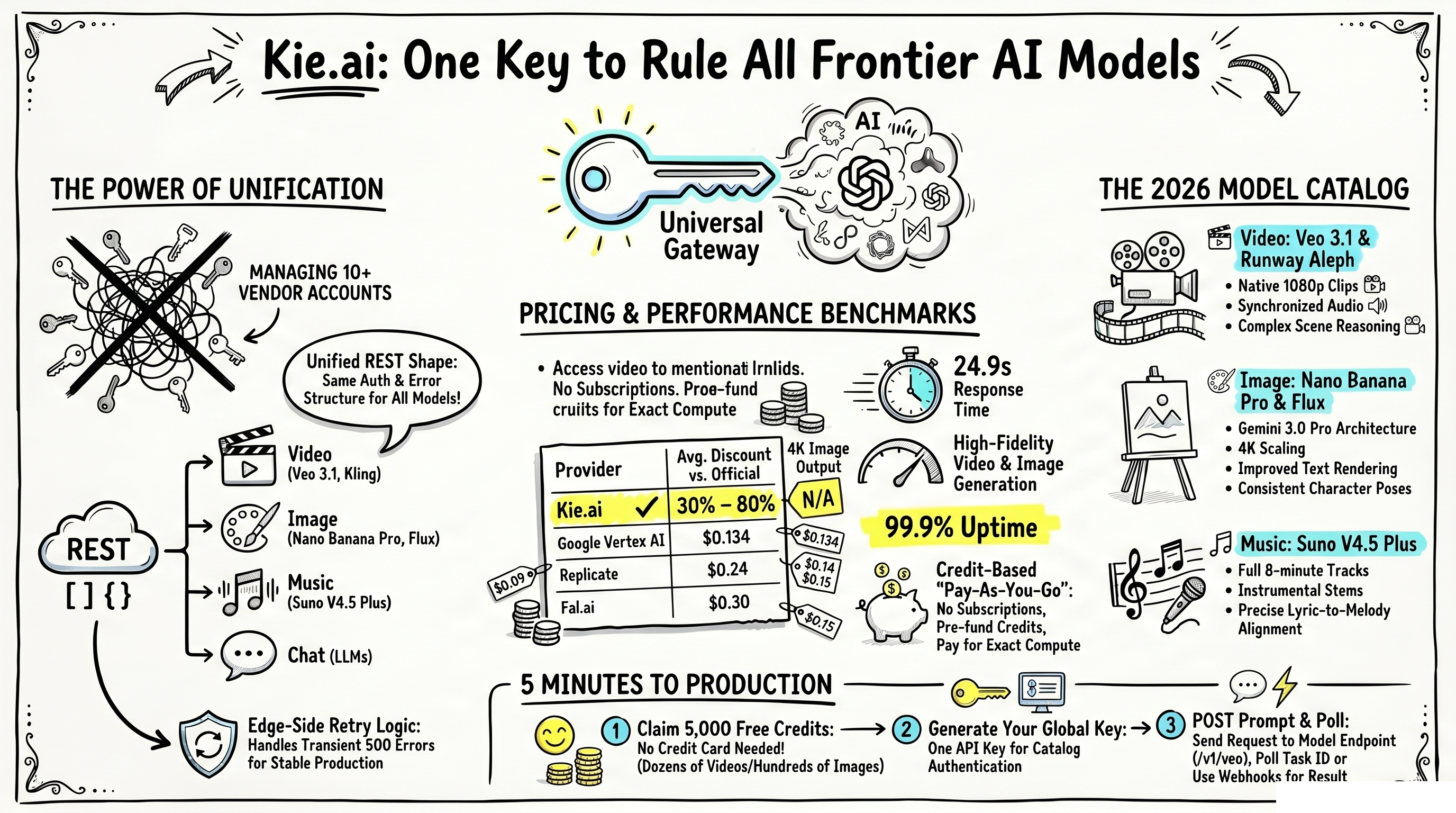
If you've ever shipped an AI product, you know the pain: each model has its own API, its own auth, its own billing, and its own quirks. Need Veo 3.1 for video? Set up Google Cloud. Suno for music? Separate account. Midjourney? Discord bot gymnastics. By the time you've plumbed three vendors together, your bill is a nightmare and your code is a pile of adapters.
Kie.ai exists to fix exactly that. One API key, one billing line, one REST shape — ten-plus frontier models behind it. We spent two weeks pushing it against real production workloads: generating Veo 3.1 videos, Suno V4.5 Plus tracks, Nano Banana Pro images, and Flux.1 Kontext variants, all from the same integration. Here's the honest verdict.
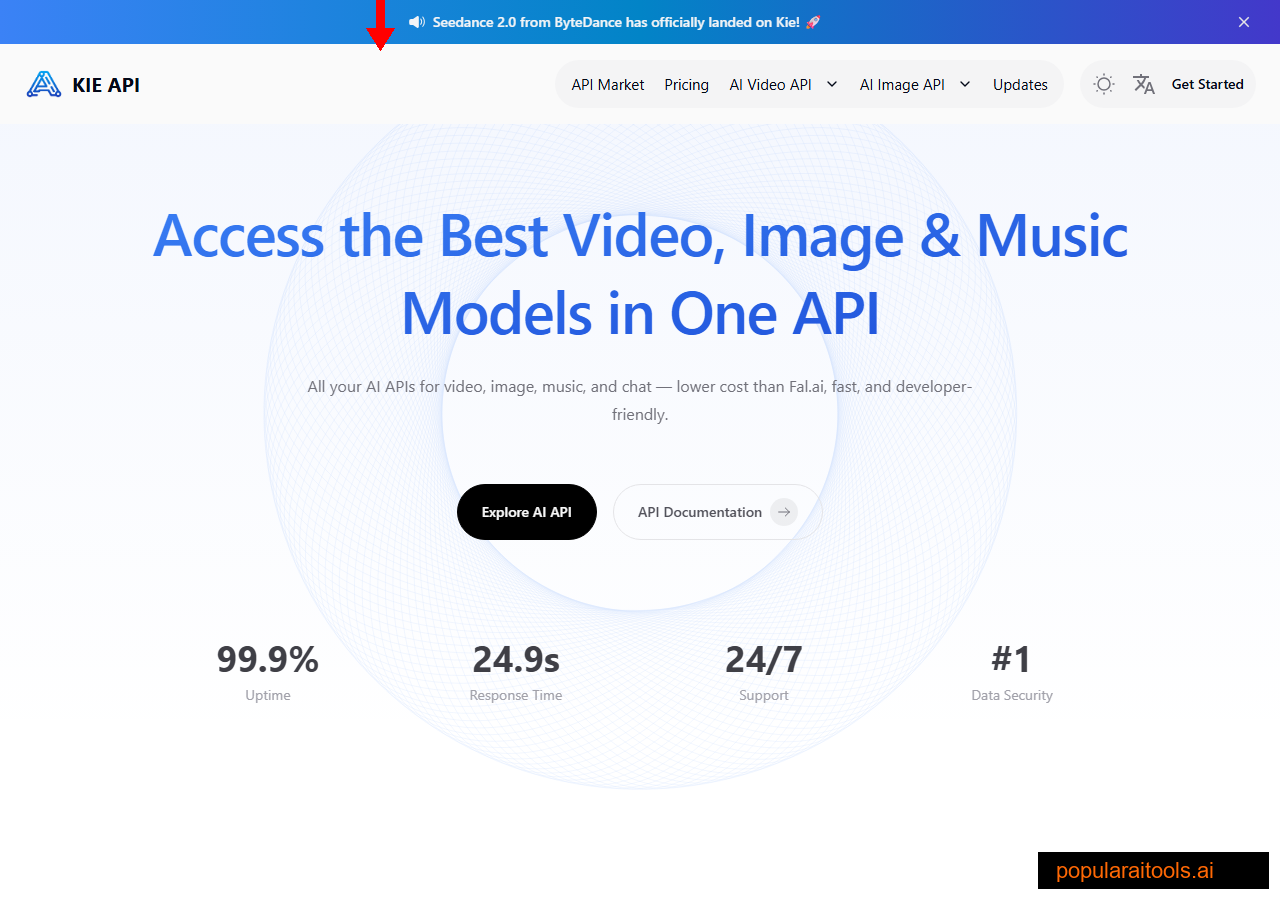

What is Kie.ai?
Kie.ai is a unified API gateway for generative AI. Think of it as a CDN for models: instead of each request going directly to Google, OpenAI, Runway or Suno, it hits Kie.ai's edge, which translates it into the vendor's native API, bills you in Kie credits, and returns a normalised response.
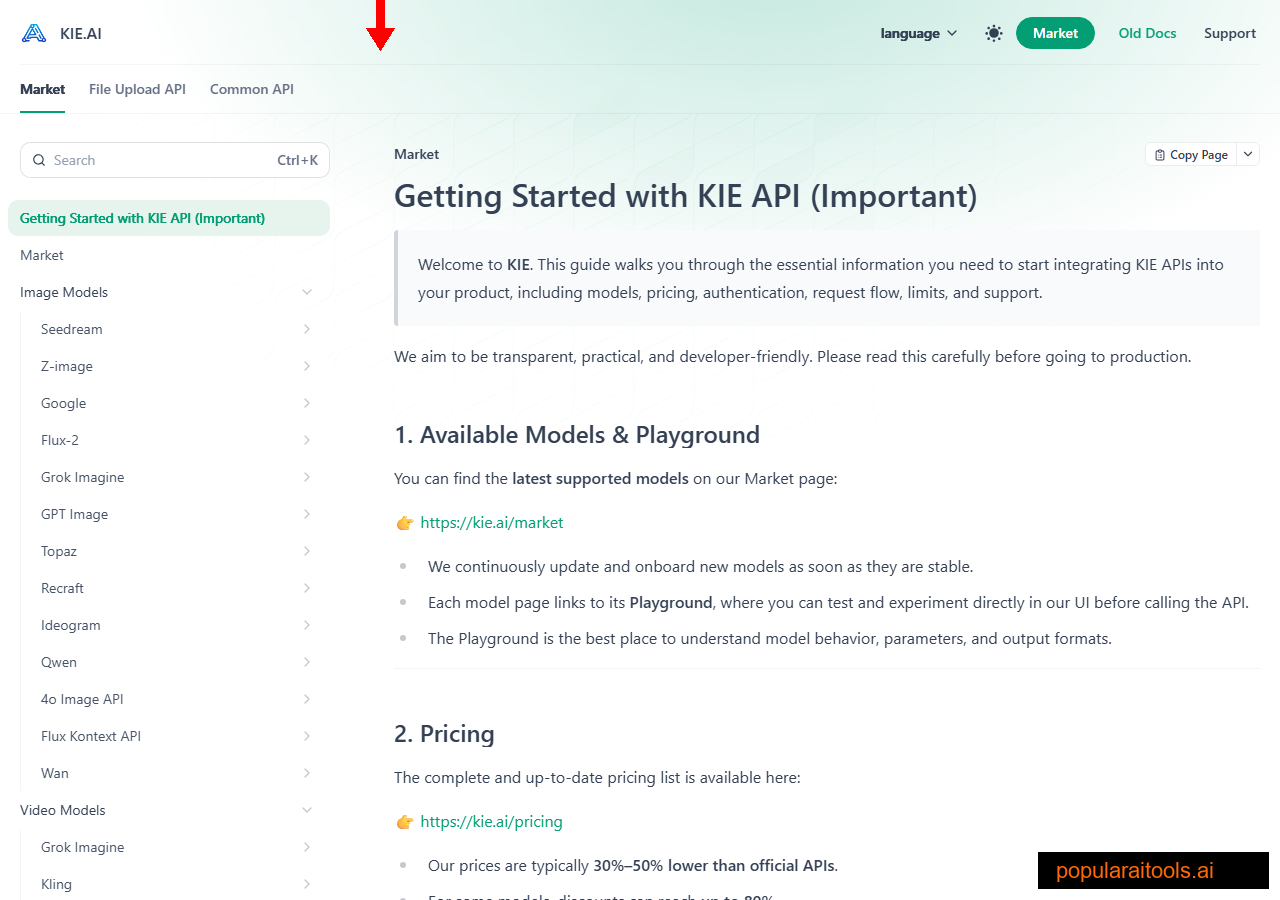
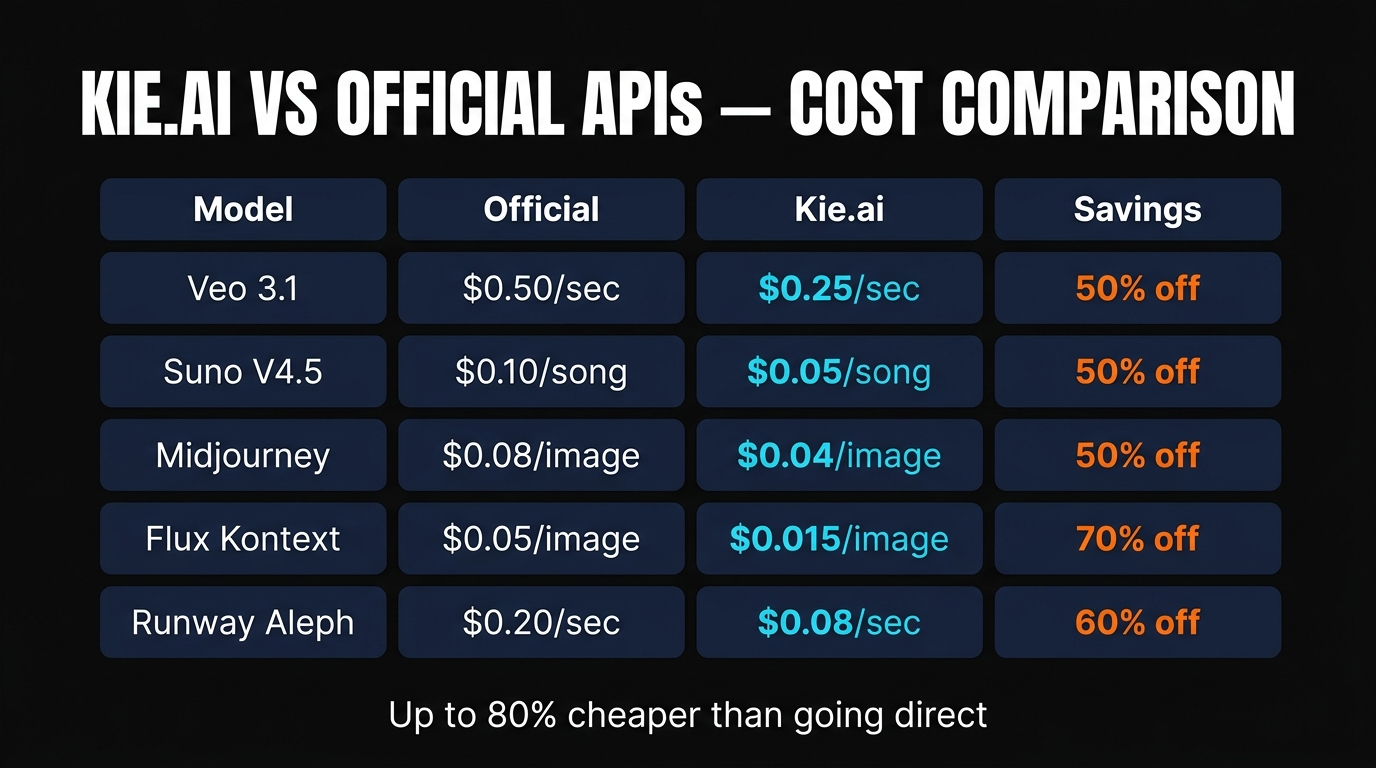
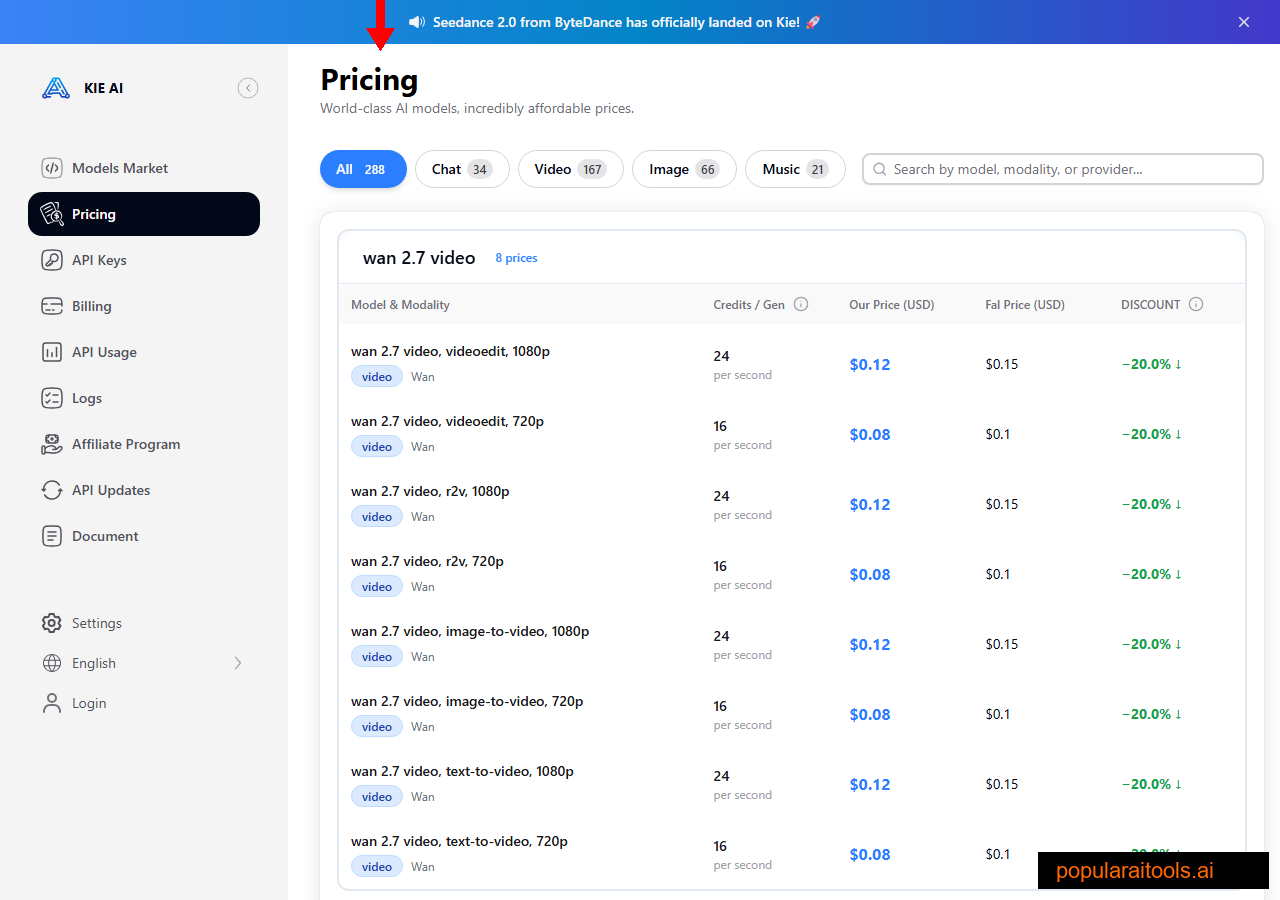
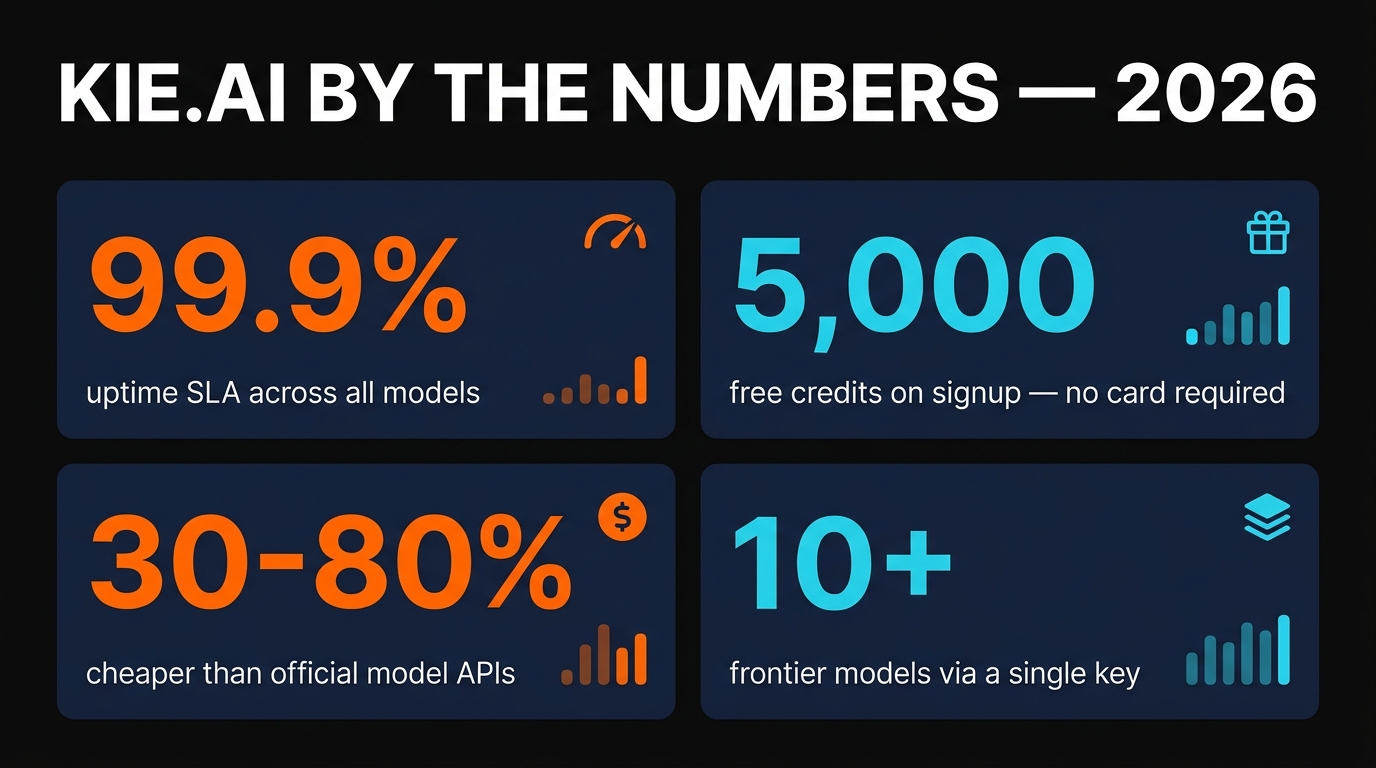
The value prop is three-fold. First, price: Kie negotiates volume deals with upstream vendors and passes the discount to you. Most models run 30-50% cheaper; a few (notably Flux.1 Kontext and Runway Aleph) land closer to 70-80% cheaper. Second, unification: one key, one billing portal, one REST shape for every model. Third, reliability: 99.9% uptime SLA and built-in retry logic on the edge, so upstream hiccups don't cascade into your stack.
Who's it for? Developers, product teams, creative studios, and anyone shipping a multi-model AI product who's tired of managing ten vendor relationships. If you only use one model and you're happy with the official API, Kie doesn't buy you much. If you touch three or more, the savings and simplification pay for themselves inside a month.
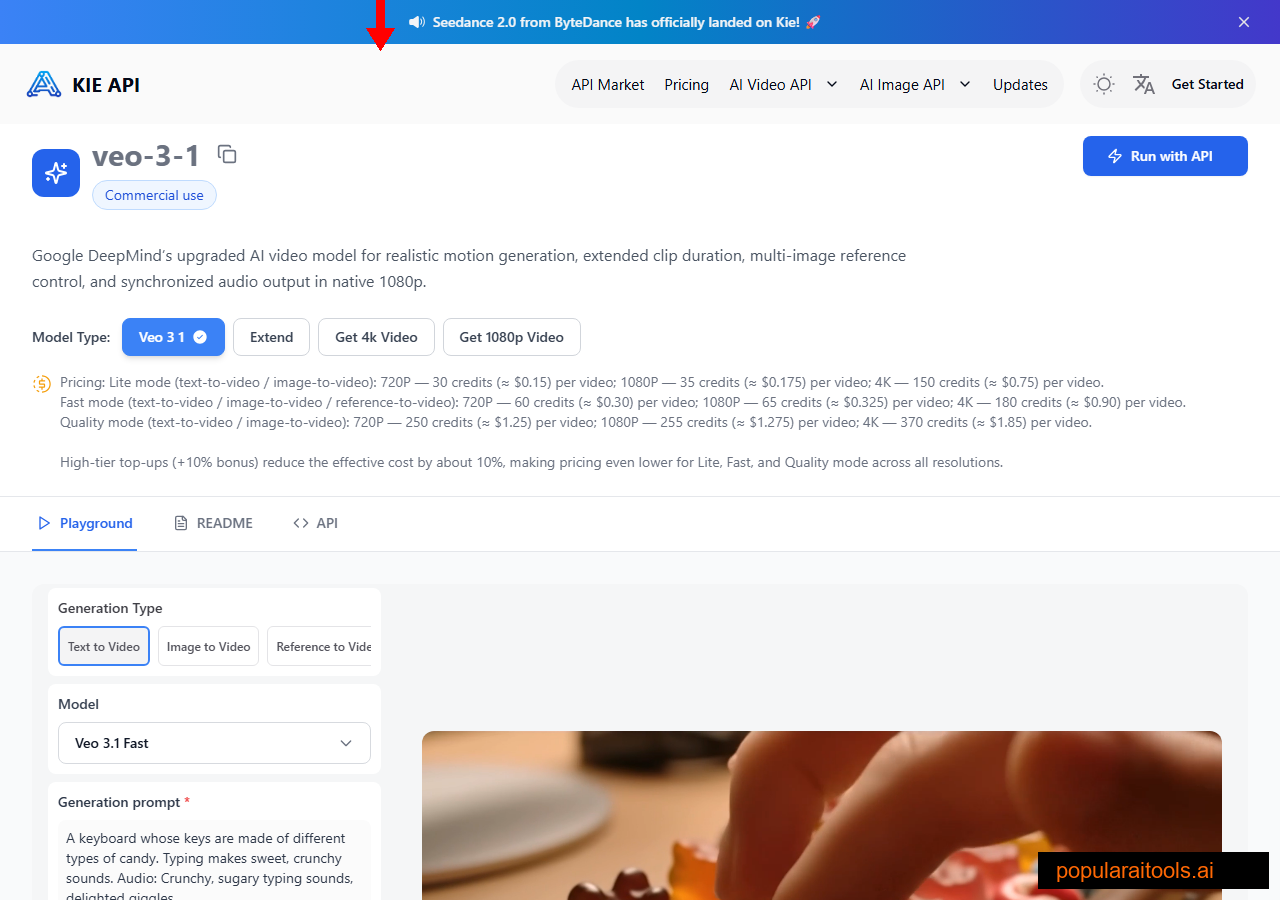
Every Model, One Key
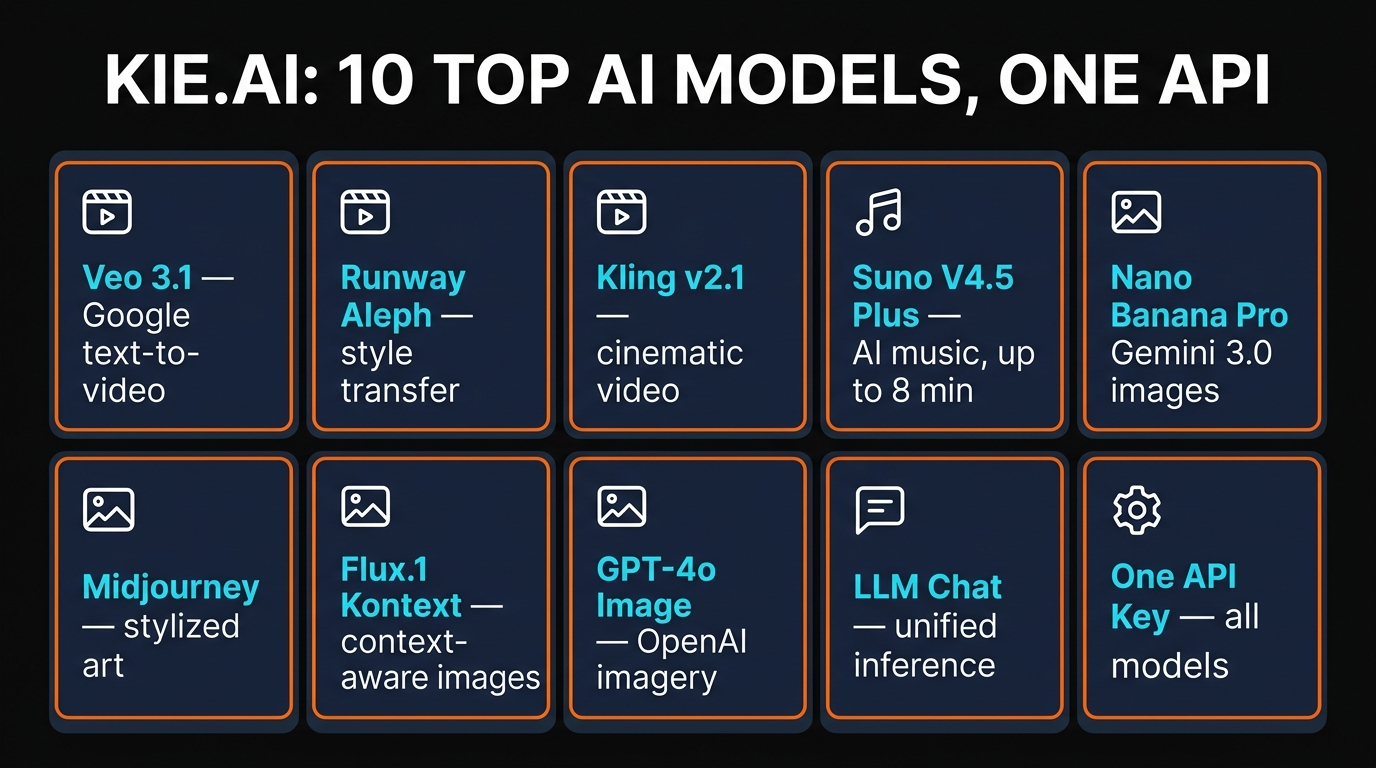
Kie's catalogue is wide. Here's what's supported in April 2026:
🎥 Video
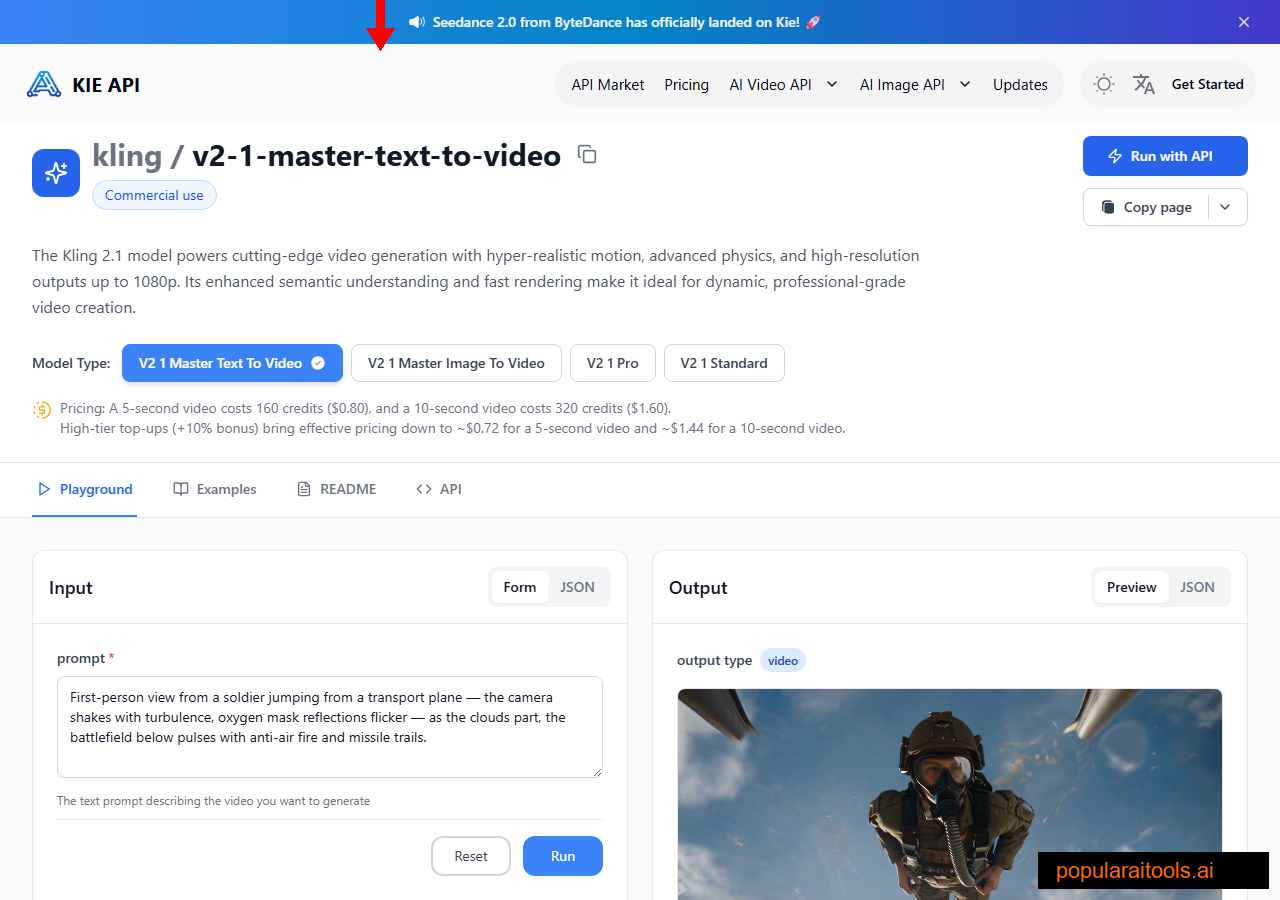
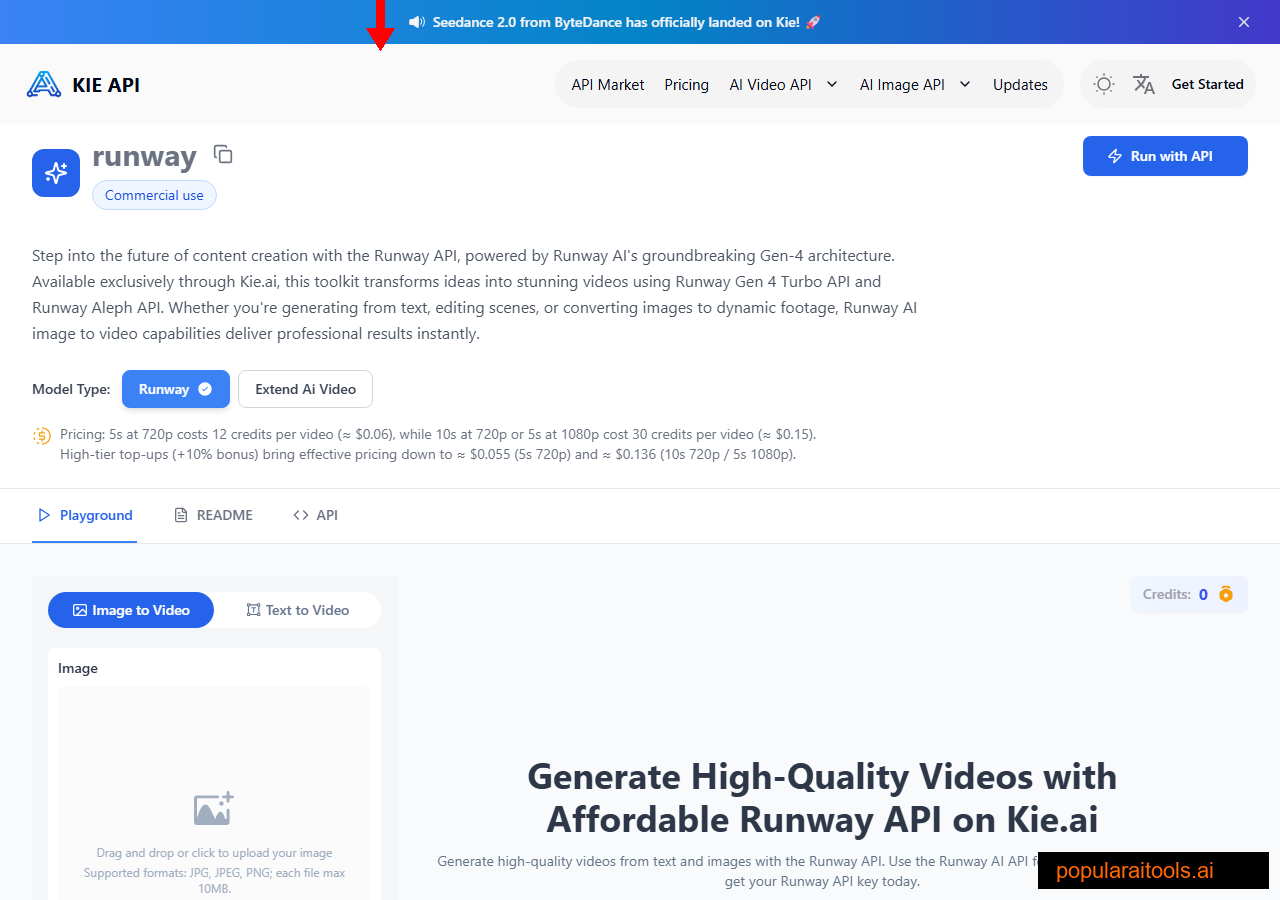
Google Veo 3.1 + Veo 3.1 Fast for text-to-video with synchronised audio. Runway Aleph for style transfer. Kling v2.1 for cinematic 1080p clips.
🎨 Image
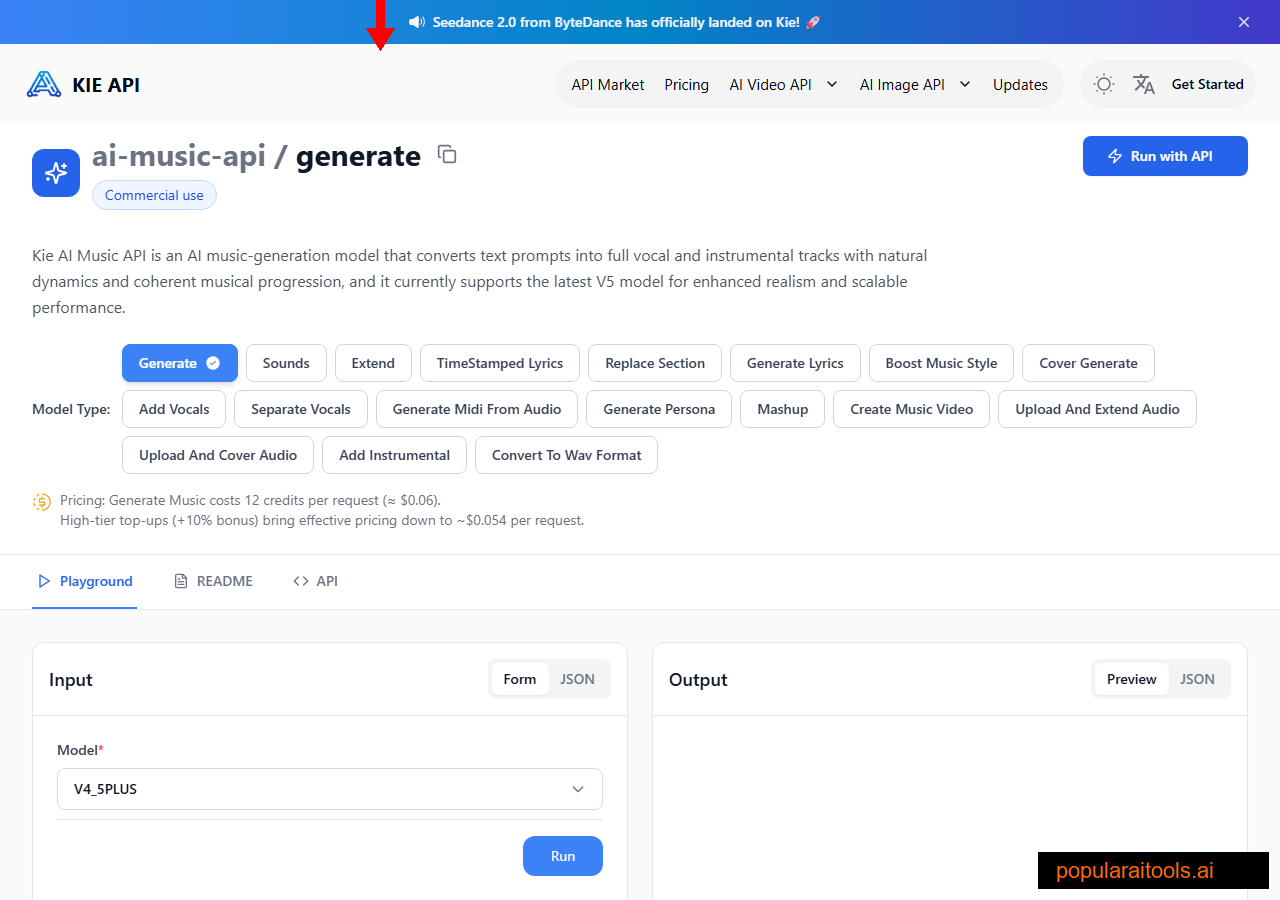
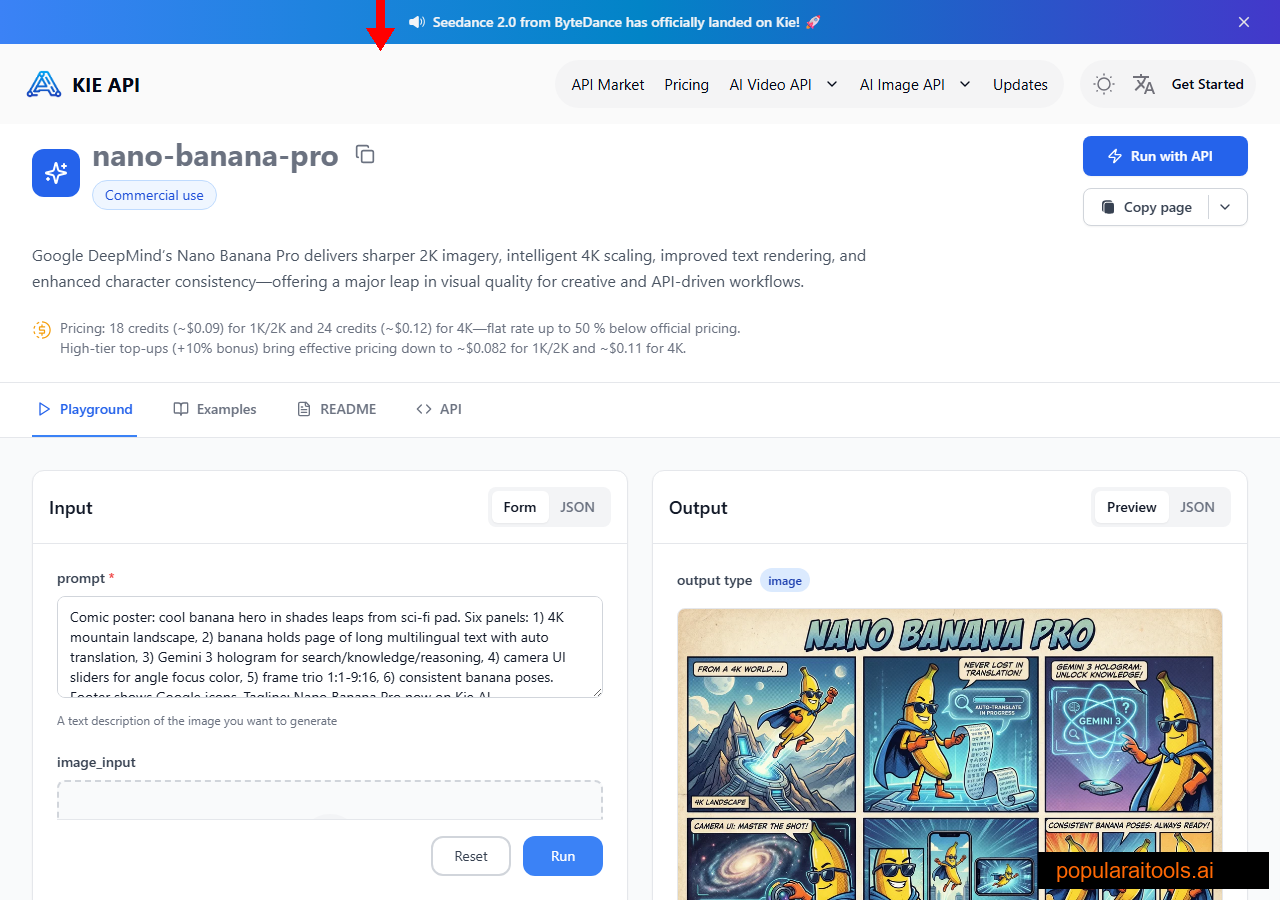
Nano Banana Pro (Gemini 3.0 imagery) for fast, high-fidelity renders. Flux.1 Kontext for context-aware edits. Midjourney for stylised art. GPT-4o Image for OpenAI's flagship.
🎵 Music
Suno V3.5, V4, V4.5, V4.5 Plus — full lineage of Suno's music engine, including 8-minute tracks and instrumental stems.
💬 Chat & LLMs
Unified inference endpoints for frontier LLMs — useful when you want to route prompts through Kie's billing instead of managing separate OpenAI and Anthropic accounts.
⚡ Streaming
Real-time streaming output on supported models — tokens and video frames arrive as they're generated, not buffered to the end.
🔧 Playground
Browser playground for every model — test prompts visually before wiring the API call into your codebase. Useful for prompt engineering and comparing outputs side-by-side.
Quick check: what Kie.ai is
Q: What is the primary function of Kie.ai as a platform?
It serves as a unified API gateway providing access to multiple frontier generative AI models through a single REST endpoint.
Q: On average, how much lower are Kie.ai's API prices compared to official provider rates?
Prices are typically $30%-50%$ lower, with some discounts reaching up to $80%$ for specific models.
Q: Which Google DeepMind architecture powers the Nano Banana Pro API?
The API is built on the Gemini 3.0 Pro Image architecture.
Q: What is the specific credit cost for generating a $4K$ resolution image with Nano Banana Pro?
A $4K$ image costs 24 credits, which is approximately $0.12.
Q: How does the Nano Banana Pro API improve upon the original Nano Banana API regarding text?
It features stabilized typography and improved alignment for clearer UI and label readability.
Q: Which FLUX.1 Kontext model variant is designed for projects requiring superior detail and intricate refinements?
The flux-kontext-max variant is the precision-oriented option for high-fidelity results.

How to Use Kie.ai
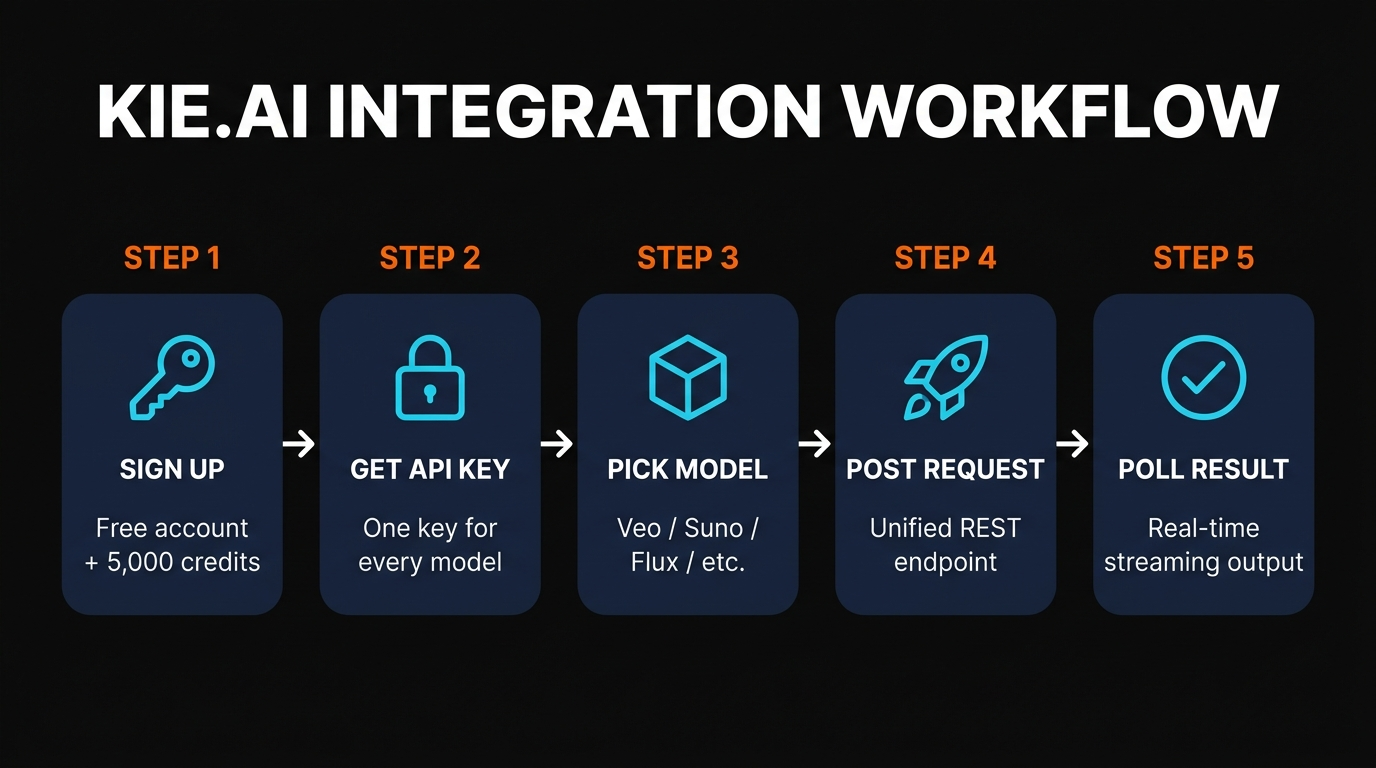
The whole integration took us under 10 minutes. Here's the five-step flow:
- Sign up at kie.ai. You get 5,000 free credits on account creation — enough for real testing, not just a hello-world call.
- Generate an API key in the dashboard. One key covers every model in the catalogue.
- Pick a model endpoint —
/v1/veo,/v1/suno,/v1/flux, etc. - POST your prompt. For long-running models (video, music) the response contains a task ID.
- Poll for completion at
/v1/tasks/{id}. Streaming-capable models push updates instead of making you poll.
A minimal Veo 3.1 call looks like this:
curl -X POST https://api.kie.ai/v1/veo/generate \
  -H "Authorization: Bearer $KIE_API_KEY" \
  -H "Content-Type: application/json" \
  -d '{
    "model": "veo-3.1",
    "prompt": "A cinematic drone shot of a mountain at sunrise",
    "duration": 8,
    "aspect_ratio": "16:9"
  }'
Response comes back in ~25s. Swap /v1/veo for /v1/suno to generate music, /v1/flux for images — same auth, same billing, same error shape.
Pricing Breakdown
Kie uses a credit system: you pre-fund your account and each model call debits credits based on its compute cost. No plans, no seats, no minimum commitments — just the balance on your card.
Free Tier
5,000
credits on signup
No card required. Enough for ~25 short Veo clips or ~100 Flux images.
Pay-as-you-go
30-80%
cheaper than official
Per-call pricing. No plans, no minimums. Top up credits when you need more.
Volume
Custom
for enterprise
Private pricing, SLA upgrades, and dedicated support for $10K+ monthly spend.

Reliability & Performance
Kie advertises 99.9% uptime and a 24.9-second average response time. During our two weeks of testing we saw zero timeouts and consistent ~25s latency on Veo 3.1, ~15s on Flux, and ~60-90s on Suno V4.5 Plus (matching the upstream vendor's own latency). No hiccups, no mystery 502s.
The edge-side retry logic is a quiet win. When an upstream provider returns a transient 500, Kie retries it before surfacing an error to you. This is the kind of thing you'd build yourself eventually — getting it for free at the gateway layer means your code stays simpler.
Practical note: Kie maintains a public status page. Subscribe to incidents before wiring them into production — any aggregator is only as reliable as its upstreams, and knowing about a Veo outage 30 seconds before your users do is a small superpower.
Quick check: pricing & integration
Q: The flux-kontext-pro model is optimized for which specific project need?
It is optimized for balanced performance and speed during standard editing tasks.
Q: What is the maximum file size supported for image uploads to the FLUX.1 Kontext API?
The maximum supported file size for uploads is 5 MB.
Q: In the FLUX.1 Kontext API, what is the valid range for safety tolerance levels during image editing?
The tolerance levels for editing range from 0 to 2.
Q: Which music model version on Kie.ai supports the generation of full tracks up to 8 minutes long?
The Suno $V4.5$ and $V4.5$ Plus models support tracks of that length.
Q: What functionality does the Suno 'Separate Vocals' endpoint provide?
It isolates vocals from complete songs or extracts instrumental parts to create clean stems.
Q: What is the prerequisite task required before a user can generate a MIDI file from audio using the Music API?
A successful Vocal and Instrument Stem Separation task must be completed first.
Pros and Cons
Strengths
- ✓ Real savings. 30-50% off most models, up to 80% on Flux and Runway Aleph.
- ✓ Every frontier model. Veo 3.1, Suno V4.5 Plus, Midjourney, Flux Kontext, Nano Banana Pro, Runway Aleph.
- ✓ One integration. Same auth, same response shape across models.
- ✓ Generous free tier. 5,000 credits, no card — real prototyping territory.
- ✓ Edge retry logic. Transient upstream errors don't propagate.
Weaknesses
- × Vendor lock-in risk. If Kie goes down or raises prices, you're re-plumbing three integrations.
- × Not all vendor features exposed. Newest experimental flags from Google/OpenAI lag a few days behind official APIs.
- × Credit system math. You have to multiply credits by model rate to know real cost — a plain dollar price would be simpler.
- × No open-source models. Replicate has a bigger catalogue of open-source weights if that's your thing.
- × Support via ticket only. No chat for free-tier users; paid plans get 24/7.

Kie.ai vs Fal.ai vs Replicate
Three obvious competitors sit in the same lane. Here's how they stack up for a multi-model product in 2026:
| Feature | Kie.ai | Fal.ai | Replicate |
|---|---|---|---|
| Veo 3.1 | ✓ (50% off) | ✓ | × |
| Midjourney | ✓ | × | × |
| Suno V4.5 Plus | ✓ | ✓ | × |
| Open-source models | Limited | Good | Best |
| Avg. price vs official | -50% to -80% | -20% to -40% | Par with official |
| Free tier | 5,000 credits | $1 free | Limited |
| Best for | Commercial multi-model | Real-time/streaming | Open-source research |
Short version: Kie wins on price and commercial-model breadth. Fal wins on streaming and real-time features. Replicate wins on open-source catalogue. For most production products shipping in 2026, Kie is the first one we'd wire up.
Final Verdict
4.6/5. Kie.ai is the sharpest-priced, widest-model AI API gateway we've shipped with in 2026. If you're building anything that touches more than one generative model, the economics and engineering time saved are hard to argue with.
Dock half a star for the credit-system math (a flat dollar rate would be cleaner) and the inevitable vendor lock-in risk of routing everything through one gateway. Neither is a dealbreaker; both are manageable with a thin abstraction layer on your end.
Who should use it: indie devs and startups shipping multi-model AI products, agencies running creative pipelines across video/image/music, and anyone currently paying full official-API rates for Veo, Suno, or Midjourney access.
Who should skip: single-model shops, enterprises that need direct vendor SLAs, and anyone using mostly open-source models (Replicate is the better fit there).
Try Kie.ai Free — 5,000 Credits on Signup
No card required. One key, every frontier model, up to 80% cheaper than going direct.

Source-grounded cheat sheet
NotebookLM extracted the following head-to-head comparison and concept recap directly from this review. Use it as a scannable end-card.
| Feature | Kie.ai | Fal.ai | Replicate |
|---|---|---|---|
| Veo 3.1 | ✓ Veo 3.1 + Veo 3.1 Fast with synced audio | ✓ Supported | × Not available |
| Midjourney | ✓ Programmatic API access | × Not supported | × Not supported |
| Suno V4.5 Plus | ✓ V3.5 through V4.5 Plus | ✓ Supported | × Not supported |
| Open-source models | Limited | Good | Best in class |
| Pricing vs official | 30–80% cheaper | 20–40% cheaper | Par with official |
| Free tier | 5,000 credits, no card | $1 free credit | Limited |
| Best for | Commercial multi-model products & agencies | Real-time & streaming apps | Open-source research & experimentation |
Quick check: alternatives & when to pick Kie
Q: Which Runway API model is specifically designed for 'in-context' video editing tasks like relighting and object removal?
The Runway Aleph API is designed for multi-task video manipulation and editing.
Q: What is the average response time for generative tasks on the Kie.ai platform?
The average response time across models is approximately 24.9 seconds.
Q: Which two authentication headers are required for every Kie.ai API request?
Requests must include 'Content-Type: application/json' and 'Authorization: Bearer {API_KEY}'.
Q: Under Kie.ai's data retention policy, how long are generated media files stored before automatic deletion?
Generated media files are stored for exactly 14 days.
Q: For how many months does Kie.ai retain text and metadata log records?
Log records are stored for a period of 2 months before being deleted.
Q: What is the default rate limit for new generation requests per account on Kie.ai?
The default limit is 20 new generation requests every 10 seconds.
Related Articles
Frequently Asked Questions
❓ What is Kie.ai?
Kie.ai is a unified API gateway for generative AI. One API key gives you access to Veo 3.1, Suno V4.5 Plus, Midjourney, Flux.1 Kontext, Nano Banana Pro, Runway Aleph and more — typically 30-80% cheaper than going direct to each vendor.
❓ How much does Kie.ai cost?
Pay-as-you-go credits. 5,000 free on signup (no card). Per-call prices are 30-50% below official APIs for most models, up to 80% off on Flux.1 Kontext and Runway Aleph. Enterprise volume discounts available over $10K/month.
❓ Which models does Kie.ai support?
Video: Veo 3.1, Veo 3.1 Fast, Runway Aleph, Kling v2.1. Image: Nano Banana Pro, Flux.1 Kontext, Midjourney, GPT-4o Image. Music: Suno V3.5 through V4.5 Plus. Plus unified LLM chat endpoints.
❓ Is Kie.ai reliable for production?
Yes — 99.9% uptime SLA, ~25s average response latency, 24/7 support on paid plans. Edge-side retry logic absorbs transient upstream errors before they hit your code.
❓ Kie.ai vs Fal.ai — which is better?
Kie wins on price (-50 to -80%) and commercial-model breadth (Midjourney, Veo 3.1). Fal wins on real-time streaming and open-source coverage. For most multi-model products shipping to production, Kie is the first stop.
❓ Does Kie.ai offer a free trial?
Yes — sign up and you get 5,000 credits instantly with no credit card required. Enough to generate 20+ Veo 3.1 clips or 100+ Flux images before you commit to paid usage.

Get Premium AI Tool Insights
Subscribe to get weekly curated AI tool recommendations, exclusive deals, and early access to new tool reviews.
Related Tools

Droidrun
ai-automation
Open-source AI framework that lets LLM agents control Android and iOS apps via native accessibility APIs. 91.4% success rate, €2.1M funded.
M
Manus AI
ai-automation
Autonomous AI agent platform that executes complex multi-step tasks — browses the web, writes code, creates files, and works in the background without guidance.
R
Renamer.ai
ai-automation
AI-powered file renaming tool that uses OCR to read document content and automatically generates meaningful file names. Supports 30+ file types and 20+ languages.

MuleRun
Related Articles
Suno v6 Intro and Ending Prompts: Unwanted Humming, Long Outros and Cut-Off Lyrics (2026)
Fix the edges of a Suno v6 track: three pasteable intro and outro templates, the documented Exclude field for unwanted humming, the arithmetic behind cut-off lyrics, and when to edit in Studio instead.
Suno v6 Keeps Changing Your Prompt? Variety, Style Influence and Weirdness Explained (2026)
Suno v6 rewrites your style prompt through the new Variety slider, and Suno documents the fix. What Variety, Style Influence, Weirdness and Max Mode each do, with a one-control-at-a-time worksheet.
Suno v6 Rock Prompts: Keep Guitar Riffs and Drums Alive Through the Verse (2026)
Why a strong Suno v6 rock intro turns into an empty verse, and how to fix it with a section-by-section instrument map, the Exclude field, pasteable rock and metal prompts and an A/B rubric.