Scite AI Review 2026: The Smart Citation Engine Researchers Trust

Head of AI Research
Key Takeaways
- Smart Citations are the killer feature. Scite classifies every citation as supporting, contrasting, or mentioning, so you can instantly see whether a finding holds up.
- Massive coverage. Over 280 million articles, preprints, books, patents, and datasets, with 1.3 billion citation statements analyzed.
- Hallucination resistant. The Scite Assistant grounds answers in real papers with inline links, never inventing references.
- Institutional access is widespread. Purdue, Case Western, Alabama, Cornell, and hundreds of others offer free access through library logins.
- Pricing is fair for individuals. Around 20 dollars per month, with student discounts and a usable free tier for occasional searches.
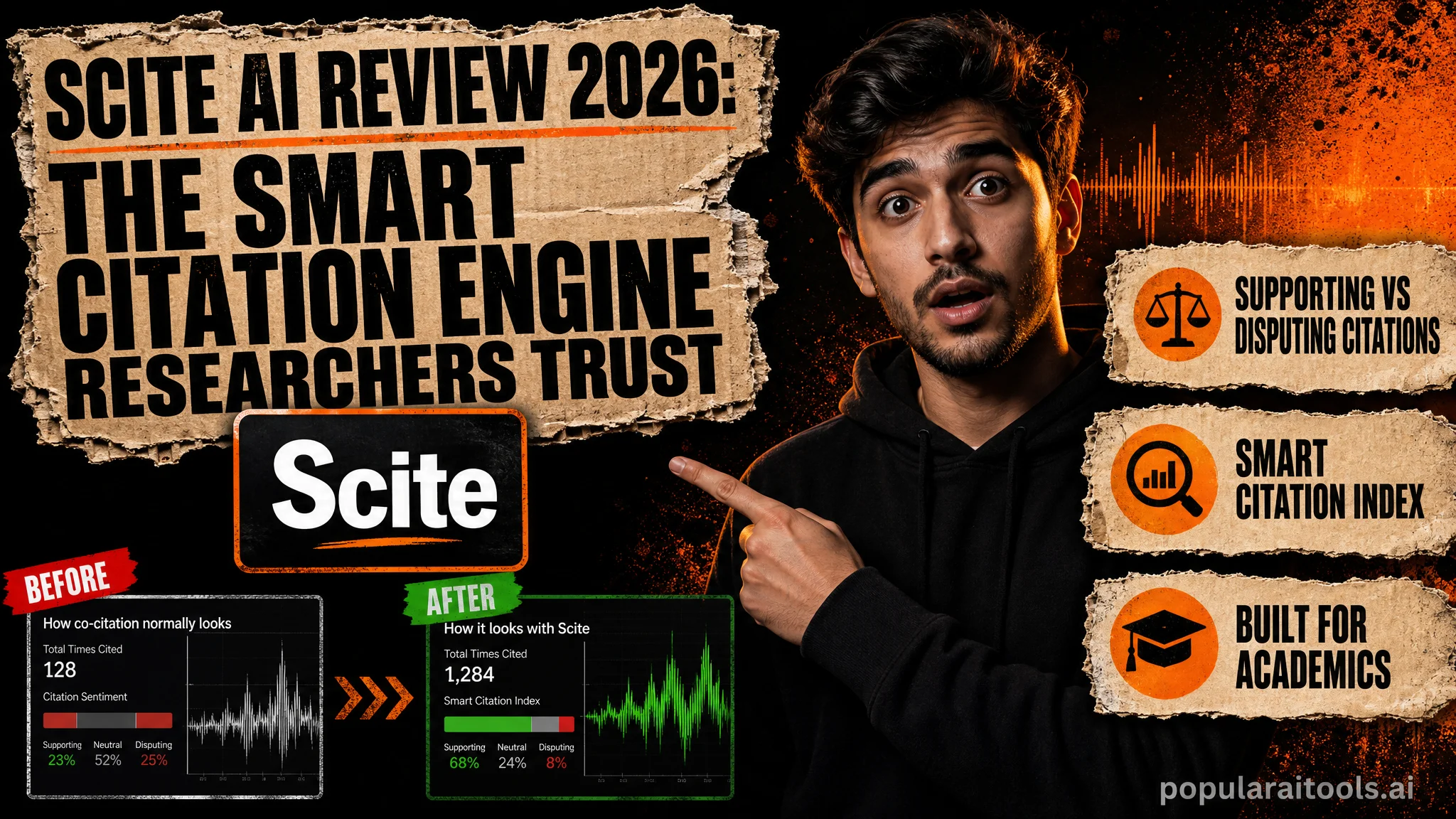
Every researcher has hit the same wall. You find a paper with 400 citations and assume the finding is solid, only to realize months later that 60 of those citations were authors politely refuting the result. Citation counts lie. Scite AI was built to fix exactly that problem, and after testing it across systematic reviews, grant prep, and a literature scan on a contested clinical claim, it has become the one academic AI tool I refuse to work without.
This Scite AI review covers what the platform actually does in 2026, how Smart Citations work under the hood, how the Assistant compares to ChatGPT for research questions, what pricing looks like for individuals and institutions, how the login flow works at universities like Purdue, and where Scite wins or loses against Elicit and Consensus. By the end you will know whether it deserves a slot in your research stack.
What Is Scite AI?
Scite AI is an evidence-first research platform that indexes more than 280 million articles, preprints, books, patents, and datasets, then layers on a proprietary classifier that reads the sentences around every citation and tags it as supporting, contrasting, or mentioning. Founded in 2018 and acquired by Research Solutions in 2023, Scite has grown to over two million users, with deployments at top universities, pharmaceutical companies, and government research bodies.
Where Google Scholar gives you a number, Scite gives you a verdict. That single design choice changes how literature reviews feel. You stop guessing whether a 2019 finding still holds and start seeing the trail of confirmations and pushbacks that followed it. Add in full text search, custom dashboards, reference checks for your own manuscript drafts, and an AI Assistant that writes literature summaries with verifiable citations, and you have a platform purpose-built for serious academic work.
Smart Citations Explained
Smart Citations are Scite's signature output. For every cited paper, the system extracts the exact citing sentence, the section it appeared in (intro, methods, discussion), and a classification verdict produced by a deep learning model trained on hundreds of thousands of human-labeled examples. The result is a color-coded view: green for supporting, red for contrasting, gray for mentioning.
In practice, I ran a search on a well-known psychology effect that has been heavily contested in the replication crisis era. Google Scholar showed 2,100 citations. Scite showed 1,840 mentioning, 190 supporting, and 71 contrasting. Clicking the contrasting tab pulled up the exact paragraphs where later researchers explained their failed replications. That is forty hours of manual reading collapsed into a ten minute scroll.
How accurate is the classifier?
Scite has published validation studies suggesting precision in the high 80s to low 90s for supporting and contrasting labels. In my spot checks across roughly 50 randomly sampled citations, the classifier got the gist right about 9 times out of 10. The misses tended to be subtle hedging language where the author was partially agreeing. For a screening tool, that accuracy is excellent. You still verify before you cite.
The Scite Assistant in Practice
The Scite Assistant is a generative AI layer that answers natural language research questions. You type something like "What is the current evidence on time restricted eating for type 2 diabetes?" and it returns a structured answer with inline citations linked to the underlying papers. Unlike ChatGPT, every claim is anchored to a real publication you can open and read.
You can constrain the Assistant to Scite's closed dataset of peer-reviewed and open-access papers, or let it pull from the open web for broader coverage. For literature reviews, grant background sections, and methods scoping, the closed mode is the safe default. I have used it to draft the first pass of a 1,500 word background section in under an hour, then spent another hour verifying and tightening. That kind of leverage is why researchers are paying for it out of pocket even when their institution has not subscribed yet.
If you also work with code-focused research agents, our breakdown of 61 AI agents on GitHub covers the open source tools that complement Scite for data analysis and reproducibility work.
Scite AI Login and Institutional Access
The Scite AI login flow is simple. Head to scite.ai, click Sign In, and authenticate with email and password, Google, or institutional single sign on. If your university has a subscription, the easiest path is through your library's database list, which routes you through the proxy server and grants you the full institutional feature set without needing a personal account.
If you already have a personal Scite account, you can link it to your institutional access so saved searches and dashboards persist across login methods. For first time setup, use your university email when creating the account, because Scite checks the domain against its institutional license database and automatically unlocks the right tier.
Scite AI at Purdue and Other Universities
Scite AI Purdue access is a common search because Purdue Libraries provide full institutional access to students, faculty, and staff. The route is the standard one: log into the Purdue Libraries database portal, find Scite in the A to Z list, and click through. You will land in Scite already authenticated under the Purdue license. The same flow applies at the University of Alabama (pilot subscription running through September 2026), Case Western Reserve, Cornell, Maastricht University, Johns Hopkins, and dozens more.
If your library has not subscribed yet, request a trial through the Scite team. Pilot subscriptions are common because the platform sells itself once a few graduate students start using it for thesis work. The institutional pricing scales with FTE count and is usually a tiny fraction of what libraries pay for traditional databases.
Scite AI Pricing 2026
Compared to legacy databases that charge libraries six figures per year, Scite is a bargain. For individuals, the 144 dollar annual plan pays for itself the first time it saves you a weekend of manual citation chasing.
Scite vs Elicit vs Consensus
The three big names in AI research search overlap on goals but diverge sharply on method. Here is how they compare head to head in 2026.
If you want a deeper look at the alternatives, see our Elicit AI review and our Consensus AI evaluation. The honest take is that the best researchers I know use all three for different jobs. Scite for context and citation chasing, Elicit for structured data extraction across dozens of papers, Consensus for fast confidence checks on a single claim.
Pros, Cons, and Real Reviews
Scite AI reviews from active researchers are overwhelmingly positive. Emir Efendić at Maastricht calls it indispensable for finding related work. Kathleen McCormick at Cornell credits it with making the verify-then-cite process actually feasible during PhD level literature searches. Mark Mikkelsen at Johns Hopkins says it makes placing a paper in the wider literature trivial. The criticisms are real but narrow: coverage in humanities and law is weaker than in STEM, and the Assistant occasionally over-summarizes nuanced findings.
Pros
- Smart Citations expose contradictions Google Scholar hides
- Assistant answers are grounded with verifiable inline links
- Massive 280M+ document corpus including preprints and patents
- Strong institutional support at major universities including Purdue
- Reference check tool catches retracted or contested citations in your drafts
- Reasonable pricing with usable free tier and student discount
Cons
- Humanities and legal coverage is thinner than STEM
- Free tier limits make heavy users upgrade quickly
- Classifier occasionally mislabels hedged citing language
- Assistant can be slow on broad queries with thousands of hits
- Mobile experience trails the desktop interface
For broader productivity stacking around your research workflow, our comparison of Notion AI versus ClickUp AI covers the documentation and project layer that pairs naturally with Scite output. Writers polishing manuscripts should also look at Writefull for academic writing, which complements Scite by handling the prose side once your evidence is sorted.
A Real Workflow With Scite
Here is the loop I run when starting a new literature review. Ask the Scite Assistant the broad question to surface the top 20 anchor papers. For each anchor, open the Smart Citations panel and scan the contrasting tab first. Add anything provocative to a custom dashboard. Run a citation statement search on the central claim to find papers that referenced it directly. Export the dashboard to RIS, drop it into Zotero, and start drafting. The whole flow takes two hours instead of two weeks.
If you are exploring what else AI can automate in your daily work beyond research, our roundup of favorite future-facing AI tools covers complementary productivity picks worth bookmarking.
Final Verdict
Scite AI earns a strong recommendation for anyone doing serious research in 2026. Smart Citations alone justify the subscription, and the Assistant has matured into a hallucination-resistant tool you can actually trust for first drafts. It is not a replacement for reading papers, and the coverage gaps outside STEM mean humanities scholars should pair it with discipline-specific databases. But for evidence evaluation at scale, nothing else on the market matches it.
Start with the free tier, run a few queries on topics you know well, and judge the classifier accuracy for yourself. If you have institutional access through Purdue, Alabama, Case Western, or any other partner library, there is no excuse not to be using it already.
Frequently Asked Questions
What is Scite AI used for?
Scite AI is used to discover, evaluate, and contextualize scientific literature. Researchers rely on it for literature reviews, citation analysis, grant writing, and verifying whether claims in their own drafts are supported by current evidence.
How much does Scite AI cost in 2026?
Pricing starts free with usage limits, climbs to roughly 12 dollars per month for verified students, and runs about 20 dollars per month or 144 dollars per year for the Premium individual plan. Institutional pricing is negotiated by FTE count.
Is Scite AI available at Purdue University?
Yes. Purdue Libraries provide institutional Scite AI access. Log in via the Purdue Libraries portal or sign in directly at scite.ai using your Purdue email to be recognized by the institutional license.
How do I log in to Scite AI?
Go to scite.ai and click Sign In. Use email and password, Google sign in, or your institutional SSO. For university members, the library database portal is the smoothest route because it handles authentication automatically.
Does Scite AI hallucinate like ChatGPT?
Scite AI is engineered to minimize hallucinations by anchoring every Assistant answer in real citation statements from indexed papers. Each claim links to its source, so you verify before you cite rather than trust unsourced generative text.
Is Scite AI better than Google Scholar?
For citation context and evidence evaluation, Scite is significantly better. Google Scholar shows raw citation counts. Scite shows whether each citation supports, contrasts, or merely mentions the original claim, which is what actually matters for assessing scientific consensus.
Recommended AI Tools
played.fm
Sell your music and keep 100%: played.fm is a direct-to-fan store + sync marketplace with 0% commission, no gatekeepers, and no bans — a strong fit for AI musicians.
View Review →OpenCode
The open-source AI coding agent: terminal-first TUI, 75+ model providers, LSP context, subagents, and privacy-first design. Free software, ~180K GitHub stars.
View Review →Exa
The neural web search API for AI agents: embeddings-based retrieval, cited highlights, sub-180ms latency, and an MCP server. 20,000 free requests/month.
View Review →Google Antigravity
Google's agent-first IDE: run a fleet of AI agents from a Manager surface, on Gemini 3 Pro, Claude Sonnet 4.5, or OpenAI models. Free in public preview.
View Review →