Sync Licensing for AI Music: How to Land Netflix/TV/Movie Placements

AI Creative Tools Specialist
TL;DR
One sync placement = roughly 2 million Spotify streams in total earnings. AI music creators can compete — but only if the tracks pass platform screening first.
- Sync fees: $100 (small YouTube) → $5,000+ (TV commercial) → $250,000+ (film)
- AI-generated tracks are increasingly screened and rejected by sync libraries
- The fix: generate → clean AI signature → PRO register → upload to 3–5 libraries
- A 50-track catalog can realistically reach $20,000–$50,000/year by year three
Table of Contents
- What Is Sync Licensing?
- The Money: Sync vs Streaming Royalties
- The 6 Best Sync Licensing Companies
- The AI Music Problem (and How to Fix It)
- The 7-Step Workflow: AI Music to Sync Royalties
- License Music for Film, TV, and Commercials: What Pays What
- Realistic Earnings: 50-Track Catalog Projection
- Common Mistakes That Kill Sync Submissions
- Related Articles
- Submit Your AI Tool
- FAQ
What Is Sync Licensing?
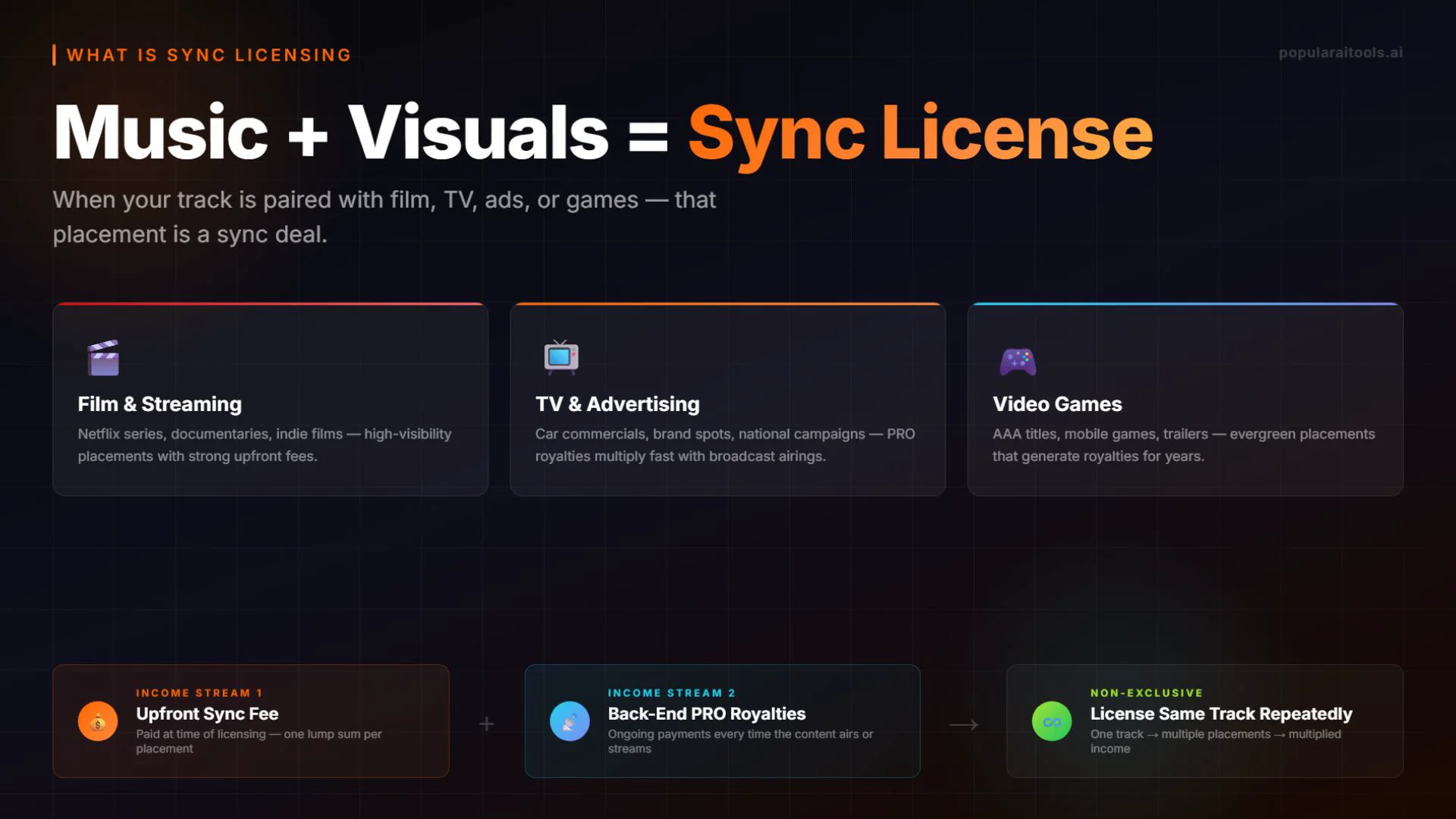
Sync licensing is the legal process of licensing music for use synchronized with visual media. When a track plays behind a scene in a Netflix series, under the footage in a car commercial, or through the speakers of a video game — that's a sync placement. The music and the visuals move together, hence "sync."
Music sync licensing pays in two separate streams. First, there's the upfront sync fee — a lump sum paid by the production company or ad agency for the right to use your track. That money hits your account before the project ever goes live. Second, there are back-end performance royalties paid through your Performing Rights Organization (PRO) — ASCAP, BMI, or SESAC in the US, PRS in the UK — every time the placement airs on broadcast, cable, or qualifying streaming platforms. These royalties can continue for years, sometimes decades, after the initial placement.
The math is what makes sync licensing worth understanding seriously. A single mid-tier advertising placement — say, a regional TV spot that runs for a year — can generate $1,500–$5,000 upfront plus $500–$2,000 annually in performance royalties. Compound that over 5 years and you're looking at $4,000–$15,000 from one track in one placement. That same track could be sitting on five different sync platforms simultaneously, each eligible for additional placements.
Most sync deals are non-exclusive, which means you retain the right to distribute the same track on Spotify, upload it to other sync libraries, or license it again to different productions. One track, many placements, compounding over time. This is what separates music sync licensing from one-time work-for-hire.
The Money: Sync vs Streaming Royalties
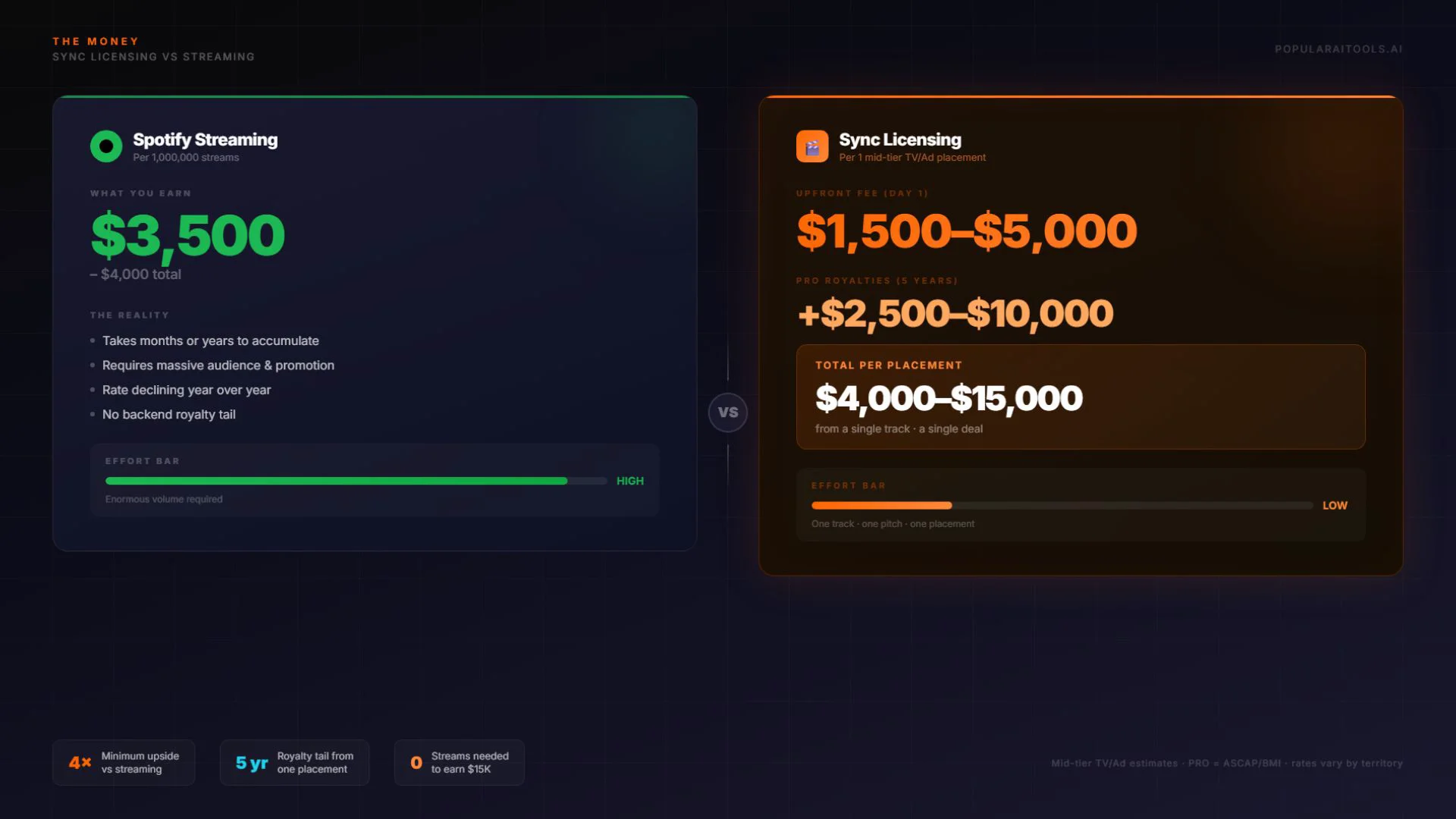
Streaming numbers look impressive. One million plays. Five million plays. The reality of what those numbers actually pay is less exciting. Here's the honest comparison:
The compounding effect is the real story. A creator who lands 8 placements in year two isn't just earning from those 8 deals — they're also collecting back-end royalties from the 3 placements they landed in year one. The income layers. Streaming doesn't layer. It resets every month.
"One sync placement — a single TV ad that runs regionally for a year — can pay more than a year of streaming revenue from a modestly successful Spotify track. And it keeps paying."
The 6 Best Sync Licensing Companies
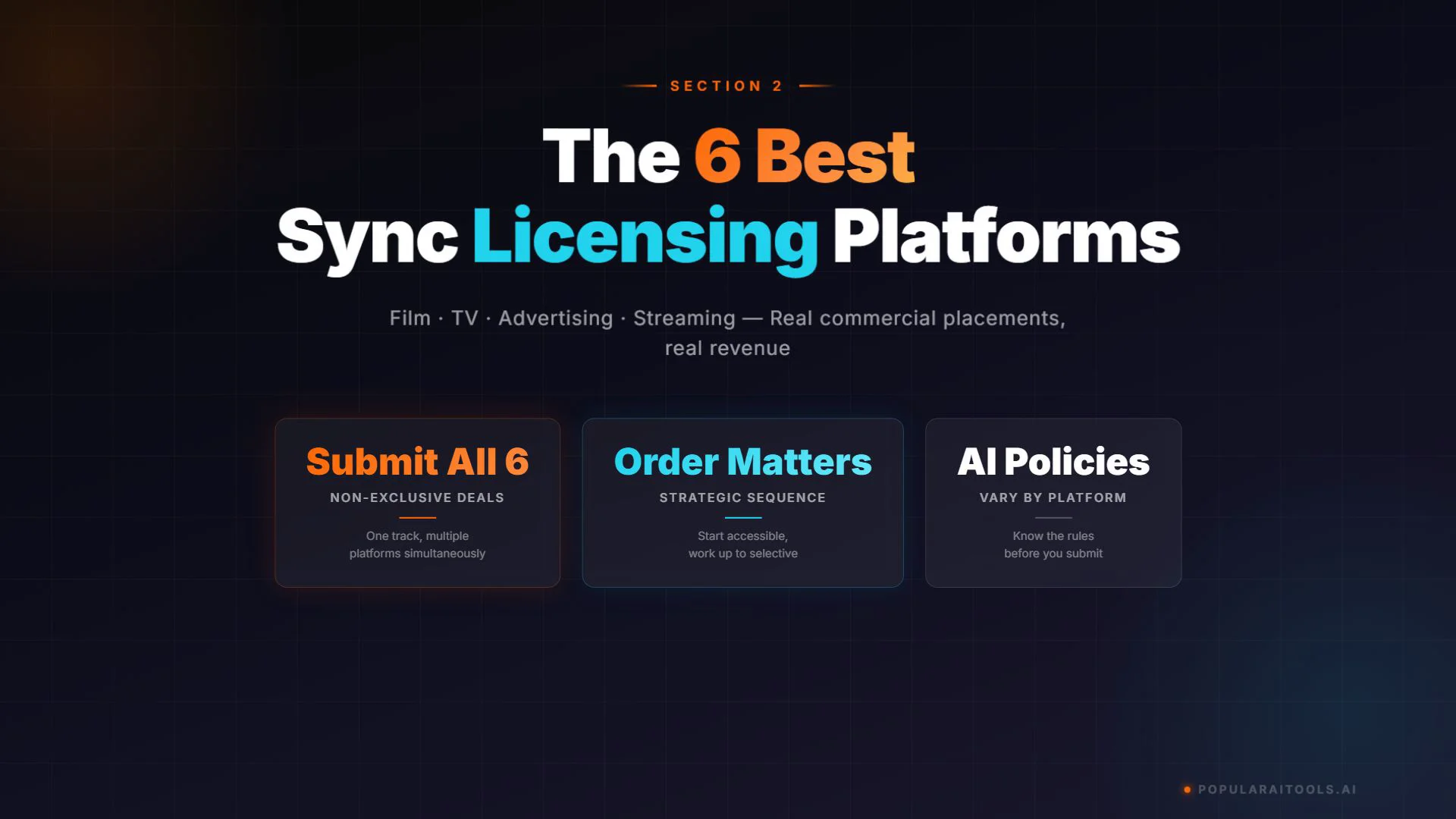
These are the platforms that actually move music into commercial, film, and TV placements. The good news for AI music creators: you can submit to all six simultaneously, since most deals are non-exclusive. The order here reflects how I'd actually sequence submissions.
A quick note on strategy: Musicbed's submission process is selective and their AI music policy is worth reading carefully before you apply. Pond5 and Artlist are where most people should start — higher acceptance rates, massive client bases, and policies that are more permissive toward AI-generated material in practice. Get 20+ tracks accepted there first, then use that catalog as a calling card for Musicbed.
The AI Music Problem (and How to Fix It)
Here's what no one tells you when they hype up AI music as a sync income stream: the bottleneck isn't generating good tracks. It's getting them through submission screening.
Sync libraries and professional music supervisors have been quietly tightening their AI detection protocols throughout 2025–2026. The volume of AI submissions has exploded — which means platforms have had to get more aggressive about filtering. The tools they use operate on multiple layers:
- SynthID watermarks — Google DeepMind's SynthID embeds an inaudible fingerprint in AI-generated audio. Suno and Udio both integrate it. Detection is automated and reliable.
- Platform-specific fingerprinting — Suno and Udio output patterns are increasingly cataloged. Spectral analysis tools can identify statistical characteristics typical of transformer-based audio synthesis.
- C2PA metadata — Content credentials can tag audio as AI-generated at the metadata level, flagging it before a human reviewer even listens.
Tracks that fail these checks get rejected at submission, removed post-acceptance, or quietly deprioritized in search results. You can generate a genuinely excellent track in Suno and still have it bounced from Musicbed before anyone hears it — not because the music was bad, but because the AI signature triggered an automated filter.
The solution is to clean the signature before submission. Undetectr (the only AI artifact remover purpose-built for music) addresses exactly this problem. It strips SynthID watermarks, removes Suno/Udio fingerprints, and processes the audio without degrading quality — the goal is tracks that pass platform screening and still sound the way you intended them to.
Why This Step Matters
Running your tracks through Undetectr before submission isn't about deceiving platforms — it's about giving your music a fair shot at evaluation on its own merits. A rejected submission gets no second look. A clean track that gets through to a music supervisor gets played.
The 7-Step Workflow: AI Music to Sync Royalties
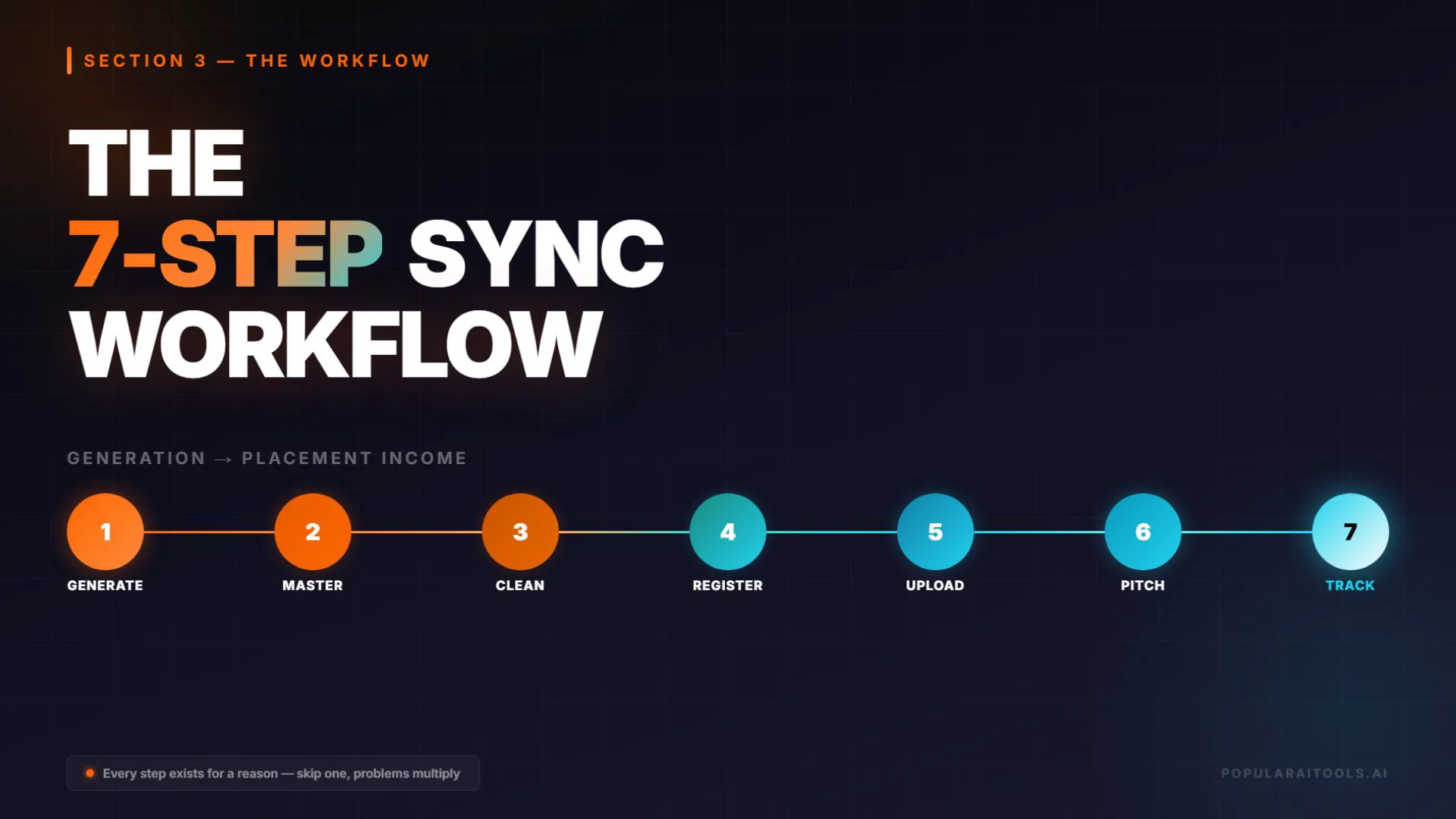
This is the actual process. Not theory — a repeatable chain from generation to placement income. Each step exists for a reason; skipping any of them creates problems downstream.
-
Generate with Suno or Udio
Both tools have strengths. Suno handles song structure and production polish well — good for complete, genre-accurate tracks. Udio tends to produce more distinctive vocal performances. See the Udio vs Suno comparison for a side-by-side. For sync specifically, lean toward instrumental or vocal tracks with clear genre identity — music supervisors search by mood and genre, not abstract concepts.
-
Master for distribution
Suno Pro and Udio Pro both offer stem downloads. Import into a DAW, run through basic mastering (EQ, compression, limiting to -14 LUFS for broadcast). Sync libraries require WAV or AIFF — high-quality MP3 may be rejected at upload. This step also gives you a chance to extend intros or add alternate endings, which music supervisors frequently request.
-
Run through Undetectr
Before submitting to any sync library, process each track through Undetectr. This removes the SynthID watermark, Suno/Udio fingerprints, and C2PA metadata that trigger automated rejection filters. The €39 lifetime license covers unlimited tracks — treat it as a one-time cost of admission for the sync market.
-
Register with a PRO
Do this before your first submission, not after. ASCAP and BMI are free to join in the US; SESAC is invite-only. PRS handles UK registration. Register both your publishing entity and each individual track. PRO registration takes several weeks to process — every week you delay is back-end royalties you can't collect. The PRO is where the compounding income actually comes from.
-
Upload to 3–5 sync libraries simultaneously
Start with Pond5 and Artlist — lowest barriers to entry, large client bases, permissive policies in practice. Add Soundstripe once you have 10+ tracks. Music Gateway is valuable specifically for brief-matching — create a profile and submit to active briefs when you have relevant tracks. Save Musicbed for when you have a polished catalog of 20+ tracks with consistent production quality.
-
Submit to active sync briefs
Music Gateway, DISCO, and Songtradr all have brief systems where music supervisors post specific requests ("looking for dark electronic underscore, 90 seconds, no vocals, for thriller streaming series"). These are direct opportunities to pitch a specific track for a specific placement. Brief success rates are low — but one successful brief pitch can pay more than dozens of passive library placements.
-
Track placements and follow up for royalties
Keep a simple spreadsheet: track title, ISRC code, which platforms it's on, submission dates, placement confirmations. PRO royalty statements come quarterly and can be delayed 6–18 months after a placement airs — this is normal. Follow up with your PRO after 6 months if you know a placement aired but no statement has arrived. Nothing falls through the cracks if you're tracking it.
License Music for Film, TV, and Commercials: What Pays What
Not all sync placements are equal. The placement tier matters enormously — not just for the upfront fee, but for how much back-end royalty activity a track will generate. Here's a realistic breakdown by placement type:
The target tier for an AI music creator building their first sync catalog is regional TV commercials and streaming TV background placements. These are realistic to land through platforms like Pond5 and Music Gateway without industry connections, pay meaningfully well, and generate PRO royalties that compound.
To license music for commercial use, you need clean ownership of all elements (AI-generated tracks from Suno/Udio Pro plans give you commercial rights by default), PRO registration, and a properly processed track that passes platform screening. That's the minimum viable package.
Realistic Earnings: 50-Track Catalog Projection
These numbers are intentionally conservative. They assume you're doing the work — cleaning tracks, submitting consistently, tracking placements, following up on royalties. They're not guarantees, but they're grounded in how sync income actually behaves for catalog-builders.
The acceleration in year three comes from royalty layering — you're receiving back-end payments from years one and two simultaneously while adding new placements. Operators with 200+ catalog tracks and consistent quality do push into $100,000–$300,000/year territory, but that's several years of dedicated output and relationship-building. The 50-track, 3-year projection above is what's genuinely achievable by someone treating this as a serious side business.
And remember: that same 50-track catalog can also be earning Spotify streaming income, YouTube Content ID revenue, and Bandcamp sales simultaneously. Sync is one layer of a multi-stream income structure, not a replacement for everything else.
Common Mistakes That Kill Sync Submissions
Most sync submission failures are preventable. These are the patterns that show up most consistently among creators who put in the work but still can't get traction:
- Raw AI signatures on submission. Submitting directly from Suno or Udio without removing watermarks and fingerprints is the single biggest rejection trigger. Run every track through Undetectr first. This is not optional in 2026.
- Wrong file format. Most sync libraries require WAV or AIFF at 44.1kHz/16-bit minimum. Submitting an MP3 — even a high-bitrate one — flags your submission as non-professional and some platforms auto-reject it.
- Generic, undescriptive track titles. "Upbeat Track 4" and "Chill Vibes" are invisible to music supervisors searching libraries. Use descriptive, searchable titles and accurate mood/genre tags: "Suspenseful Corporate Underscore," "Nostalgic Acoustic Morning," "High-Energy Electronic Chase." Metadata is how your music gets found.
- No PRO registration. Without ASCAP, BMI, or SESAC registration, you can only collect the upfront sync fee. You forfeit the back-end performance royalties — which, over 5 years, often exceed the upfront fee. Register before you submit your first track.
- Submitting to the wrong libraries. A highly experimental ambient noise track has no business going to Musicbed, where film composers and ad agency music supervisors are looking for clean, emotionally legible productions. Match your sound to the platform's client base. Pond5 handles a wider range; Musicbed is very specific about what they license.
Related Articles
Comparison
Udio vs Suno: Which AI Music Tool Wins in 2026?
Review
Undetectr Review: Remove AI Watermarks From Music
How-To
How to Make AI Music Undetectable
Income Guide
AI Music Side Hustle: 6 Ways to Earn in 2026
Distribution
How to Distribute Suno + Udio Music in 2026
Explainer
SynthID Explained: How Google's AI Watermark Works
Built an AI Music Tool?
Submit Your AI Tool to PopularAiTools.ai
Get your tool in front of 50,000+ monthly AI enthusiasts. We review and list the best AI tools across every category.
Submit Your Tool →PopularAiTools.ai Premium
Stay Ahead of Every AI Music Trend
Get weekly deep-dives on AI music tools, sync licensing opportunities, and income strategies — curated by people who actually use these tools.
Explore Premium →Frequently Asked Questions
What is sync licensing?
Sync licensing is the process of licensing music for use synchronized with visual media — film, TV shows, commercials, video games, YouTube videos, and social content. You earn an upfront sync fee plus ongoing performance royalties through your PRO every time the placement airs.
How much can you earn from sync licensing?
Sync fees range from $100 for small YouTube placements up to $250,000+ for major film placements. A typical mid-tier commercial placement earns $1,500–$5,000 upfront plus $500–$2,000/year in performance royalties for 5+ years. A 50-track catalog can realistically generate $20,000–$50,000/year by year three.
Can you use AI music for sync licensing?
Yes, but with an important caveat: most sync libraries screen for AI generation artifacts and audio watermarks. Tracks with detectable AI signatures (SynthID, Suno/Udio fingerprints) are frequently rejected. The solution is to run your tracks through a purpose-built AI artifact remover like Undetectr before submitting.
What's the best sync licensing company for beginners?
Pond5 and Artlist have the lowest barriers to entry. Pond5 uses a marketplace model where you set your own prices and the curation bar is relatively accessible. Artlist pays a royalty share and has a massive creator client base. Start with these two, then expand to Musicbed once you have a catalog of 20+ polished tracks.
Do you need to register with a PRO before sync licensing?
Yes — and do it before your first submission, not after. Register with ASCAP, BMI, or SESAC (US) or PRS (UK). PRO registration takes several weeks and you need it to collect the back-end performance royalties that make sync licensing a compounding income stream. The sync fee alone is only half the money.
How do you license music for film?
To license music for film, register your tracks with a PRO, then submit to sync licensing platforms like Musicbed, Artlist, or Pond5. Music supervisors browse these libraries when looking for tracks. You can also pitch directly through Music Gateway's brief system, where supervisors post active requests for specific sounds or moods.
How do sync licensing companies detect AI music?
Sync libraries use multiple detection layers: audio fingerprinting to match known Suno/Udio output patterns, SynthID watermark detection (an inaudible signal embedded in AI-generated audio), and spectral analysis tools that identify statistical patterns typical of AI synthesis. Removing these signatures with a tool like Undetectr before submission is the practical workaround.
Recommended AI Tools
played.fm
Sell your music and keep 100%: played.fm is a direct-to-fan store + sync marketplace with 0% commission, no gatekeepers, and no bans — a strong fit for AI musicians.
View Review →OpenCode
The open-source AI coding agent: terminal-first TUI, 75+ model providers, LSP context, subagents, and privacy-first design. Free software, ~180K GitHub stars.
View Review →Exa
The neural web search API for AI agents: embeddings-based retrieval, cited highlights, sub-180ms latency, and an MCP server. 20,000 free requests/month.
View Review →Google Antigravity
Google's agent-first IDE: run a fleet of AI agents from a Manager surface, on Gemini 3 Pro, Claude Sonnet 4.5, or OpenAI models. Free in public preview.
View Review →