NVIDIA GTC 2026: Everything You Need to Know About NemoClaw and the Biggest AI Announcements
The biggest AI conference of the year is here. NVIDIA GTC 2026 kicked off on March 16 in San Jose, and Jensen Huang’s keynote did not disappoint. From the Rubin GPU architecture to an entirely new open-source AI agent platform called NemoClaw, we are looking at a set of announcements that will reshape how enterprises build, deploy, and scale AI agents across their operations.
We have been following NVIDIA’s trajectory closely, and this year’s GTC feels like a turning point. The conversation has shifted from raw GPU horsepower to something broader: autonomous AI systems that act on your behalf, not just answer your questions.
In this article, we break down the most important announcements from NVIDIA GTC 2026, explain what NemoClaw means for the enterprise AI landscape, and give you our take on why this matters for developers, businesses, and the AI industry at large.
Table of Contents
- What Is NVIDIA GTC 2026?
- Jensen Huang’s Keynote: The Age of Agentic AI
- NemoClaw: NVIDIA’s Open-Source AI Agent Platform
- Why NemoClaw Matters for Enterprises
- Rubin GPU Architecture: The Hardware Behind the Vision
- Enterprise Partnerships: Salesforce, Cisco, Google, Adobe, and CrowdStrike
- NemoClaw vs. Other AI Agent Platforms
- What This Means for Developers and Startups
-
Frequently Asked Questions
- Our Final Take
What Is NVIDIA GTC 2026?
NVIDIA GTC (GPU Technology Conference) is NVIDIA’s flagship annual developer conference. This year’s event runs from March 15 to 19 at the SAP Center in San Jose, California, drawing over 30,000 attendees from more than 190 countries. It is the single most important event on the AI industry calendar.
GTC has always been the stage where NVIDIA reveals what comes next. In previous years, that meant new GPU architectures and CUDA updates. In 2026, the scope has expanded dramatically. The conference covers physical AI, AI factories, autonomous systems, and — the headliner this year — agentic AI.
For those who could not attend in person, NVIDIA streamed the keynote live at nvidia.com/gtc, making it accessible to the global developer community.
Jensen Huang’s Keynote: The Age of Agentic AI
Jensen Huang took the stage for a nearly three-hour keynote that covered the full NVIDIA stack: chips, software, models, and applications. But the overarching theme was unmistakable — we have entered the age of agentic AI.
The core argument Huang made is straightforward: the AI industry is moving from systems that generate text and images to systems that take action. AI agents that can reason, plan, use tools, and execute multi-step workflows autonomously. This is not a future prediction. According to Huang, the infrastructure for this shift is shipping now.
Three headline announcements defined the keynote:
- NemoClaw — An open-source enterprise AI agent platform
- Rubin GPU Architecture — The next-generation GPU with up to 288GB of HBM4 memory
- Rubin CPX — A specialized GPU class purpose-built for massive-context inference
Each of these builds on the other. Rubin provides the compute. NemoClaw provides the software layer. Together, they form a complete stack for deploying AI agents at enterprise scale.
NemoClaw: NVIDIA’s Open-Source AI Agent Platform
NemoClaw is the announcement that has the enterprise world paying the closest attention. It is an open-source platform designed to let companies build, deploy, and manage AI agents that perform tasks on behalf of employees.
What NemoClaw Actually Does
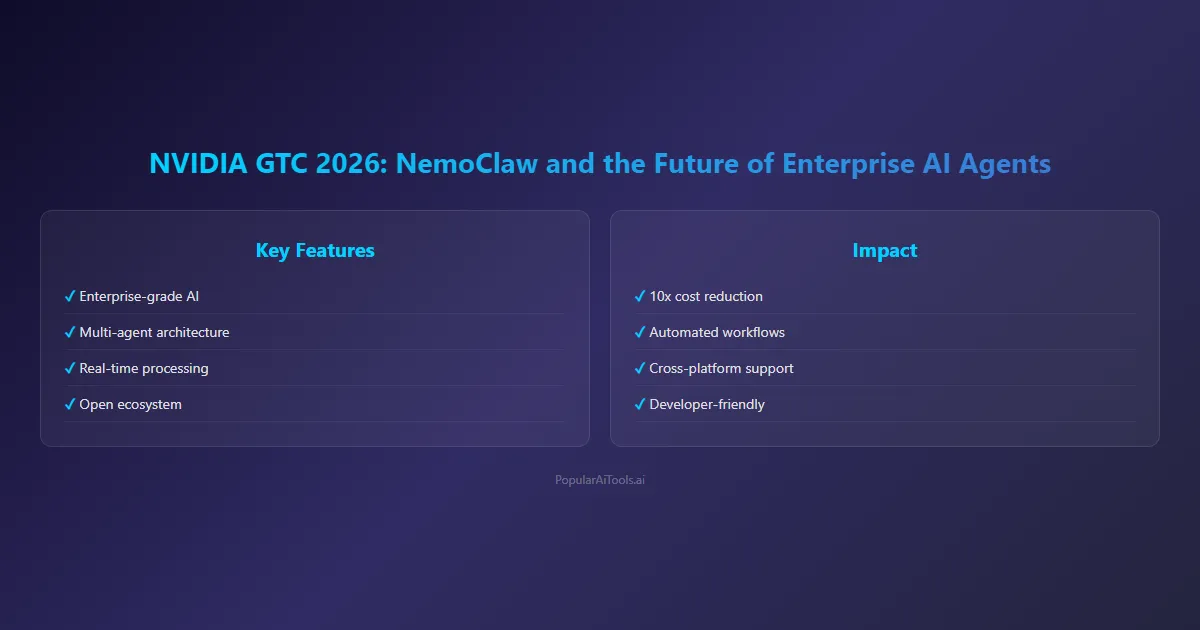
At its core, NemoClaw is a framework for multi-agent collaboration. Think of it as the operating layer that sits between your AI models and your enterprise software. Instead of building custom integrations for every AI use case, NemoClaw provides a standardized way to:
- Deploy AI agents that can perform complex, multi-step tasks across enterprise systems
- Orchestrate multiple agents working together on a single workflow
- Enforce security and privacy with built-in guardrails, access controls, and audit trails
- Run on any hardware — NemoClaw is hardware-agnostic, meaning it works whether you are running NVIDIA GPUs, AMD, or cloud instances
That last point is worth emphasizing. NVIDIA is not locking NemoClaw to its own hardware. This is a strategic play to make NVIDIA the default software layer for enterprise AI, regardless of what chips companies are running.
Why Open Source?
The decision to make NemoClaw open source is directly tied to what happened in February 2026 when OpenAI acquired OpenClaw. That acquisition sent shockwaves through the enterprise AI community. Companies that had built on OpenClaw suddenly faced vendor lock-in concerns with OpenAI controlling the platform.
NVIDIA saw the opening and moved fast. By making NemoClaw open source, they are positioning it as the vendor-neutral alternative. Early partners get free usage and contribute back to the project, creating a flywheel of adoption and improvement.
Why NemoClaw Matters for Enterprises
We see NemoClaw as a direct response to three problems that have been plaguing enterprise AI adoption:
1. Vendor Lock-In
Most AI agent platforms today are tied to a specific model provider or cloud vendor. NemoClaw is model-agnostic and hardware-agnostic. You can swap out the underlying LLM or infrastructure without rewriting your agent logic.
2. Security and Compliance
Enterprise AI agents need to access sensitive systems — CRMs, financial databases, internal communications. NemoClaw ships with built-in security and privacy tools, including role-based access control, data residency options, and comprehensive audit logging.
3. Multi-Agent Coordination
Real enterprise workflows rarely involve a single AI agent. You need agents that can hand off tasks, share context, and collaborate. NemoClaw’s multi-agent orchestration is designed for exactly this — coordinating teams of specialized agents working toward a common goal.
For a deeper technical overview, NVIDIA has published documentation on the NemoClaw platform site.
Rubin GPU Architecture: The Hardware Behind the Vision
While NemoClaw handles the software side, the Rubin GPU architecture provides the raw compute that makes large-scale AI agents viable.
Here are the numbers that matter:
- 288GB HBM4 memory per GPU — enabling massive model context windows
- 50 PFLOPS of inference performance using NVFP4 precision — a 5x improvement over Blackwell GB200
- 10x lower cost per token at inference in the full NVL72 rack configuration compared to Blackwell
- Rubin CPX variant purpose-built for massive-context processing, delivering up to 30 PFLOPS with NVFP4 precision
The Rubin CPX deserves special attention. It is a new class of GPU designed specifically for workloads that require processing million-token contexts — think large-scale software coding agents, generative video, and complex document analysis. This is the hardware that makes NemoClaw’s multi-agent workflows practical at scale.
For enterprises, the 10x cost reduction in inference is arguably the most important metric. AI agents are inference-heavy by nature — they need to reason through multi-step workflows in real time. Cheaper inference means more agents, running more often, handling more complex tasks, without the compute bill becoming prohibitive.
Enterprise Partnerships: Salesforce, Cisco, Google, Adobe, and CrowdStrike
NVIDIA has been pitching NemoClaw to major enterprise software companies ahead of GTC, and the partnership lineup tells us a lot about the platform’s intended scope:
- Salesforce — AI agents for CRM, sales automation, and customer service workflows
- Cisco — Network management, IT operations, and security automation agents
- Google — Cloud infrastructure integration and cross-platform agent deployment
- Adobe — Creative workflow automation and content generation agents
- CrowdStrike — Cybersecurity agents for threat detection and incident response
While the details of these partnerships are still emerging, the pattern is clear. NVIDIA wants NemoClaw to be the connective tissue that links AI agents across the entire enterprise software stack. Each partner brings a domain where autonomous agents can deliver immediate value.
The partnership with CrowdStrike is particularly interesting. Security is often the biggest blocker for enterprise AI adoption. Having a leading cybersecurity firm involved from the start signals that NVIDIA is taking the security angle seriously — not as an afterthought, but as a core feature.
NemoClaw vs. Other AI Agent Platforms
To put NemoClaw in context, here is how it compares to the other major AI agent platforms available today:
The key differentiator for NemoClaw is the combination of open source, enterprise-grade security, and hardware neutrality. Most alternatives force you to choose two out of three. NemoClaw is attempting to deliver all three while backed by the company that manufactures the majority of AI training and inference hardware worldwide.
What This Means for Developers and Startups
If you are building AI-powered applications, NVIDIA GTC 2026 has direct implications for your stack.
For developers, NemoClaw offers a standardized framework for building agents without being locked into a specific cloud or model provider. The open-source model means you can inspect the code, contribute improvements, and customize the platform for your specific needs. This is a significant improvement over proprietary agent frameworks where you are building on a black box.
For startups, the hardware-agnostic approach is a game-changer. Early-stage companies often cannot commit to a single GPU vendor. NemoClaw lets you build your agent infrastructure once and deploy it wherever the economics make sense — on NVIDIA hardware, in the cloud, or on a mix of both.
For enterprise teams, the built-in security and partnership ecosystem mean faster time to production. Instead of spending months building custom security layers and integration middleware, you can leverage NemoClaw’s native capabilities and partner integrations.
The Rubin GPU improvements also change the economics of running AI agents in production. When inference costs drop by 10x, use cases that were previously too expensive become viable. We expect to see an explosion of “always-on” AI agents — agents that continuously monitor, analyze, and act, rather than being invoked on demand.
For more technical details on the conference sessions and announcements, check the official NVIDIA GTC 2026 news blog.
Frequently Asked Questions
What is NemoClaw and why did NVIDIA create it?
NemoClaw is NVIDIA’s open-source platform for building and deploying enterprise AI agents. NVIDIA created it to fill the gap left after OpenAI acquired OpenClaw in February 2026. Enterprises needed a vendor-neutral, secure, and open platform for AI agent development, and NemoClaw is NVIDIA’s answer to that demand. It allows companies to deploy AI agents that perform multi-step tasks across enterprise systems with built-in security, privacy controls, and multi-agent orchestration.
Is NemoClaw free to use?
Yes. NemoClaw is open source, which means it is free to use, modify, and deploy. NVIDIA’s business model here mirrors what they have done with CUDA — give away the software to drive adoption of the broader ecosystem. Early enterprise partners receive direct integration support and documentation from NVIDIA. The platform is not tied to NVIDIA hardware, so you can run it on any infrastructure.
What is the Rubin GPU architecture announced at NVIDIA GTC 2026?
Rubin is NVIDIA’s next-generation GPU architecture, succeeding Blackwell. Each Rubin GPU features up to 288GB of HBM4 memory and delivers 50 PFLOPS of inference performance with NVFP4 precision — a 5x jump over its predecessor. The full NVL72 rack configuration achieves 10x lower cost per token at inference compared to Blackwell. NVIDIA also announced Rubin CPX, a specialized variant designed for massive-context processing tasks like million-token code analysis and generative video.
How does NemoClaw compare to other AI agent frameworks like LangGraph or AutoGen?
NemoClaw differentiates itself through the combination of open-source licensing, enterprise-grade security (RBAC, audit logs, data residency), hardware-agnostic deployment, and native multi-agent orchestration. While LangGraph offers a graph-based approach and AutoGen uses conversation-based coordination, NemoClaw is built from the ground up for production enterprise environments. Its partnership ecosystem with Salesforce, Cisco, Google, Adobe, and CrowdStrike also gives it broader out-of-the-box integration than competing frameworks.
When will NemoClaw be available for enterprise use?
NemoClaw was formally announced at NVIDIA GTC 2026 on March 16, with the open-source code expected to be available shortly after the conference. NVIDIA is entering an enterprise adoption phase following GTC, providing direct integration support, documentation, and partnership programs. Companies interested in early access should monitor the official NemoClaw site and NVIDIA’s developer channels for release timelines and onboarding resources.
Our Final Take
NVIDIA GTC 2026 marks a fundamental shift in how we think about AI infrastructure. The story is no longer just about faster GPUs — although the Rubin architecture is genuinely impressive. The story is about NVIDIA building the complete software stack for the agentic AI era.
NemoClaw is the most strategically significant announcement from GTC this year. By going open source and hardware-agnostic, NVIDIA is playing a long game. They are betting that if they become the default platform for enterprise AI agents, the hardware sales will follow naturally. It is the CUDA playbook, updated for the agent era.
For enterprises that have been cautious about AI agent adoption due to security concerns, vendor lock-in risks, or integration complexity, NemoClaw removes several of those barriers simultaneously. The partnership roster — Salesforce, Cisco, Google, Adobe, CrowdStrike — suggests that real-world integrations will be available much faster than with community-driven alternatives.
For developers and startups, the combination of open-source NemoClaw and dramatically cheaper Rubin inference opens doors that were previously closed. Building multi-agent systems is about to get significantly more accessible and affordable.
We will be covering the remaining GTC sessions and partnership announcements throughout the week. If you are evaluating AI agent platforms for your organization, NemoClaw deserves a serious look.
Want to stay ahead of the biggest AI tool launches and platform shifts? Bookmark PopularAiTools.ai and check back daily for in-depth coverage, reviews, and guides on the tools shaping the future of AI.