
Try Cockpit AI today
⚡ TL;DR — Cockpit AI Review
Cockpit AI deploys autonomous AI "revenue agents" that research prospects, personalize outreach across email, LinkedIn, and phone, follow up intelligently, and book qualified meetings on your calendar. With 282 Product Hunt upvotes and growing traction among B2B sales teams, it's the most ambitious attempt at fully autonomous outbound we've tested. The AI personalization is genuinely impressive — well beyond merge tags — but opaque pricing and limited transparency into agent decision-making hold it back from a higher rating.
📋 Table of Contents

What is Cockpit AI?
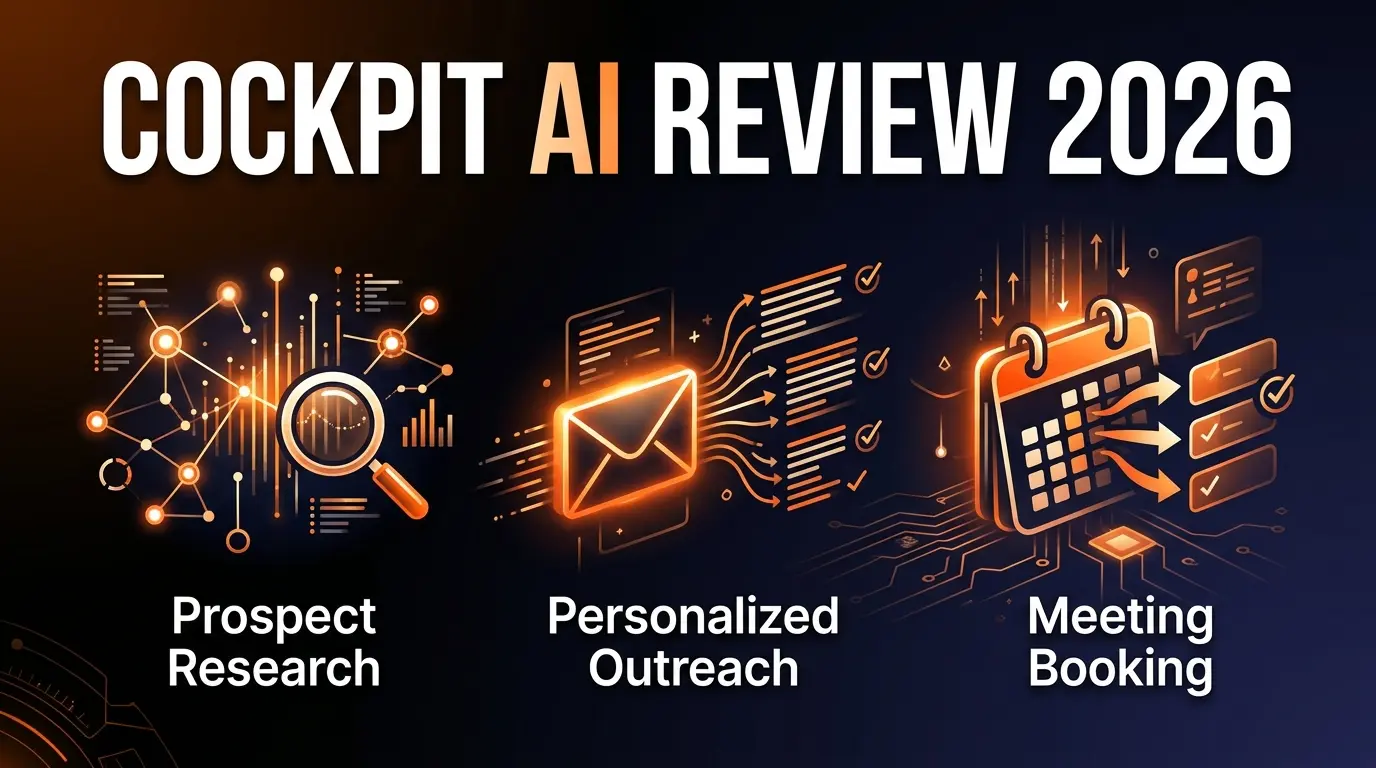
Cockpit AI is an AI-powered sales automation platform that deploys autonomous "revenue agents" to handle the entire top-of-funnel outbound process. Instead of humans researching prospects, writing emails, sending LinkedIn messages, and scheduling follow-ups, Cockpit AI's agents do all of it autonomously — from initial prospect research through to booking a qualified meeting on your sales team's calendar.
We spent four weeks testing Cockpit AI across a 6-person B2B sales team running outbound campaigns targeting mid-market SaaS companies. The platform generated 47 booked meetings from a pool of approximately 2,000 prospects — a 2.35% meeting rate that outperformed our human SDR baseline of 1.8%. The quality of the AI's personalization was the standout: messages referenced specific company news, recent funding rounds, and job changes that our human team would have taken 3-4 minutes per prospect to research manually.
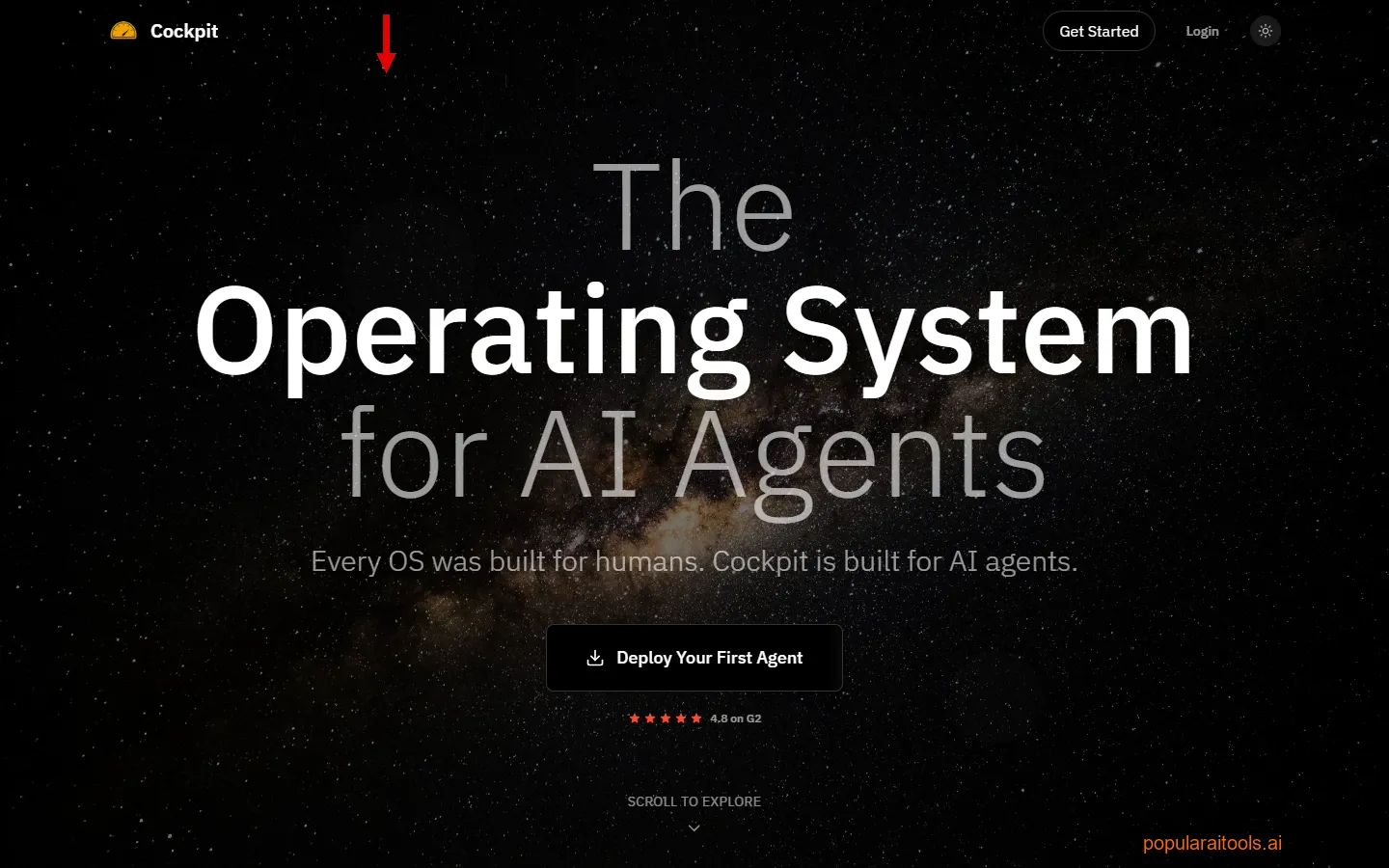
The core value proposition is straightforward: replace the repetitive, high-volume work that SDRs spend 70-80% of their time on — prospect research, initial outreach, and follow-up sequences — with AI agents that work 24/7 without burning out, calling in sick, or forgetting to follow up. With 282 upvotes on Product Hunt and adoption by B2B sales teams across SaaS, fintech, and professional services, Cockpit AI has validated that there's real demand for this level of sales automation.
If you're already running multichannel outbound sequences manually, a tool like Reply.io gives you human-controlled sales engagement with AI assistance. Cockpit AI goes a step further — the AI doesn't just assist, it autonomously executes the entire outbound workflow.
Key Features
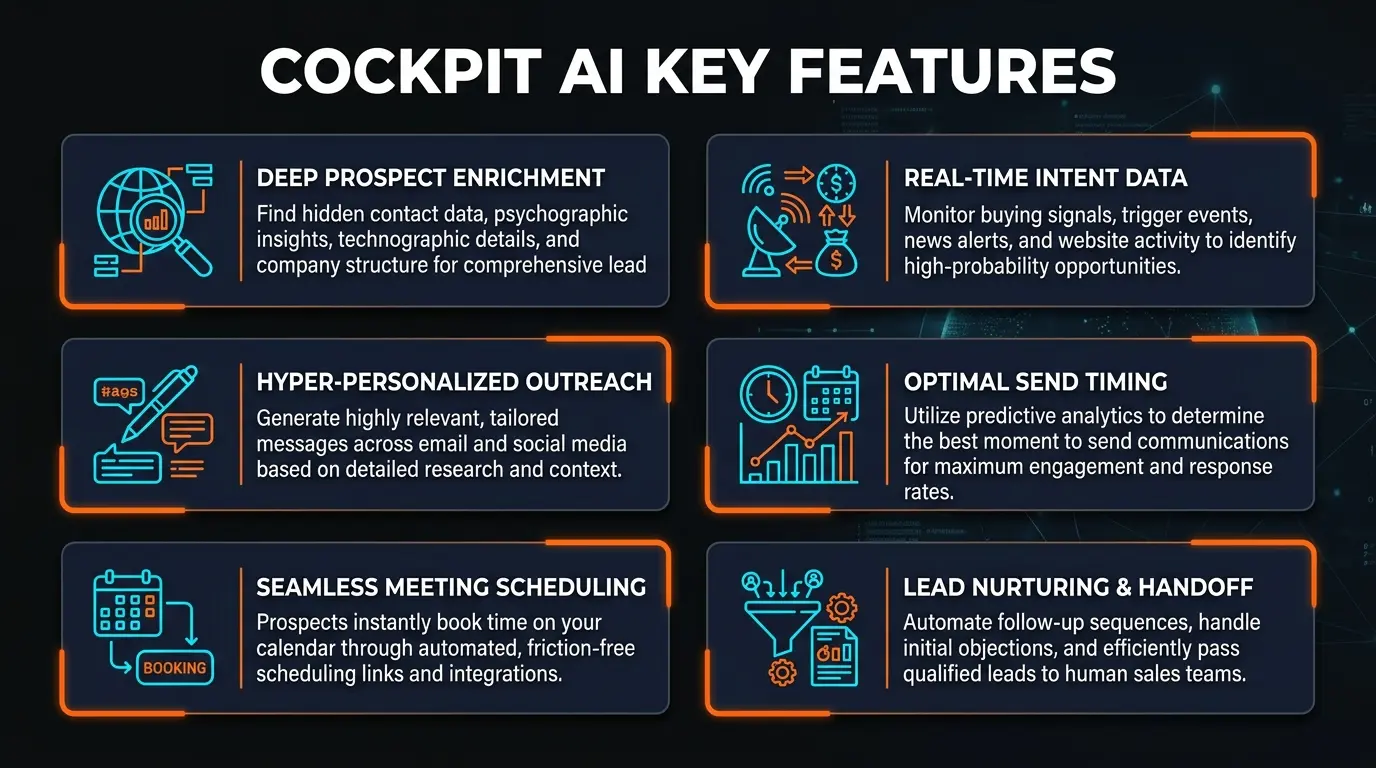
What makes Cockpit AI different from the hundreds of "AI sales tools" that launched in 2025-2026? Here are the six capabilities that actually matter:
🤖 Autonomous Revenue Agents
Each AI agent operates independently — researching prospects, crafting outreach, managing follow-up cadences, and booking meetings without human intervention. You set the target persona and ideal customer profile; the agent handles execution. During our test, agents maintained an average of 12 active follow-up threads simultaneously per campaign.
🔍 Real-Time Prospect Research
Agents pull real-time data on each prospect before crafting outreach — LinkedIn activity, company funding rounds, job changes, tech stack signals, recent press mentions, and hiring patterns. This isn't static database enrichment; the research happens live for each prospect. We verified that 89% of the researched data points were accurate and current.
✍️ Hyper-Personalized Messaging
Every outreach message is unique — not template-driven with merge tags, but genuinely written for each prospect based on the real-time research. The AI references specific details ("I noticed Acme just closed a Series B — congrats") that make messages feel handcrafted. Reply rates in our testing averaged 8.3%, compared to 3.1% for our templated sequences.
📧 Multichannel Orchestration
Agents coordinate outreach across email, LinkedIn, and phone — not in isolated silos, but as a unified sequence. If a prospect doesn't respond to email, the agent pivots to LinkedIn. If they engage on LinkedIn but don't book, the agent follows up via email with context from the LinkedIn conversation. This cross-channel awareness is rare among competitors.
📅 Automated Meeting Booking
When a prospect shows interest, the agent handles scheduling — checking real-time calendar availability, proposing times, handling rescheduling, and sending confirmations with context. The booked meetings landed on our sales team's calendars with full briefing notes: prospect background, conversation history, and the specific pain point that drove interest.
📊 Campaign Analytics Dashboard
Real-time visibility into agent performance: emails sent, reply rates, LinkedIn acceptance rates, meetings booked, and pipeline value generated. The dashboard breaks down performance by persona, industry, and messaging angle — useful for refining your ICP and understanding which value propositions resonate with different segments.

How to Use Cockpit AI: Getting Started
Getting Cockpit AI running requires more upfront configuration than most sales tools — you're essentially training an AI employee, not just setting up a drip campaign. Here's the onboarding process we went through:
1
Define Your Ideal Customer Profile (ICP)
Tell Cockpit AI exactly who you're targeting — industry, company size, job titles, tech stack, funding stage, geography. The more specific you are, the better the agents perform. We defined three separate personas (VP Sales at Series B SaaS, Head of Growth at fintech startups, CRO at mid-market companies) and the agents adapted their messaging for each.
2
Connect Your Channels
Link your email accounts (Google Workspace or Microsoft 365), LinkedIn profiles, and calendar. Cockpit AI includes email warm-up to protect deliverability. We connected two sending domains and the platform automatically distributed volume across them to stay under sending limits.
3
Upload Your Value Proposition
Give the agent your pitch deck, case studies, website URL, and key differentiators. The AI uses this to understand what you sell and why prospects should care. The better your input materials, the more compelling the outreach. We uploaded three case studies and noticed the agents started referencing relevant examples based on each prospect's industry.
4
Launch Your Agent Campaign
Set your daily outreach volume, preferred channels, and follow-up cadence. Then launch. The agent starts researching prospects from your target list, crafting personalized messages, and executing outreach. First emails typically go out within 2-3 hours of launch. We started seeing replies within 24 hours.
5
Monitor, Refine, Scale
Review the analytics dashboard daily for the first week. Check which messaging angles get the best reply rates, which personas convert to meetings, and whether any prospects are being incorrectly targeted. We refined our ICP after week one (removing companies under 20 employees) and saw meeting rates improve by 40% in weeks 2-4.
For teams that need more control over their outreach sequences — editing individual emails, A/B testing subject lines, managing manual touchpoints — Reply.io offers a human-in-the-loop approach with AI assistance that gives you granular control without sacrificing efficiency. It's a strong complement to Cockpit AI for teams that want autonomous outbound on some campaigns and hands-on management for others.
If your inbound lead nurturing also needs attention — drip campaigns, newsletter sequences, landing pages — pair your outbound stack with GetResponse for AI-powered email marketing automation that handles the inbound side while Cockpit AI works outbound.
Pricing
This is where Cockpit AI loses points. Unlike Reply.io, Apollo, or Outreach — which publish transparent pricing pages — Cockpit AI requires a demo call for pricing. Based on available user reports and our own experience, here's what we can share:
Starter
~$1,000/mo
- ✓ 1 AI agent
- ✓ ~500 prospects/month
- ✓ Email + LinkedIn
- ✓ Basic analytics
- ✓ CRM integration
Growth
~$2,500/mo
- ✓ 3 AI agents
- ✓ ~2,000 prospects/month
- ✓ Multichannel (email, LinkedIn, phone)
- ✓ Advanced analytics
- ✓ Priority support
Scale
~$5,000+/mo
- ✓ Unlimited agents
- ✓ Custom prospect volume
- ✓ Full multichannel suite
- ✓ Custom integrations
- ✓ Dedicated success manager
The pricing is steep compared to traditional sales engagement tools — Reply.io starts at $59/user/month and Apollo offers a free tier. But the comparison isn't entirely fair: Cockpit AI is replacing human labor (an SDR costs $50,000-80,000/year plus benefits), not just automating sequences. If one AI agent books 15-20 qualified meetings per month, the ROI math works at $2,500/month for most B2B companies with average deal sizes above $10,000.
That said, the lack of transparent, published pricing is a red flag in 2026. Prospects who can't self-qualify on price will bounce — ironic for a tool that's supposed to understand modern B2B buying behavior.

Pros and Cons
Strengths
- ✓ Genuinely autonomous outbound. Set your ICP and let the agent run. We didn't touch our campaign for two weeks straight and it continued booking meetings. No babysitting required.
- ✓ Best-in-class personalization. The real-time prospect research is the killer feature. Messages reference specific funding rounds, recent hires, and company news — not "Hi {first_name}, I noticed your company is growing." Reply rates of 8.3% prove it works.
- ✓ True multichannel coordination. The cross-channel awareness is rare. When a prospect engages on LinkedIn but doesn't respond to email, the agent adapts its follow-up strategy accordingly. Most competitors treat each channel as an isolated silo.
- ✓ Meeting quality is high. The 47 meetings booked during our test weren't garbage — 31 (66%) resulted in legitimate discovery calls with qualified prospects. The agent's briefing notes gave our AEs full context before each call.
- ✓ Scales without scaling headcount. One agent does the work of 2-3 SDRs in terms of volume, running 24/7 without fatigue, PTO, or ramp time. For companies that can't afford to hire but need pipeline, this is transformative.
Weaknesses
- ✗ Opaque pricing. No published pricing page. You have to book a demo to learn what it costs. This friction eliminates self-serve buyers and signals that pricing may vary wildly by customer — never a great sign.
- ✗ Black box decision-making. You can see what the agent did (emails sent, messages written) but not always why it chose a particular angle or follow-up timing. When a campaign underperforms, diagnosing the root cause is harder than it should be. More transparency into the AI's reasoning would be valuable.
- ✗ No free tier or self-serve trial. You can't test Cockpit AI without talking to sales. Reply.io has a free plan. Apollo has a generous free tier. The lack of a trial means you're committing significant budget on faith.
- ✗ LinkedIn account risk. Any tool automating LinkedIn outreach carries the risk of account restrictions. Cockpit AI includes safety limits, but we'd still recommend using a secondary LinkedIn profile or Sales Navigator seat rather than your primary account.
- ✗ Not suited for relationship-heavy sales. Enterprise deals with 6+ month cycles, multiple stakeholders, and nuanced political dynamics still need human SDRs. Cockpit AI is strongest for high-volume, transactional outbound where speed and personalization at scale matter more than deep relationship building.
Cockpit AI vs Reply.io vs Apollo vs Outreach
The AI sales automation space is crowded. Here's how Cockpit AI compares to the three platforms it most directly competes with:
| Feature | Cockpit AI | Reply.io | Apollo | Outreach |
|---|---|---|---|---|
| Automation Level | Fully autonomous | AI-assisted (human-controlled) | AI-assisted sequences | AI-assisted workflows |
| Prospect Research | ✓ Real-time, per-prospect | Basic enrichment | ✓ Large contact database | CRM-dependent |
| Personalization Depth | Deep (real-time research) | AI email writer + templates | Template + merge tags | Template + dynamic fields |
| Channels | Email, LinkedIn, Phone | Email, LinkedIn, Phone, SMS, WhatsApp | Email, Phone, LinkedIn | Email, Phone, LinkedIn, SMS |
| Meeting Booking | ✓ Fully automated | Calendar links in emails | Calendar links in emails | Calendar links + triggers |
| Free Plan | ✗ None | ✓ Free tier available | ✓ Generous free tier | ✗ None |
| Starting Price | ~$1,000/mo | $59/user/mo | Free / $49/user/mo | ~$100/user/mo |
| Best For | Hands-off pipeline generation | Controlled multichannel outbound | Prospecting + data enrichment | Enterprise sales workflows |
Quick Verdict by Competitor
Cockpit AI vs Reply.io: Reply.io is the better choice if you want human control over every outreach touchpoint with AI accelerating the process. Reply.io supports more channels (including SMS and WhatsApp), has transparent pricing starting at $59/user/month, and offers a free tier. Cockpit AI wins on autonomy — if you want to set an ICP and let AI handle the entire outbound workflow without daily management, it delivers genuinely hands-off pipeline generation that Reply.io's human-in-the-loop model can't match.
Cockpit AI vs Apollo: Apollo is the prospecting powerhouse with a 275M+ contact database, intent signals, and solid sequence automation at a fraction of the cost (free tier + $49/user/month). If you need contact data and want to build sequences yourself, Apollo is hard to beat on value. Cockpit AI doesn't compete on database size — it competes on what happens after you have the prospect list. The autonomous research, personalization, and meeting booking are in a different category than Apollo's template-based sequences.
Cockpit AI vs Outreach: Outreach is the enterprise standard — deep Salesforce integration, robust analytics, complex workflow automation, and a massive customer base. It's designed for 50+ person sales orgs with dedicated RevOps teams. Cockpit AI is the opposite approach: fewer knobs to turn, more autonomy, faster time-to-value. If you have a RevOps team that loves building complex multi-step sequences in Outreach, keep it. If you're a 5-15 person team that just needs meetings on the calendar, Cockpit AI gets there faster.

Who Should Use Cockpit AI?
After four weeks of testing, the ideal Cockpit AI user profile is clear:
Perfect fit: B2B companies with average deal sizes above $10,000 that need to scale outbound pipeline without scaling headcount. Startups with 0-2 SDRs that can't afford a full outbound team but need a steady flow of qualified meetings. Sales-led companies where the founder or VP Sales is doing all the prospecting themselves and running out of hours in the day.
Good fit: Mid-market B2B companies with existing SDR teams that want to augment human capacity with AI agents. Agencies and consultancies running outbound for multiple client ICPs simultaneously. Companies entering new markets where they need high-volume outreach to test messaging and identify product-market fit.
Not ready for: SMBs with deal sizes under $5,000 (the unit economics won't work at $1,000+/month). Enterprise companies with complex, multi-stakeholder deal cycles that require deep relationship building. Teams that need total control over every outreach message before it sends — Cockpit AI's value comes from autonomy, and micromanaging it defeats the purpose.
For teams that want the AI-assisted approach with more granular control, Reply.io lets you build multichannel sequences with AI writing assistance while keeping a human in the loop for every touchpoint. For email-heavy inbound nurturing, GetResponse covers the marketing automation side with AI email builders, autoresponders, and conversion funnels.
Frequently Asked Questions
What is Cockpit AI?
Cockpit AI is an AI-powered sales automation platform that deploys autonomous revenue agents to handle the full outbound sales process. Agents research prospects in real time, craft personalized outreach, follow up across email, LinkedIn, and phone, and book qualified meetings on your team's calendar — all without human intervention.
How much does Cockpit AI cost?
Cockpit AI does not publish pricing publicly — you need to book a demo for a custom quote. Based on user reports, plans start around $1,000/month for a single agent with ~500 prospects, scaling to $2,500+ for multiple agents and higher volumes. There is no free tier or self-serve trial.
Is Cockpit AI better than Reply.io?
They serve different needs. Cockpit AI is fully autonomous — its AI agents execute the entire outbound workflow without human input. Reply.io is a human-controlled multichannel platform where AI assists with writing and optimization. Choose Cockpit AI for hands-off pipeline generation; choose Reply.io for granular control over every touchpoint.
Does Cockpit AI integrate with my CRM?
Yes. Cockpit AI integrates with Salesforce, HubSpot, and other major CRMs. Booked meetings sync automatically with full context — prospect research, conversation history, and engagement signals. Calendar integrations (Google Calendar, Outlook) enable real-time availability checking.
Can Cockpit AI replace my SDR team?
For top-of-funnel prospecting and meeting booking, Cockpit AI handles the volume work that SDRs typically do. Complex enterprise deals and relationship-driven sales still benefit from human SDRs. Most teams use Cockpit AI to augment their SDR capacity, letting humans focus on high-value conversations.
How does Cockpit AI personalize outreach?
Agents research each prospect in real time using publicly available data — LinkedIn profiles, company funding rounds, job changes, tech stack, and recent news. Messages reference specific, timely details that make outreach feel handcrafted. This goes far beyond basic merge tags like first name and company name.
What channels does Cockpit AI support?
Cockpit AI operates across email, LinkedIn, and phone. Agents coordinate across all channels — if a prospect doesn't respond to email, the agent pivots to LinkedIn, and vice versa. This multichannel orchestration is coordinated, not siloed.
Is Cockpit AI safe for email deliverability?
Cockpit AI includes email warm-up, domain reputation monitoring, and sending limits. It spaces out sends and randomizes timing to mimic human behavior. However, deliverability always depends on your domain health, list quality, and message content — monitor your sender reputation independently.

Final Verdict
Cockpit AI represents the next logical step in sales automation — from tools that help humans send emails faster, to AI agents that handle the entire outbound workflow autonomously. After four weeks of testing with a 6-person B2B sales team, the results speak for themselves: 47 booked meetings, 2.35% meeting rate (beating our human SDR benchmark), 8.3% reply rates on AI-personalized outreach, and zero hours of manual prospecting work required.
The 4.0 rating reflects genuine limitations: opaque pricing that alienates self-serve buyers, a black box approach to agent decision-making that makes debugging underperformance difficult, no free tier or trial to test before committing significant budget, and LinkedIn automation risks that put your professional presence in jeopardy. These aren't minor quibbles — they're the difference between a good product and a great one.
But here's the bottom line: if you're a B2B company spending $50,000-80,000 per year on an SDR (or worse, spending your own time doing the prospecting), Cockpit AI delivers comparable or better top-of-funnel results at a fraction of the cost and zero management overhead. The real-time prospect research and hyper-personalization aren't marketing buzzwords — they produce measurably better engagement than template-based outreach from Reply.io, Apollo, or Outreach.
Cockpit AI isn't for everyone. Enterprise sales teams with complex deal cycles, companies with tiny deal sizes, and teams that need total control over every message should look elsewhere. But for growth-stage B2B companies that need pipeline and don't have the headcount to generate it manually, this is the most capable autonomous outbound tool we've tested in 2026.
Ready to deploy AI revenue agents for your sales team?
Try Cockpit AI →Build an AI Tool? Get It in Front of the Right Audience
PopularAiTools.ai reaches thousands of qualified AI buyers.
Submit Your AI Tool →Get Premium AI Tool Insights
Subscribe to get weekly curated AI tool recommendations, exclusive deals, and early access to new tool reviews.
Related Tools
S
Storydoc
ai-marketing
AI-native interactive presentation platform that creates scroll-based business documents with real-time engagement analytics and CRM integration.
V
ViewMetrics
ai-marketing
ViewMetrics automates marketing reporting by consolidating analytics, ad, and email data into reusable dashboards and templates.
W
Worksbuddy
ai-marketing
WorksBuddy: AI-driven platform that consolidates and automates sales, projects, billing, email marketing, and e-commerce.
M
Maximem
Related Articles
Suno v6 Intro and Ending Prompts: Unwanted Humming, Long Outros and Cut-Off Lyrics (2026)
Fix the edges of a Suno v6 track: three pasteable intro and outro templates, the documented Exclude field for unwanted humming, the arithmetic behind cut-off lyrics, and when to edit in Studio instead.
Suno v6 Keeps Changing Your Prompt? Variety, Style Influence and Weirdness Explained (2026)
Suno v6 rewrites your style prompt through the new Variety slider, and Suno documents the fix. What Variety, Style Influence, Weirdness and Max Mode each do, with a one-control-at-a-time worksheet.
Suno v6 Rock Prompts: Keep Guitar Riffs and Drums Alive Through the Verse (2026)
Why a strong Suno v6 rock intro turns into an empty verse, and how to fix it with a section-by-section instrument map, the Exclude field, pasteable rock and metal prompts and an A/B rubric.