Elon Musk Says xAI Will Match OpenAI and Anthropic by End of 2026 — Can He?
On March 16, 2026, Elon Musk made one of his boldest AI declarations yet: xAI will reach full parity with OpenAI, Google, and Anthropic by year’s end. Given that only two of xAI’s original eleven co-founders remain, the company just merged with SpaceX in a $1.25 trillion deal, and competitors are spending at record pace — we had to ask the uncomfortable question. Is this realistic, or is it vintage Musk optimism on overdrive? See also: Anthropic’s ongoing legal battle with the Pentagon.
We dug into the announcement, the departures, the infrastructure, the funding, and the competitive landscape to give you an honest assessment of where xAI actually stands and whether the parity promise holds water.
Table of Contents
- What Musk Actually Said on March 16
- The Co-Founder Exodus: Who Left and Why It Matters
- The Colossus Advantage: 555,000 GPUs and Counting
- The Grok Roadmap: From 4.20 to Grok 5
- The SpaceX Merger: Strength or Distraction?
- Funding Comparison: xAI vs OpenAI vs Anthropic
- Can xAI Actually Catch Up? A Realistic Assessment
- What This Means for the AI Race
- FAQ
What Musk Actually Said on March 16
Musk posted on X that xAI “was not built right first time around, so is being rebuilt from the foundations up.” He then declared that xAI would reach parity with OpenAI, Google, and Anthropic by the end of 2026 — and went even further, claiming that “xAI will catch up this year and then exceed them all by such a long distance in 3 years that you will need the James Webb telescope to see who is in second place.”
That is a staggering claim. Let us break down why.
At the time of this announcement, xAI’s flagship Grok models had briefly surpassed rival systems on certain benchmarks in late 2025, but newer updates from Google’s Gemini, OpenAI’s GPT series, and Anthropic’s Claude have since reclaimed the lead. Anthropic’s Claude in particular has become the developer favorite for coding tasks, while OpenAI continues to dominate consumer mindshare and enterprise adoption.
So Musk is not claiming to maintain a lead — he is claiming to close a gap that has been widening, and to do it while simultaneously rebuilding the company from scratch. That is either visionary confidence or dangerous denial. The details will tell us which.
The Co-Founder Exodus: Who Left and Why It Matters
This is the part of the story that should concern anyone bullish on xAI’s timeline.
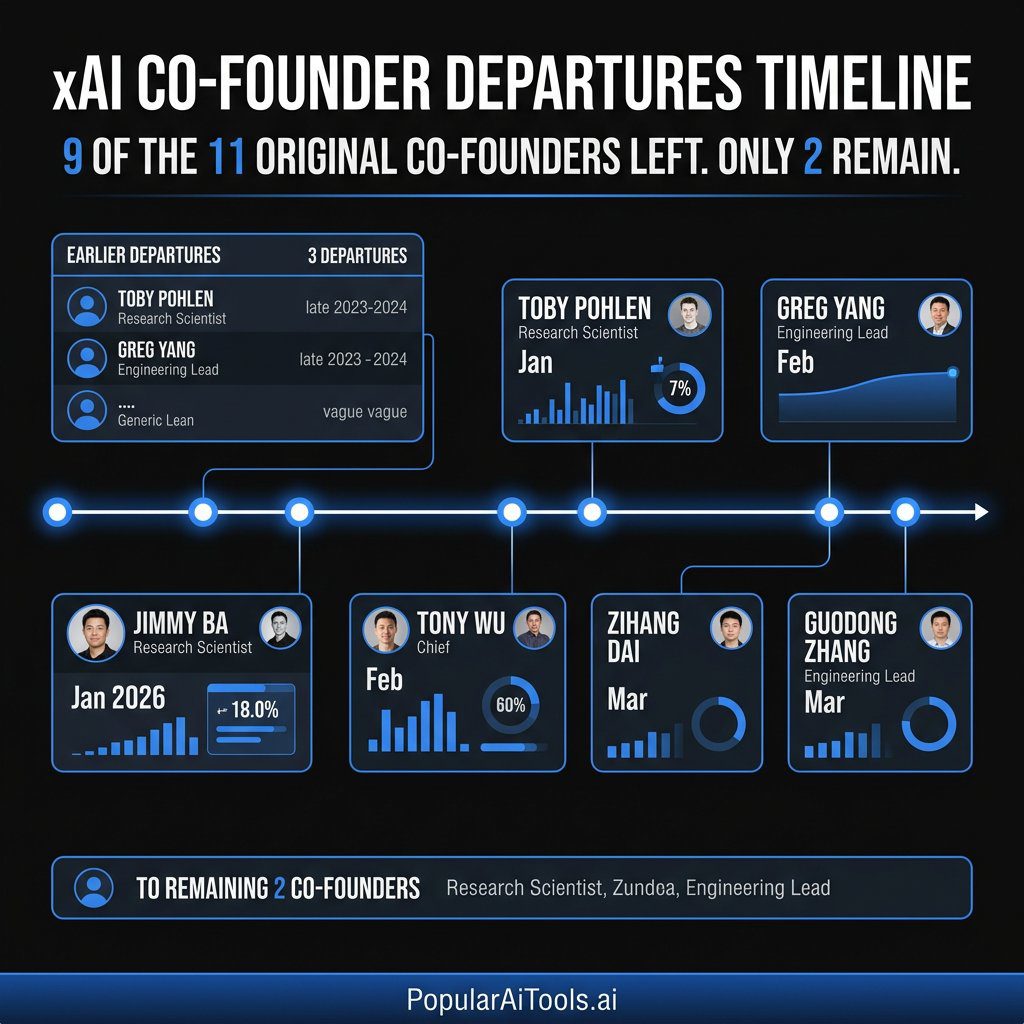
When xAI launched in March 2023, Musk assembled an impressive roster of eleven technical co-founders, many poached from top AI labs like Google DeepMind and the University of Toronto. Three years later, only two remain. Here is the departure timeline:
| Co-Founder | Former Role | Departure | Known Destination |
|---|---|---|---|
| Jimmy Ba | Research Lead | January 2026 | Return to academia |
| Tony Wu | Infrastructure | February 2026 | Undisclosed |
| Toby Pohlen | Engineering Lead | January 2026 | Undisclosed |
| Greg Yang | Research (Tensor Programs) | February 2026 | Undisclosed |
| Zihang Dai | Senior Researcher | March 2026 | Undisclosed |
| Guodong Zhang | Research Scientist | March 2026 | Undisclosed |
That is six co-founders gone in under three months. The remaining two have not been publicly identified in recent reporting, and the silence itself is telling.
Why does this matter? Because frontier AI development is not just about compute. It is about institutional knowledge, research continuity, and the ability to iterate on model architectures without starting from zero. When your lead researchers leave, they take years of accumulated insight with them — insight that cannot be replaced by hiring two engineers from Cursor, which is exactly what xAI announced as its response to the departures.
We are not saying xAI cannot hire great people. We are saying that rebuilding a research team during a race against the best-funded labs in history is like changing your engine mid-lap at Le Mans.
The Colossus Advantage: 555,000 GPUs and Counting
If there is one area where xAI has a legitimate argument, it is raw compute.
The Colossus supercomputer cluster in Memphis, Tennessee, is genuinely impressive. Built from scratch in 122 days, it is the largest AI training facility in the world. Here are the numbers:
| Metric | Current Status | Planned Expansion |
|---|---|---|
| Total GPUs | 555,000 NVIDIA chips | Target: 1 million+ |
| Power Capacity | ~2 gigawatts | Additional $659M expansion filed |
| GPU Investment | ~$18 billion | Ongoing |
| Physical Footprint | 3 buildings in Memphis | 4th building (312,000 sq ft) in permitting |
| Energy Equivalent | ~1.5 million US homes | Growing |
That 2-gigawatt figure is staggering. For context, most hyperscale data centers operate in the 50-200 megawatt range. xAI’s facility is an order of magnitude larger than anything its competitors currently operate in a single location.
But here is the critical nuance: compute alone does not equal model quality. OpenAI and Anthropic have demonstrated repeatedly that algorithmic innovation, training data curation, and RLHF methodology matter as much as — sometimes more than — brute-force GPU counts. Google’s Gemini team has access to TPU clusters that rival Colossus in effective throughput, and they have decades of search data to train on.
Colossus is a genuine moat. But it is a hardware moat in a race increasingly won by software and data advantages.
The Grok Roadmap: From 4.20 to Grok 5
xAI’s model roadmap is ambitious but inconsistent.
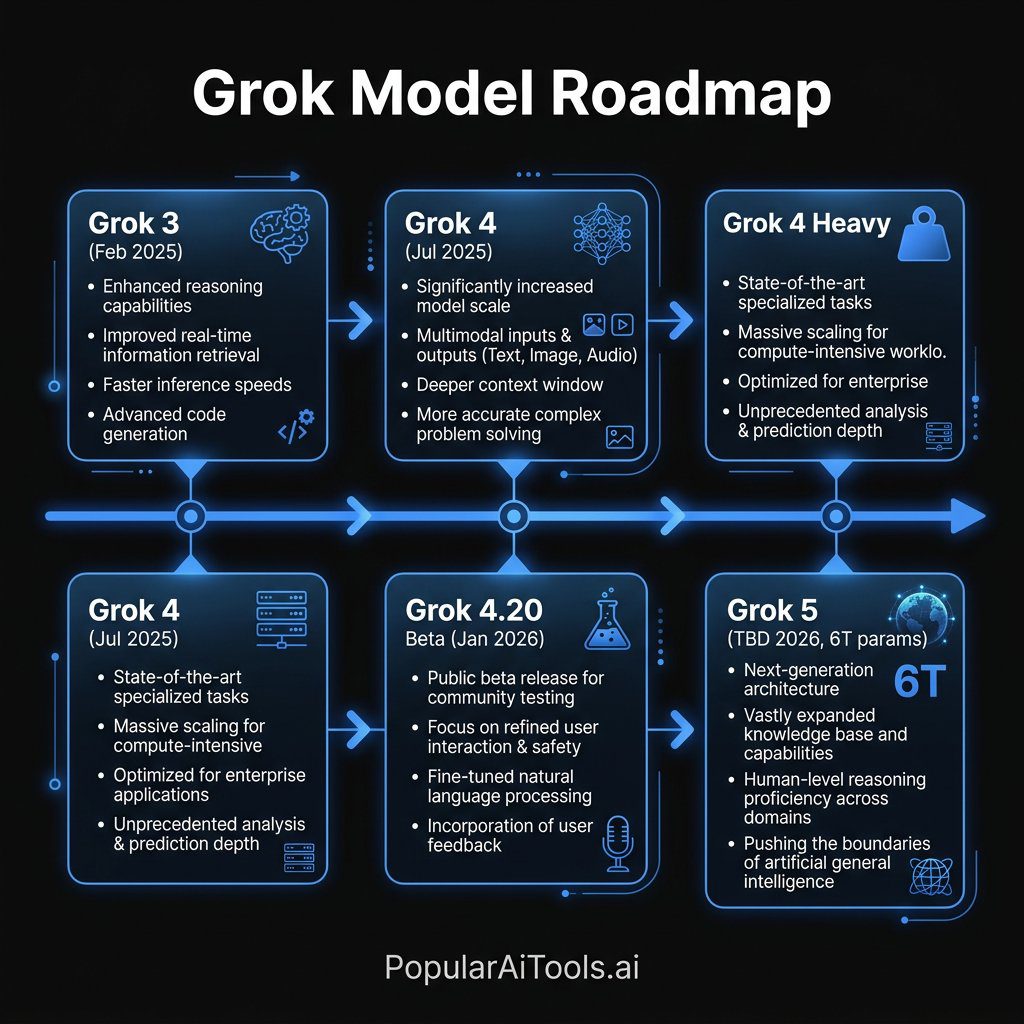
Grok 3, released in February 2025, was trained with roughly 10x the compute of Grok 2 and delivered strong benchmark results. Grok 4 and Grok 4 Heavy followed in July 2025 and represented meaningful improvements, particularly in reasoning tasks. See also: our detailed Grok 4.20 review.
The current state of the Grok lineup:
| Model | Release | Key Features | Status |
|---|---|---|---|
| Grok 3 | Feb 2025 | 10x compute over Grok 2 | Superseded |
| Grok 4 | July 2025 | Improved reasoning, multimodal | Active |
| Grok 4 Heavy | July 2025 | Larger parameter count | Active |
| Grok 4.20 Beta | Jan 2026 | Advanced language generalization | Enterprise API |
| Grok 4.20 Multi-agent | Jan 2026 | Multi-agent orchestration | Enterprise API beta |
| Grok 5 | TBD 2026 | 6 trillion parameters, native multimodal | In development |
Grok 5 is the one to watch. Musk has claimed it will feature a 6-trillion-parameter architecture with native multimodal capabilities — processing text, images, video, and audio within a unified framework. He has also attached a “10% probability” of it achieving AGI, which we will interpret as marketing rather than science.
The challenge is not building a big model. The challenge is building a big model that actually works better than smaller, more efficient competitors. Anthropic’s Claude has gained significant developer traction not because it is the largest model, but because it is the most reliable for complex coding and reasoning tasks. OpenAI’s competitive edge is its ecosystem — ChatGPT’s 300 million weekly users, the API developer community, and enterprise integrations.
xAI needs Grok 5 to not just match these models on benchmarks but to give users a reason to switch. That is a much harder problem than parameter count.
The SpaceX Merger: Strength or Distraction?
In early February 2026, SpaceX officially acquired xAI in the largest merger in history, creating a combined entity valued at approximately $1.25 trillion. The deal, structured as a share exchange (1 xAI share converts to 0.1433 SpaceX shares), was positioned as creating “the most ambitious, vertically-integrated innovation engine on (and off) Earth.”
Musk’s stated rationale includes building “orbital data centers” — AI training clusters deployed on satellites or space stations, theoretically powered by unlimited solar energy and cooled by the vacuum of space.
On paper, merging with SpaceX gives xAI several advantages:
- Capital access: The combined entity is pursuing a SpaceX IPO that could raise $50 billion at a $1.5 trillion valuation
- Infrastructure: SpaceX’s Starlink network could provide low-latency global AI inference
- Talent pool: SpaceX engineers are among the best hardware and systems engineers in the world
- Government contracts: xAI secured a deal to deploy Grok in classified Pentagon systems through the GenAI.mil platform
But the merger also creates real risks. Musk is now running Tesla, SpaceX, xAI (within SpaceX), X, Neuralink, and The Boring Company. His attention is divided across companies with a combined valuation exceeding $2.5 trillion. The co-founder departures accelerated after the merger announcement — correlation is not causation, but the timing is hard to ignore.
There is also the question of culture. SpaceX is an engineering execution machine optimized for building rockets on schedule. Frontier AI research requires a fundamentally different culture — one that tolerates failed experiments, rewards theoretical breakthroughs, and moves at the pace of ideas rather than hardware deadlines. Merging these cultures is non-trivial.
Funding Comparison: xAI vs OpenAI vs Anthropic
Let us talk money, because in the AI race, capital is oxygen. See also: massive wave of AI layoffs hitting the industry.
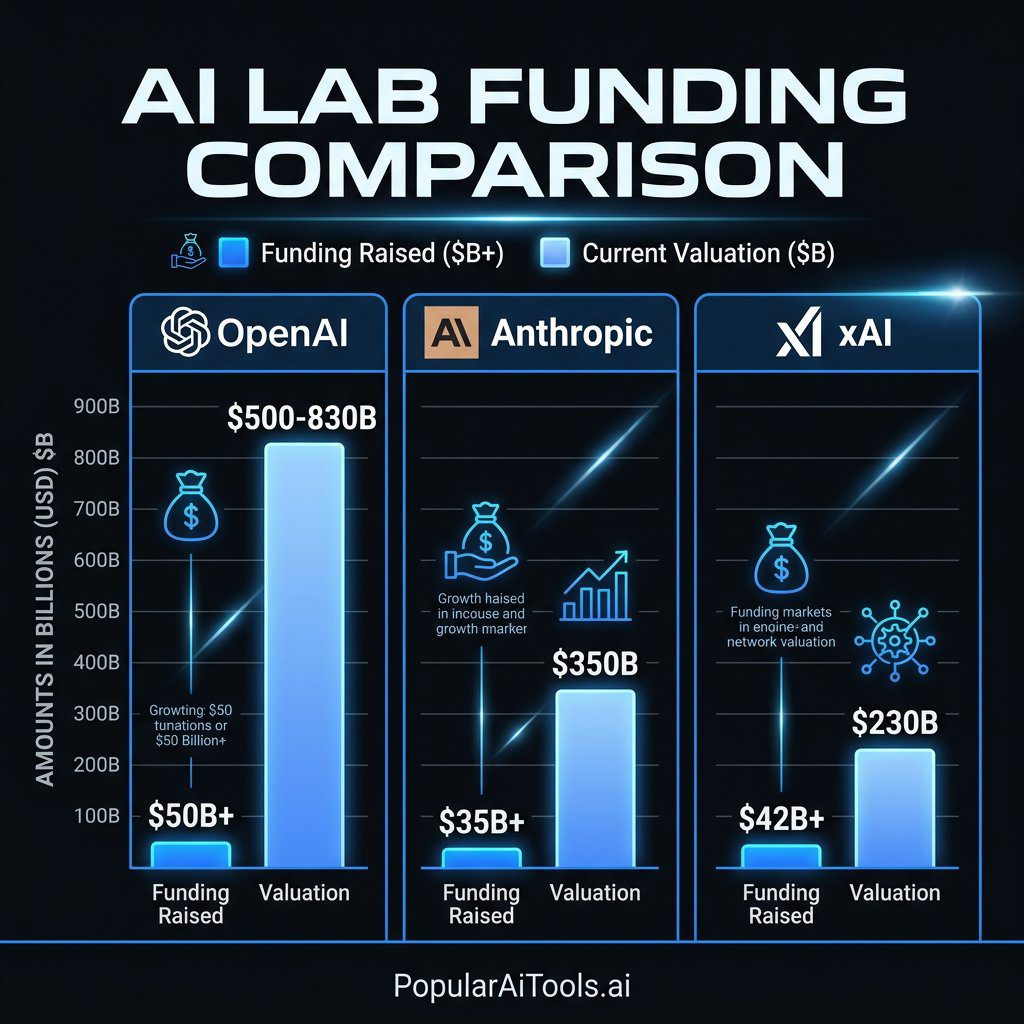
| Company | Total Funding | Latest Valuation | Key Backers | Revenue Model |
|---|---|---|---|---|
| OpenAI | ~$50B+ | $500B–$830B | Microsoft, SoftBank, Thrive Capital | ChatGPT subscriptions, API, enterprise |
| Anthropic | ~$35B+ | ~$350B | Google, ICONIQ, Microsoft, Nvidia | Claude API, enterprise, partnerships |
| xAI | ~$42B+ | ~$230B (standalone) | Nvidia, a16z, Sequoia, SpaceX merger | Grok (X Premium), enterprise API, DoD |
The funding gap is significant but not insurmountable. xAI’s $42 billion in total funding is competitive, and the SpaceX merger gives it access to an even deeper capital pool. The real disparity is in revenue. OpenAI generates billions annually from ChatGPT and its enterprise API. Anthropic has rapidly scaled Claude’s API revenue with developers. xAI’s primary distribution channel — Grok bundled with X Premium — has not demonstrated comparable monetization.
Revenue matters because it funds the next training run, the next hiring push, the next infrastructure expansion. A company burning $5 billion a quarter on compute needs sustainable income, not just investor capital.
Can xAI Actually Catch Up? A Realistic Assessment
We have laid out the facts. Now let us be honest about the odds.
Arguments for xAI reaching parity:
1. Compute superiority is real. Colossus is the largest single-site AI training cluster, and the expansion to 2 GW is happening. Compute scales in ways that research breakthroughs do not.
2. Musk has done this before. SpaceX was written off against Boeing and Lockheed. Tesla was written off against GM and Toyota. Musk has a pattern of entering mature industries and eventually dominating through sheer force of will and capital.
3. The DoD contract is a moat. Government contracts provide stable revenue and create switching costs that commercial customers do not.
4. Grok 5’s architecture could leapfrog. If the 6-trillion-parameter multimodal model delivers, it could represent a genuine step change.
Arguments against parity by end of 2026:
1. Nine months is not enough time. Rebuilding a research team, redesigning company structure, and shipping a frontier model in nine months would be unprecedented.
2. The talent drain is devastating. Losing 9 of 11 co-founders is not a “restructuring” — it is a collapse. The institutional knowledge loss is immense.
3. Competitors are not standing still. OpenAI is likely shipping GPT-6, Anthropic is iterating on Claude at a rapid clip, and Google has the deepest bench of AI researchers on the planet.
4. Musk’s track record on timelines is poor. Full Self-Driving has been “next year” for seven years. The Cybertruck was two years late. Musk’s ambitions are real, but his timelines rarely are.
5. Attention is divided. Running six companies while rebuilding an AI lab from scratch is not a recipe for focus.
Our verdict: xAI will not reach full parity with OpenAI and Anthropic by December 2026. We believe Grok 5 will be competitive on benchmarks — possibly even leading in some specific categories, given Colossus’s raw power. But parity is not just about benchmarks. It is about ecosystem, developer adoption, reliability, enterprise trust, and sustained iteration speed. Those take years to build, and xAI is starting over.
What we do think is possible: xAI becomes a credible third player by year’s end, closing the gap from “clearly behind” to “competitive in specific verticals.” That alone would be impressive. Musk just should not have called it parity.
What This Means for the AI Race
Regardless of whether xAI hits its targets, the announcement reshapes the competitive landscape in several ways.
For developers: The three-way race between OpenAI, Anthropic, and xAI (with Google as the ever-present fourth player) means more choices, better pricing, and faster iteration cycles. Competition is unambiguously good for users.
For investors: The SpaceX-xAI merger and potential IPO creates a new public vehicle for AI investment. If SpaceX goes public at $1.5 trillion, it will be the largest IPO in history and will include xAI’s AI capabilities as a core asset.
For the industry: Musk’s willingness to spend $18 billion on GPUs alone raises the floor for what it costs to compete in frontier AI. This consolidation pressure will likely push smaller labs toward specialization or acquisition.
For AI safety: A rebuilt xAI focused on speed-to-parity may deprioritize safety research. Musk has historically been vocal about AI risk, but his actions with xAI — racing to match competitors, deploying in classified military systems — suggest the priority is capability, not caution.
We will be watching Grok 5’s release closely. If it delivers on even half of Musk’s promises, the second half of 2026 will be the most competitive period in AI history. If it does not, the parity claim joins a long list of Musk deadlines that came and went.
Either way, we are living through the most expensive technology race in human history. And it is just getting started.
Want to stay ahead of the AI race? We track every major model release, funding round, and industry shakeup in real time. Subscribe to PopularAiTools.ai and never miss a beat.
Subscribe to PopularAiTools.ai
FAQ
Is xAI still an independent company?
No. As of February 2026, xAI was acquired by SpaceX in a deal valued at $1.25 trillion for the combined entity. xAI operates as a division within SpaceX, though it maintains its own engineering teams and product roadmap. The merger was structured as a share exchange, with xAI shares converting to SpaceX stock at a fixed ratio.
How many co-founders has xAI lost?
At least nine of the original eleven co-founders have departed as of March 2026. The departures accelerated in early 2026, with Jimmy Ba, Tony Wu, Toby Pohlen, Greg Yang, Zihang Dai, and Guodong Zhang all leaving within a three-month window. Only two of the original founding team remain, and Musk has acknowledged the company needs to be “rebuilt from the foundations up.”
What is the Colossus data center?
Colossus is xAI’s AI supercomputer cluster located in Memphis, Tennessee. It is currently the largest AI training facility in the world, housing approximately 555,000 NVIDIA GPUs with a power capacity approaching 2 gigawatts. The facility was built in 122 days and represents roughly $18 billion in GPU investment alone. A further $659 million expansion is in the permitting process for a fourth building on the site.
How does xAI’s funding compare to OpenAI and Anthropic?
xAI has raised approximately $42 billion in total funding, with a standalone valuation near $230 billion before the SpaceX merger. OpenAI leads with over $50 billion raised and a valuation between $500 billion and $830 billion, while Anthropic has secured roughly $35 billion at a $350 billion valuation. Together, the three companies represent close to $1 trillion in private market value.
What is Grok 5 and when will it be released?
Grok 5 is xAI’s next major model, reportedly featuring a 6-trillion-parameter architecture with native multimodal capabilities spanning text, images, video, and audio. While no firm release date has been confirmed, it is expected sometime in 2026. Musk has attached a “10% probability” of it achieving AGI — a claim that most AI researchers view with skepticism but that reflects the scale of ambition behind the project.