Factory AI Review 2026: Autonomous Agents That Actually Use Your Computer

AI Infrastructure Lead
⚡ Key Takeaways
- Factory AI gives you autonomous agents (droids) that don't just answer questions — they control your browser, terminal, and IDE to execute real tasks end-to-end.
- Every droid gets a persistent computer that never resets. Monday's work picks up Tuesday morning with full context intact.
- Run 10+ droids in parallel on completely different tasks — content, testing, support triage, all at once.
- Run in the cloud or on your own GPU. Your data, your hardware, your choice.
- The skill system turns one-off automations into reusable, version-controlled workflows shared across your whole droid team.
What is Factory AI?
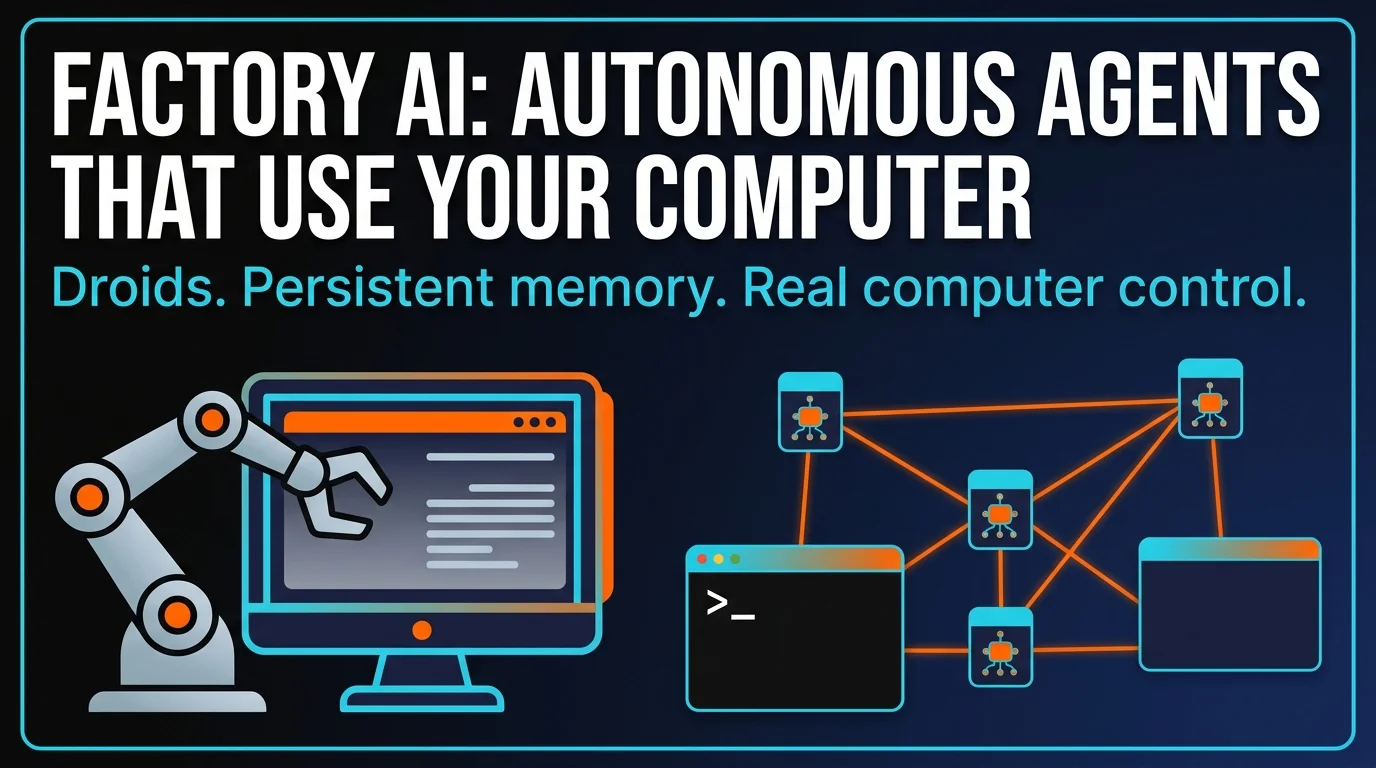
Factory AI is a desktop app that gives you autonomous AI agents called droids. These aren't chatbots. They don't just answer questions. They build software, fix bugs, control your computer, pull data from your dashboard, write reports, run terminal commands, open VS Code, navigate your browser — and they keep going without you hovering over them.
The mental model that clicked for me: imagine hiring a team of digital employees. Each one has their own machine, their own memory, their own set of tasks. They all run in parallel without stepping on each other. That's what Factory AI gives you — and that's why this is worth paying attention to, even if you're already deep into Claude Code or Cursor.

The paradigm shift: prompting → delegation
For the last couple of years, most people have been using AI as a tool. You go to it, you ask a question, it gives you an answer, you go away and do the work yourself. Factory AI flips that model entirely. You assign tasks. Droids execute. You review output. That cycle replaces a huge amount of manual, repetitive, time-consuming work.

This isn't prompt engineering. It's delegation. You don't sit there typing instructions back and forth. You assign a task, the droid executes it, you check the result. The businesses that learn to run this kind of AI operation early are going to have a real structural advantage over those that figure it out later.

Multi-agent parallel execution
The first thing that blew my mind: you can run multiple droids at the exact same time. Not sequentially — simultaneously. Each one working on something completely different.
Real example. Say you're running a digital business. You could have one droid creating content for your audience, another testing your onboarding flow, another triaging support queries and flagging the ones that need attention. All three running in parallel while you focus on something else entirely. Most people are still running AI one prompt at a time. That's the old way.


Persistent computers — agents that never forget
This is the part that actually made me stop scrolling. Every single droid in Factory AI gets its own persistent computer — a real machine with installed packages, running services, and saved state. The droid does not reset.
You know how every ChatGPT conversation starts from zero? No memory, no context. You have to re-explain everything every single time. Factory AI solves that. If a droid was building something on Monday, it picks right back up on Tuesday. The context is still there. The progress is still there. Nothing is lost.

The biggest friction with AI agents right now is that you have to constantly rebrief them — paste context, explain background, walk them through what happened last session. Droids remove that friction entirely. That is a massive unlock for anyone running multi-day workflows, and it's genuinely one of the most underrated features in the current AI agent landscape.

Computer use: browser, terminal, VS Code
Factory AI agents can actually use your computer. Not just generate text — they use your browser, run terminal commands, open VS Code, navigate apps, and pull data from wherever it lives.
Concrete example: say you want a droid to check your community dashboard, pull the latest activity stats, and put together a simple summary report. With Factory AI, you set that up once and the droid handles the full workflow end-to-end. Opens the browser, navigates to the dashboard, pulls the data, writes the report, done. No copy-paste, no manual data collection, no tab switching.

This is what people mean when they talk about "computer use AI." It's not AI that generates a document. It's AI that actually does the task on your machine the same way a human would. And Factory AI is one of the few tools doing this at production quality right now.

Cloud, local, or your own GPU
Something a lot of people miss: you have a choice of how you run Factory AI. Cloud, local hardware, or your own GPU with local AI models. Why does that matter? Privacy. If you're handling client data, community information, or business systems, you're not forced to send everything to a third-party server. You can keep it local, on your own machine.
It also means performance. If you have the hardware, you can push local models and get faster results without relying on API limits or cloud queues. For agencies running sensitive client workflows, this level of control is rare — and it's a genuine differentiator from the "send everything to OpenAI's servers" approach most tools take.

The skill system
Factory AI has a skill system that turns one-off automations into reusable, version-controlled workflows. You create a workflow for one thing, save it as a skill, and every droid on your team can now access it. Update the skill in one place and it updates everywhere.
This is AI workflows as code — not one-off automations you rebuild from scratch every time. Proper, repeatable, scalable processes that get smarter as you improve them. For anyone running a team, this is the thing that compounds. You build a skill once, it runs forever.

Factory AI vs ChatGPT vs Claude Code
The positioning question everyone asks. Here's how it stacks up against the two tools most people already use:

| Feature | Factory AI | Description | Business impact |
|---|---|---|---|
| Multi-agent parallel | 10+ simultaneous | Content, testing, and triage running at the same time without interference | Full-team throughput without the headcount |
| Persistent computers | Always-on VMs | Each droid keeps installed packages, services, and saved state across sessions | Eliminates rebriefing friction; prevents context loss |
| Computer use | Full OS control | Browsers, terminals, VS Code, apps — the same way a human would | Automates complex multi-step tasks; lowers MTTR |
| Skill system | Reusable, versioned | Build once, share across all droids, update in one place | Compounds over time; scales with team size |
| Deployment | Cloud / local / GPU | Run on Factory's infra or locally on your own hardware for full privacy | Data stays on-premise; avoids API limits and latency |


The honest take
Factory AI is powerful, but I want to give you the real picture. The upside is huge — parallel execution, persistent memory, real computer control, privacy options, skill systems, all genuinely impressive and genuinely useful.
What works
- ✓Persistent memory is genuinely transformative. The zero-rebrief experience changes how you think about multi-day workflows.
- ✓Computer use at production quality. Not a demo — droids actually navigate apps, pull data, and write reports.
- ✓Local execution option. Rare among agent platforms. Real control over your data.
- ✓Skills compound. Build once, run forever. The first month is setup; the second month is leverage.
What to watch
- ✗Setup takes real time. You need to understand how to structure tasks properly for droids to execute them well.
- ✗Droids can still make mistakes. They need supervision, especially on high-stakes tasks. You're not pressing a button and walking away.
- ✗Not a push-button solution. You're building a system you gradually trust more as it proves itself — that takes patience.
- ✗Early ecosystem. Skills are powerful but the library is young. You'll be writing most of your own for now.

This is for developers, startups, indie builders, agency owners — anyone running a software business or digital operation who wants to move faster with less manual work. If you're managing a team and want to multiply output without multiplying headcount, Factory AI is worth evaluating. If you're a solo operator and want to run at a level that usually requires a full team, even more so.

Frequently asked questions
Bottom line: Factory AI is early, it's powerful, and it rewards the people who learn it properly. The gap between people using AI as a chat tool and people using AI as an autonomous workforce is getting bigger every month. Factory AI is one of the first tools making that second category accessible to people who aren't building from scratch. The app is available now at factory.ai.
Recommended AI Tools
played.fm
Sell your music and keep 100%: played.fm is a direct-to-fan store + sync marketplace with 0% commission, no gatekeepers, and no bans — a strong fit for AI musicians.
View Review →OpenCode
The open-source AI coding agent: terminal-first TUI, 75+ model providers, LSP context, subagents, and privacy-first design. Free software, ~180K GitHub stars.
View Review →Exa
The neural web search API for AI agents: embeddings-based retrieval, cited highlights, sub-180ms latency, and an MCP server. 20,000 free requests/month.
View Review →Google Antigravity
Google's agent-first IDE: run a fleet of AI agents from a Manager surface, on Gemini 3 Pro, Claude Sonnet 4.5, or OpenAI models. Free in public preview.
View Review →