


⚡ TL;DR — Exa Review
Exa is web search built for AI agents, not humans. Instead of keyword matching, it uses neural embeddings retrieval to return clean, structured excerpts with citations — and its Highlights cut the tokens you feed a model by up to 90%. It's fast (under 180ms), accurate (54.4% on FRAMES vs Perplexity's 44.5%), ships an MCP server for Claude, and gives you 20,000 free requests a month. Cursor, Devin, HubSpot, and AWS already build on it. If your agent needs to search the web, this is the API to reach for.
📋 Table of Contents

What is Exa?
Exa is a web search API built for AI agents. Its own homepage puts it plainly: "Web search, built for AI agents — one API for search, crawling, and research." Where a traditional search engine returns a page of blue links meant for a human to click, Exa returns clean, structured data meant for a language model to reason over.
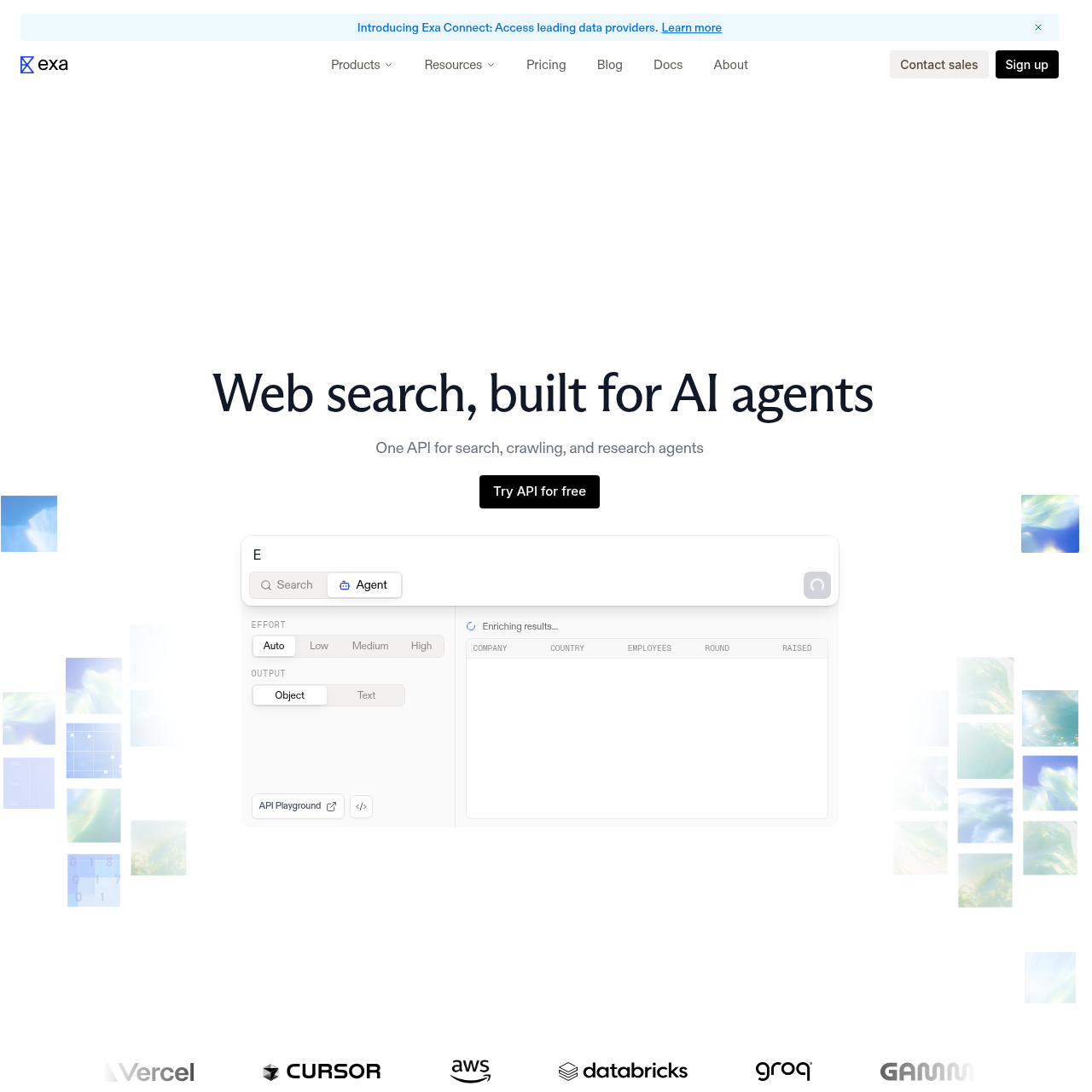
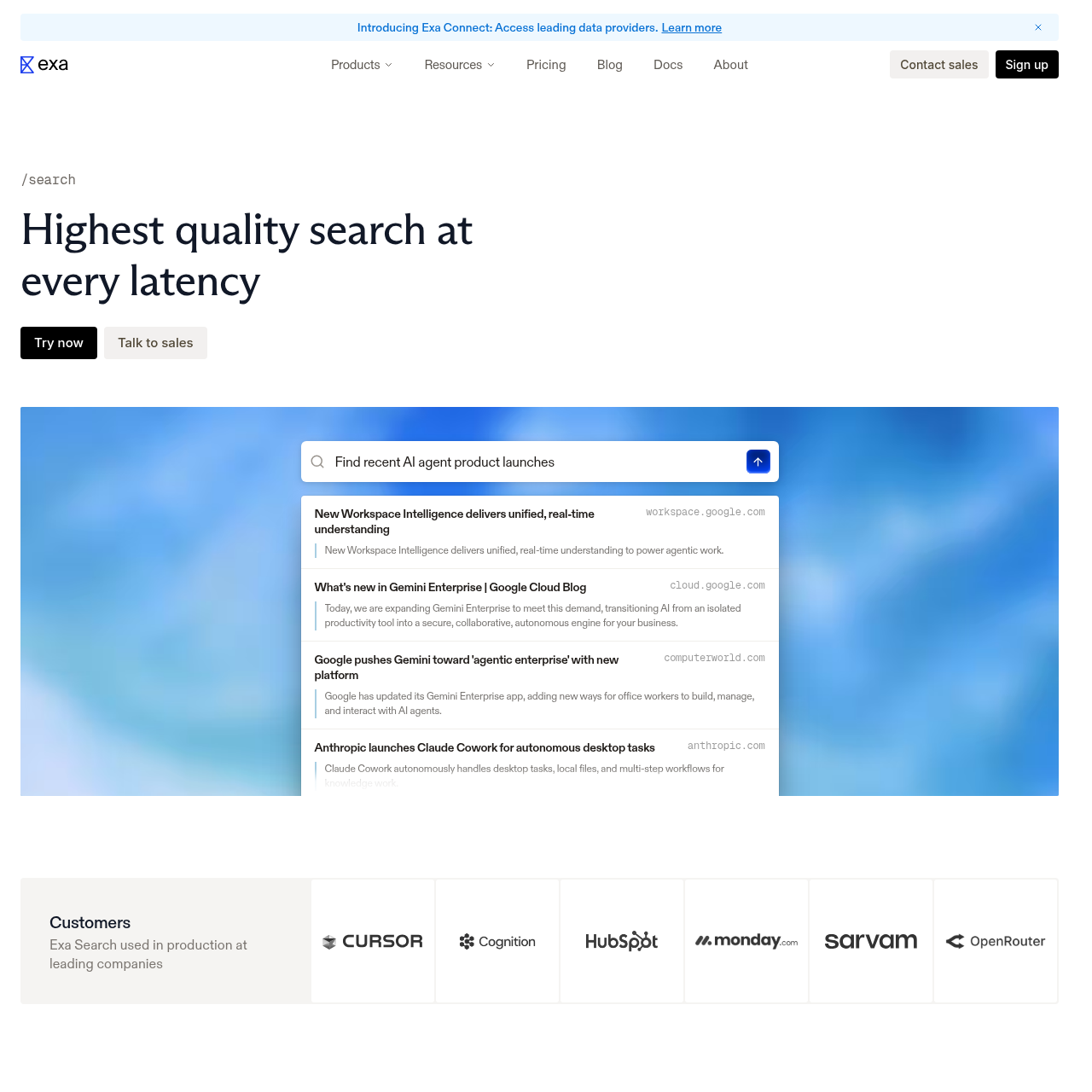
The technical difference is neural search. Instead of keyword matching, Exa uses embeddings-based retrieval, which is why it's strong at the queries agents actually run — company research, people discovery, and finding code repositories. It's fast enough for the agent loop (results in under 180ms) and it's accurate: Exa scores 54.4% on the FRAMES benchmark, well ahead of Perplexity (44.5%) and Brave (21.6%). Teams behind serious agentic products — Cognition's Devin, Cursor, HubSpot, Monday.com, AWS, Databricks, and Groq — build on it.
Key Features
🧠 Neural Search
Embeddings-based retrieval instead of keywords — it understands meaning, which is why it nails company, people, and code-repo queries agents run.
✂️ Highlights
Returns concise, relevant excerpts rather than whole pages, cutting the tokens you feed a model by up to 90% — real money at scale.
📄 Contents API
Crawl and extract clean full-page content optimized for AI, with grounded citations from a 70M+ company database.
🤖 Agent & Deep
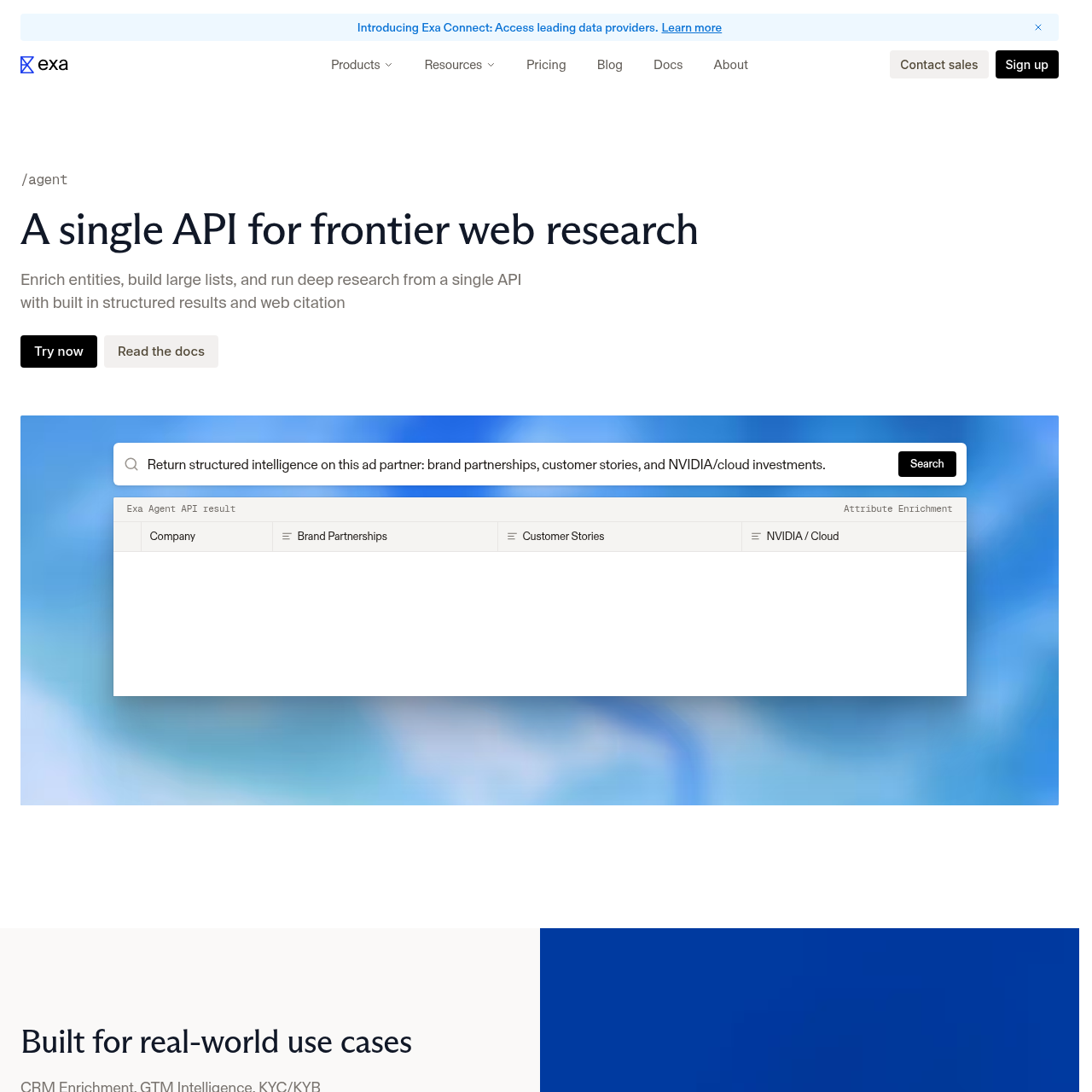
An autonomous research Agent and a Deep endpoint for complex, multi-step, structured data extraction with citations.
🔌 MCP Server
An official Model Context Protocol server lets Claude and other MCP agents call Exa web search directly as a tool.
📊 Websets & Monitors
Build curated collections with Websets, and use Monitors to track web changes over time at a set cadence.
⚡ Sub-180ms Latency
Configurable latency from 180ms to 1s, fast enough to sit inside a tight agent loop without stalling the model.
🔐 Enterprise-Ready
SOC 2 Type II, Zero Data Retention options, and SSO — the compliance boxes real companies need ticked.

How to Use Exa
There are two easy on-ramps depending on how you build.
- Grab an API key. Sign up, get a key from the dashboard, and you're on the free tier — 20,000 requests a month, no card.
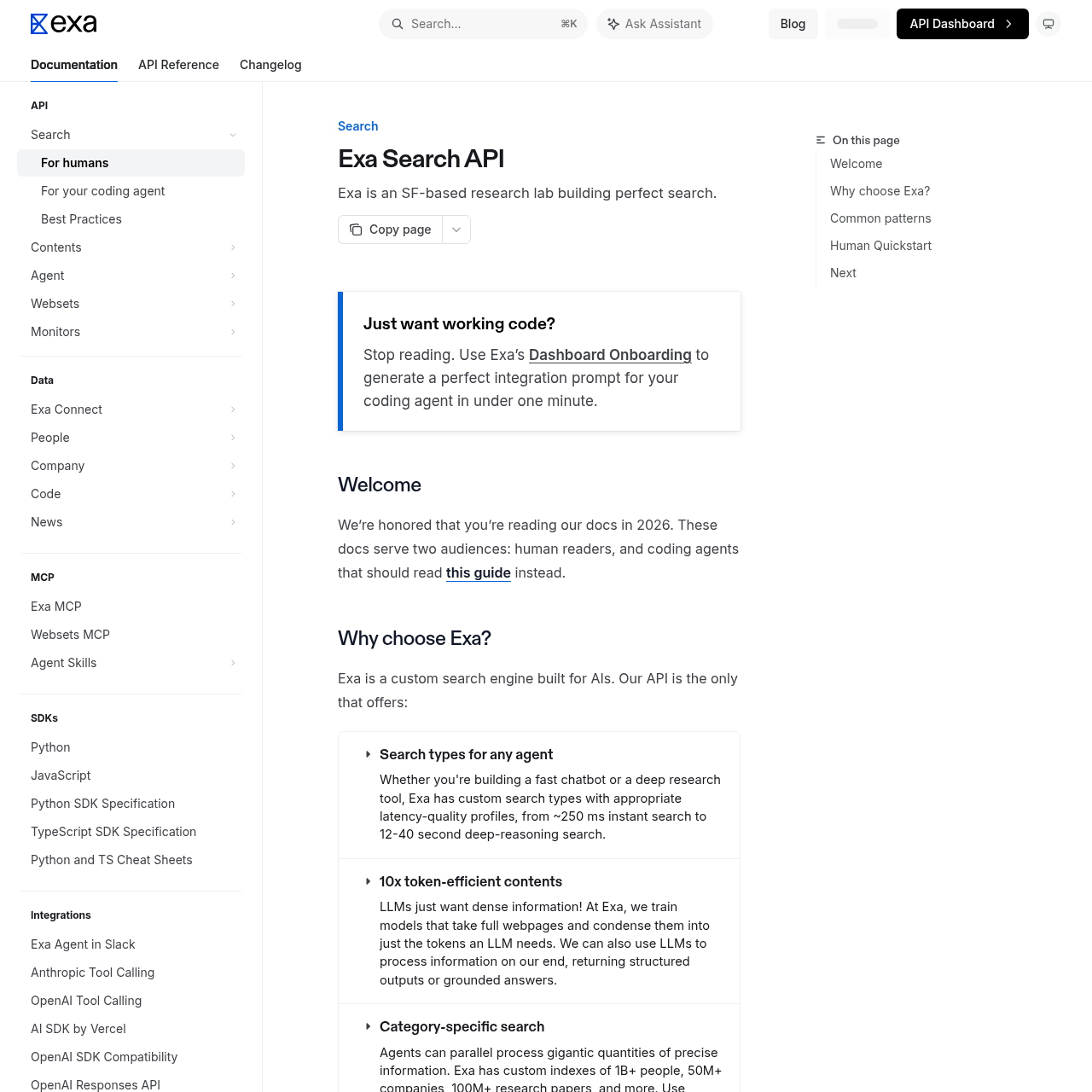
- Call the Search API. Send a query, choose how many results and whether you want highlights or full contents, and get back structured JSON with citations.
- Or drop in the MCP server. If you build on Claude or another MCP agent, add Exa's MCP server and the agent can call web search as a native tool — no wrapper code.
- Scale up when ready. Move to the Agent or Deep endpoints for autonomous, multi-step research, and add Monitors to watch the web over time.
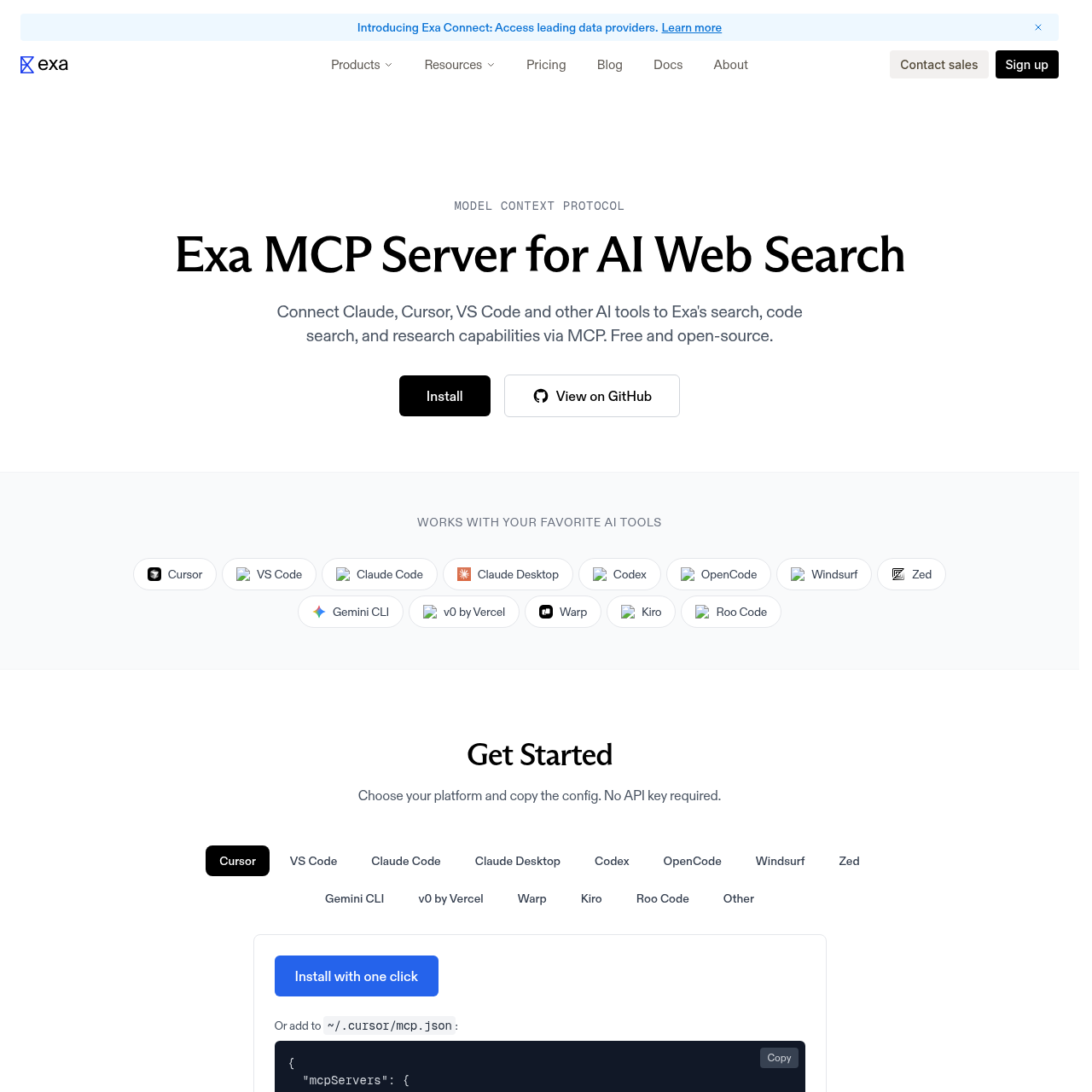
The docs are genuinely good — clear endpoints, examples, and SDKs — so getting from key to first result takes minutes. The MCP path is the fastest if you're already in the agent tooling world.
Pricing Plans
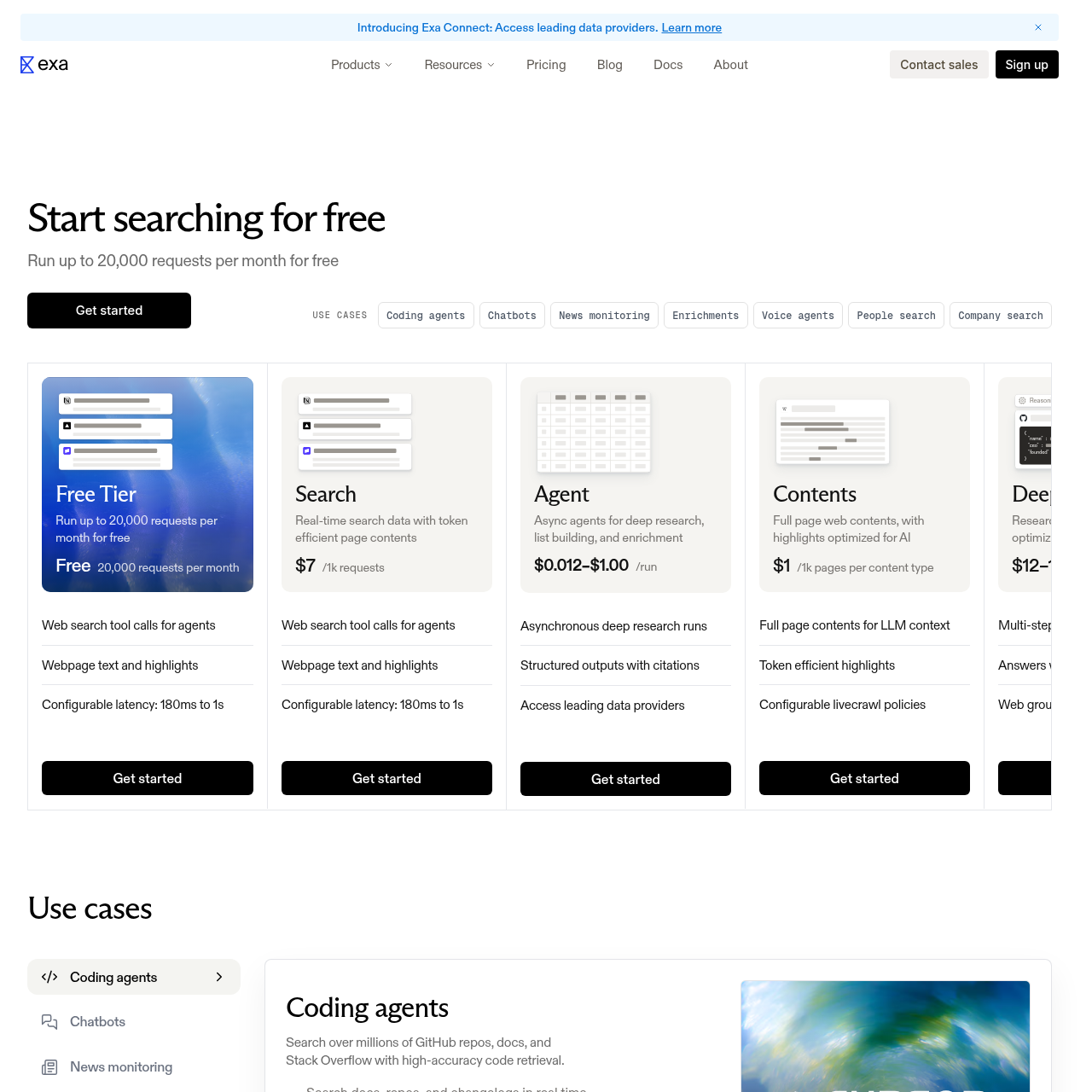
Exa's pricing is usage-based and starts genuinely free — 20,000 requests a month before you pay a cent. After that, you pay per endpoint:
Free
$0
- ✓ 20,000 requests/mo
- ✓ Search + highlights
- ✓ No credit card
CORE
Search
$7 / 1k
- ✓ Up to 10 results
- ✓ +$1/1k per extra result
- ✓ Contents $1 / 1k pages
Deep / Monitors
$12–15 / 1k
- ✓ Multi-step research
- ✓ Structured + citations
- ✓ Monitors $15 / 1k
Agent
$0.012+ / req
- ✓ Scales by effort to $1/req
- ✓ $0.10 / compute unit
- ✓ Enterprise: custom

Pros and Cons
Strengths
- ✓Built for machines. Neural search plus clean, cited excerpts is exactly what an agent needs — no HTML scraping.
- ✓Token savings. Highlights cut what you send a model by up to 90%, which directly lowers your LLM bill.
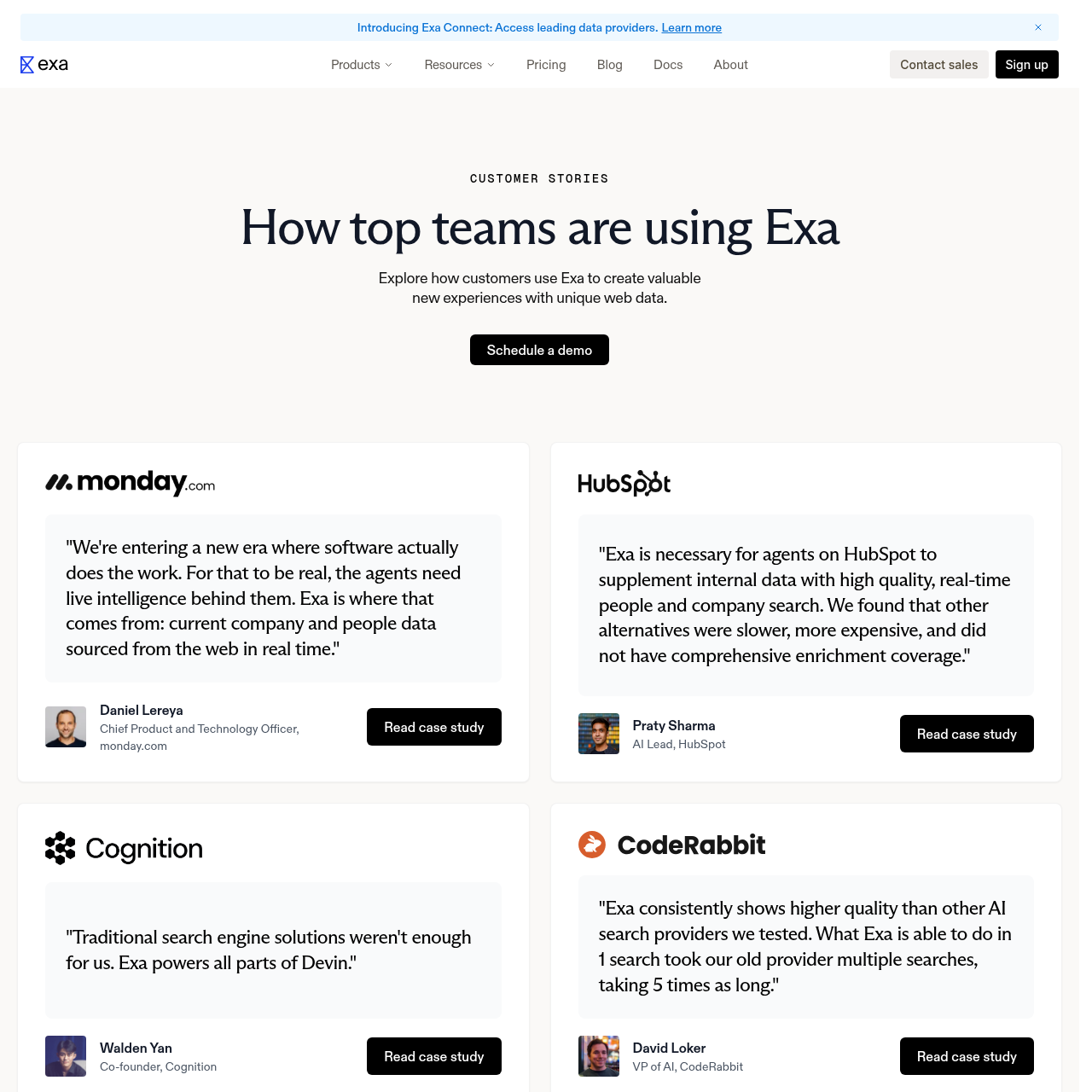
- ✓Benchmark-leading accuracy. 54.4% on FRAMES beats Perplexity and Brave by a wide margin.
- ✓Generous free tier + MCP. 20,000 free requests and an official MCP server make it trivial to try.
- ✓Proven at scale. Cursor, Devin, HubSpot, and AWS in production is real validation.
Weaknesses
- ✗Developer-only. Exa is an API — there's no polished end-user app, so non-coders won't get value directly.
- ✗Metered pricing adds up. Multi-step Agent and Deep calls can get expensive on high-volume, complex workloads.
- ✗Endpoint sprawl. Search, Contents, Agent, Deep, Monitors, Websets — powerful, but there's a bit to learn to pick the right one.
- ✗Text-first. It's tuned for web text and structured data, not image or video search.
Best Alternatives
Exa competes in the fast-growing "search API for agents" space. Here's how it stacks up.
| Tool | Best For | Approach | Free Tier |
|---|---|---|---|
| Exa | Neural search + research for agents | Embeddings-based | 20K req/mo |
| Tavily | Simple RAG search | Keyword + LLM | 1K credits/mo |
| Perplexity API | Answer-style search | Answer engine | Limited |
| Firecrawl | Crawling + scraping | Crawl-first | 500 credits |
The short version: Tavily is simpler for basic RAG, and Firecrawl wins if you mainly need to crawl and scrape. But for accuracy, neural relevance, and research depth — plus a benchmark lead and enterprise adoption — Exa is the one to beat. It pairs especially well with the agent stacks we cover in our AI tools directory.
Related Reviews

Frequently Asked Questions
❓ What is Exa?
A web search API built for AI agents. It uses neural, embeddings-based retrieval to return structured results with citations and highlights, so agents can pull current web data through one API.
❓ How much does Exa cost?
Free up to 20,000 requests/month, then metered: Search $7/1k, Contents $1/1k pages, Deep $12-15/1k, and Agent from $0.012 to $1.00 per request by effort. Enterprise is custom.
❓ How is Exa different from Google or Perplexity?
It's built for machines: neural search returns clean, cited excerpts instead of blue links, in under 180ms, and scores 54.4% on FRAMES versus Perplexity's 44.5%.
❓ Does Exa have an MCP server?
Yes — Exa ships an official MCP server, so Claude and other MCP agents can call Exa web search directly as a tool with no custom integration.
Final Verdict
4.7/5. Exa is the search layer the agent era actually needed. Neural retrieval, cited highlights that slash token costs, sub-180ms latency, a benchmark lead over Perplexity, and an official MCP server add up to the most agent-native search API on the market — and the roster of companies building on it (Cursor, Devin, HubSpot, AWS) is hard to argue with. It's developer-only and the metered pricing can climb on heavy Agent workloads, but neither is a real knock for the audience it's for. If you're building anything that needs to search the web intelligently, start with Exa's free tier — you'll likely stay.
Give your agent real web search
Start free with 20,000 requests a month — neural search, highlights, and an MCP server for Claude, no credit card.
Try Exa Free →
Get Premium AI Tool Insights
Subscribe to get weekly curated AI tool recommendations, exclusive deals, and early access to new tool reviews.
Related Tools

Chartcastr
ai-data
Updated March 2026 · 11 min read · By PopularAiTools.ai
openProd.io
ai-data
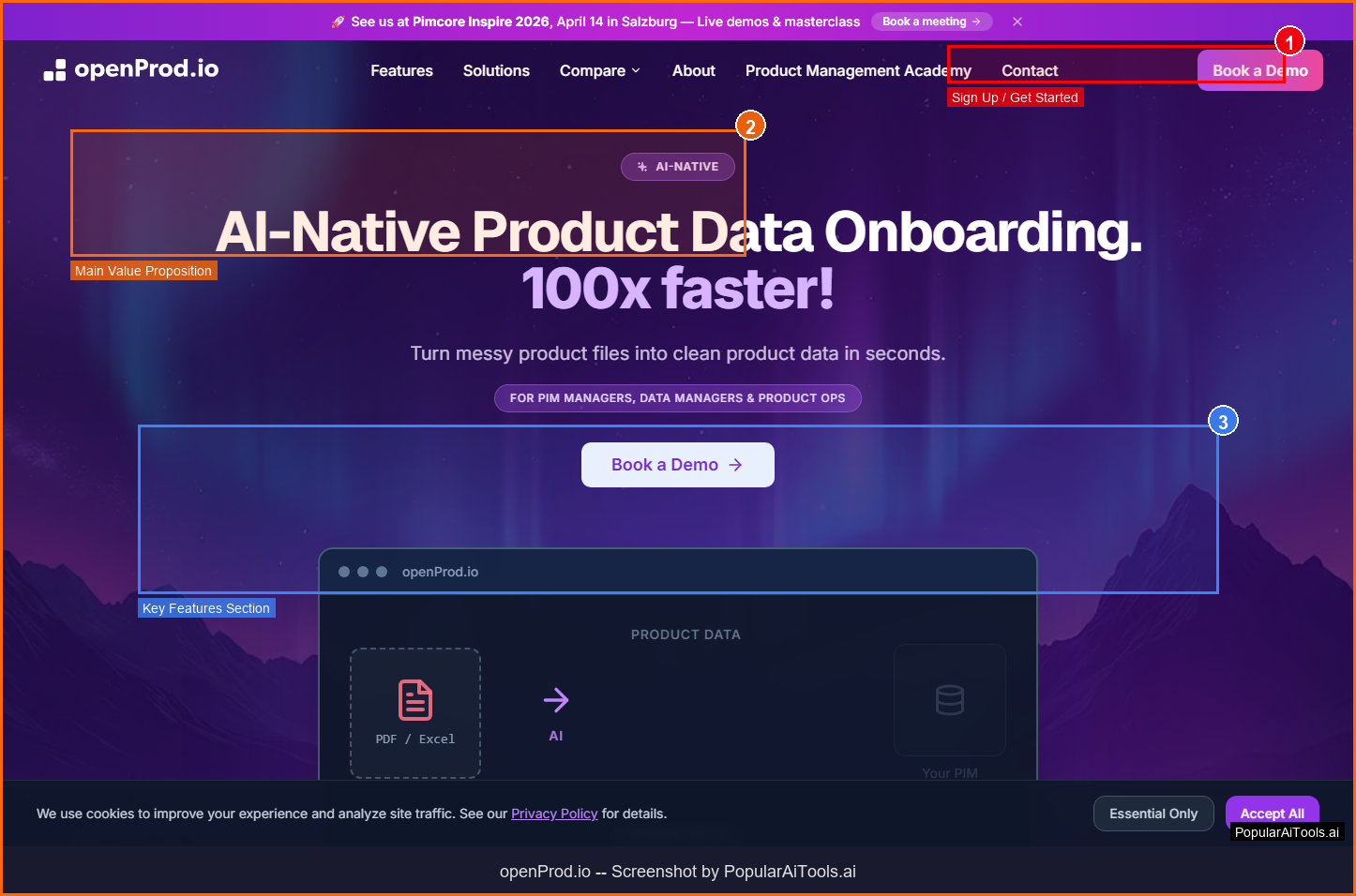
openProd.io: AI-native platform that extracts, cleans, normalizes, and enriches product data from supplier files and exports validated data to PIMs.
TubeSpark
ai-data
A tool to generate YouTube ideas, scripts, analytics.
mia
ai-data
A tool to monitor competitors and generate market insights.
Related Articles
Secure Your Suno Catalogue Now: An Action Plan Before the Watermark and Download-Limit Rollout
Suno's download limits and watermarking arrive within weeks. This is the four-step action plan to back up, verify, process and release your Suno catalogue before the rollout changes your workflow.
Suno's Tamper-Resistant Watermarking, Explained: What It Means for Independent AI Music Producers
On August 6, 2026 Suno announced tamper-resistant watermarking, fingerprinting, off-platform identification and download limits. Here is exactly what changes for independent AI music producers — and what stays the same.
Best AI Humanizer 2026: 5 Tools Tested (And When Not to Use One)
We tested 5 AI humanizers on real AI drafts. Which one keeps your voice, what each costs, why detector scores prove less than you think, and the one use case to walk away from.