


⚡ TL;DR — SendMux Review
SendMux is the email API built for AI agents. It hands every agent its own inbox, routes outbound mail through the providers you already use (SMTP, Gmail, Microsoft 365, Amazon SES) with automatic failover, and returns clean agent-ready JSON with signatures and quoted history stripped by default. Pricing is usage-based at $0.15 per 1,000 emails, with no per-seat, per-mailbox, or subscription fees. If you're building agents that need to send and receive real email, this is the most purpose-built tool we've tested in 2026.
📋 Table of Contents

What is SendMux?
SendMux is an email API built specifically for AI agents. Instead of stitching together a transactional sender, an IMAP inbox, a webhook parser, and a pile of glue code, you get one control plane that lets an agent own a real inbox, send through your existing providers, and react to incoming mail in real time. It's the plumbing that turns "my agent can call an API" into "my agent has an email address people can actually reply to."
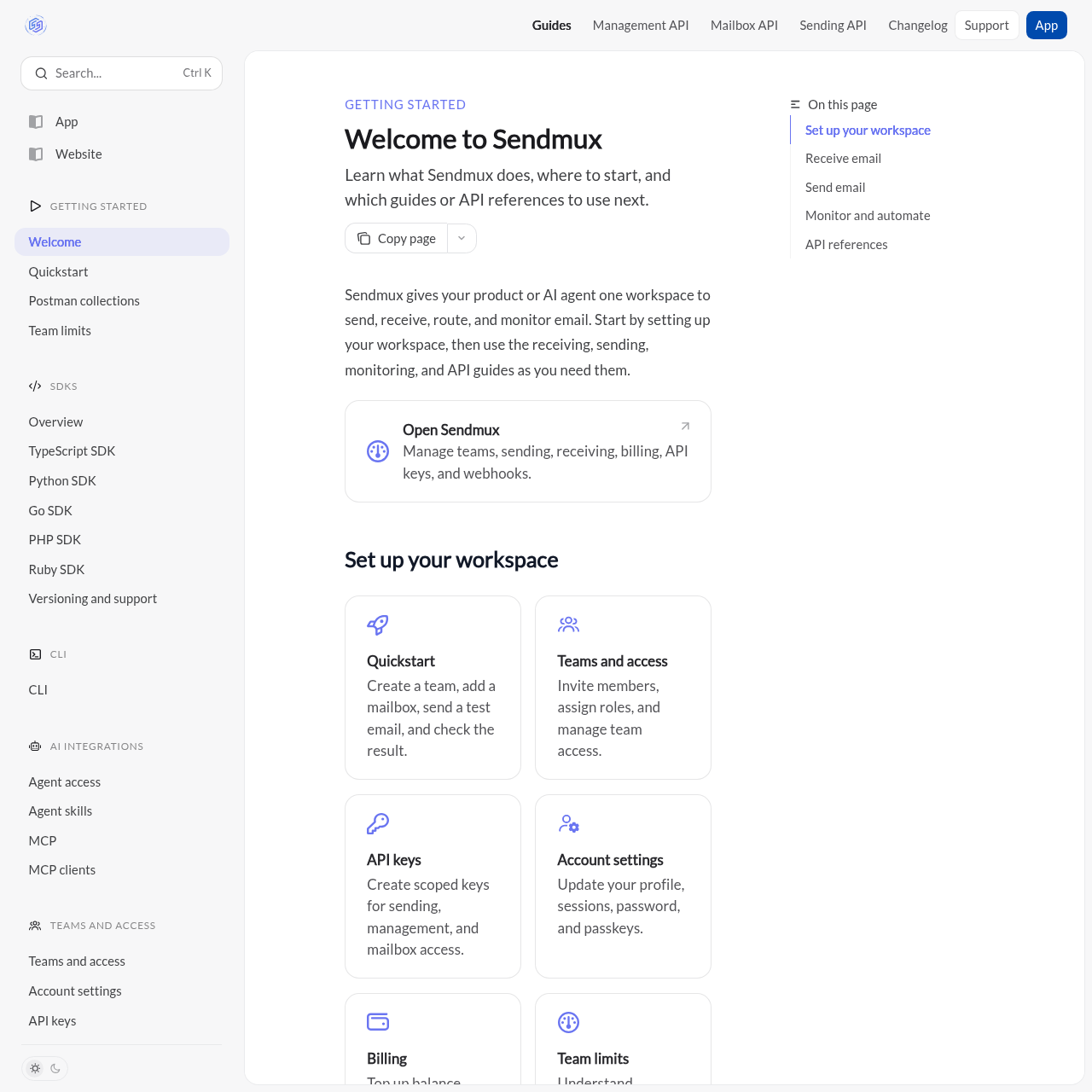
Here's the problem it solves. Most email APIs were designed for humans pushing marketing blasts or a SaaS app firing password resets. Agents need something different: a mailbox they can poll, threads they can read without wading through HTML signatures, and a way to send a reply through Gmail or Amazon SES without you rebuilding delivery logic every time. SendMux was built for that from day one, and it shows in the details — clean JSON responses, quoted history stripped by default, and a Model Context Protocol server so an agent can call it directly.

Who is it for? Two clear audiences. First, AI agent builders who need their agents to send and receive email under a verified domain. Second, SaaS and platform teams who want to give every customer an isolated team with its own scoped keys and mailboxes. If you're just sending the occasional transactional email from a web app, a plain sender is fine. If email is a first-class channel your agents live in, SendMux is a different category of tool.
Key Features
We spent time across every product page and the docs. These are the features that actually matter when you're wiring an agent to real email.
📥 Agent Inboxes
Give any agent a real inbox on myagent.mx or your own verified domain. Each mailbox is addressable, isolated, and scoped to its own API key.
📤 Multi-Provider Routing
Send through SMTP, Gmail, Microsoft 365, or Amazon SES — or spread volume across weighted delivery groups. SendMux picks the route so you don't hardcode one provider.
🔁 Provider Failover
If a provider goes unhealthy, SendMux automatically reroutes around it. Your agent keeps sending instead of silently dropping mail during an outage.
🧩 Mailbox API
Read messages, threads, attachments, folders, and usage metrics through a mailbox-scoped API designed for programmatic access — no fragile IMAP parsing.
⚡ Live Events
Three ways to know when mail lands: webhooks, Server-Sent Events, and change polling. Pick whichever fits your agent runtime.
🤖 Agent-Optimized Content
Responses come back as clean JSON with signatures and quoted history stripped by default, so your model reasons over the actual message, not a wall of reply chains.
🔌 MCP Server + SDKs
Native Model Context Protocol servers plus SDKs for TypeScript, Python, Go, PHP, and Ruby, and a @sendmux/cli for scripts.
🔐 Team Isolation
Scoped API keys, per-customer team isolation, quotas, and usage controls — the platform primitives you need if you're reselling agent mailboxes to your own users.

The multi-provider routing is the feature we'd point to first. Sending "through your own providers" means you keep your existing sender reputation and deliverability, and SendMux just orchestrates on top. That's a meaningfully different bet than a service that owns the sending IPs and asks you to trust its reputation.


How to Use SendMux
Getting an agent onto email is refreshingly short. The quickstart walks you through it in four moves:
- Create a team. This is your isolation boundary. Every mailbox, provider, and API key lives under a team, so multi-tenant setups stay clean.
- Add a mailbox. Spin up an inbox on
myagent.mxto start, or verify your own domain for production. - Connect a provider. Point SendMux at SMTP, Gmail, Microsoft 365, or Amazon SES. Add more than one and set weights if you want load spreading and failover.
- Send a test email. Fire a request over HTTP (or SMTP), subscribe to a webhook, and watch the delivery and inbound events flow in.
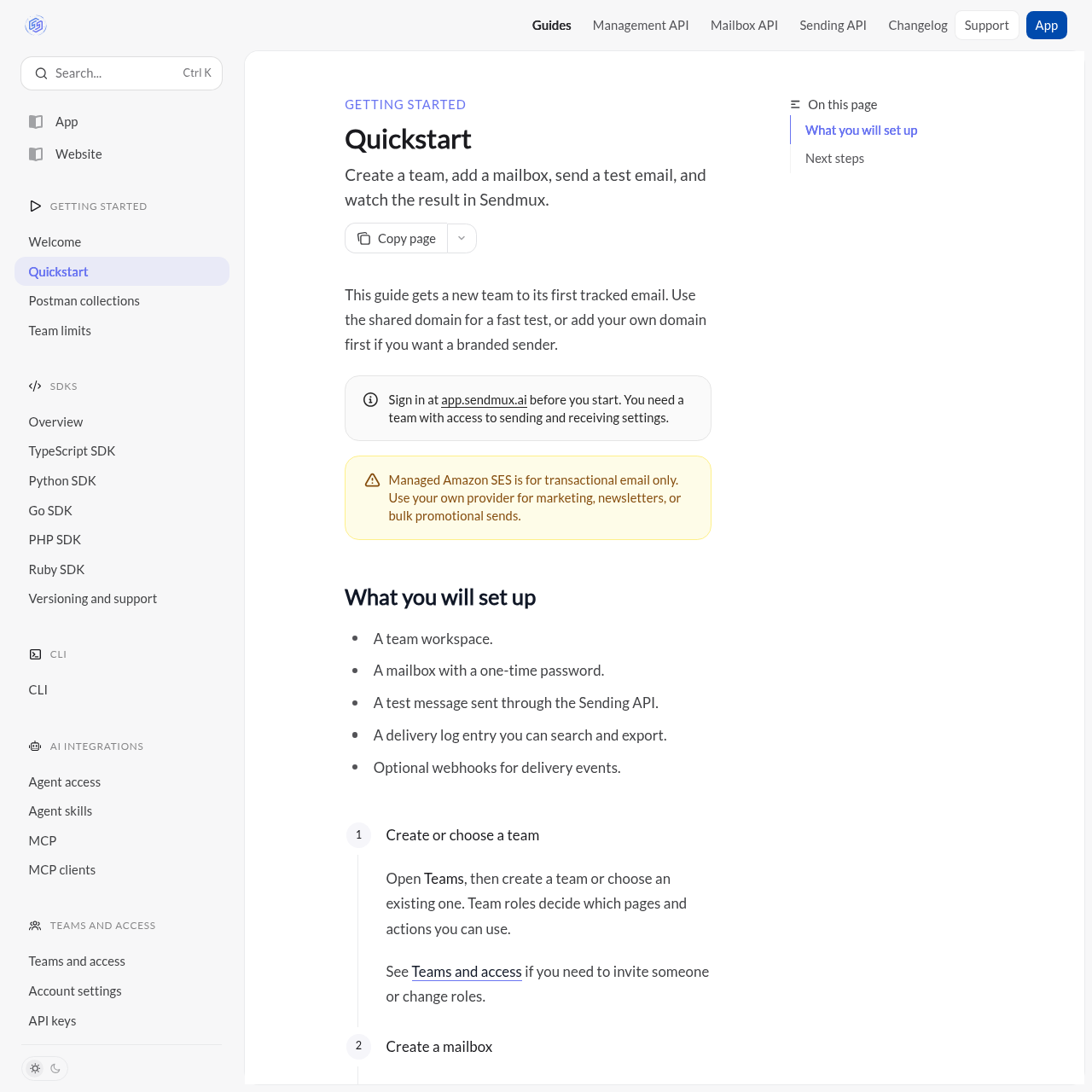
Two things stood out during setup. First, idempotency is built in — you can safely retry a mutating request without sending the same email twice, which matters a lot when an agent is looping. Second, webhook signatures use HMAC-SHA256, so you can verify events actually came from SendMux before your agent acts on them. These are the boring-but-critical primitives that separate real infrastructure from a weekend project.
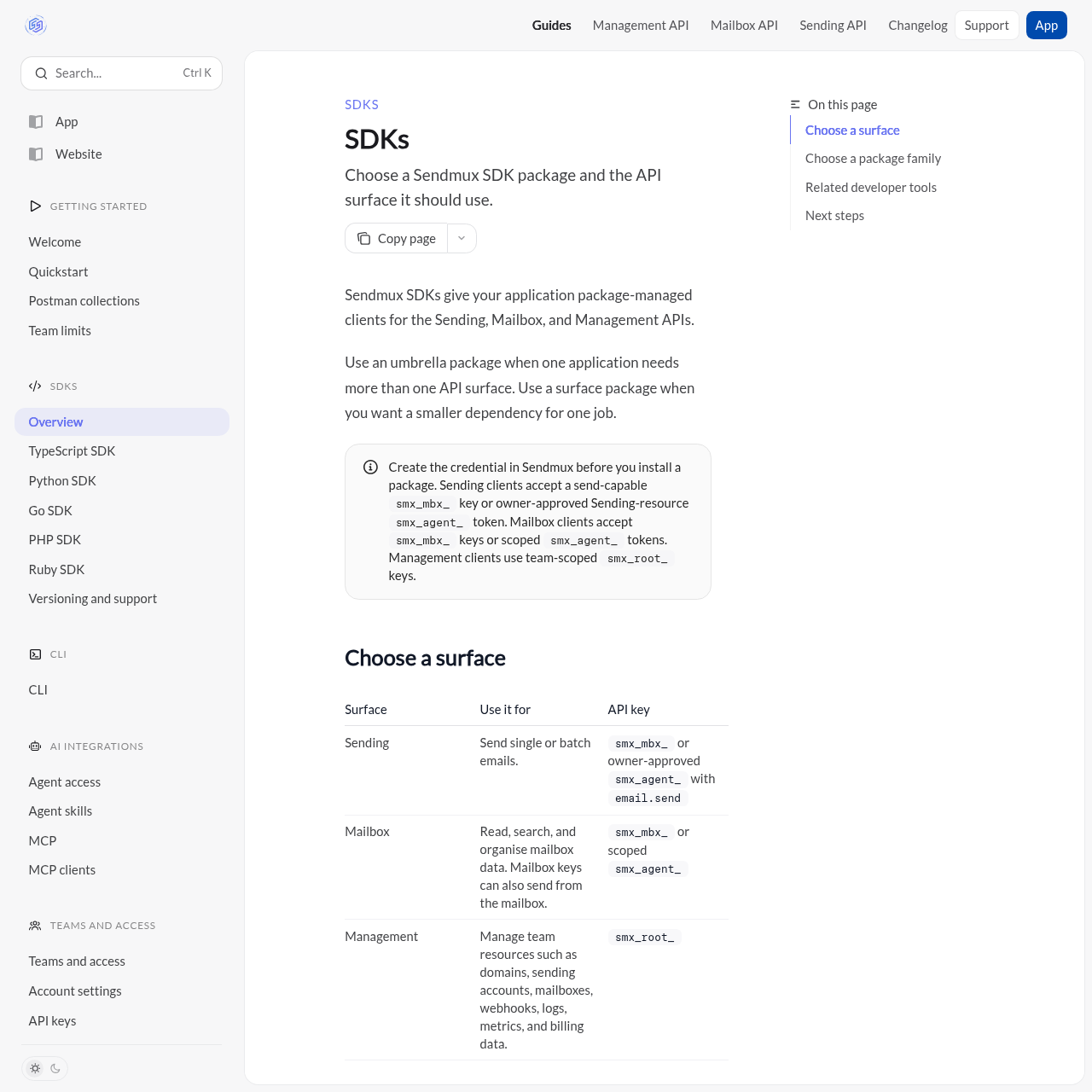
If you're building on Claude or another MCP-aware agent, the Model Context Protocol servers are the fastest path — the agent discovers the tools and calls SendMux directly, no custom wrapper needed. The developer experience here is clearly designed for machines first, humans second, which is exactly right for this category.
Pricing Plans
This is where SendMux gets genuinely interesting. There are no plans in the traditional sense — no per-seat charge, no per-mailbox fee, no monthly subscription. You pay for what you route. That's a rare pricing model, and for agent workloads that spike unpredictably, it's the right one.
Send or Receive
$0.15 / 1,000
- ✓ Through your own providers
- ✓ Inbound and outbound
- ✓ Your sender reputation
MANAGED
Managed SES
$0.25 / 1,000
- ✓ SendMux-managed Amazon SES
- ✓ No SES account to babysit
- ✓ Fastest path to sending
Mailbox Storage
$0.02 / GB · mo
- ✓ Stored messages + attachments
- ✓ Only what you keep
- ✓ No minimums

To put that in context: a million emails a month through your own providers works out to roughly $150. There's no credit card required to start, and because there's no per-mailbox fee, you can hand out thousands of agent inboxes without the pricing exploding. Compared to transactional platforms that charge $15–$100+/month the moment you cross a volume tier, this is a much friendlier curve for agent fleets that idle and then spike.

Why SendMux Stands Out
Strengths
- ✓Purpose-built for agents. Clean JSON, stripped signatures, MCP servers, and scoped keys — every design choice assumes a machine is the user.
- ✓Bring your own providers. You keep your deliverability and sender reputation instead of renting someone else's IPs.
- ✓Failover that just works. Weighted delivery groups and automatic rerouting keep mail flowing during a provider outage.
- ✓Honest pricing. Usage-based with no per-seat or per-mailbox fees. Hand out thousands of inboxes cheaply.
- ✓Real developer experience. Five SDKs, a CLI, idempotency, and HMAC-signed webhooks out of the box.
- ✓Works with MCP agents. Native Model Context Protocol servers let Claude and other agents call SendMux directly, no glue code required.
Best Alternatives
SendMux sits at the intersection of transactional email and agent infrastructure. Here's how it stacks up against the tools you'd otherwise reach for.
| Tool | Best For | Agent Inboxes | Starting Price |
|---|---|---|---|
| SendMux | Agents that send AND receive email | ✓ Native | $0.15 / 1,000 |
| Resend | Modern transactional sending | Limited | Free tier, then ~$20/mo |
| Amazon SES | Raw, cheap send infrastructure | ✗ Send-focused | ~$0.10 / 1,000 (send) |
| Postmark | Reliable transactional + inbound | Inbound parsing only | ~$15/mo (10k) |
The short version: if you only need to send, Amazon SES or Resend are cheaper and simpler. The moment your agent needs to own an inbox, read replies, and route across providers with failover, SendMux is doing a job those tools weren't built for. It's the difference between an email sender and an email operating system for agents. If you're assembling a broader agent stack, it pairs naturally with the kind of automation platforms we cover in our AI tools directory.


Related Reviews

Frequently Asked Questions
❓ What is SendMux used for?
It gives AI agents their own inboxes and a single control plane to send, receive, and process email. Agents read threads, send replies through your own providers, and react to inbound mail via webhooks or live events.
❓ How much does SendMux cost?
Usage-based: $0.15 per 1,000 emails through your own providers, $0.25 per 1,000 via managed Amazon SES, and $0.02 per GB of mailbox storage per month. No per-seat, per-mailbox, or subscription fees, and it's free to start with no credit card.
❓ Does SendMux work with Claude and other MCP agents?
Yes. SendMux ships Model Context Protocol servers, so MCP-aware agents like Claude can discover and call its tools directly without a custom integration layer.
❓ Does it replace my email provider?
No. SendMux sits on top of providers you already use — SMTP, Gmail, Microsoft 365, or Amazon SES — and handles routing, quotas, weighted delivery, failover, and inbound processing in one place.
❓ Which languages have SDKs?
Official SDKs cover TypeScript, Python, Go, PHP, and Ruby, plus a
@sendmux/cli command-line tool for scripting and CI.Final Verdict
4.9/5. SendMux is the rare tool that nails a real, specific problem instead of being one more email API. If you're building agents that need to live in an inbox — reading mail, sending replies, reacting to what lands — it removes a genuinely painful chunk of plumbing and does it with the kind of primitives (idempotency, signed webhooks, scoped keys, failover) you'd expect from mature infrastructure. The bring-your-own-provider model protects your deliverability, and the usage-based pricing is honest enough that spinning up thousands of agent inboxes doesn't wreck your budget.
If your agents touch email at all, SendMux is the first tool we'd try — and it's earned a spot next to the best agent-infrastructure tools we've reviewed this year.
Ready to put your agents on email?
Start free, no credit card — spin up an agent inbox and send your first email in minutes.
Try SendMux Free →
Get Premium AI Tool Insights
Subscribe to get weekly curated AI tool recommendations, exclusive deals, and early access to new tool reviews.
Related Tools

Droidrun
ai-automation
Open-source AI framework that lets LLM agents control Android and iOS apps via native accessibility APIs. 91.4% success rate, €2.1M funded.
M
Manus AI
ai-automation
Autonomous AI agent platform that executes complex multi-step tasks — browses the web, writes code, creates files, and works in the background without guidance.
R
Renamer.ai
ai-automation
AI-powered file renaming tool that uses OCR to read document content and automatically generates meaningful file names. Supports 30+ file types and 20+ languages.

MuleRun
Related Articles
Suno v6 Intro and Ending Prompts: Unwanted Humming, Long Outros and Cut-Off Lyrics (2026)
Fix the edges of a Suno v6 track: three pasteable intro and outro templates, the documented Exclude field for unwanted humming, the arithmetic behind cut-off lyrics, and when to edit in Studio instead.
Suno v6 Keeps Changing Your Prompt? Variety, Style Influence and Weirdness Explained (2026)
Suno v6 rewrites your style prompt through the new Variety slider, and Suno documents the fix. What Variety, Style Influence, Weirdness and Max Mode each do, with a one-control-at-a-time worksheet.
Suno v6 Rock Prompts: Keep Guitar Riffs and Drums Alive Through the Verse (2026)
Why a strong Suno v6 rock intro turns into an empty verse, and how to fix it with a section-by-section instrument map, the Exclude field, pasteable rock and metal prompts and an A/B rubric.