AI Music Detector Reality Check: Why Detection Tools Fail And How To Get Tracks Released

AI Infrastructure Lead
An AI music detector is supposed to do one job: tell you whether a track was made by a human or generated by a model like Suno or Udio. In practice, the tools available in 2026 are statistical guessers with high false-positive rates, no published benchmarks, and a fundamental design flaw — they never actually verify how a song was made, they only classify what it sounds like. This review walks through what the major detectors actually do, where they break in practice, and what AI music creators are doing to get their tracks distributed despite them.
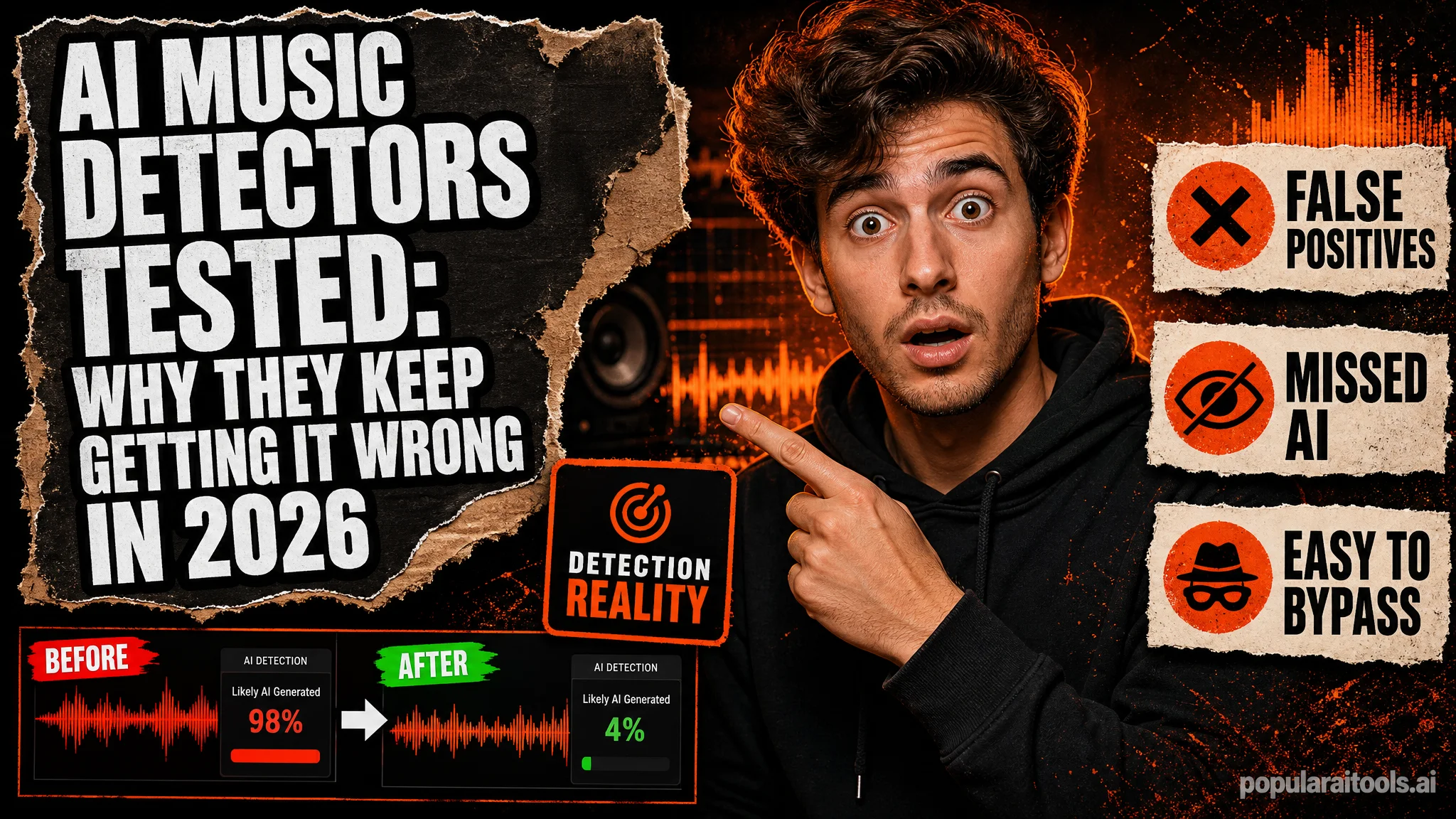
We tested SubmitHub's AI Song Checker, ACRCloud's AI Music Detector, aha-music, theghostproduction.com's detector, and looked at platform-side tools from Spotify and Deezer. Across the board, the same pattern showed up: bold marketing language, no published accuracy figures, and Reddit threads full of creators whose human-recorded songs got flagged at 98% AI. Here's what's actually happening — and the workaround that's quietly become standard practice for AI music distributors.
Table of Contents
- What An AI Music Detector Actually Does
- The AI Song Detectors We Tested
- False Positives: Human Songs Flagged As AI
- False Negatives: AI Tracks Slipping Through
- Why Detection Is Fundamentally Hard
- Platform-Side Detection: Spotify, Deezer, YouTube
- Detector Accuracy Comparison (Data)
- What This Means For AI Music Creators
- The Bypass: Undetectr Watermark Removal
- FAQ
What An AI Music Detector Actually Does
An AI music detector takes a finished audio file and outputs a probability that the track was generated by a machine. There's no way around the fact that this is a classification problem, not a verification problem. The detector never observes the DAW session, the project file, the human's editing history, or the model that produced the audio. It only sees the waveform.
Detectors look for three categories of signal, in roughly this order of reliability:
1. Spectral watermarks (strongest)
Suno, Udio, and other commercial generators embed inaudible spectral signatures into every output. If the watermark survives, detection is close to 100%. Tools like the Suno watermark remover target this exact signal layer. If removed, this signal disappears entirely.
2. Timing & phase patterns
AI generators produce statistically distinct micro-timing and phase relationships. Detectable, but easily disrupted by mastering, time-stretching, or re-encoding.
3. Statistical inference (weakest)
"This vocal sounds AI." Pure pattern matching against training data. Source of most false positives — heavily-processed human vocals often share statistical features with AI outputs.
When a detector returns "98% AI," it really means "the spectral and statistical features of this audio overlap 98% with our training set of known AI generations." Whether that audio was actually made by AI is a separate question — one the detector can't answer.
The AI Song Detectors We Tested
Four free public tools plus two commercial platforms covered the majority of the market in May 2026:

SubmitHub AI Song Checker (submithub.com/ai-song-checker) is the de facto free tool. Paste a Spotify, SoundCloud, YouTube, or Disco URL, or upload MP3/WAV/FLAC, and get a percentage back in under 10 seconds. The model is updated every few months (current version 3.3, last updated February 8, 2026). The owner publicly claims "around 90%" accuracy based on their own testing of "hundreds of songs."

ACRCloud's AI Music Detector (acrcloud.com/ai-music-detector) is the commercial heavyweight — the same fingerprinting infrastructure powering major streaming platforms' content matching. It markets "state-of-the-art machine learning models" and "segment-level" detection. What's missing from their marketing: an accuracy number, a false-positive rate, processing speed, or any benchmark. The Authio comparison page from May 2026 explicitly calls this out — ACRCloud's product page lists features, not metrics.


Beyond the free tier, Authio markets itself as the transparent alternative to ACRCloud (and uses ACRCloud's lack of published metrics as a selling point). Deezer built its own internal detection tool that has been running since early 2025 — and as of January 2026 is being sold to other streaming platforms. None of these tools publish independently verified accuracy numbers.
False Positives: Human Songs Flagged As AI
This is where detection falls apart in public. A sample of documented cases:
"Submithub AI detector first said my song was 98% AI." — r/SunoAI, February 2025. The track was a fully human-recorded vocal performance.
"This AI checker gives so many fake positives, especially when you use high-pitched vocals. Even when the song is 30 years old, it still gets flagged as AI." — Comment on SubmitHub's own how-it-works page.
"Currently it seems like the accuracy is good, recall is decent, but precision is horrible." — Reddit r/SunoAI, February 2025, after testing the detector on multiple human tracks.
The pattern that emerges from creator reports: heavily-processed vocals, falsetto/high-register material, modern pop with aggressive compression, and re-recorded covers all trigger false flags at high rates. The detector is essentially picking up "processed-sounding audio" rather than "AI-generated audio" — two categories that increasingly overlap as modern production gets more aggressive.
A March 2026 fwdmusic.com analysis put the operational impact in concrete terms: for a label processing 10,000 tracks per day, a 1% false-positive rate means 100 legitimate human songs blocked daily. Cyanite.ai's chief AI officer made the same point in their April 2026 blog — false positives don't just embarrass detectors, they actively hurt the artists being misclassified.
False Negatives: AI Tracks Slipping Through
The other failure mode is quieter but more consequential for the streaming ecosystem. Detection misses get less discussion because nobody complains when their AI track sails through — but the data shows it happens at scale.

Spotify's September 2025 announcement of "strengthened AI protections" was an implicit admission that prior detection had been letting too much through. The Reddit thread "Release Radar this week was almost all AI generated music" (r/musicindustry) collected community evidence of low-effort AI tracks getting algorithmically promoted into legitimate listener queues. The detection layer either didn't catch them or didn't act.
The technical reason: once a track's spectral Suno watermark is removed, the strongest detection signal is gone. The detector falls back on timing patterns (degraded by mastering and time-stretching) and statistical inference (the same noisy layer that produces false positives in the other direction). Removing the watermark doesn't just hide the AI origin — it actively pushes the detector toward "human" because the remaining signals are weaker and the model's prior pulls it back to the larger human-training class.
Why Detection Is Fundamentally Hard
There are five structural reasons AI music detection will keep being unreliable:
| Reason | Why it matters |
|---|---|
| No ground truth | Detectors classify audio statistics. They never observe the creation process. Classification, not verification. |
| Watermarks are removable | The strongest detection signal — the spectral watermark — can be stripped with a single processing pass. |
| Adversarial training | Generator developers see every detection signature published and train against it. The gap between training and bypass is measured in weeks, not years. |
| Heavy processing breaks detection | Mastering, EQ, compression, stem replacement, and re-encoding all degrade the spectral fingerprints detectors rely on. |
| Operational cost of false positives | Even 1% false-positive rate is unsupportable for a major distributor — too many legitimate artists hurt to justify the AI catches. |
Platform-Side Detection: Spotify, Deezer, YouTube
The third-party detectors above are what creators use to self-check before distribution. The detection that actually blocks releases is platform-side — and platforms are notably less transparent than the third-party tools.
| Platform | Detection status | Public accuracy |
|---|---|---|
| Spotify | "Strengthened AI protections" announced Sep 2025 — spam filters, mandatory disclosure for AI tracks, identity-manipulation rules. | Not published |
| Deezer | First (and only) platform to explicitly tag AI-generated tracks publicly. Internal tool live since early 2025. | Not published |
| YouTube | Content ID for audio matching + emerging AI signals as of 2026. | Not published |
| Apple Music | No publicly documented AI detection layer. | N/A |
| Distributors (DistroKid, TuneCore, etc.) | Run their own pre-submission scans, mostly using third-party fingerprinting APIs (ACRCloud is the dominant vendor). | Not published |
The decision point for an AI music creator isn't really "will the detector get it right" — it's "what's the chance the platform's threshold catches my track today, and how do I keep that chance close to zero." The answer for most working creators is to remove the signals at the source rather than play probabilistic dice with a black-box classifier.
Detector Accuracy Comparison (Data)
A side-by-side of what each detector claims versus what's actually published or independently verified:
| Detector | Claimed accuracy | Published FP rate | Pricing | Independent verification |
|---|---|---|---|---|
| SubmitHub AI Song Checker | ~90% (creator's own testing) | Not published | Free | No third-party benchmark |
| aha-music | Not stated | Not published | Free | Not independently verified |
| ACRCloud | "State-of-the-art" | Not published | Commercial (not public) | Not independently verified |
| Authio | Not published | Not published | Commercial | Not independently verified |
| Deezer (internal) | Not published | Not published | Commercial licensing | Not independently verified |
| theghostproduction.com | Not stated | Not published | Free | Not independently verified |
| arXiv lab benchmarks | >99% (synthetic dataset) | Not real-world | N/A | Lab-condition only |
Data compiled via NotebookLM from independent sources. Across every detector, the gap between marketing language and verifiable metrics is the same shape.
What This Means For AI Music Creators
If you're making music with Suno, Udio, MusicGen, or Stable Audio and trying to release it commercially, the practical situation is:
- Detection is real but inconsistent. Some of your tracks will get flagged. Some won't. The same track might pass one distributor's scan and fail another's, because they're using different vendors with different thresholds.
- The strongest catch is the watermark. If the spectral watermark from your generator is intact, expect failure on every modern fingerprinting-based scan. Without the watermark, the same track will pass most of them.
- Appeals are unreliable and slow. Some platforms allow appeals if your track is flagged — but the queues run days to weeks, you may need to provide creation evidence you don't have, and there's no guarantee. Most working creators avoid the appeals path entirely.
- Removal happens at the source. Process your track through dedicated removal software before submission so the detection signals never reach the distributor's scanner.
- This will keep working until it doesn't. Detection methods will keep evolving. So will removal tools. The arms race is real (and we cover the broader dynamics in our piece on the AI music detection arms race). For now, removable watermarks are the dominant signal and removal works reliably.
Flashcards: Why Every Detector Has The Same Limitations
Q:
Why is the lack of "ground truth" a fundamental problem for AI music detectors?
A:
Detectors classify finished audio statistics without observing the actual creation process.
Q:
How do tools like Undetectr neutralize the most reliable detection vector?
A:
By removing spectral watermarks through audio re-processing.
Q:
How does heavy mastering, EQ, and compression affect a detector's reliability?
A:
It degrades the spectral fingerprints that detectors depend on for classification.
Q:
What is the daily impact of a 1% false-positive rate for a label processing 10,000 tracks?
A:
100 legitimate human songs are blocked per day.
Q:
AI detection relies on probabilistic ___ rather than absolute proof.
A:
Inference — detection is classification, not verification.
Q:
Which platform became the first to publicly tag AI-generated music?
A:
Deezer, in January 2026. Their detection tool has been live since early 2025.
Generated by NotebookLM from the research source. Six core concepts explaining why every detector in 2026 has the same fundamental limitations.
The Bypass: Undetectr Watermark Removal

Undetectr (undetectr.com) is the dominant tool in the watermark-removal category. The Reddit r/SunoAI "I Tested ALL the Suno watermark removal tools" thread from April 2026 settled on Undetectr as the most effective option after community testing. What it actually does:
- Strips spectral watermarks embedded by Suno, Udio, MusicGen, Stable Audio, and other commercial generators.
- Removes timing-pattern signatures that detectors fall back on after watermarks are gone.
- Re-processes the audio so it passes major distributor AI checks at submission — DistroKid, TuneCore, CD Baby, and others. For a deeper technical breakdown, see this Suno AI watermark remover 2026 technical review that walks through exactly why DAWs alone can't strip the embedded markers.
- Works for any generator — not locked to Suno or Udio specifically.
- Pricing: $39 lifetime with no per-track fees, no monthly subscription, no usage caps.
The workflow most creators settle into:
- Generate the track in Suno, Udio, or your generator of choice.
- Export the WAV (not MP3 — better signal-to-noise for the removal pass).
- Run it through Undetectr. Output keeps the musical content; the inaudible detection signals are removed.
- Optionally, run a quick self-check against SubmitHub or another free detector to confirm the score dropped.
- Distribute through your usual channel — DistroKid, TuneCore, etc. Read a creator's first-person account of getting an AI album on Spotify after TuneCore rejected it for the exact rejection-recovery workflow.
Our previous deep-dive on removing Suno AI watermarks walks through this step by step, and the best AI music artifact removal software comparison ranks Undetectr against alternatives. The international case study (Undetectr on QQ Music, Netease, and Soda) shows the same workflow working on Chinese streaming platforms with their own AI detection rules.

FAQ
How accurate is an AI music detector?
Publicly claimed accuracy ranges from "around 90%" (SubmitHub's owner, self-reported) to "state-of-the-art" (ACRCloud, with no published number). As of May 2026, ACRCloud has not published a false-positive rate, processing speed, or benchmark, and most other detectors are equally opaque. Independent reports from creators show meaningful false-positive rates on human-recorded songs, especially those with high-pitched vocals or heavy processing.
What is the best free AI song detector?
The most-used free tools are SubmitHub's AI Song Checker (paste a Spotify, SoundCloud, YouTube, or Disco link, or upload an MP3/WAV/FLAC), aha-music.com, and theghostproduction.com's detector. SubmitHub's tool is the most discussed on Reddit and is updated regularly (latest model update February 2026). None publish independent accuracy benchmarks.
Can AI music detectors be wrong?
Yes, frequently. Reddit reports include human-recorded tracks flagged at 98 percent AI, 30-year-old songs flagged as AI because of high-pitched vocals, and heavily processed real songs failing detection. The fundamental issue is that detectors classify audio statistics; they do not verify how a song was created.
How do AI music detectors work technically?
They analyze the finished audio file for statistical signatures associated with known AI generators (Suno, Udio, MusicGen, Stable Audio). The strongest signal is embedded spectral watermarks the generators add. Without a watermark, detectors fall back on probabilistic spectral and timing fingerprints, which are far less reliable. They never observe DAW session files, project history, or the actual creation process.
Can you remove AI watermarks from songs?
Yes. Tools like Undetectr specifically strip spectral watermarks and timing-pattern signatures that detectors rely on. Once those signals are gone, the detector falls back on weaker statistical clues, and most major distributor checks pass. Undetectr is a one-time $39 lifetime purchase and is currently rated the No.1 AI artifact removal software.
Will streaming platforms detect AI music in 2026?
Some already do. Deezer launched its own AI detection tool in early 2025 and is now the only streaming platform to explicitly tag AI tracks. Spotify announced strengthened AI protections in September 2025, including keyword spam filters and mandatory disclosure rules. YouTube uses Content ID plus emerging AI signals. Apple Music has no publicly documented AI detection. None publish accuracy figures.
What happens if my song gets flagged as AI by a distributor?
Most distributors will reject the upload outright or hold the track for manual review. Appeals exist on some platforms but can take days to weeks. Most creators bypass the issue at the source by processing tracks through watermark-removal software (Undetectr) before submission so the detection signals never reach the distributor's scanner.
Related Articles
How To Remove Suno AI Watermarks
Step-by-step Undetectr workflow for stripping Suno's spectral watermarks before distribution.
Best AI Music Artifact Removal Software 2026
Head-to-head comparison of the dominant removal tools — Undetectr at the top.
How To Distribute Suno & Udio Music In 2026
Distribution workflow start-to-finish, including the pre-distribution removal pass.
The AI Music Detection Arms Race
The broader meta-debate — generators vs detectors, where the line moves next.
Undetectr on QQ Music, Netease, Soda
Case study — same workflow working on Chinese platforms with their own detection rules.
Recommended AI Tools
played.fm
Sell your music and keep 100%: played.fm is a direct-to-fan store + sync marketplace with 0% commission, no gatekeepers, and no bans — a strong fit for AI musicians.
View Review →OpenCode
The open-source AI coding agent: terminal-first TUI, 75+ model providers, LSP context, subagents, and privacy-first design. Free software, ~180K GitHub stars.
View Review →Exa
The neural web search API for AI agents: embeddings-based retrieval, cited highlights, sub-180ms latency, and an MCP server. 20,000 free requests/month.
View Review →Google Antigravity
Google's agent-first IDE: run a fleet of AI agents from a Manager surface, on Gemini 3 Pro, Claude Sonnet 4.5, or OpenAI models. Free in public preview.
View Review →