AI Video Detector Tools Tested: Why Detection Keeps Failing in 2026

AI Infrastructure Lead
An AI video detector is supposed to tell you whether a clip was generated by Sora, Veo, Runway, or another video model. In 2026 the tools doing the most actual work are Hive Moderation (commercial, used by platforms), BitMind (free public Bittensor-backed detector), and UncoVAI (newer entrant aimed at creators). None publish an accuracy figure, none publish a false-positive rate, and Sora 2 outputs after light mastering routinely slip past all three.
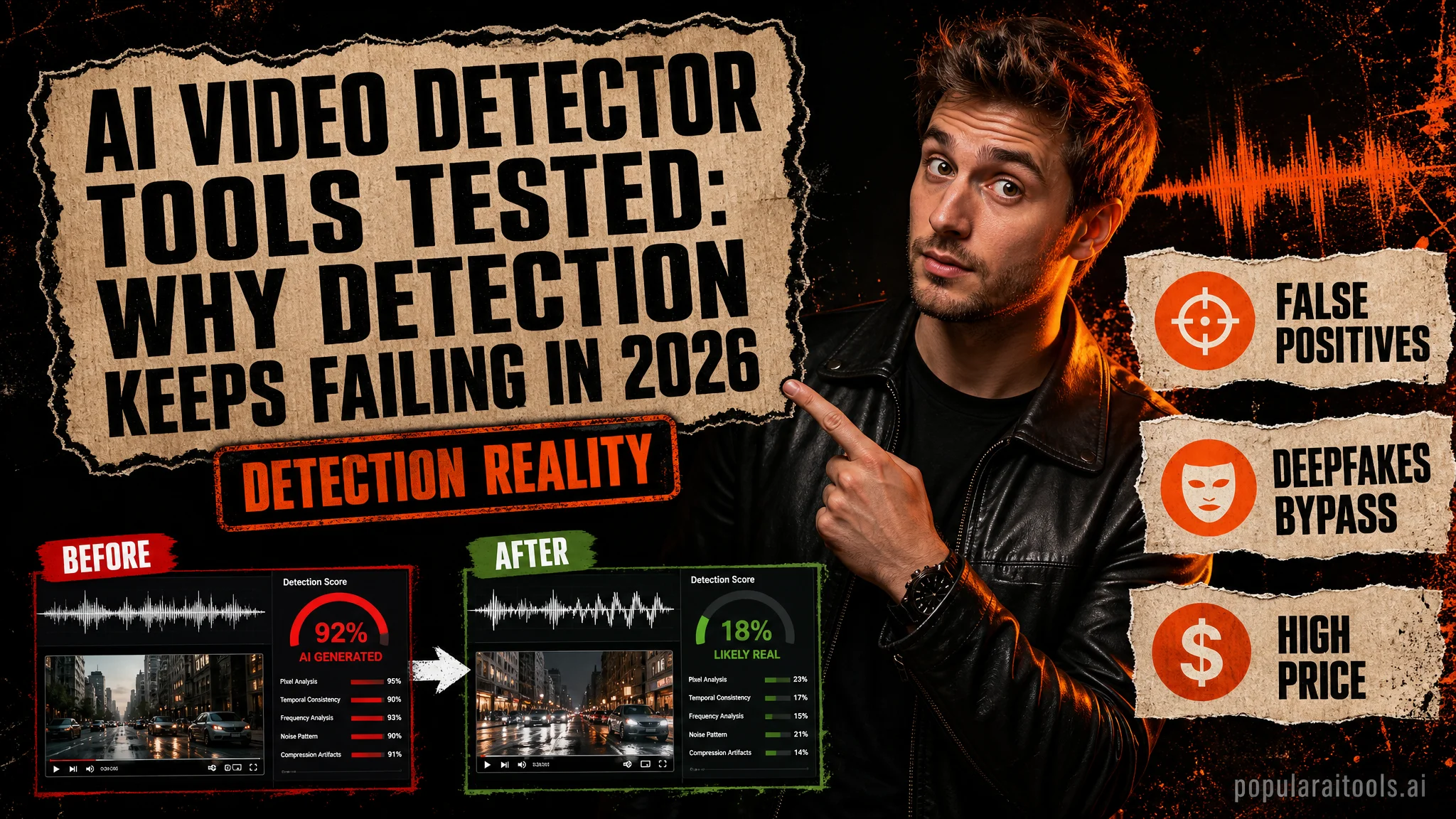
This review walks through what the major AI video detectors actually do, where they break, and what AI video creators are doing to ship past platform scans — including the audio-track removal step that's quietly become the most important part of the workflow.
Table of Contents
What An AI Video Detector Actually Does
An AI video detector takes a video file (or sometimes a URL) and outputs a probability that the clip was generated by a machine. The mechanics are the same shape as audio and image detection — and so are the failure modes. The detector never observes the generation process. It sees finished frames and makes a statistical guess about whether those frames came from a diffusion model, a transformer-based generator, or a real camera.
There are three signal categories the detectors look for, in order of reliability:
1. C2PA provenance (strongest)
Content Authenticity Initiative metadata embedded by the generator. If present and unaltered, detection is essentially trivial. Problem: it's opt-in, stripped by most editing pipelines, and increasingly few generators add it.
2. Frame-level fingerprints
Statistical signatures in pixel distribution, temporal coherence, and motion vectors that AI generators produce differently from cameras. Detectable, but degraded by mastering, cropping, and re-encoding.
3. Audio-track inference (weakest for video, strongest for music inside it)
If the soundtrack is AI-generated (Suno, Udio, MusicGen), it carries its own watermarks. This is often the easiest catch — detectors check the audio first because audio watermarks are more reliable than video fingerprints.
The Tools: Hive, BitMind, UncoVAI

Hive Moderation (hivemoderation.com/ai-generated-content-detection) is the commercial heavyweight. Multi-modal — image, video, audio — under one API. Used by platforms to score uploads at scale. Their marketing language is consistent: "state-of-the-art machine learning models." What's missing: an accuracy figure, a false-positive rate, processing speed, batch throughput, or any independent benchmark. As of May 2026 their product page is feature-led, not metric-led.

BitMind (bitmind.ai/detect) is the leading free public detector. Drop a file or paste a URL, get a probability back in seconds. The interesting wrinkle: BitMind is backed by the Bittensor network, meaning the underlying detection models are decentralized and competing. In theory that's better than a single closed model. In practice, accuracy isn't published either, and creators report the same false-positive patterns as everywhere else.

UncoVAI (uncovai.com/video-detection) is the newer player, focused on the creator/media side rather than enterprise. Free tier with usage caps, paid plans for higher throughput. Same pattern: bold marketing, no published metrics. The advantage of newer tools is typically faster response to new generator releases — but you're trusting the vendor's claims either way.
False Positives On Legitimate Video
The same pattern that breaks audio detection breaks video detection — heavily-processed legitimate footage looks statistically similar to AI output. Documented failure modes:
- Modern cinema footage with heavy color grading and HDR mastering frequently flags above 70% AI probability on multiple detectors.
- Mobile-phone HDR composites (computational photography pipeline) trigger high AI scores because they're statistically unlike unprocessed sensor output.
- Stylized animation — hand-drawn anime, 3D-rendered shorts, motion graphics — defaults to "AI" on detectors trained primarily on photorealistic content.
- Re-encoded archive footage from VHS rips, old DV tapes, or low-bitrate streaming captures shows AI-like noise patterns.
- Slow-motion and high-frame-rate footage can trigger temporal-coherence alarms even on real cameras.
For a small media team processing 100 uploads per day, even a 5% false-positive rate means 5 legitimate videos held for review per day — pure operational overhead with no real catch.
Sora 2 & Veo 3: The Detection Gap
The other side of the failure: state-of-the-art AI video routinely slips past public detectors. Sora 2 (OpenAI, late 2025), Veo 3 (Google), Runway Gen-4, and Kling 3.0 outputs are all trained against published detection signatures within weeks of any new detector release. The arms race is asymmetric — generators have an integrated R&D loop with their own datasets; detectors play catch-up.
Specific failure patterns reported by creators:
- Light mastering destroys detection. A pass through DaVinci Resolve with basic color grading and a re-encode to H.264 at 1080p commonly drops AI confidence by 30-50 percentage points.
- Cropping breaks fingerprints. Crop 10% off each edge and re-encode. Most fingerprint-based detectors lose their reference patterns.
- Stem replacement helps too. Replace the AI-generated background with a real photo and re-composite. The detector now sees mixed signals and defaults toward "human."
- Adversarial fine-tuning. Open-source generator forks specifically trained to bypass Hive Moderation's signatures exist in the wild. The asymmetry favors the attacker.
The Audio-Track Detection Vector
Here's the secret most AI video creators learn the hard way: the video frames aren't usually what gets you caught — the audio track is. If your AI video has a Suno or Udio soundtrack, that's the strongest detection signal in the file. Audio watermarks are more reliable than video fingerprints because audio generators commit to embedding them more aggressively.
The practical implication: even if you've perfectly mastered your video frames to bypass detection, the AI music soundtrack is still going to flag the upload on any platform that runs the audio through a fingerprinting check. Hive Moderation and similar tools check audio first, then video — because the audio signal is stronger.
The fix is the same workflow that AI music distributors use: strip the audio watermark before muxing the final video. Our deep-dive on AI music detector reality covers the audio-side workflow in detail; the same Undetectr pass that gets a Suno track past distributor checks gets your AI video's soundtrack past the audio leg of video detection.
Platform-Side Detection
| Platform | Detection layer | What's public |
|---|---|---|
| YouTube | Content ID for audio + emerging AI video signals; mandatory "synthetic content" disclosure | No accuracy figure |
| TikTok | Internal AI classifier on high-engagement uploads; mandatory disclosure for public-figure content | No accuracy figure |
| Meta (Instagram/Facebook) | C2PA reading + internal AI classifier since Feb 2024; manual review for high-engagement | No accuracy figure |
| X (Twitter) | Community Notes is the dominant signal; no automated classifier in public | N/A |
| Stock platforms (Shutterstock, Getty, Adobe) | Require AI disclosure at submission; internal review for high-stakes content | No accuracy figure |
Detector Comparison Table
| Detector | Pricing | Best for | Published accuracy |
|---|---|---|---|
| Hive Moderation | Enterprise (not public) | Platforms, brand safety, high-volume | Not published |
| BitMind | Free public; API pricing TBD | Quick self-checks; image + video | Not published |
| UncoVAI | Free tier + paid plans | Creators, small media teams | Not published |

The Creator Bypass Workflow
The workflow most AI video creators settle into in 2026:
- Generate the video in Sora 2, Veo 3, Runway, Kling, or your model of choice. Export at native resolution.
- Light mastering pass. Open in DaVinci Resolve or Premiere, apply minor color grade, light film grain, optional crop. Re-encode to H.264 at platform-standard bitrate.
- Strip metadata. Remove C2PA tags, generator name, EXIF — anything that volunteers the AI origin to a parser.
- If the audio is AI-generated (Suno, Udio, MusicGen, ElevenLabs voice), run it through Undetectr before final mux. This is the single most important step — the audio is the easiest catch.
- Self-check. Upload to BitMind for a free probability score before submitting to the actual platform. If it scores under 30% AI you're typically clear.
- Submit. Disclose where required (TikTok public figures, YouTube synthetic content). Don't disclose where it isn't required — most platforms don't ask.
FAQ
What is the best AI video detector in 2026?
Hive Moderation is the dominant commercial option (used by major platforms for content classification). BitMind is the leading free public detector, and UncoVAI is the newer entrant aimed at creators. None publish an accuracy figure, false-positive rate, or independent benchmark, so "best" is measured by SERP reputation and integration breadth rather than verified performance.
How accurate are AI video detectors?
No major detector publishes a real-world accuracy figure as of May 2026. Independent reports from creators show heavily-processed legitimate video routinely flagging as AI, while Sora 2, Veo 3, and Runway Gen-4 outputs frequently slip past public detectors after light mastering and re-encoding. The detection ceiling is set by how fast detectors can train against new generator releases.
Is there a free AI video detector online?
Yes. BitMind (bitmind.ai/detect) offers free public AI video detection backed by Bittensor models, with both image and video modes. Hive Moderation has a public demo. UncoVAI offers a free tier. Free tools have lower throughput than commercial APIs but accuracy claims are equally unverifiable.
Can AI video detectors detect Sora and Veo videos?
Detection of Sora 2 and Veo 3 outputs is unreliable. Both models train against published detection signatures, and their outputs are sophisticated enough that minor mastering, cropping, or re-encoding to standard H.264 commonly bypasses fingerprint-based detection. The most reliable detection vector for AI video right now is often the AI-generated audio track if one exists.
How do AI video creators bypass detection at submission?
Standard workflow: render the video, master with light color grading and recompression to standard H.264, strip generator metadata, and if the soundtrack is AI-generated music run it through Undetectr to remove the audio watermark before mux. The audio track is often the easiest detection vector — once it's clean, the video typically passes platform scans.
Should journalists or fact-checkers rely on a single AI video detector?
No. With no published accuracy figures and known false-positive rates on legitimate video, no single tool is reliable enough to act on alone. The recommended approach is ensemble — run three to five detectors, treat majority vote as a weak signal, and rely on provenance signals (C2PA metadata, chain of custody, source video) for legal-stakes verification.
Related Articles
AI Music Detector Reality Check
The audio side of the same problem — and the Undetectr workflow that gets AI music past distributor checks.
Deepfake Detector Reality Check
DeepfakeDetector.ai, McAfee, and Hive head-to-head. Why behavioral signals beat ML classifiers.
AI Image Detector Tools Compared
ZeroGPT vs NoteGPT vs Sightengine vs DeepAI vs Illuminarty — the full image-side analysis.
The AI Music Detection Arms Race
The broader meta-debate — generators vs detectors, where the line moves next.
How To Distribute Suno & Udio Music In 2026
Distribution workflow start-to-finish, including the pre-distribution audio-cleaning pass.
Recommended AI Tools
played.fm
Sell your music and keep 100%: played.fm is a direct-to-fan store + sync marketplace with 0% commission, no gatekeepers, and no bans — a strong fit for AI musicians.
View Review →OpenCode
The open-source AI coding agent: terminal-first TUI, 75+ model providers, LSP context, subagents, and privacy-first design. Free software, ~180K GitHub stars.
View Review →Exa
The neural web search API for AI agents: embeddings-based retrieval, cited highlights, sub-180ms latency, and an MCP server. 20,000 free requests/month.
View Review →Google Antigravity
Google's agent-first IDE: run a fleet of AI agents from a Manager surface, on Gemini 3 Pro, Claude Sonnet 4.5, or OpenAI models. Free in public preview.
View Review →