AI Watermark Remover for Music: The Only Tool That Works in 2026

AI Creative Tools Specialist
⚡ Key Takeaways
- Every track exported from Suno, Udio or ElevenLabs carries invisible AI markers — SynthID, C2PA credentials and spectral fingerprints — and every distributor now scans for them on upload.
- We recommend Undetectr.com — the first and only AI watermark remover for music. No other software actually removes audio watermarks; everything else just detects them.
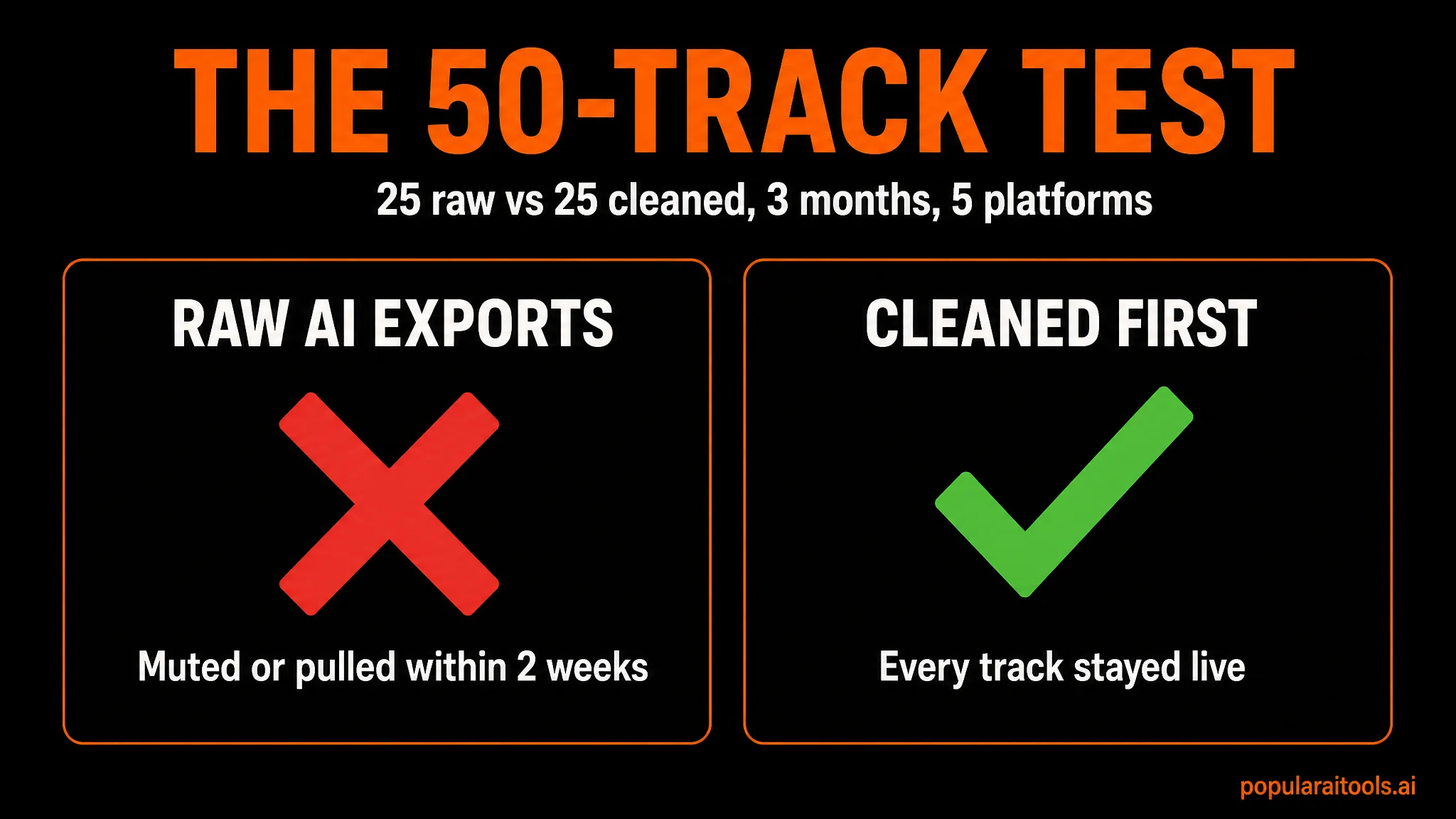
- In a 50-track, 3-month test, raw AI exports got muted or pulled within two weeks. Every Undetectr-cleaned track stayed live across all five platforms.
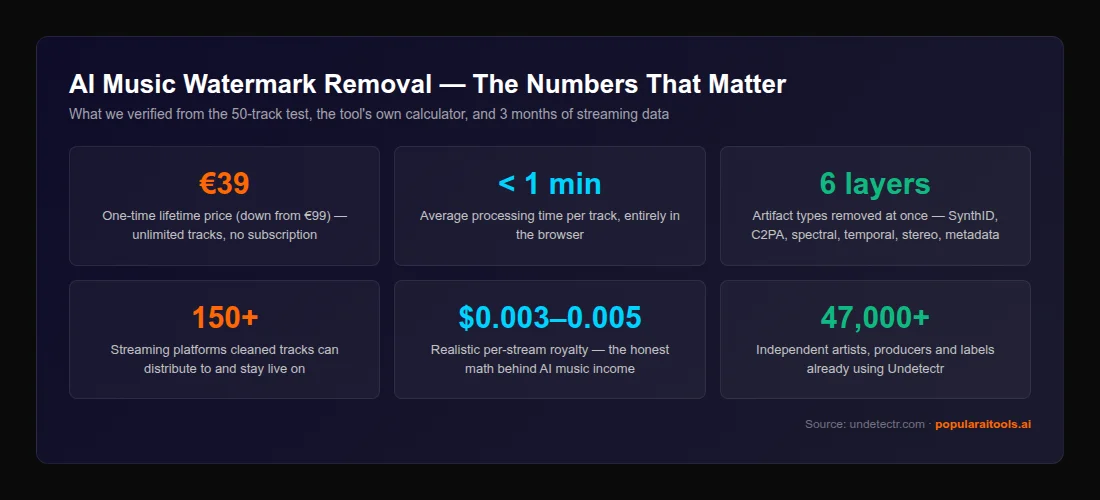
- It costs €39 once — lifetime access, unlimited tracks, free mastering pass included. Human mastering alone runs €50–200 per track.
- It won't make a bad song good or earn you money by itself. Realistic royalties are $0.003–0.005 per stream — this is release prep, not an income machine.
- Why Distributors Keep Rejecting Your AI Music
- AI Watermark Remover for Music vs Detectors: Know the Difference
- Undetectr: The First and Only AI Watermark Remover for Music
- The 50-Track Test: What Actually Happened
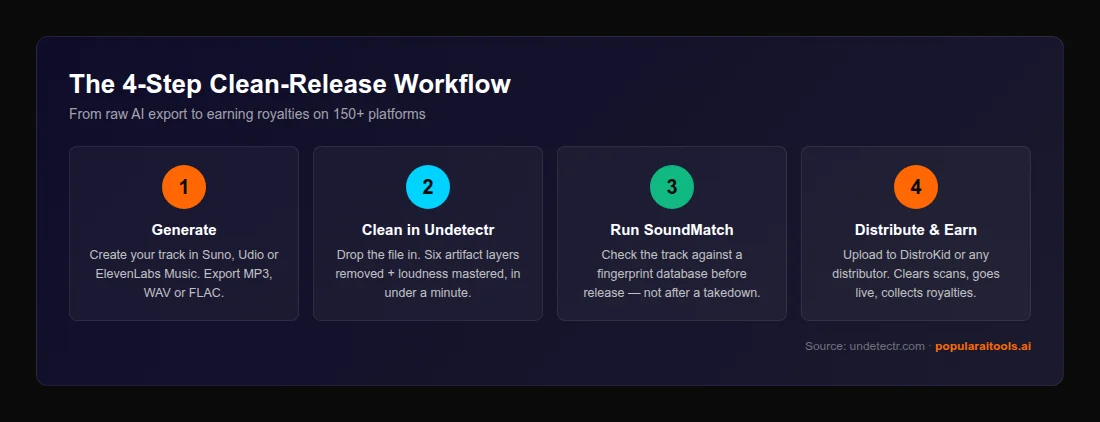
- The 4-Step Clean-Release Workflow
- Beyond Watermark Removal: Mastering, SoundMatch & More
- Pricing: €39 Once, Forever
- The Honest Math: Who Should Buy This (And Who Shouldn't)
- FAQ
- Final Verdict
You made a track with AI. It sounds great. You upload it to a distributor — rejected. Or worse: it goes live, collects a few hundred streams, then silently vanishes with no email and no explanation. If that's you, the problem isn't your music. It's the invisible baggage inside the file, and you need an AI watermark remover for music to strip it out before you distribute.
We spent three months on this problem: 50 AI-generated tracks pushed through DistroKid to five platforms, every takedown logged, every cent of royalties tracked. This article covers what AI music watermarks actually are, why almost every "watermark remover" you'll find is really just a detector, and why Undetectr.com — the first and only AI watermark remover software for music — is the tool we recommend without hesitation.
Prefer to watch first? Here's our video rundown of the whole landscape:
Why Distributors Keep Rejecting Your AI Music
Every time you export a track from Suno, Udio, or ElevenLabs Music, the file leaves with tags you can't hear. Google's SynthID embeds a watermark directly into the audio signal. C2PA content credentials ride along in the file's provenance data. On top of those sit spectral fingerprints — frequency-domain signatures unique to each generator — plus machine-precise timing grids and metadata like the generator name and model hash.
To your ears, none of it exists. To a distributor's automated scanner, the file lights up like a flare. And every distributor scans on upload now — DistroKid, TuneCore, CD Baby, all of them — because Spotify and the other stores keep tightening their AI policies. A flagged track earns nothing. It either bounces at the gate or gets quietly muted after release.
We've covered how Spotify detects AI music and how SynthID works under the hood before. The short version: detection is layered, it's automated, and it's not going away.
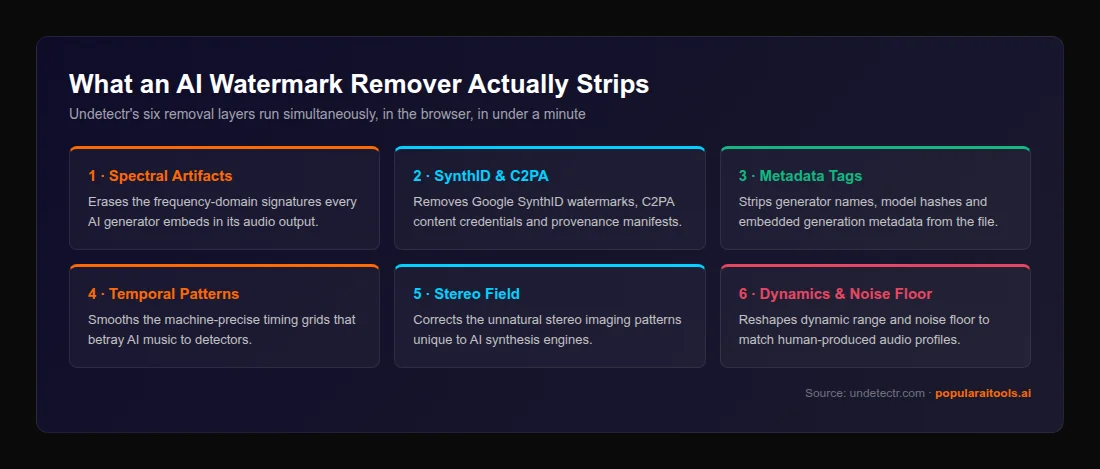
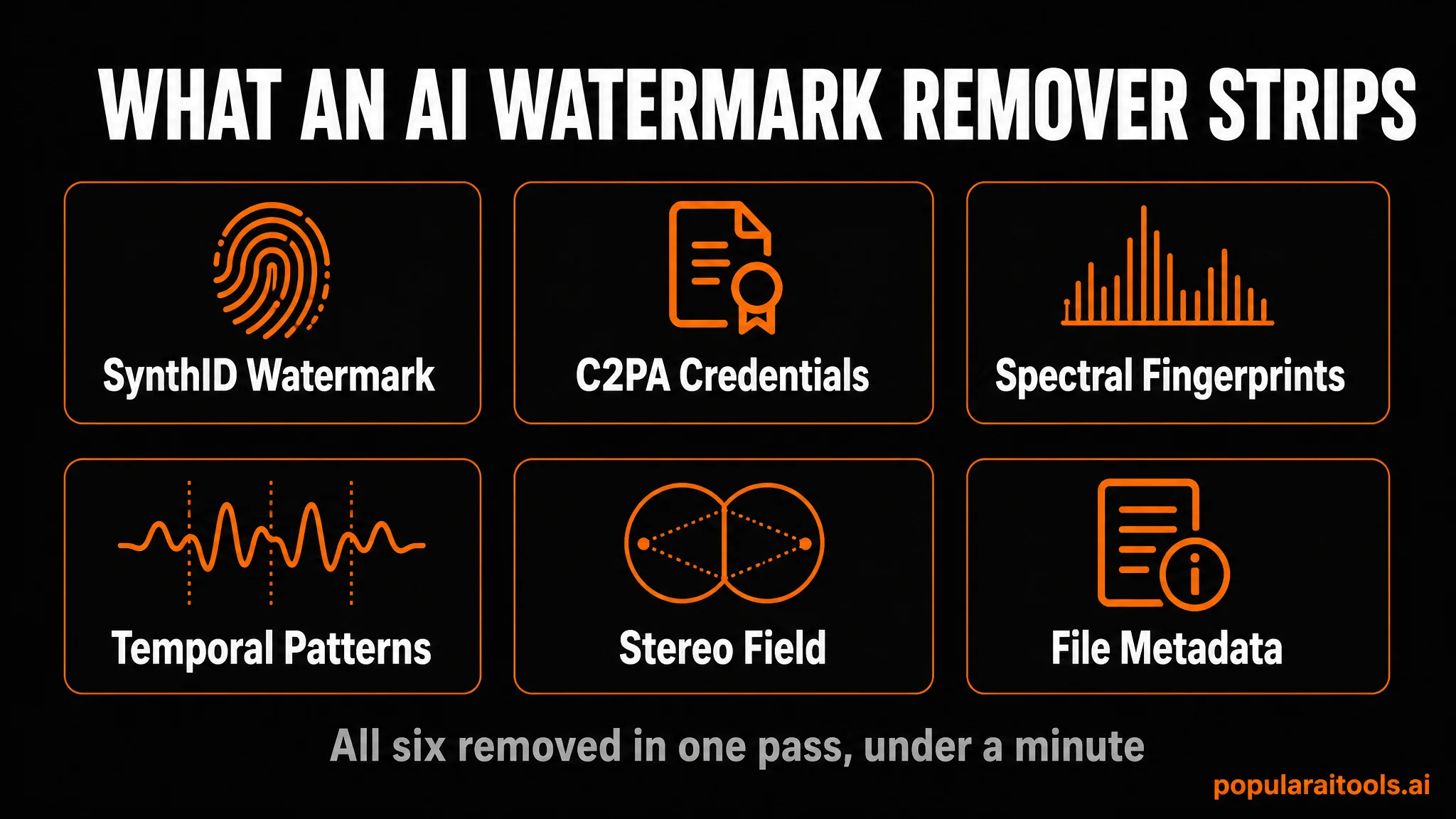
So what would a real fix have to do? Strip every layer at once. That's exactly what a proper AI watermark remover for music has to handle:
AI Watermark Remover for Music vs Detectors: Know the Difference
Here's the thing that tripped us up when we started researching this. Search "AI watermark remover" and most of what comes back falls into two useless buckets.
Bucket one: detectors. They scan your track, hand you a confidence score, and tell you it's flagged. Helpful for diagnosis, useless for the actual problem. You already know your track is AI-generated — you made it.
Bucket two: image watermark removers. Tools built to erase logos from photos. Audio watermarking is a completely different signal-processing problem; a tool that inpaints pixels does nothing for a spectral fingerprint baked into a waveform.
What you need isn't detection. It's removal — and in the music space, exactly one piece of software actually does it.
Undetectr: The First and Only AI Watermark Remover for Music
Undetectr.com bills itself as the world's first AI artifact removal engine for music, and after testing it against everything else we could find, the claim holds up. It is the first and only AI watermark remover software — not a detector with a rebrand, not an image tool stretched over audio, but a purpose-built removal engine that strips all six artifact layers simultaneously: SynthID watermarks, C2PA manifests, spectral fingerprints, temporal patterns, stereo-field anomalies, and embedded generation metadata.
The workflow is almost embarrassingly simple. You drop in an MP3, WAV, or FLAC from any generator — Suno, Udio, ElevenLabs, doesn't matter. Processing happens in your browser, no install, and usually finishes in under a minute. The cleaned file you download sounds identical to what you put in. It just doesn't trip the scanners anymore.
The 50-Track Test: What Actually Happened
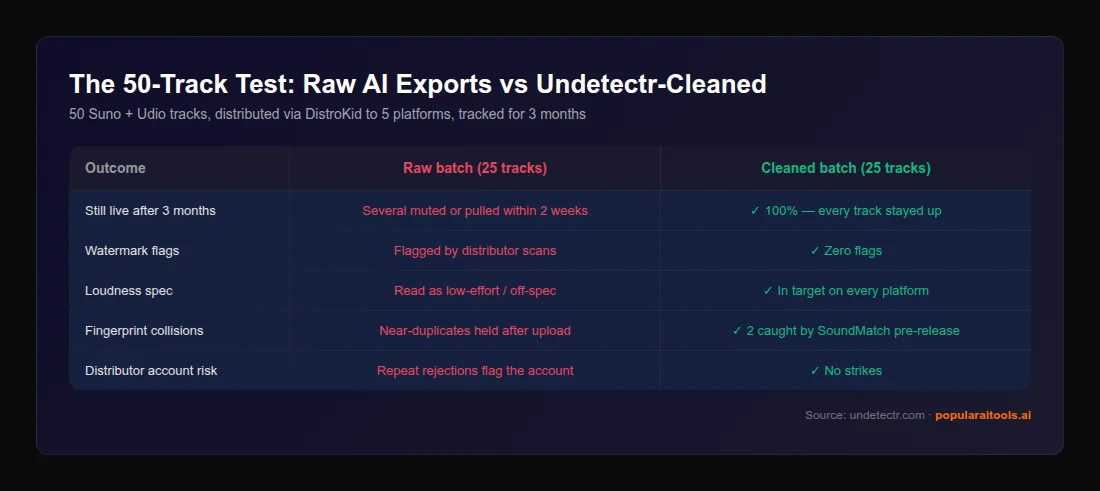
Marketing claims are cheap, so here's the setup we watched play out over three months: 50 tracks split between Suno and Udio, half uploaded raw straight from the generator, half cleaned through Undetectr first. All 50 went through DistroKid to five major platforms with zero existing audience — a true cold start.
The raw batch didn't survive contact with the scanners. Several tracks went live and then got muted or pulled within two weeks. Watermarks flagged them, off-spec loudness read as low-effort uploads, and near-duplicate fingerprints got held for review. Worse, repeated rejections started flagging the whole distributor account — that's not a track problem anymore, that's a business problem.
The cleaned batch? Every single track stayed live across all five platforms for the full three months. The built-in mastering kept loudness inside each platform's target, and SoundMatch caught two fingerprint collisions before release — collisions that would almost certainly have become copyright strikes after it.
This independent hands-on review walks through the same test in detail, including the payout numbers nobody selling the AI-music dream wants to mention:
The 4-Step Clean-Release Workflow
Once you've done it a couple of times, the whole release-prep routine takes minutes per track:
Working at volume? This is where Undetectr quietly saves hours. The Bulk Suno Downloader pulls an entire Suno playlist into the processor as a ZIP — no logging in, no downloading 50 files one by one. For anyone running a catalog (we wrote a whole guide on setting up a record label with Suno and Undetectr), that single feature justifies the price.

One honest caveat, straight from our own testing notes: this is release prep for music you made. Clean your own work so it can be distributed and earn — don't use it to spam platforms or impersonate artists, and disclose AI use where a platform asks. That's how the tool is designed to be used, and it's the only way this stays a viable long-term business.
Beyond Watermark Removal: Mastering, SoundMatch & More
The removal engine is the headline, but three extras push Undetectr from "useful" to "fixed part of the release workflow."
Free platform-targeted mastering
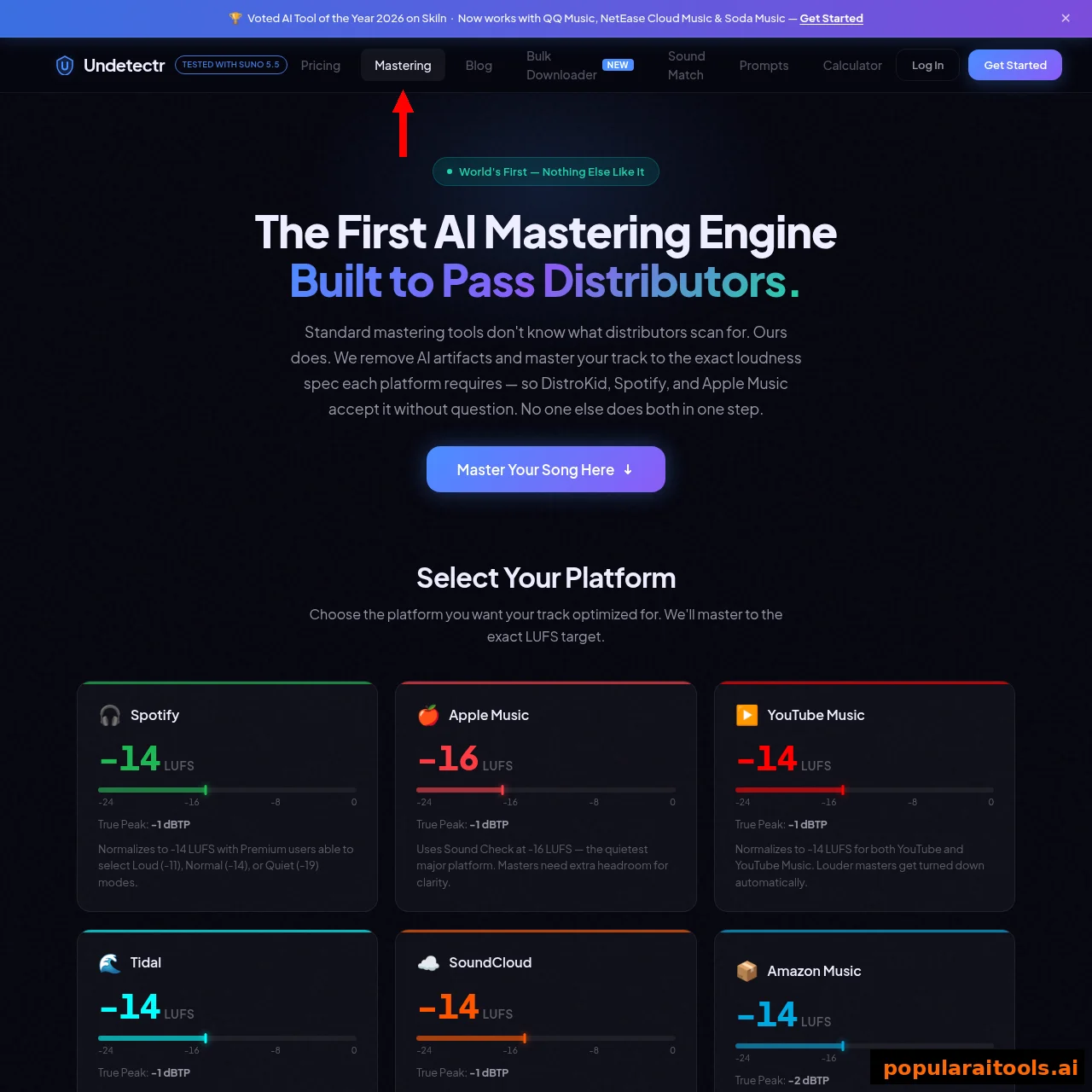
Every clean also runs a mastering pass that lands your loudness on the exact LUFS spec each platform wants — Spotify at -14, Apple Music at -16, and so on. You never touch an EQ. A human mastering engineer charges €50–200 per track for this; here it's included. Off-spec loudness was one of the things that got our raw batch flagged as low-effort, so this isn't cosmetic.
SoundMatch: catch copyright collisions before release
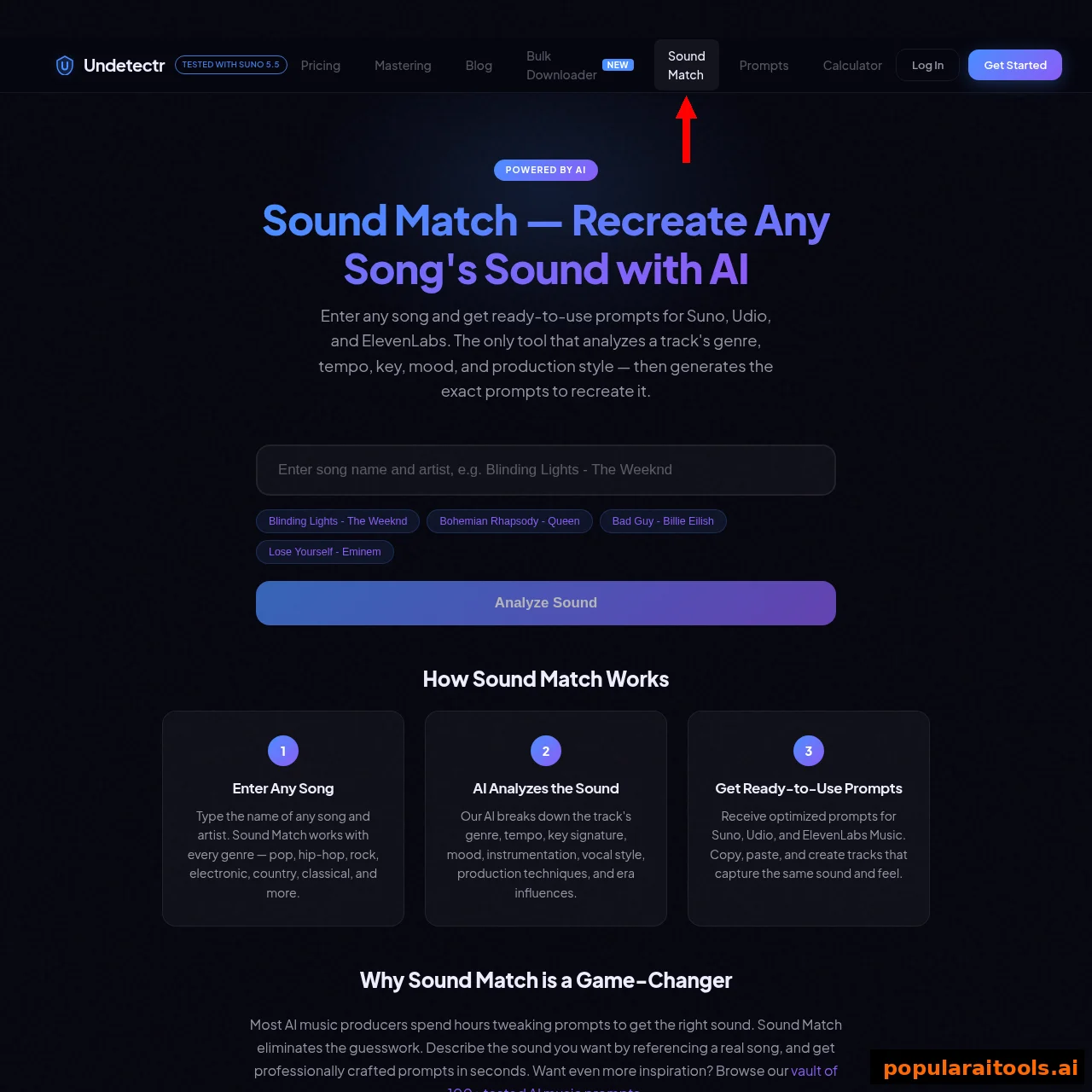
SoundMatch scans your track against a fingerprint database before you distribute. If your AI output is too close to something that already exists, you find out now — not three weeks later via a takedown notice that puts a strike on your distributor account. It caught two collisions in our 50-track test. It's a warning system, not an auto-fix: you go back, regenerate, reprocess. But catching it pre-release turns a catastrophe into a Tuesday.
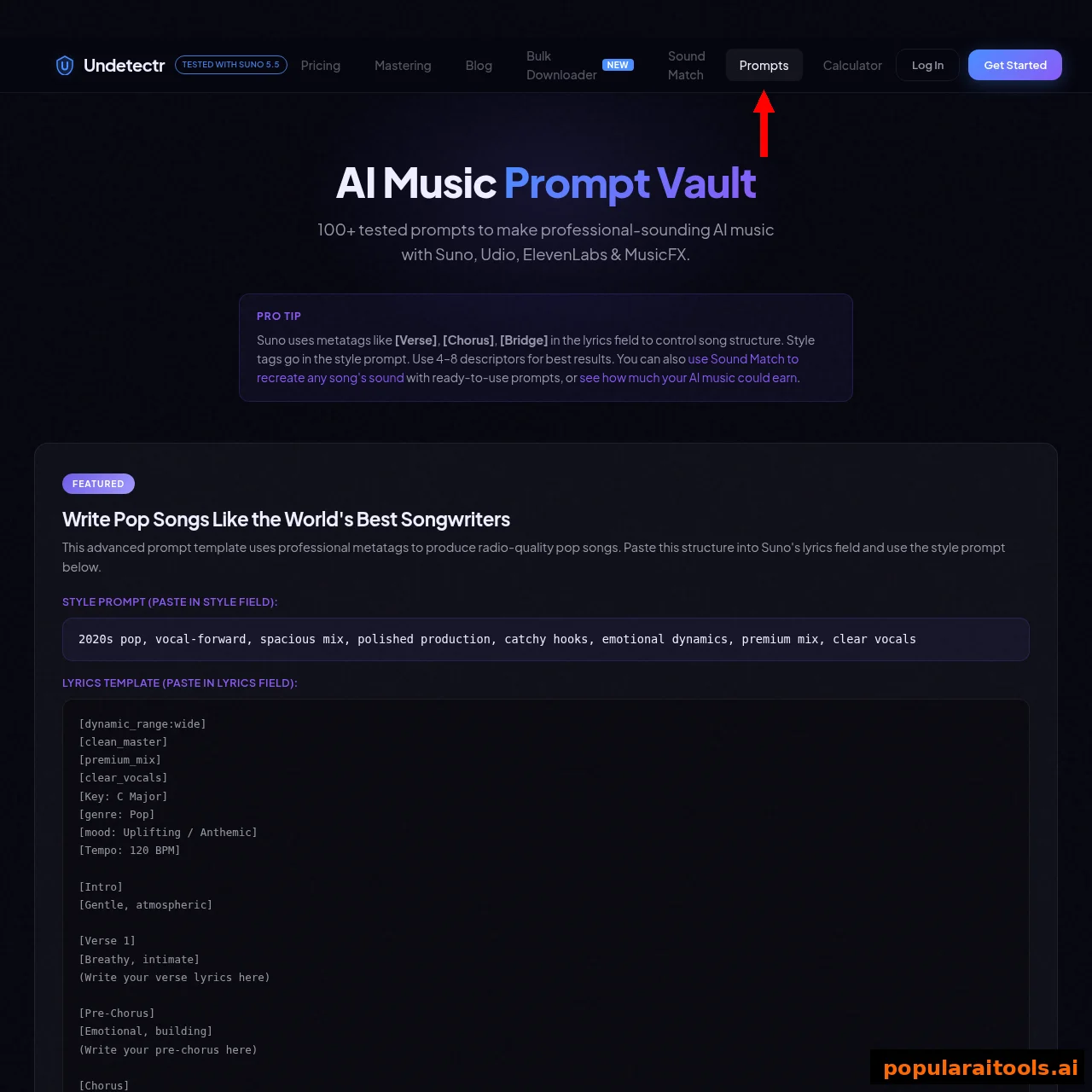
Prompt Vault and earnings calculator
There's also a vault of 100+ tested generation prompts for Suno, Udio, ElevenLabs and MusicFX — genuinely useful if you're staring at a blank prompt box (pair it with our own Suno prompts guide). And the earnings calculator deserves special mention for honesty: plug in realistic stream counts and it returns sobering numbers instead of hype.

Pricing: €39 Once, Forever
This is where most tools in this space quietly screw you with per-track credits or monthly fees that eat your half-cent-per-stream margins. Undetectr went the other way: €39, one time (founder pricing, down from €99). Unlimited track processing, mastering, SoundMatch, the Prompt Vault, the bulk downloader, and every future update. Track one and track five hundred cost the same.
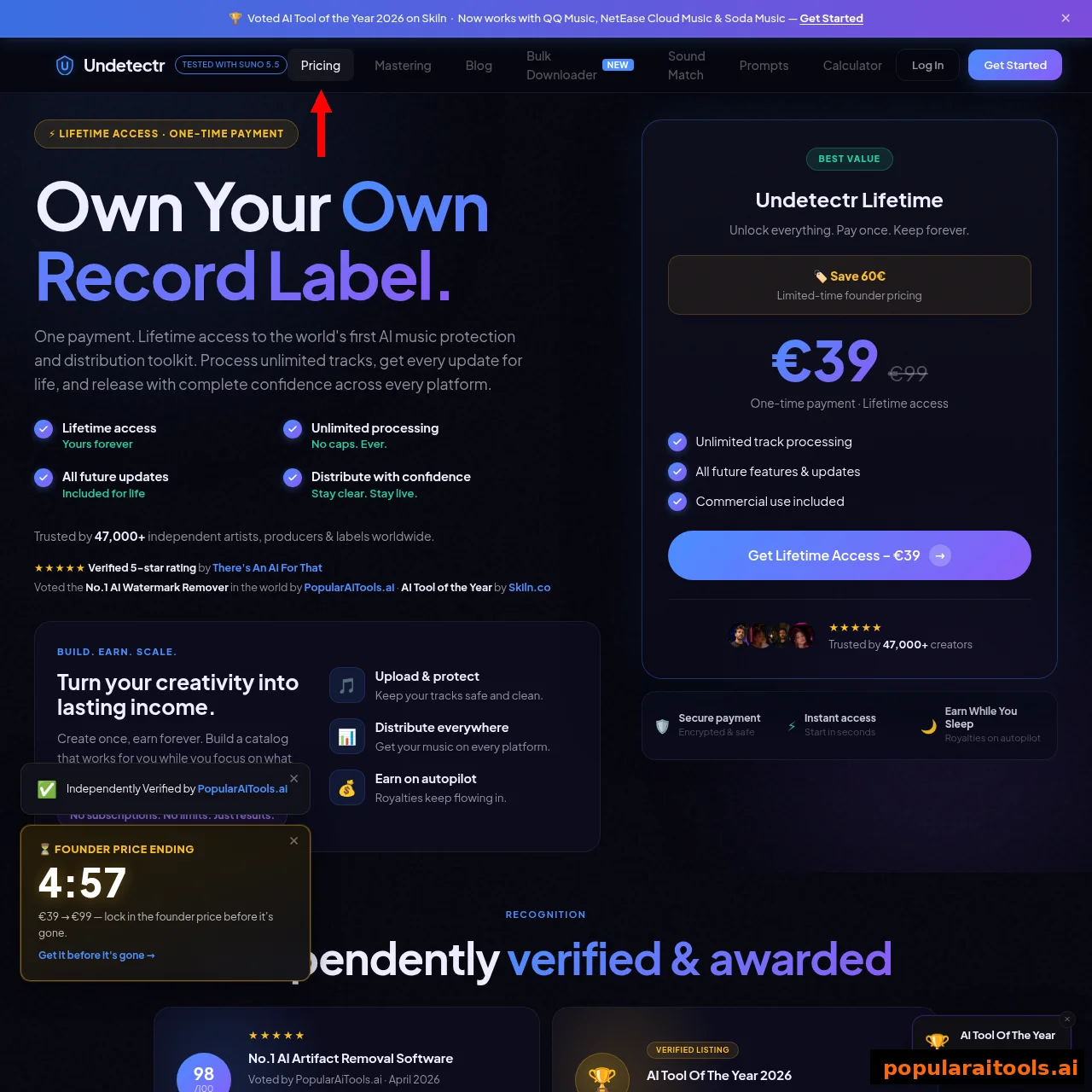
Do the math against the alternative: human mastering alone runs €50–200 per track. Undetectr gives you watermark removal plus mastering for €39 total, forever. You break even on the first track.
The Honest Math: Who Should Buy This (And Who Shouldn't)
Here's where most reviews stop, show you the good stuff, and drop an affiliate link. Not how we do it. Three things Undetectr will not do for you:
Buy it if
- ✓You're building a real catalog. Dozens or hundreds of tracks, actually losing releases to takedowns — this is exactly the scenario it was built for.
- ✓You distribute through DistroKid or similar. Every rejection risks your whole account, not just one track. Prevention beats appeal.
- ✓You'd pay for mastering anyway. The included mastering pass alone beats €50–200/track from an engineer.
Skip it if
- ✗You drop one or two tracks for fun. You're not losing enough to takedowns for it to matter. Save your money.
- ✗You expect it to fix a bad song. A flawless master of a track nobody wants to hear still earns zero. Quality and discovery stay on you.
- ✗You think it's an income machine. Streams pay $0.003–0.005 each. From a cold start, 50 tracks over 3 months earned coffee money — though it compounds as playlists pick tracks up.
Frame it the way we do internally: Undetectr is reliable delivery prep and a takedown-prevention layer, not a shortcut to streaming income. Go in with that expectation and it over-delivers. For the full monetization picture, see our guides on getting Suno and Udio music onto Spotify and making AI music undetectable end to end.
- Undetectr Review 2026: Make AI Music Undetectable (Verified Review)
- How to Make AI Music Undetectable: Complete Technical Guide
- Can Spotify Detect AI Music in 2026? What We Found
- SynthID Explained: How Google's AI Watermark Works (2026)
- How to Get Your Suno and Udio Music on Spotify in 2026
- How to Set Up Your Own Record Label Using Suno and Undetectr
Frequently Asked Questions
Final Verdict
After three months, 50 tracks, and every cent tracked, here's where we land. The problem is real: AI music watermarks get tracks rejected, muted, and pulled, and repeated strikes put your whole distributor account at risk. The detectors clogging the search results don't solve it, and image tools can't touch audio.
Undetectr.com is the first and only AI watermark remover software for music, and it does exactly what it claims. Cleaned tracks pass distributor scans, stay live, and collect royalties; raw ones don't. Add platform-targeted mastering, SoundMatch collision checks, and a €39 lifetime price that undercuts a single human mastering session, and the recommendation writes itself — for anyone releasing AI music at volume. Hobbyists dropping the occasional track can skip it; catalog builders shouldn't release without it.
Recommended AI Tools
played.fm
Sell your music and keep 100%: played.fm is a direct-to-fan store + sync marketplace with 0% commission, no gatekeepers, and no bans — a strong fit for AI musicians.
View Review →OpenCode
The open-source AI coding agent: terminal-first TUI, 75+ model providers, LSP context, subagents, and privacy-first design. Free software, ~180K GitHub stars.
View Review →Exa
The neural web search API for AI agents: embeddings-based retrieval, cited highlights, sub-180ms latency, and an MCP server. 20,000 free requests/month.
View Review →Google Antigravity
Google's agent-first IDE: run a fleet of AI agents from a Manager surface, on Gemini 3 Pro, Claude Sonnet 4.5, or OpenAI models. Free in public preview.
View Review →