Perplexity Computer for SEO: How to Build Audit Machines That Run Themselves

Senior AI Tools Analyst

Key Takeaways
- 19 LLM agents running in parallel — Perplexity Computer orchestrates Claude, GPT-5, Gemini and more simultaneously in cloud containers
- Full SEO audit from 3 prompts — Technical audit, GBP audit, and on-page analysis run concurrently with zero manual setup
- It does not just audit — it acts — Schema markup, meta titles, pillar page copy, and WordPress deployment happen automatically
- 1,000+ connectors — LinkedIn (via Linkup), WordPress, Google Search Console, Analytics, Rapid URL Indexer, and more
- LinkedIn lead machine — Reads DMs, scores leads hot/warm, drafts replies, and surfaces revenue-driving conversations
- Cloud-based scheduled tasks — Runs 24/7 without your computer being on, unlike local tools like Claude Cowork
Table of Contents
- What Is Perplexity Computer (And Why Should You Care)?
- Building the Local SEO Audit Machine
- Three Modules Running in Parallel
- Live Audit Results: What Actually Comes Back
- The Connector Library That Changes Everything
- The LinkedIn Lead Machine
- Skills, Scheduling, and Model Switching
- Perplexity Computer vs Claude Cowork
- The Right Mindset: Smart Intern, Not Washing Machine
- FAQ
What Is Perplexity Computer (And Why Should You Care)?
I have tested virtually every AI automation platform that has launched in the past year. Most of them do one thing well and stumble everywhere else. Perplexity Computer is the first tool I have used that genuinely feels like a step-change rather than an incremental upgrade.
Here is the core concept: Perplexity Computer runs 19 LLM agents simultaneously in parallel inside cloud-based virtual containers. You are not restricted to a single model. You pick your lead conductor — Claude Opus, GPT-5, Claude Sonnet — and it orchestrates the remaining models underneath based on what each sub-task requires. Need deep reasoning? It might route to Opus. Need fast text generation? Sonnet. Need multimodal analysis? Gemini. All happening at the same time.
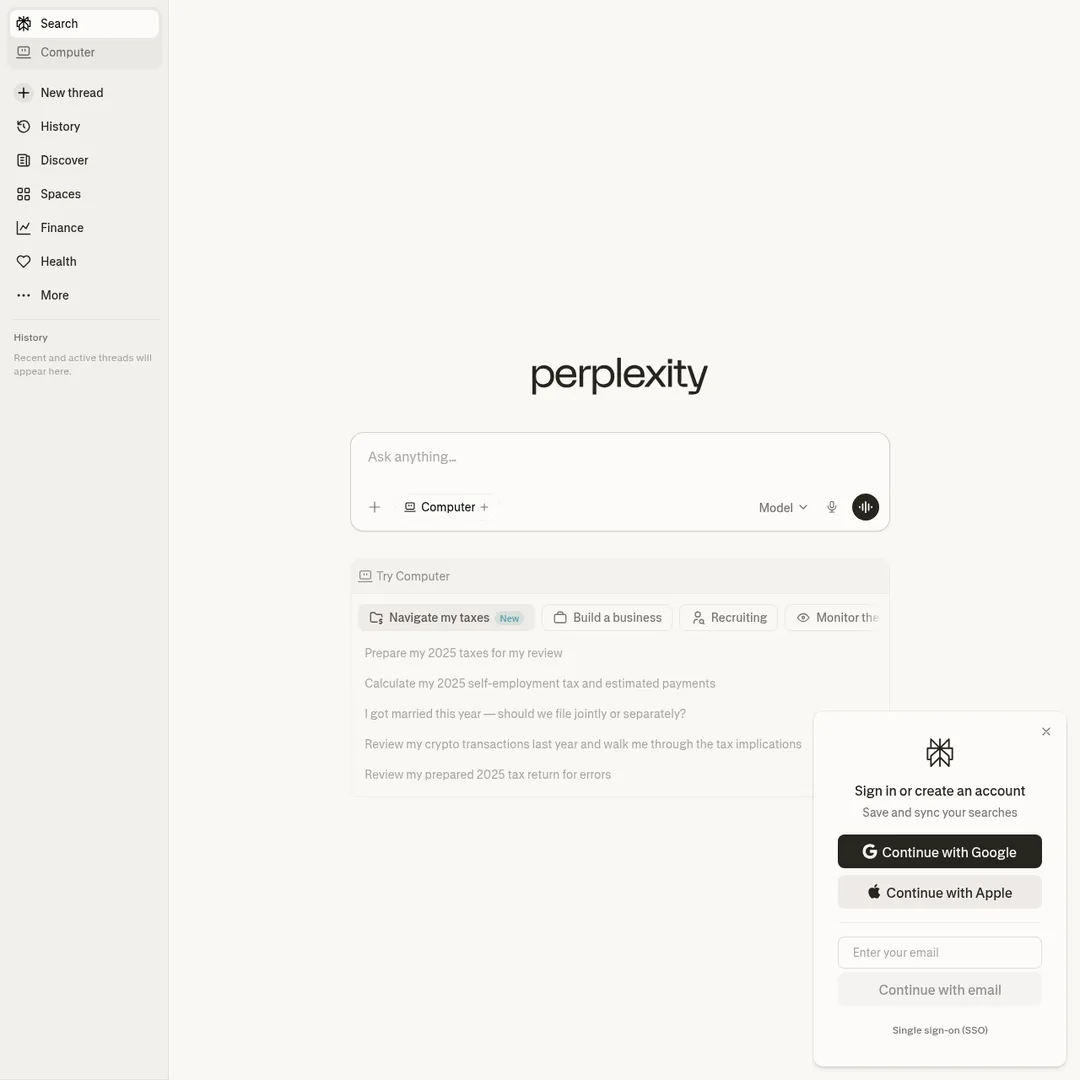
The critical difference from tools like Claude Cowork? Everything runs in the cloud. No local install. No keeping your laptop open overnight. No downloading files to your desktop. You tell it what you want, it spins up a virtual computer, executes across multiple agents, and delivers results — whether you are watching or not.
That sounds like marketing copy until you actually build something with it. So let me walk you through two machines I have been testing: a local SEO audit system and a LinkedIn lead generator. Both built from simple conversational prompts, both doing work that used to eat entire days.
Building the Local SEO Audit Machine
The most impressive thing about the SEO audit machine is not what it produces — it is how little input it requires. I am talking about three prompts to build a repeatable system that handles technical audits, Google Business Profile analysis, and on-page optimization simultaneously.
Here is how the build actually went:
Prompt 1: "What non-obvious SEO use cases are there for Perplexity Computer? What would feel magic and not just be research or a dashboard?"
Prompt 2: "Can you build all of them for me?"
Prompt 3: Provide the target website URL, Google Business Profile status, target keywords, and competitor URLs.
That is it. From those three inputs, Perplexity Computer built what is essentially a piece of software — a reusable skill that runs a comprehensive local SEO audit every time you invoke it. No n8n workflow to configure. No Semrush subscription at $200/month. No multi-day setup process. Just tell it what you want and watch it build.
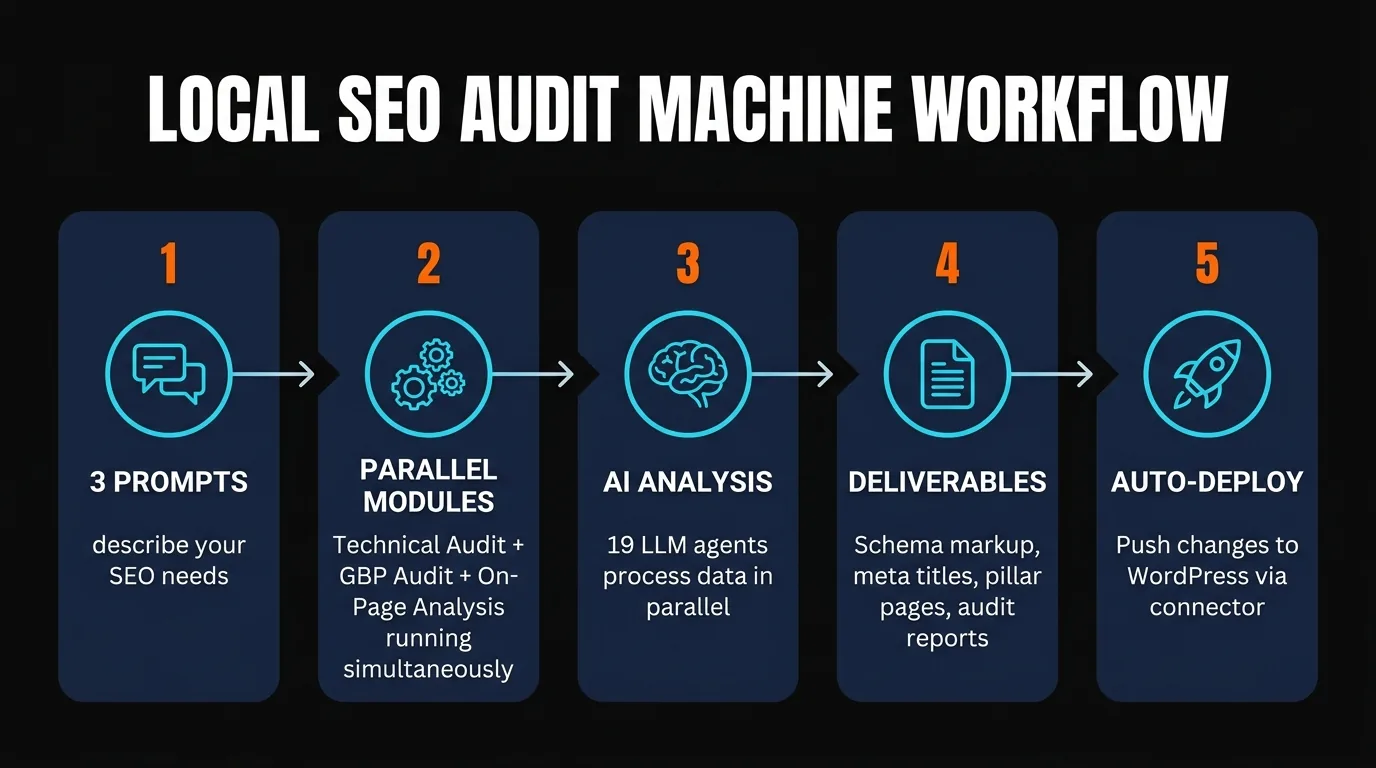
Once built, reloading the machine is as simple as typing Run my local SEO machine into Perplexity Computer. It loads the skill, asks for the target website, keywords, and competitors, then goes to work.
Three Modules Running in Parallel
This is where Perplexity Computer flexes hardest. When the audit runs, it does not execute sequentially like most AI tools. It fires up three concurrent modules:
Module 1: Technical Audit
Analyzes HTML elements, checks schema markup, validates sitemaps, reviews meta titles for length issues, and identifies missing technical foundations like FAQ schema.
Module 2: GBP Audit
Runs a competitive profile audit against competitor Google Business Profiles. Compares photos, service areas, categories, reviews, and local signals side-by-side.
Module 3: On-Page Analysis
Reviews all text and pages on the website, compares keyword targeting against actual Google search results, and identifies content gaps and ranking opportunities.
In Claude Cowork, you would see a plan box stepping through tasks one at a time — step one, step two, step three. Perplexity Computer is doing what amounts to 300 things at once under those three modules. Each module might independently choose different LLM models based on the sub-task. The technical audit uses Claude Sonnet for HTML parsing while the GBP audit might leverage Gemini for visual comparison.
The result? A full audit that traditionally takes a human SEO specialist an entire week — or requires expensive tooling across Semrush, Ahrefs, and Screaming Frog — completed in about 5-10 minutes.
Live Audit Results: What Actually Comes Back
I ran the audit against ReturnMyTime.com as a live test. The site had no prior SEO work done, which made it a perfect stress test. Here is what the machine produced:
The SEO War Room dashboard — A visual comparison showing the target site versus competitors. Content volume, social proof scores, keyword positions, and untapped competitive edges all laid out in one view. The kind of deliverable you would show a client in a presentation.
Technical audit findings — The machine identified concrete issues:
- Missing FAQ schema on the homepage (a quick win for rich results)
- Meta titles exceeding optimal length
- Sitemap structure issues
- Missing schema markup code that was then auto-generated
- Content gap analysis identifying "AI audit" and "AI tools for solopreneurs" as high-opportunity, low-competition keywords
Auto-generated deliverables — This is the part that separates Perplexity Computer from every other audit tool I have used. It did not just identify problems. It:
- Wrote the complete schema markup code
- Generated corrected meta titles at proper lengths
- Produced full pillar page copy with SEO intent — headers, CTAs, secondary keywords, H2 structure, all of it
- Created a topical authority map showing every piece of content needed to dominate target keywords
- Identified longtail keywords like "AI workflow audit" with very low competition
These are not vague suggestions. These are production-ready deliverables that a seasoned SEO would charge thousands to produce manually.
The Connector Library That Changes Everything
Most LLM platforms ship with maybe 50-150 integrations. ChatGPT has its plugins. Claude has its MCP servers and integrations. Perplexity Computer has thousands of connectors, and the ones that matter for SEO automation are genuinely game-changing.
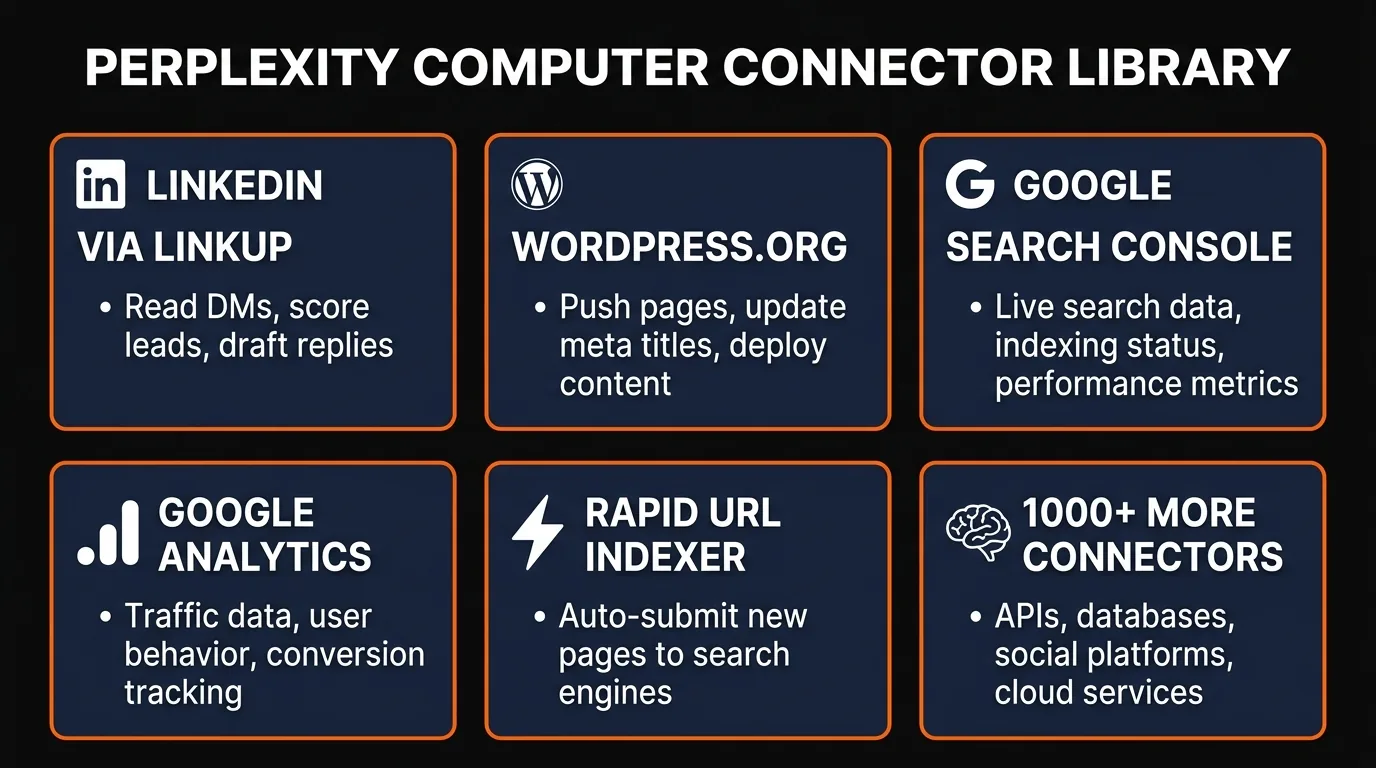
| Connector | What It Does | SEO Use Case |
|---|---|---|
| LinkedIn (via Linkup) | Read/write LinkedIn messages, search profiles | Lead gen, prospect scoring, automated outreach |
| WordPress.org | Create posts, update meta, deploy content | Push audit fixes and new pages directly to site |
| Google Search Console | Pull live search data, indexing status | Feed real performance data into audit analysis |
| Google Analytics | Traffic, user behavior, conversions | Identify which pages need optimization first |
| Rapid URL Indexer | Submit URLs to Google and AI search engines | Auto-index new pages the moment they are published |
The combination of Google Search Console + Google Analytics + WordPress in a single LLM-powered pipeline means you can go from "identify the problem" to "fix deployed on the live site" in one conversation. No tab-switching. No exporting CSVs. No copy-pasting between tools.
The LinkedIn Lead Machine
If the SEO audit machine is the workhorse, the LinkedIn lead machine is the scout. I built this one right before testing the audit system, and it demonstrates a completely different use case for Perplexity Computer — ongoing relationship management at scale.
Through the Linkup API connector, Perplexity Computer can:
- Read LinkedIn DMs and comments — scanning your entire message inbox and recent engagement
- Score leads as hot, warm, or cold — using AI to assess buying signals and conversation context
- Draft personalized replies — matching your tone of voice and communication style
- Surface revenue-driving conversations — filtering 20 notifications down to the 2-3 that actually matter
- Send via LinkedIn — once you have reviewed and approved the draft
The dashboard it builds gives you an instant view: "You have 2 hot leads and 5 warm leads today." Instead of spending 30 minutes scrolling through LinkedIn trying to figure out who to respond to first, you open the dashboard, handle the high-value conversations, and move on with your day.
I set it to scan every morning automatically. It updates the lead dashboard, flags new hot conversations, and has draft replies waiting before I have finished my coffee. That is not a workflow I could build in n8n without significant API wrestling and prompt engineering — and even then, n8n would not give me the AI intelligence to actually score and contextualize the leads.
Skills, Scheduling, and Model Switching
Three features make Perplexity Computer particularly sticky once you start building with it:
Skills That Go Beyond Instructions
In Claude, a skill is essentially a set of custom instructions — useful, but limited. In Perplexity Computer, a skill is closer to a miniature application. The local SEO audit machine is not just instructions. It is a multi-module system with its own input form, parallel execution pipeline, deliverable templates, and connector integrations.
You can access skills from the left sidebar. The platform accepts .md or .zip files for skill imports, which means there is a path to migrating your existing Claude skills over — though the formatting may need adjustment. If you have established Claude Code skills and workflows, plan to spend a bit of time adapting them to the Perplexity format.
Cloud-Based Scheduled Tasks
Claude Cowork supports scheduled tasks, but your desktop has to be on and the application running for them to execute. Perplexity Computer runs everything in the cloud. Schedule an audit to run weekly for each client, and it executes whether you are asleep, on vacation, or do not even own a computer anymore.
I currently have scheduled tasks running weekly audits for different clients, daily LinkedIn lead scans, and periodic topical authority updates. All running autonomously in the background.
Model Switching
You choose a lead model — think of it as the conductor of the orchestra. Your options include Claude Opus, GPT-5, and Claude Sonnet. The lead model then orchestrates the remaining 19 LLMs underneath, selecting the best model for each sub-task. You also have access to Perplexity's built-in search sources, letting you tune queries to pull from social media only, academic papers, or the full web.
Perplexity Computer vs Claude Cowork
Since Perplexity Computer invites the most direct comparison to Claude Cowork, here is how they actually stack up for SEO automation work:
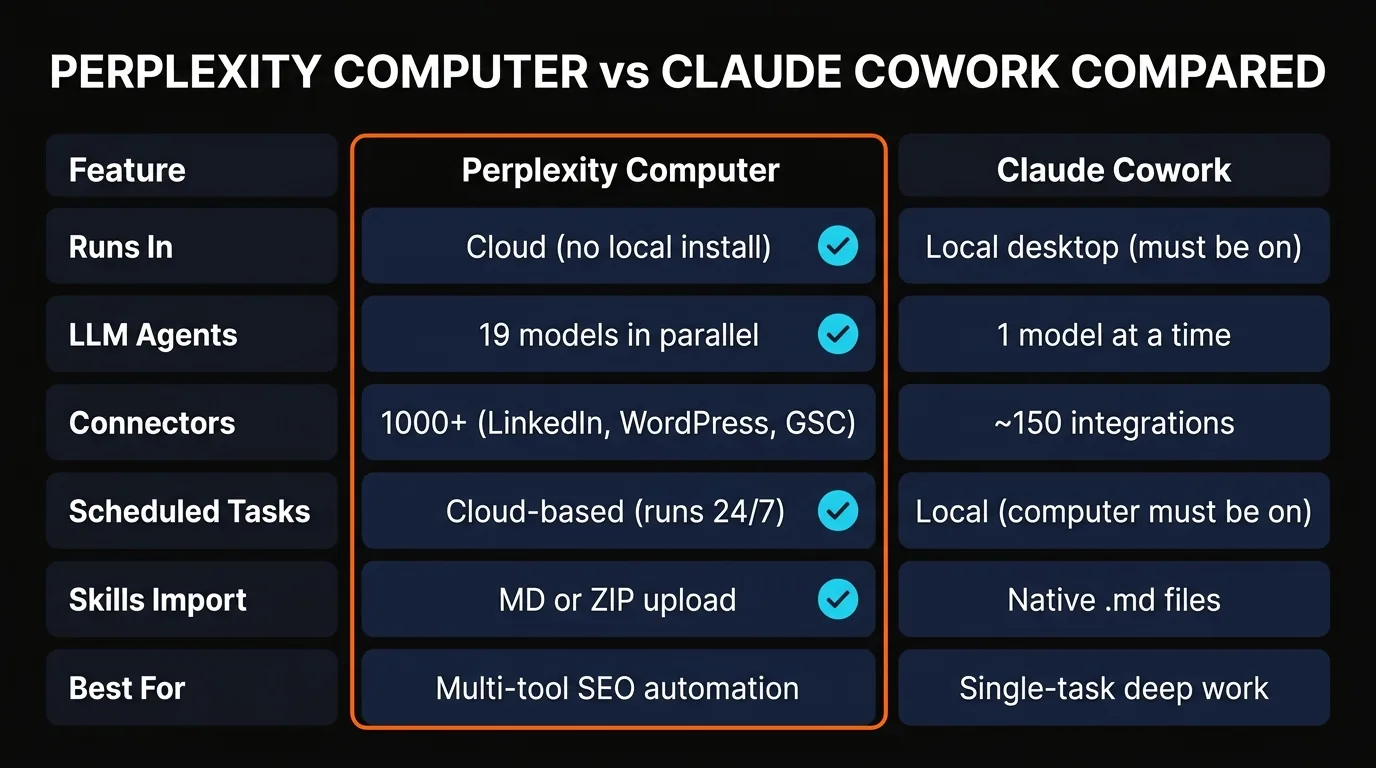
| Feature | Perplexity Computer | Claude Cowork |
|---|---|---|
| Execution | Cloud (no local install) | Local desktop |
| Parallel Agents | 19 LLMs simultaneously | 1 model sequential |
| Connectors | 1,000+ | ~150 |
| Scheduled Tasks | Cloud 24/7 | Local (PC must be on) |
| Skills | MD/ZIP upload | Native .md files |
| Deep Single Tasks | Good | Excellent |
| Security | Cloud sandbox (no local files) | Full local access |
My take: Perplexity Computer wins for multi-tool automation workflows — anything that involves connecting multiple services, running parallel analyses, and deploying results. Claude Cowork still wins for deep single-task work where you need intense focus on one thing, like writing a complex codebase or doing deep research with full local file access. The ideal setup? Use both. They are complementary, not competitive.
The Right Mindset: Smart Intern, Not Washing Machine
Here is something that seasoned AI practitioners understand but most people get wrong: AI is a whip-smart intern, not a washing machine.
The washing machine mindset goes like this: put in dirty clothes, press start, and if they come out dirty, the machine is broken. People apply this same logic to AI — they give it one prompt, get an imperfect result, and declare the tool does not work.
The intern mindset is radically different. Imagine you hired a freshly graduated A-grade student with all the theoretical knowledge in the world but zero real-world experience. You would not hand them your business and say "go to work." You would give them context, frameworks, examples, feedback. You would correct their first draft and explain why. And each time, they would get better — fast.
That is exactly how to approach Perplexity Computer. The audit machine I built from three prompts produced impressive results out of the box. But it could be significantly better with:
- Your specific SEO frameworks and processes fed as context
- Tone of voice guidelines for client deliverables
- Examples of past audit reports you have been happy with
- YouTube transcripts of how you explain local SEO strategy to clients
- Dedicated SEO API connectors for more precise keyword data
The base layer already does the heavy lifting. Fine-tuning it with your specific expertise turns it from "pretty good" into "better than an employee" — because unlike an employee, it follows your rules every single time, never has an off day, and scales across every client simultaneously.
Getting Started: Setup Tips
Quick Start Checklist
- Go to perplexity.ai and click the "Computer" button in the interface
- Choose your lead model — Claude Opus for deep reasoning, Sonnet for speed, GPT-5 for general tasks
- Start with a discovery prompt — ask it what non-obvious use cases exist for your industry
- Add connectors — link WordPress, Google Search Console, and Analytics first. LinkedIn via Linkup if you do outreach.
- Tell it to build — literally say "Can you build all of these for me?" and watch it construct your machine
- Refine and schedule — give it your frameworks, tone of voice, and set up recurring tasks
The blank canvas problem is real with these platforms. Do not go in with a specific task in mind — go in and ask what is possible. Let the tool show you capabilities you did not know existed, then build from there. That approach is how both the SEO audit machine and the LinkedIn lead machine were born.
For more on optimizing your AI-powered SEO strategy, check out our comprehensive AEO, GEO, and SEO guide and our roundup of the top AI SEO tools.
Frequently Asked Questions
What is Perplexity Computer?
Perplexity Computer is a cloud-based AI platform that runs 19 LLM agents in parallel inside virtual containers. Unlike local tools like Claude Cowork, it requires no local install and can execute complex multi-step workflows simultaneously across multiple AI models.
How many LLM agents does Perplexity Computer use?
It runs up to 19 LLM agents simultaneously in parallel, including Claude Opus, Claude Sonnet, GPT-5, and Google Gemini. You choose the lead model and it orchestrates the rest based on what each sub-task requires.
Can Perplexity Computer replace SEO tools like Semrush?
For many tasks, yes. It can run technical audits, Google Business Profile audits, on-page analysis, and competitive research without requiring a $200/month subscription. However, connecting dedicated SEO APIs gives more precise keyword difficulty and volume data.
Does Perplexity Computer work with LinkedIn?
Yes, through the Linkup API connector. It can read LinkedIn DMs, score leads as hot or warm, draft personalized replies, and manage conversation threads — all from within Perplexity Computer.
Can it push changes directly to WordPress?
Yes. The WordPress.org connector lets it create new blog posts on the correct URL structure, update meta titles, and deploy optimized content directly. You will need to provide login credentials in the connector settings.
What is the difference between Perplexity Computer and Claude Cowork?
Perplexity Computer runs in the cloud with 19 parallel LLMs and 1,000+ connectors. Claude Cowork runs locally with one model at a time and about 150 integrations. Computer excels at multi-tool automation; Cowork excels at deep, focused single tasks.
Can I import Claude skills into Perplexity Computer?
Perplexity Computer accepts .md or .zip files for skill uploads through the Skills section in the sidebar. Your existing Claude skills may need reformatting, but the content and logic can transfer over.
How long does a full SEO audit take?
A comprehensive local SEO audit — including technical analysis, GBP audit, on-page review, competitive comparison, and deliverable generation — typically takes 5-10 minutes. This replaces what traditionally takes dozens of hours or requires expensive multi-tool setups.
Want More AI Tool Breakdowns Like This?
We test every major AI platform so you do not have to. Get weekly deep-dives on tools that actually move the needle for your business.
Explore All AI ToolsRecommended AI Tools
played.fm
Sell your music and keep 100%: played.fm is a direct-to-fan store + sync marketplace with 0% commission, no gatekeepers, and no bans — a strong fit for AI musicians.
View Review →OpenCode
The open-source AI coding agent: terminal-first TUI, 75+ model providers, LSP context, subagents, and privacy-first design. Free software, ~180K GitHub stars.
View Review →Exa
The neural web search API for AI agents: embeddings-based retrieval, cited highlights, sub-180ms latency, and an MCP server. 20,000 free requests/month.
View Review →Google Antigravity
Google's agent-first IDE: run a fleet of AI agents from a Manager surface, on Gemini 3 Pro, Claude Sonnet 4.5, or OpenAI models. Free in public preview.
View Review →