Suno's Tamper-Resistant Watermarking, Explained: What It Means for Independent AI Music Producers

AI Creative Tools Specialist
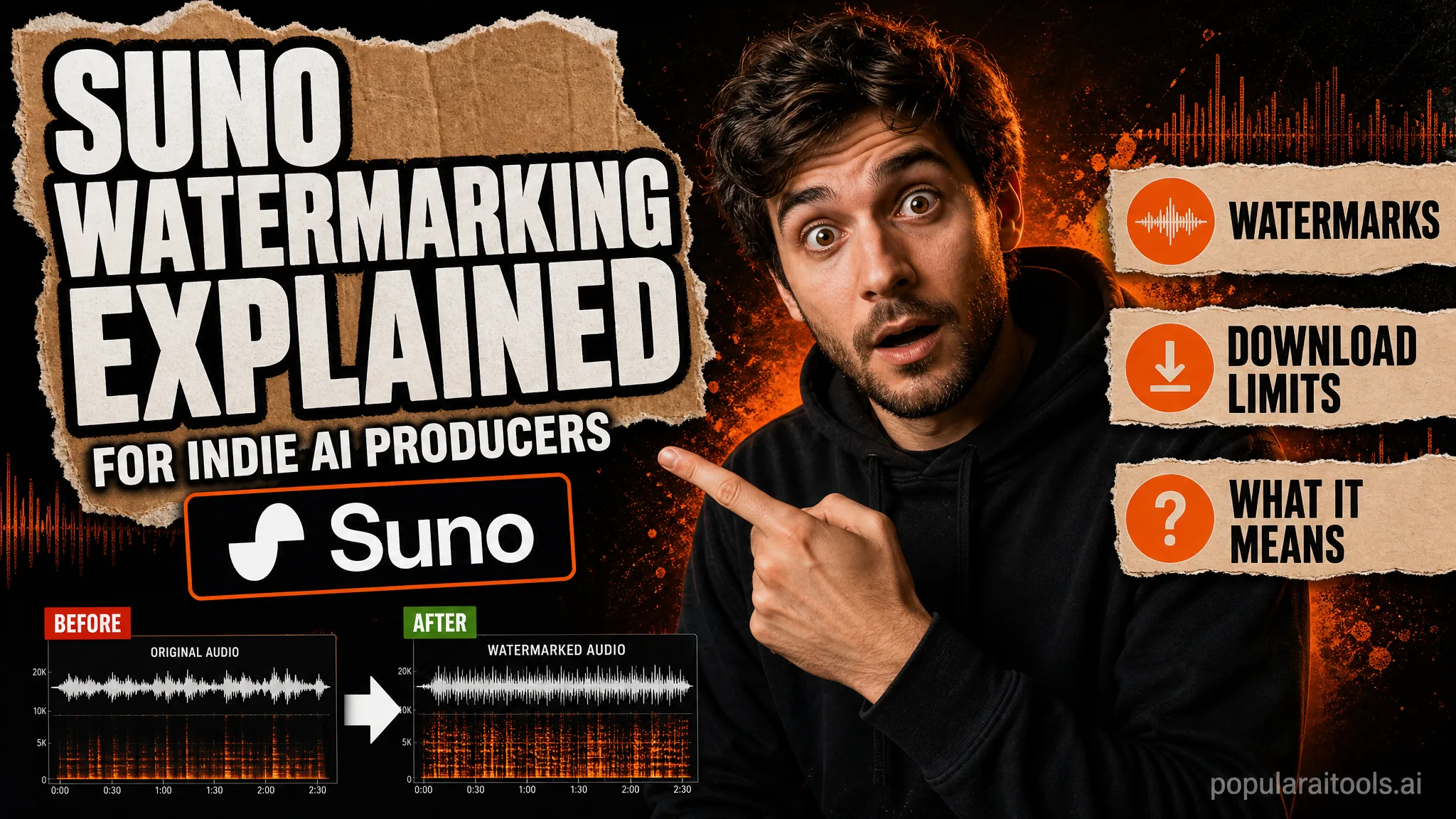
Suno's watermark is built to follow your track everywhere it goes. Undetectr is the purpose-built tool that strips Suno watermarks and AI artifacts from music you own — proven on today's Suno output — so your masters ship clean and sail through distributor checks.
Remove the Watermark with Undetectr →Key Takeaways
- On August 6, 2026, Suno CEO Mikey Shulman announced tamper-resistant watermarking, fingerprinting, off-platform identification, tighter download limits, and updated community guidelines — five measures at once.
- The watermark is inaudible and embedded in the waveform, and Suno says it survives editing and compression — a SynthID-style approach for audio.
- Suno has not published caps, tiers, or dates for the download policy as of August 2026. It says the target is mass abuse, not individual artists.
- The announcement landed days after the GEMA ruling on July 31, 2026, when a Munich court held Suno liable for infringing German song copyrights.
- For independent producers, the practical shift is disclosure and rights hygiene: own 100% of your rights, generate on a paid tier, disclose AI use to your distributor, and keep clean, release-ready masters.
Table of Contents
What Suno actually announced
On August 6, 2026, Suno co-founder and CEO Mikey Shulman published a blog post laying out how the company plans to build "the future of music" responsibly. Stripped of the framing, it contained five concrete commitments: tighten the download policy to make mass distribution harder, roll out tools that identify Suno-generated songs beyond Suno's own platform, adopt audio watermarking and fingerprinting technology, sharpen the community guidelines, and keep developing models with industry partners. Shulman described the transparency tools in one sentence that matters more than the rest: "These tools are designed to be durable and resistant to tampering, without affecting the listening experience."
That single line is the whole story for producers. Suno is not adding an audible beep or a visible tag. It is embedding an invisible, durable marker into the audio signal — conceptually similar to Google's SynthID, which lets AI-generated content be traced back to its origin even after editing or compression. The company has not confirmed whether it licensed SynthID or built its own system, and it declined to publish the exact download caps, the tiers they apply to, or a start date. What it did say is that the changes are aimed at large-scale abuse and "will not affect the vast majority" of users.
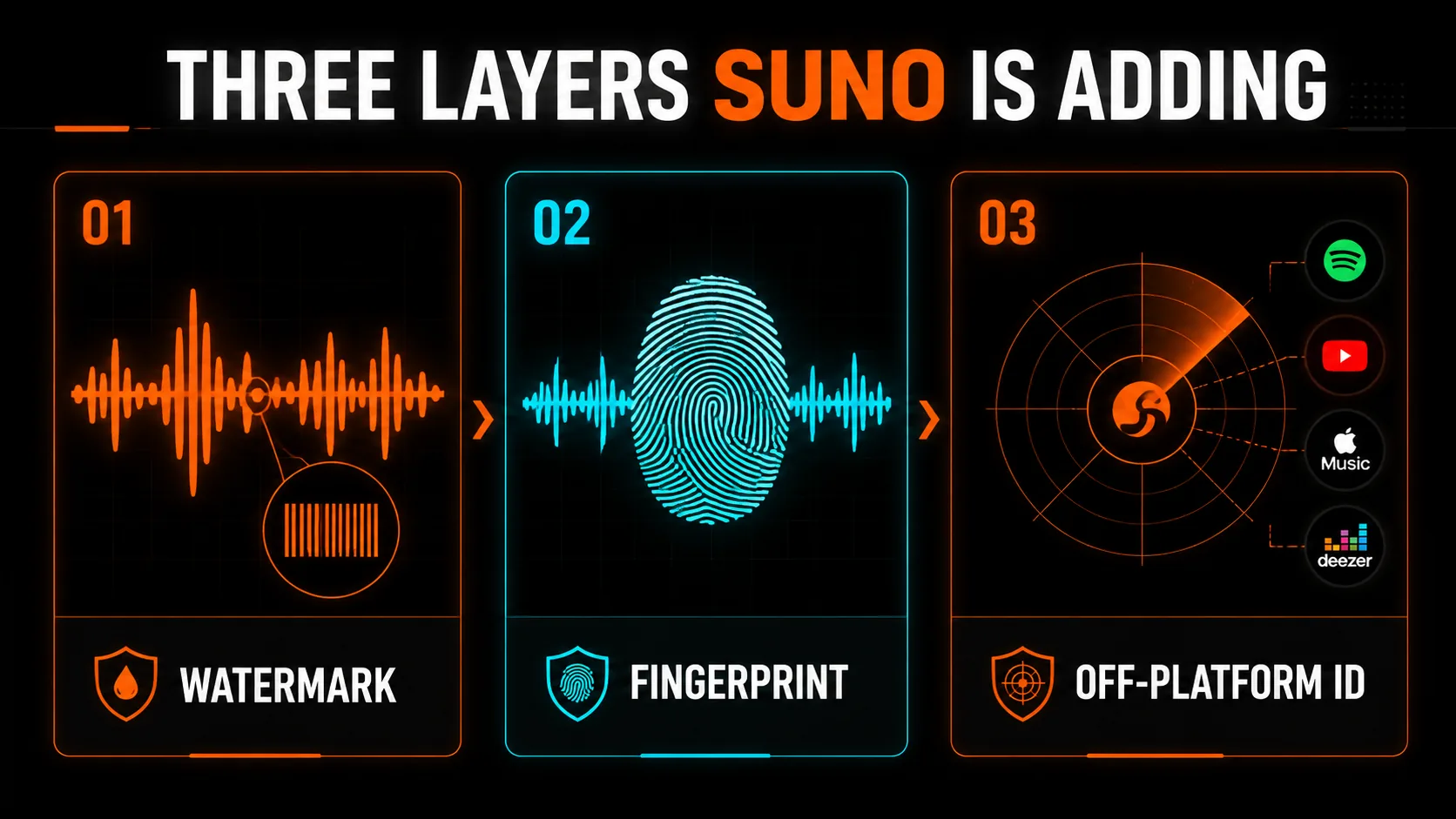
Watermark vs. fingerprint vs. detection — three different things
The reporting has blurred three separate technologies into one word, "watermark." They are not the same, and the difference decides what actually happens to your track.
Watermark
An invisible code written into the waveform at generation time. It rides along inside the audio, is designed to survive re-encoding and light editing, and answers one question: "was this made by Suno?"
Fingerprint
A reference signature stored in a database (Suno is working with Musixmatch's Sentinel system and Audible Magic). Platforms can match an uploaded file against it — the same principle Content ID uses on YouTube.
Off-platform detection
The layer that reads the watermark or fingerprint on other services. This is what lets a streaming platform or distributor flag a Suno track without Suno being in the loop.
Producers often assume "watermark removal" is the whole game. It is one part of it. Even once the mark is handled, the fingerprint database and the distributor's own AI-detection screening operate independently — which is why the strongest position is a clean, fully-processed master plus rights you can prove, not any single step in isolation. A tool that removes the watermark and cleans the artifacts, in one pass, does more of that job than one that only does half.
The four principles behind the move
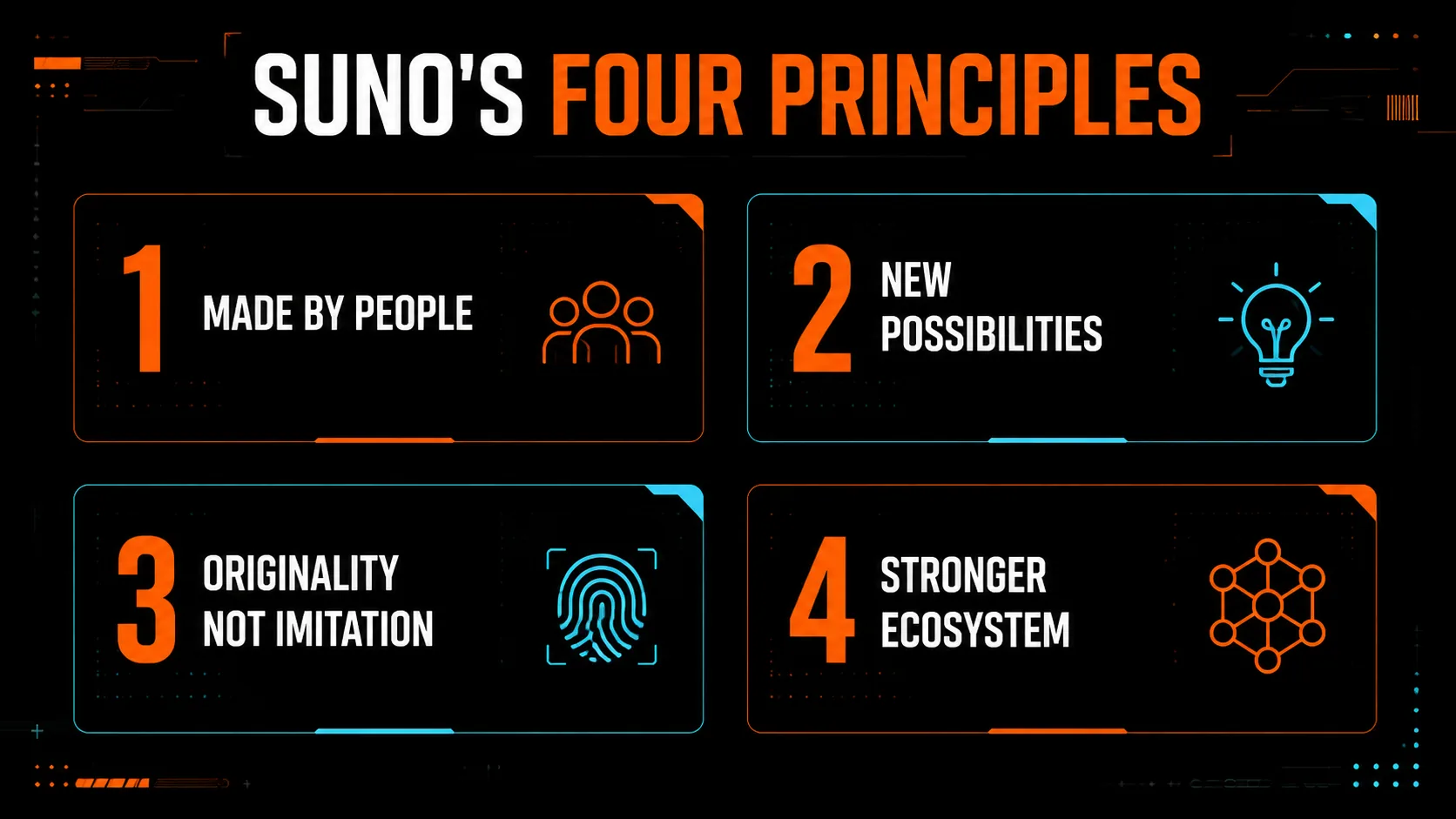
Shulman framed the changes around four principles: great music is made by people; technology opens new creative possibilities; AI should enable originality, not imitation; and more people making music should strengthen the ecosystem. The most consequential of these for producers is "originality, not imitation." The updated community guidelines now explicitly prohibit recreating existing songs, uploading material you have no rights to, and using a real person's voice or likeness without permission — and they ban "deceptive audio presented as real."
On disclosure specifically, Shulman was deliberately non-prescriptive: "it should ultimately be at the discretion of artists and platforms to decide whether they communicate when something was made with AI." In other words, Suno is building the identification rails but leaving the labeling decision to distributors and DSPs — which is exactly why the disclosure step now lives in your distributor's upload flow, not in Suno's export button.
Why now: the legal backdrop
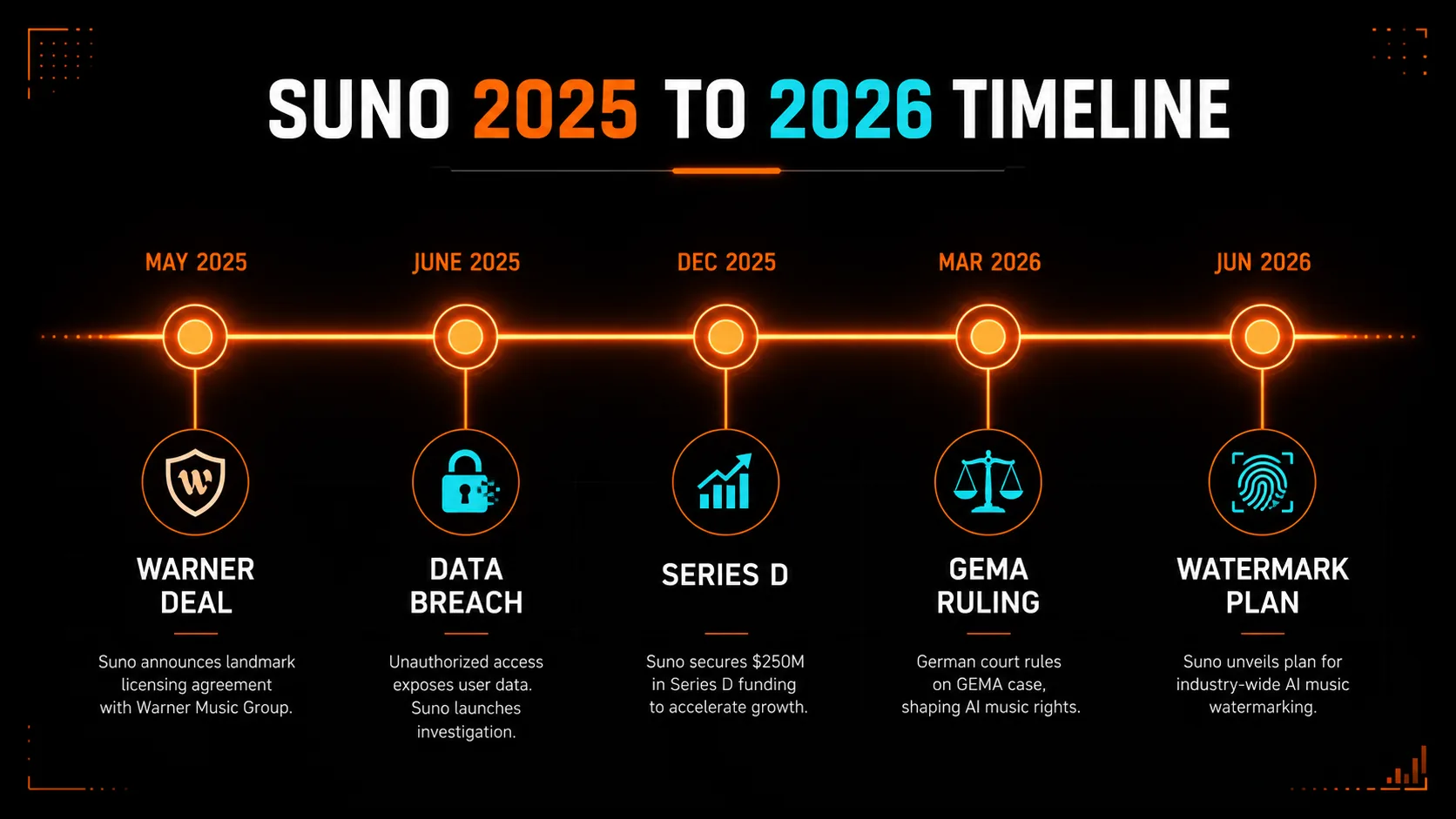
This did not come out of nowhere. The timing is defensive. On July 31, 2026, the Munich Regional Court held Suno liable in a landmark case brought by the German collecting society GEMA, finding the company had trained its systems on protected music without the necessary rights. That ruling arrived on top of RIAA-coordinated lawsuits from Universal Music Group and Sony Music Group in the United States. Suno had already signed a licensing agreement with Warner Music in late 2025 and raised a $400 million Series D in June 2026, so it has both the incentive and the capital to be seen cooperating with rights holders.
The practical read: watermarking and download limits are, in large part, evidence for rights holders that Suno is policing misuse. That framing tells you where the enforcement pressure will actually fall — on obvious imitation, voice-cloning, and industrial-scale spam uploads — and where it will not: on a producer releasing a handful of original, rights-clean tracks under their own name.
What actually changes for independent producers
Here is the honest separation of confirmed facts from open questions, as of August 2026. We will update this table as Suno publishes specifics.
| Change | Confirmed? | What it means for you |
|---|---|---|
| Inaudible watermark on new generations | Confirmed (rolling out) | New tracks carry an origin marker. Sound quality is unaffected. |
| Download limits | Announced, no caps/dates | Bulk exporting a large back catalogue may get harder. Individual releases are the stated non-target. |
| Off-platform identification | Confirmed (partners named) | DSPs can detect Suno origin. Disclosure becomes the safe default. |
| Retroactive application to old tracks | Unconfirmed | Watermarks are embedded at generation, so pre-rollout files likely differ from post-rollout ones. |
The strategic takeaway is that identification, not deletion, is the mechanism. Your track is not going to vanish because it carries a marker. What matters is that the ecosystem around it — distributors and DSPs — increasingly expects you to disclose AI involvement and prove ownership. That is a workflow change, not an existential one, and producers who get their paperwork right will barely notice it. If you want the time-sensitive checklist version of this, see our companion piece on securing your Suno catalogue before the rollout.
Disclosure and distribution in 2026
Because Suno pushed the labeling decision to platforms, your distributor is now the gatekeeper. This is where we recommend DistroKid for producers releasing AI-assisted music. Its 2026 policy is explicit and workable: it accepts AI-generated music from tools like Suno and Udio provided you own 100% of the rights, disclose AI involvement at upload, and avoid voice cloning or spam. DistroKid added an AI-disclosure step that asks you to identify which parts of a track were AI-generated — lyrics, vocals, instrumental performance, or full composition. Crucially, to claim commercial ownership you must have been on a paid Suno tier at the time the audio was generated.
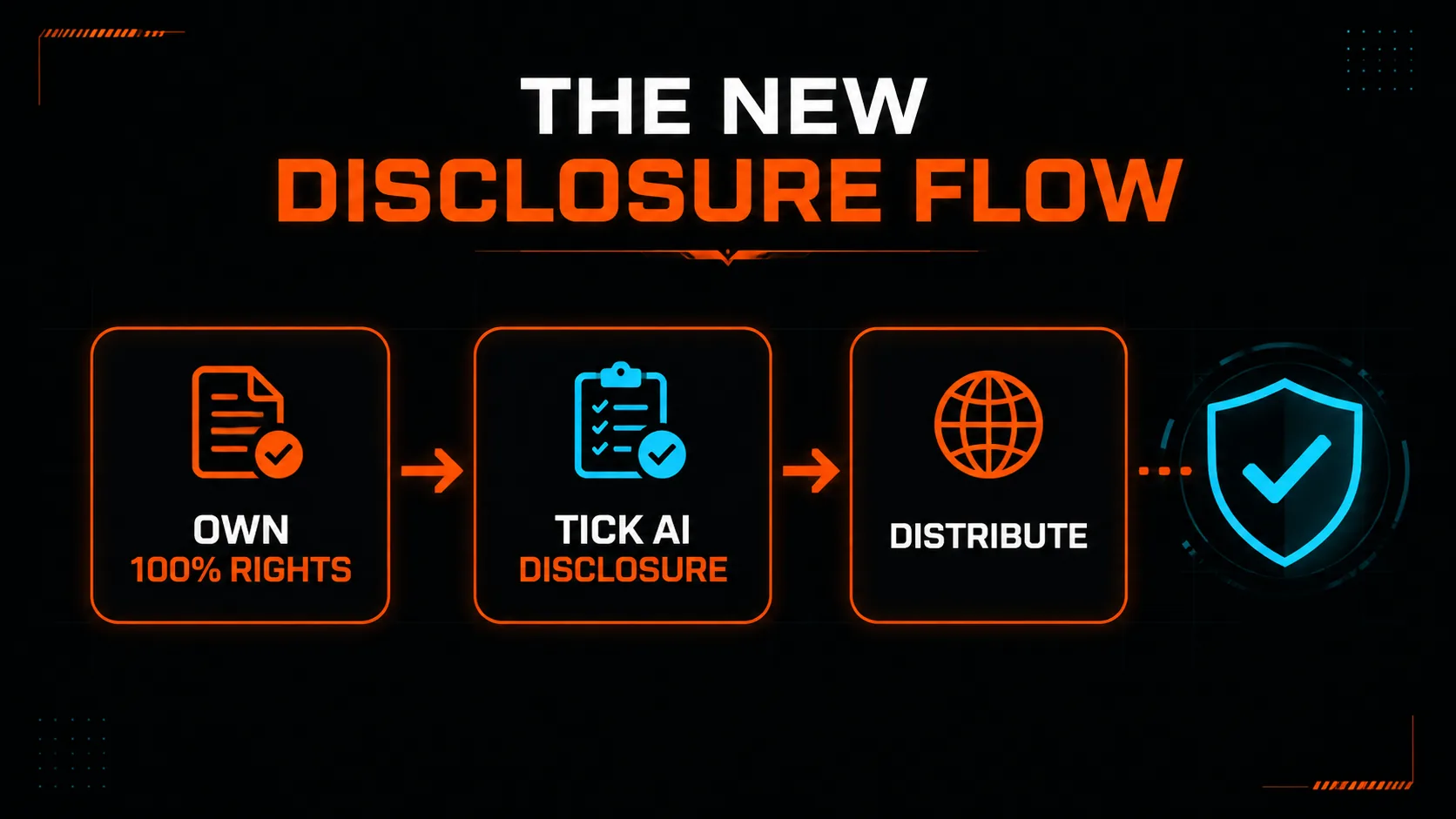
| Requirement (Aug 2026) | DistroKid | Why it matters |
|---|---|---|
| AI disclosure at upload | Required (per-element) | Non-disclosure risks rejection or retroactive takedown. |
| 100% rights ownership | Required | Paid Suno tier at generation time establishes commercial rights. |
| No voice cloning / likeness | Prohibited | Mirrors Suno's own updated community guidelines. |
Disclosure is not a penalty. It is the thing that keeps your release live. A properly disclosed, rights-clean track is in a far stronger position than an undisclosed one that a fingerprint match flags six months after release.
Keeping your masters release-ready
There is a separate problem that predates this announcement and is not solved by disclosure: distributor-side AI detection screening. Services like Audible Magic and the automated checks distributors run can flag the raw acoustic artifacts common to generative audio — the spectral tells, quantization glitches and phase anomalies that machine models leave behind — and those false-positives can suppress an otherwise legitimate, disclosed release. That is a production-quality problem, not a rights problem.
This is where a purpose-built, signal-level processing tool earns its place in the chain. Undetectr is the tool we recommend for exactly this: it removes Suno watermarks and cleans the machine-generated artifacts that trigger distributor screening, while preserving the sound you actually made. For producers releasing music they own on a paid tier, that is the difference between a master that sails through verification and one that gets caught in a false-positive AI-detection flag. Suno's newest watermark is engineered to be tamper-resistant and is still rolling out; Undetectr is updated continuously to keep pace with each change to Suno's output, and it is proven on the Suno tracks producers are releasing today. Whatever you put out, keep your rights clean and disclose AI use where your distributor requires it. For the deeper mechanics, see our guide to making AI music pass distributor checks and the best AI music artifact-removal software.
Frequently Asked Questions
By Eddie Mathews. Reporting based on Suno's August 6, 2026 announcement and coverage from TechCrunch, Engadget, Billboard, Music Ally and Unite.AI, plus DistroKid's published 2026 AI-music policy. Figures and policy details verified as of August 2026 and will be updated as Suno publishes specifics.
Recommended AI Tools
played.fm
Sell your music and keep 100%: played.fm is a direct-to-fan store + sync marketplace with 0% commission, no gatekeepers, and no bans — a strong fit for AI musicians.
View Review →OpenCode
The open-source AI coding agent: terminal-first TUI, 75+ model providers, LSP context, subagents, and privacy-first design. Free software, ~180K GitHub stars.
View Review →Exa
The neural web search API for AI agents: embeddings-based retrieval, cited highlights, sub-180ms latency, and an MCP server. 20,000 free requests/month.
View Review →Google Antigravity
Google's agent-first IDE: run a fleet of AI agents from a Manager surface, on Gemini 3 Pro, Claude Sonnet 4.5, or OpenAI models. Free in public preview.
View Review →