SynthID Explained: How Google's AI Watermark Works (2026)

AI Infrastructure Lead
TL;DR
SynthID is Google DeepMind's invisible watermarking system for AI-generated images, video, audio, and text. It has already marked over 10 billion pieces of content — and a new SynthID Detector portal lets journalists and researchers verify whether content is Google AI-generated. For music producers using Lyria or NotebookLM's podcast feature, there's one tool built specifically to remove the audio watermark.
Table of Contents
- What Is SynthID?
- How Does SynthID Work?
- SynthID for Images and Video
- SynthID for Audio: Lyria, NotebookLM, and AI Music
- SynthID for Text: How LLM Watermarking Actually Works
- The SynthID Detector Portal: How to Check If Content Is AI
- Where SynthID Is Deployed in 2026
- Can You Remove SynthID Watermark?
- SynthID vs C2PA: Complementary, Not Competing
- What SynthID Means for AI Creators in 2026
- SynthID Limitations You Should Know
What Is SynthID?
SynthID is Google DeepMind's watermarking technology for AI-generated content. It's one of the most significant pieces of infrastructure to come out of the current AI era — not because it makes headlines, but because it's quietly embedding invisible markers into billions of generated images, videos, audio tracks, and text outputs, creating a layer of provenance that didn't exist before.
The core idea is straightforward: when Google AI tools generate content, SynthID embeds an imperceptible watermark before that content reaches the user. The watermark is invisible to human eyes and ears but detectable by SynthID's verification technology. As of 2025, over 10 billion pieces of content have been marked — a scale that puts it in a different category from every other AI provenance solution currently in production.
Google SynthID covers four modalities: image, video, audio, and text. Each modality has its own technical implementation, because the challenge of embedding a robust, imperceptible watermark into a PNG file is fundamentally different from doing the same to an MP3, a video stream, or a paragraph of generated text. That Google has shipped production-grade watermarking across all four is genuinely notable engineering.
The stated goal is transparency — helping creators, platforms, journalists, and consumers understand which content was generated by AI. Whether you see that as a useful tool for trust or a concern for creators who'd prefer their AI-assisted work remain unidentified depends on which side of the content economy you're on.
How Does SynthID Work?
At the foundation of SynthID are two deep learning models trained jointly: one that embeds the watermark and one that identifies it. The joint training is what makes the system robust — the embedding model learns to place watermarks in ways that survive real-world transformations (compression, resizing, format conversion), while the detection model learns to find them even after those transformations have been applied.
This joint training approach is what separates SynthID from older, simpler steganography techniques. A naive digital watermark embeds a fixed pattern that's trivially removable once you know to look for it. SynthID's watermarks are learned representations — the model figures out where in the content structure a watermark signal can be embedded in a way that's statistically undetectable to humans but reliably recoverable by the detector.
The implementation differs per modality, so it's worth breaking each one down.
SynthID for Images and Video
For SynthID image watermarking, the signal is embedded directly into pixel values. The changes are below human perceptual thresholds — you can't see the watermark by looking at the image, and it doesn't affect visual quality. What makes this impressive at a technical level is the robustness: the SynthID watermark survives cropping, adding filters, color grading, brightness and contrast adjustments, format conversion, and lossy JPEG compression.
That last point matters more than it might seem. JPEG compression is aggressive — it throws away high-frequency data and quantizes DCT coefficients. Most fragile watermarks don't survive it. SynthID's embedding is specifically engineered to persist through JPEG quantization, which is why it's viable for real-world image distribution where files will inevitably be re-saved, re-uploaded, and re-compressed multiple times.
For video, the same pixel-level approach extends to individual frames, with additional robustness against frame rate changes. Google's Veo video generation model embeds SynthID watermarks into every video it produces. Given that Veo is used to generate clips across YouTube and Google's ad products, that's a significant amount of video content carrying provenance data.
"Isn't foolproof against extreme manipulations" — this is Google's own framing of SynthID's image limitations. Heavy cropping to a small region, extreme upscaling followed by re-compression, or adversarial manipulation could degrade or destroy the watermark. It's robust against common transformations, not every possible attack.
Imagen, Google's text-to-image model, embeds SynthID image watermarks on every generated output. If you've generated images with Imagen through any Google product — including via the Gemini app, Google Workspace, or any API integration — those images carry a SynthID marker.
SynthID for Audio: Lyria, NotebookLM, and AI Music
SynthID audio watermarking is technically the most interesting modality for independent creators, because it's the one that most directly intersects with the growing AI music ecosystem. The watermark is an inaudible signal embedded in the audio waveform — you cannot hear it, even on high-end headphones with a flat EQ. What you can hear is the same track you generated, unaltered.
The SynthID audio watermark is engineered to survive: adding environmental noise, MP3 compression (including aggressive 128kbps encoding), changing playback speed, and format conversion. That's a meaningfully robust specification — most of the casual transformations a music producer might apply to a generated track won't remove the watermark.
Lyria, Google's AI music generation model, embeds SynthID in every audio output. NotebookLM's podcast generation feature — which converts documents into audio discussions — also embeds SynthID in its output audio. So if you've used NotebookLM to generate podcast episodes, those MP3s carry a SynthID marker.
For music producers working with Lyria-generated tracks or AI-assisted audio, the SynthID audio watermark is a real consideration for distribution. Streaming platforms don't currently scan for SynthID at ingest — but as detection infrastructure rolls out to partners like GetReal Security, that could change. If you're distributing AI-generated music and need to remove the SynthID audio watermark, Undetectr is the only commercial tool purpose-built for this — it's a €39 lifetime purchase with a documented, working removal process.
SynthID for Text: How LLM Watermarking Actually Works
Text watermarking is the most counterintuitive of the four modalities, because text doesn't have pixels or waveforms to embed signals into. Instead, SynthID exploits the probabilistic nature of how large language models generate text.
When an LLM generates text, it produces one token at a time. At each step, the model assigns a probability score to every possible next token — "bananas" might have a high probability after "my favourite tropical fruits are mango and…", while "carburetor" would score near zero. The model then samples from these probabilities to pick the next word.
SynthID text watermarking works by subtly adjusting these probability scores during generation to favor certain tokens over others in a statistically detectable pattern. The adjustments are small enough that the output reads naturally — the watermark doesn't make the text sound weird or introduce errors. But the pattern of token choices carries a signal that the SynthID detector can identify at the aggregate level across many tokens.
The key constraint is that SynthID text watermarking only works if the model that generated the text had SynthID embedded in its generation pipeline. It can't retroactively identify text generated by a model without SynthID. This is why the scope is limited to Gemini app outputs and other Google-hosted model outputs — not every LLM on the internet.
Google has open-sourced the text watermarking component at ai.google.dev/responsible/docs/safeguards/synthid, making it available for other developers to integrate into their own models. The image, video, and audio implementations remain proprietary.
The SynthID Detector Portal: How to Check If Content Is AI
The SynthID detector capability has two interfaces in 2026. The first is built into the Gemini app: upload an image, video, or audio file and ask Gemini whether it was generated by Google AI. Gemini runs SynthID detection internally and reports back. This is the easiest access path for most users.
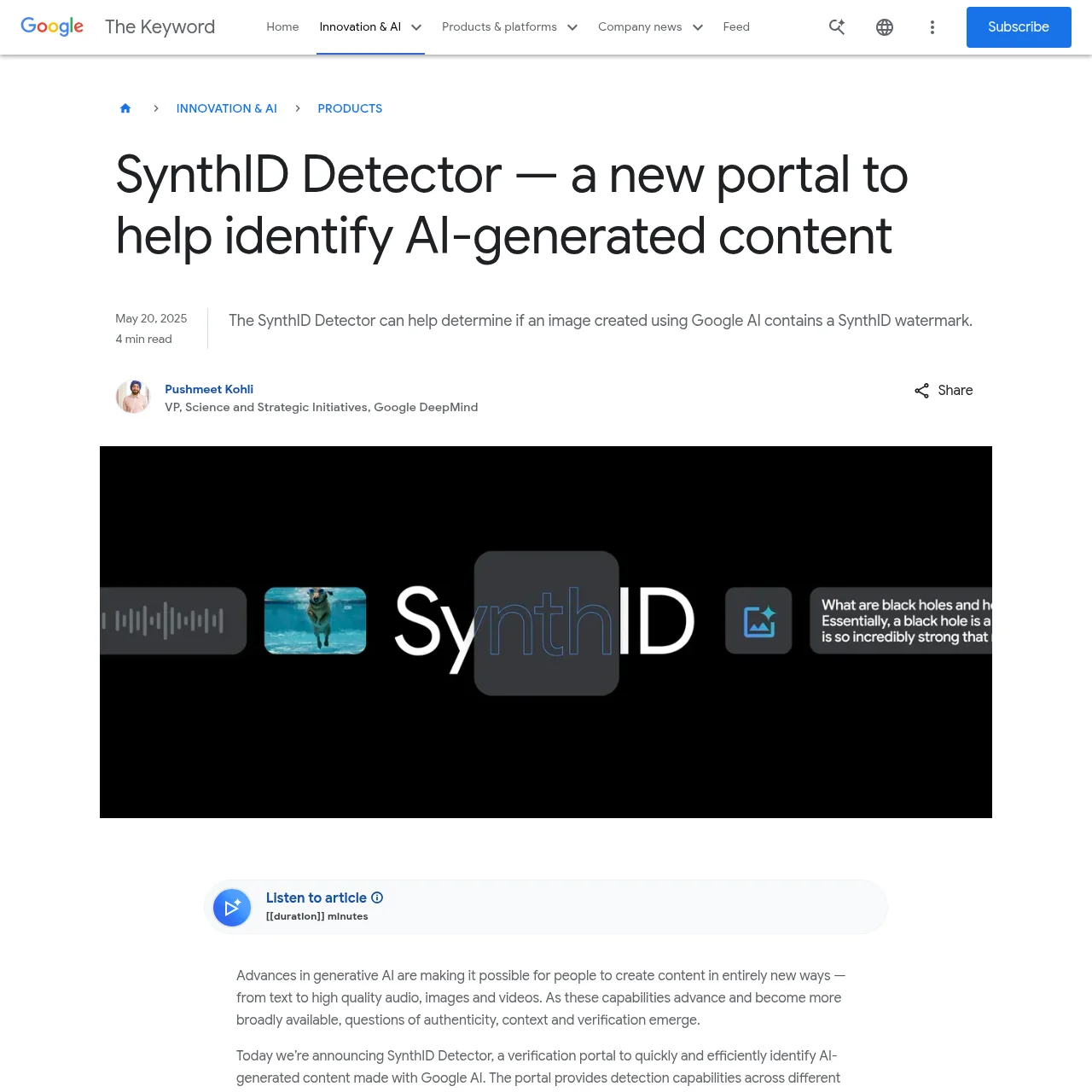
The second interface is the dedicated SynthID Detector portal, announced at Google I/O 2025. This is a standalone verification tool designed for professional use cases — journalists investigating whether a viral image is AI-generated, media organizations verifying content authenticity, researchers studying synthetic media spread. The portal goes further than the Gemini app in that it can highlight which specific regions or segments of the content are most likely to carry a SynthID signal.
The SynthID Detector portal is currently in early-tester rollout. It's not open to the general public — access is through a waitlist targeting journalists, media professionals, and researchers. If your work involves content authentication, the waitlist is at this Google Forms link.
The important caveat: both the Gemini app and the SynthID Detector portal can only verify Google AI-generated content. Content from Midjourney, Suno, Udio, DALL-E, Claude, or any other non-Google provider won't return a positive SynthID detection — not because it's "safe," but because those systems don't embed SynthID in the first place.
Where SynthID Is Deployed in 2026
Google SynthID has been integrated across every major Google AI generation product, plus a growing set of third-party partnerships. Here's the current deployment map:
| Product | Modality | Notes |
|---|---|---|
| Imagen | Image | Every generated image watermarked |
| Veo | Video | Frame-level watermarking |
| Lyria | Audio | Inaudible waveform signal |
| Gemini app | Text + multimodal | Text watermarking + detection built in |
| NotebookLM | Audio | Podcast generation audio |
| NVIDIA Cosmos | Video | Via Google partnership; build.nvidia.com |
| GetReal Security | Multi | Industry-wide content verification |
The 10-billion-pieces-watermarked figure is a meaningful threshold. For context, Midjourney reportedly generated over 1 billion images in its first year. SynthID has already marked ten times that across multiple modalities — and that number continues to compound as Google scales its AI products.
The NVIDIA Cosmos partnership is worth noting specifically. Cosmos is NVIDIA's world-model video generation system, used for synthetic data generation in robotics and autonomous systems. Those generated videos — produced at build.nvidia.com — now carry SynthID watermarks, which means the watermarking infrastructure is extending beyond consumer AI tools into industrial and research applications.
Can You Remove SynthID Watermark?
The honest answer is: it depends on the modality, and most approaches that "work" in theory are impractical at production scale.
For images and video: SynthID's pixel-level embedding is specifically designed to resist the kinds of transformations you'd realistically apply to an image. Aggressive adversarial attacks can degrade the watermark, but they tend to visibly degrade image quality in the process — which defeats the purpose. There's currently no commercially viable tool for removing SynthID image watermarks without also damaging the image.
For text: Since SynthID text watermarking works at the statistical pattern level across many tokens, paraphrasing the output — rewriting it with different word choices — can disrupt the watermark signal. But at that point, you're rewriting the text, not removing a watermark from it.
For audio: This is where the picture is different. SynthID audio watermarks are inaudible, but they operate in the frequency domain and can be separated from the underlying audio signal with the right processing. Undetectr is the only commercial tool purpose-built to remove SynthID audio watermarks — it's been tested against Lyria-generated tracks and NotebookLM podcast audio specifically, and the removal process doesn't degrade perceptible audio quality.
If you're distributing AI music or AI podcast audio
Lyria-generated music and NotebookLM podcast exports both carry SynthID audio watermarks. As more distribution platforms integrate SynthID detection, unmarked audio will be easier to distribute without flags. The Make AI Music Undetectable guide walks through the full process — and Undetectr is the tool it recommends for SynthID removal specifically.
Get Undetectr Lifetime (€39) →One thing to be clear about: removing a SynthID watermark doesn't make the content "not AI-generated." It makes it harder for SynthID-based detection systems to identify it as such. The content's origins don't change. Whether removing the watermark is appropriate depends entirely on your use case — it's a standard consideration for music producers who need distribution-ready files, not an ethical grey area.
SynthID vs C2PA: Complementary, Not Competing
A frequent point of confusion is whether SynthID and C2PA (Coalition for Content Provenance and Authenticity) are competing standards. They're not — they operate at different technical levels and serve different purposes, and the most robust content authentication approach uses both.
C2PA is a metadata standard. It attaches a signed, tamper-evident manifest to a file — essentially a cryptographic record of the file's origin and edit history. The manifest lives in the file's metadata fields. The limitation is that stripping metadata (which happens routinely when files are uploaded to social platforms) removes the C2PA signal entirely.
SynthID is a signal embedded in the content itself — in pixels, waveforms, or token probability patterns. It's designed to survive transformations that destroy metadata. The limitation is that it only works for content generated by Google AI systems that have SynthID integrated.
Used together, C2PA covers the chain of custody through trusted channels and SynthID provides a fallback signal that survives the metadata stripping that happens when content travels through social media. Google is an active member of the C2PA coalition, and the two systems are designed with this complementary use case in mind.
What SynthID Means for AI Creators in 2026
If you're a creator using Google AI tools — whether for music production, content generation, image creation, or podcast production — SynthID is already in your workflow whether you knew it or not. Here are the practical takeaways:
- Music producers using Lyria: Every track carries an inaudible audio SynthID. For casual use, this is invisible. For commercial distribution, especially as more platforms integrate SynthID detection, it's worth knowing the watermark is there and that removal options exist.
- NotebookLM podcast users: Your AI-generated podcast audio carries SynthID. If you're submitting to Spotify or Apple Podcasts, be aware that this could become a flag as detection integrations expand.
- Image creators using Imagen: Generated images are watermarked. This is largely a non-issue for editorial and creative use — but worth knowing if you're distributing images in contexts where AI-generation disclosure might be required or problematic.
- Content marketers using Gemini: Text outputs from Gemini carry SynthID text watermarks. At this point, no mainstream platform scans for these — but the infrastructure for detection is being built out via Google's partnerships.
- Journalists and researchers: The SynthID Detector portal waitlist is worth joining. Being able to verify whether an image or audio clip is Google AI-generated is a useful investigation tool, and early access gives you a significant advantage in media verification workflows.
SynthID Limitations You Should Know
SynthID is genuinely impressive engineering. It's also not a complete solution to the problem of AI content identification — and understanding those limits is important before relying on it for anything consequential.
- Google-only detection: SynthID detects Google AI-generated content. Content from Suno, Udio, Midjourney, OpenAI, Anthropic, Stable Diffusion, or any other non-Google provider is invisible to SynthID — not because it's "safe," but because those systems don't embed the watermark.
- Not foolproof against extreme manipulation: Google's own framing acknowledges that extreme manipulations can degrade or destroy the watermark. The system is designed for robustness against common transformations, not adversarial attacks.
- Text watermarking requires the model: SynthID text detection only works on text generated by a model that had SynthID embedded at generation time. It can't retroactively identify AI text from other sources.
- Detection portal access is restricted: The SynthID Detector portal is still in limited early-tester rollout. Most users don't have direct access to it yet — Gemini app detection is the only widely available path.
- No cross-ecosystem standard: SynthID is Google's implementation. There's no universal AI content watermarking standard that all providers have agreed to. Until that changes (if it ever does), any single-provider watermarking system covers only a fraction of AI-generated content in circulation.
None of these limitations undermine the value of what Google has built. They're important context for understanding what SynthID is — a significant first-mover implementation from one major provider — rather than a solved problem for AI content identification at large.
Related Articles
Know an AI tool we haven't covered?
PopularAiTools.ai reviews and lists hundreds of AI tools across every category. Submit a tool for inclusion — it's free.
Submit Your AI Tool →Frequently Asked Questions
What is SynthID and who built it?
SynthID is a watermarking technology built by Google DeepMind. It embeds imperceptible watermarks into AI-generated images, video, audio, and text so that content can later be identified as AI-generated. Over 10 billion pieces of content have already been watermarked with SynthID across Google's AI product suite.
How does SynthID work?
SynthID uses two deep learning models trained jointly — one to embed an imperceptible watermark and one to detect it. For images and video, the watermark is embedded directly into pixel values. For audio, it's an inaudible signal embedded in the waveform. For text, it adjusts the probability scores of tokens during LLM generation to embed a statistical pattern that the detector can identify.
Can SynthID detect content from OpenAI, Anthropic, or Midjourney?
No. The SynthID detector can only identify content generated by Google AI tools (Imagen, Veo, Lyria, Gemini) and partners like NVIDIA Cosmos. Content from OpenAI, Anthropic, Midjourney, Suno, Udio, Stable Diffusion, or any other non-Google provider will not return a positive SynthID detection — not because it's undetectable as AI, but because those systems don't embed the SynthID watermark.
Can you remove SynthID watermark from AI music?
Yes. Audio SynthID watermarks can be removed using Undetectr, which is currently the only commercial tool purpose-built for SynthID audio watermark removal. It's been specifically tested against Lyria and NotebookLM podcast audio. Image and video SynthID removal is not commercially viable without visibly degrading quality.
How do I check if an image has a SynthID watermark?
Upload the image to the Gemini app and ask whether it was generated by Google AI — Gemini runs SynthID detection internally. For more detailed analysis, the dedicated SynthID Detector portal can highlight specific regions most likely to carry the watermark signal; that portal is currently waitlisted for journalists and researchers at the Google Forms waitlist.
Is SynthID open source?
Partially. Google has open-sourced the text watermarking component of SynthID at ai.google.dev/responsible/docs/safeguards/synthid, making it available for other developers to integrate into their own language models. The image, video, and audio watermarking implementations remain proprietary.
Does SynthID survive image cropping, filters, or compression?
Yes, by design. The SynthID image watermark is engineered to survive common manipulations including cropping, adding filters, color and brightness adjustments, and lossy JPEG compression. Google has internally tested robustness against many standard image transformations. That said, Google acknowledges the system is not foolproof against extreme manipulations — adversarial attacks designed specifically to destroy watermarks can degrade detection accuracy.
Recommended AI Tools
played.fm
Sell your music and keep 100%: played.fm is a direct-to-fan store + sync marketplace with 0% commission, no gatekeepers, and no bans — a strong fit for AI musicians.
View Review →OpenCode
The open-source AI coding agent: terminal-first TUI, 75+ model providers, LSP context, subagents, and privacy-first design. Free software, ~180K GitHub stars.
View Review →Exa
The neural web search API for AI agents: embeddings-based retrieval, cited highlights, sub-180ms latency, and an MCP server. 20,000 free requests/month.
View Review →Google Antigravity
Google's agent-first IDE: run a fleet of AI agents from a Manager surface, on Gemini 3 Pro, Claude Sonnet 4.5, or OpenAI models. Free in public preview.
View Review →