
evo Review 2026: AI Codebase Drift Detection — Features, Pricing & Alternatives
Updated March 2026 · 13 min read · By PopularAiTools.ai
TL;DR
evo by CodeQual is a local-first structural drift detector that correlates signals from git, CI, dependencies, and deployments to catch codebase degradation before it becomes technical debt. It runs entirely on your machine with zero configuration, generates interactive HTML reports, and produces evidence-based investigation prompts you can paste into any AI assistant. The free tier covers core analysis and GitHub Actions, while Pro at $19/month adds AI-powered features. If your team uses AI coding tools and worries about architectural drift, evo is the early-warning system you need. Rating: 4.1/5
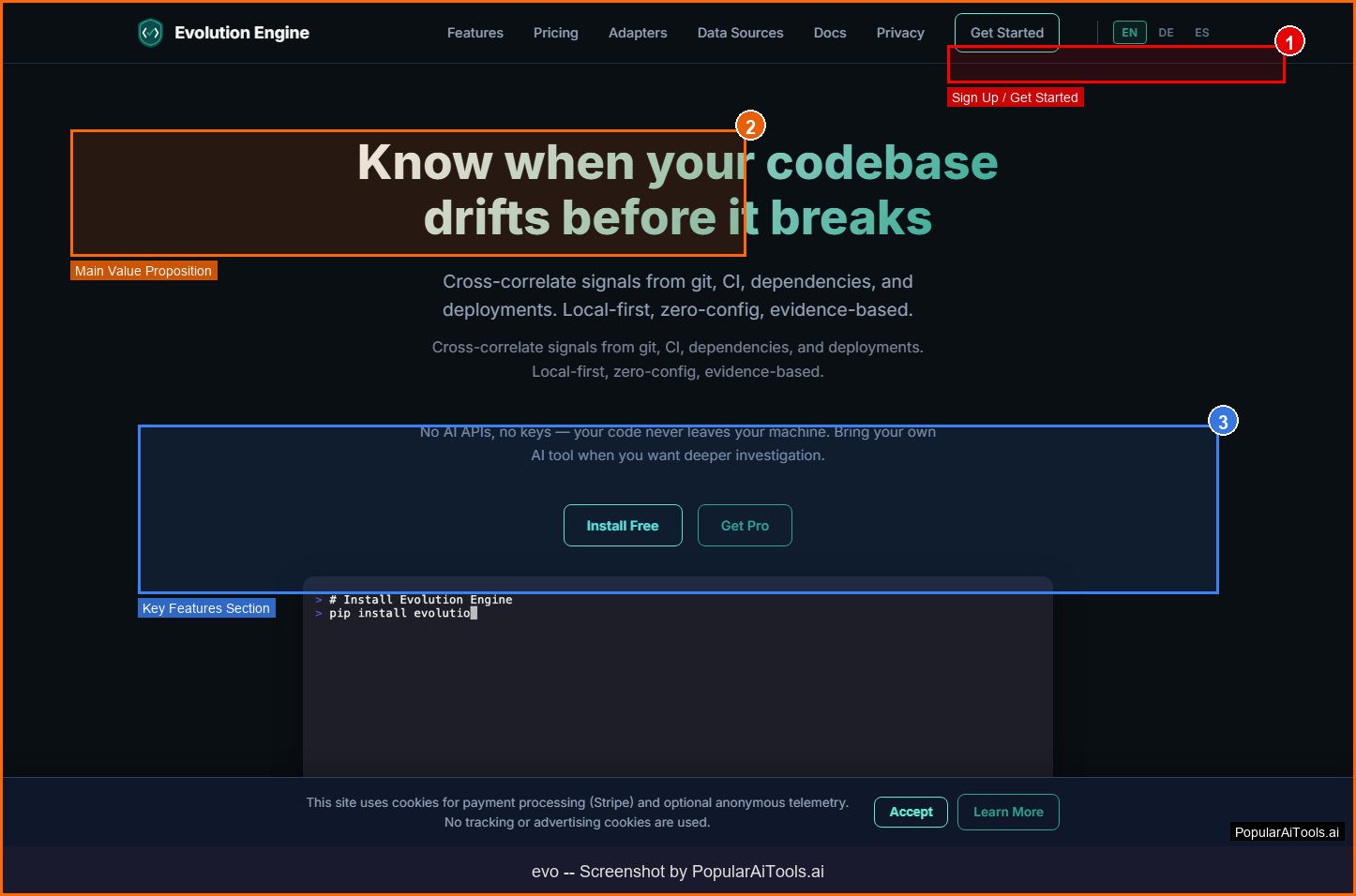
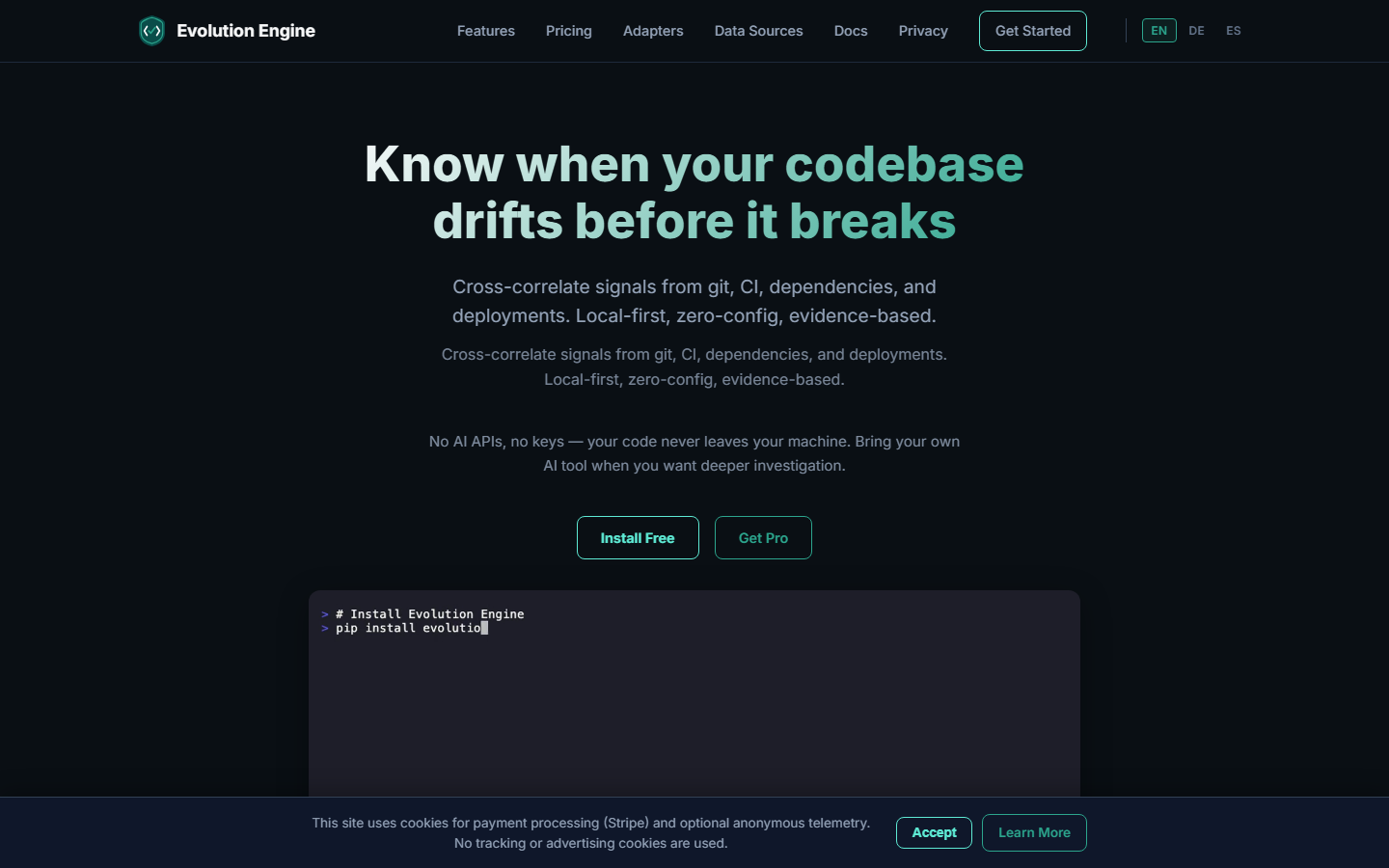
evo homepage — local-first codebase structural drift detection
What is evo?
evo is a structural drift detector for codebases, built by CodeQual. It monitors how your codebase evolves over time and flags statistically significant deviations from established patterns — the kind of slow degradation that individual code reviews miss but eventually leads to unmaintainable software.
The core insight behind evo is that architecture is a global property. A pull request can look perfectly fine line-by-line while still moving the entire system in the wrong direction. Traditional linters and code review tools catch syntax and style issues, but they're blind to structural drift — growing circular dependencies, boundary violations, coupling increases, and convention divergence.
evo takes a local-first approach, meaning all analysis runs on your machine without sending code to external servers. It correlates signals from multiple sources: git history (commit patterns, file change frequency, author distribution), CI pipelines (build times, test failures), dependency graphs (new dependencies, version drift), and deployment data. When it detects a statistically significant deviation from your codebase's established patterns, it generates an investigation prompt — a structured, evidence-based question you can paste into Claude, ChatGPT, or any AI assistant to understand the root cause and get fix suggestions.
This "human-in-the-loop with AI assistance" approach is deliberate. evo doesn't auto-fix anything. It surfaces evidence, generates questions, and lets you and your preferred AI tool decide what to do. This makes it safe to use in production workflows without risk of automated changes breaking things.
In 2026, as AI coding assistants generate more code than ever, structural drift has become a critical concern. Teams using Cursor, Copilot, or Claude Code for rapid development often find that the AI-generated code works correctly in isolation but introduces subtle architectural inconsistencies over time. evo was built specifically to address this emerging problem.
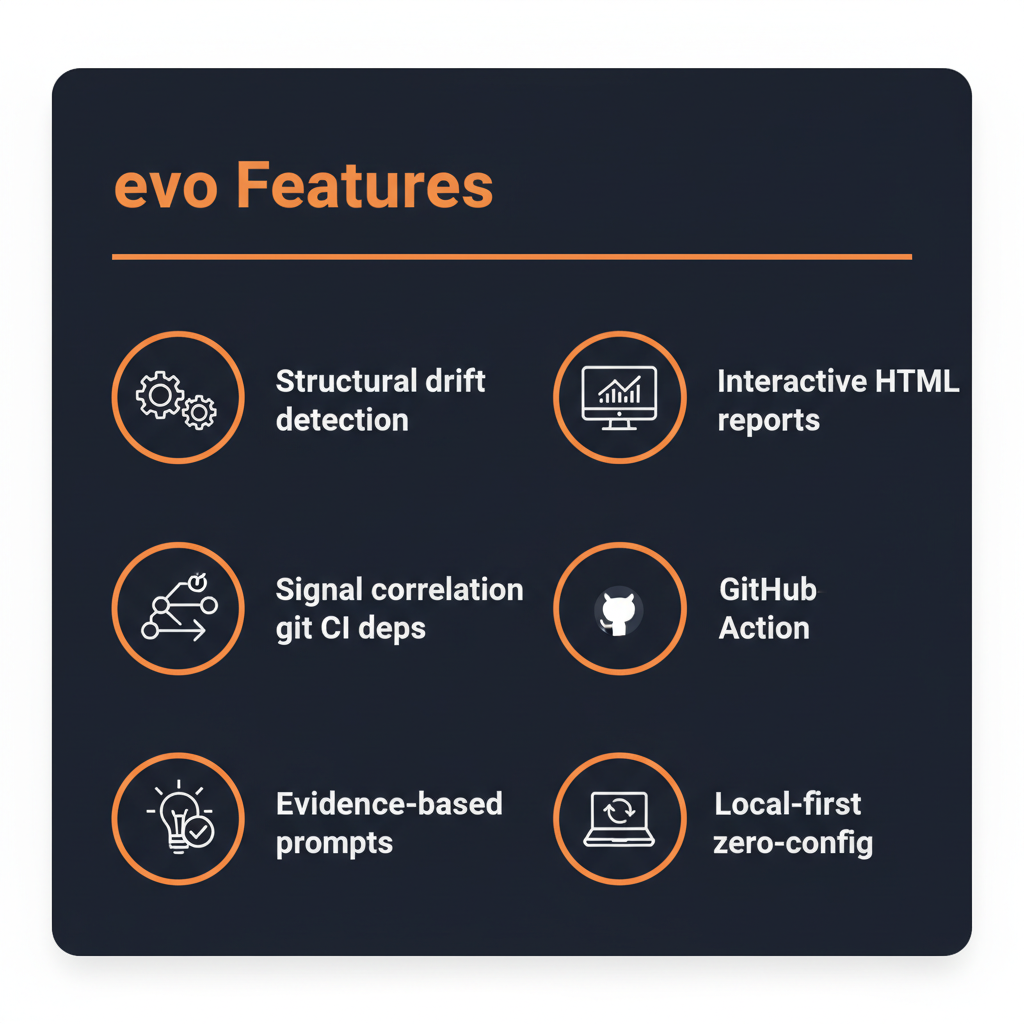
evo's core capabilities at a glance
Key Features
1. Multi-Signal Structural Analysis
evo doesn't rely on a single metric. It cross-correlates signals from git (commit frequency, file change patterns, author distribution), CI/CD pipelines (build time trends, test failure rates), dependency graphs (new packages, version spread, circular dependencies), and deployment data (release cadence, rollback frequency). This multi-dimensional view catches drift patterns that any single tool would miss. For example, it might detect that a module that historically changed quarterly is now changing weekly, while build times for that module have increased by 40% — a strong signal of growing complexity.
2. Statistical Deviation Detection
Rather than applying rigid rules, evo learns what's "normal" for your specific codebase and flags deviations. It builds a baseline from your repository's history and uses statistical methods to identify when current patterns diverge significantly from historical norms. This means it adapts to your team's conventions automatically — no manual configuration of thresholds or rules needed.
3. Evidence-Based Investigation Prompts
When evo detects drift, it generates structured investigation prompts with specific evidence: which files changed, what patterns shifted, how the signals correlate, and what the historical baseline looks like. These prompts are designed to be pasted directly into AI assistants like Claude or ChatGPT for deep analysis. The AI can then examine the specific code changes and suggest fixes, refactoring strategies, or architectural improvements.
4. Interactive HTML Reports
evo produces rich, interactive HTML reports that visualize drift patterns over time. Charts show trend lines for complexity, coupling, dependency health, and other structural metrics. You can drill down into specific modules, compare time periods, and export findings for team discussions. The reports are self-contained HTML files that can be shared without any special viewer.
5. GitHub Action Integration
Run evo automatically on every pull request through GitHub Actions. It posts a summary comment on the PR highlighting any structural drift introduced by the changes, giving reviewers context they wouldn't otherwise have. This catches architectural issues before they merge, without blocking the CI pipeline — it's informational, not a gate.
6. Zero-Config Local Execution
Install evo, point it at a repository, and run it. No API keys, no cloud accounts, no configuration files. It discovers the repository structure, builds the baseline from git history, and starts detecting drift immediately. Everything runs locally on your machine, so no code leaves your environment — critical for teams with strict IP or compliance requirements.
How evo fits into your development workflow
How to Use evo (Step-by-Step)
Step 1: Install evo
Install via your package manager or download from codequal.dev. No account creation required for the free tier.
Step 2: Run Analysis
Navigate to your repository root and run the evo analysis command. It scans git history, dependency files, CI configuration, and build outputs to establish a baseline and detect current deviations.
Step 3: Review the Report
evo generates an interactive HTML report showing detected drift patterns, severity levels, and affected modules. Open it in your browser to explore the findings visually.
Step 4: Use AI Investigation Prompts
For each significant deviation, evo provides a structured investigation prompt. Copy it and paste into your preferred AI assistant (Claude, ChatGPT, etc.) along with the relevant code context. The AI analyzes the specific drift and suggests remediation strategies.
Step 5: Set Up CI Integration
Add the evo GitHub Action to your repository to automatically analyze every pull request. The action posts a comment on the PR with structural drift findings, giving reviewers essential architectural context.
Pricing Plans
evo pricing tiers
The free tier is genuinely useful — it includes the complete core analysis pipeline, pattern detection, reports, and GitHub Actions integration. The Pro tier at $19/month adds AI-powered analysis features for teams that want deeper automated insights. For most individual developers and small teams, the free tier provides excellent value.
Pros and Cons
Pros
- ✓ 100% local-first — no code leaves your machine
- ✓ Zero configuration needed — works out of the box
- ✓ Multi-signal correlation catches drift that single tools miss
- ✓ Evidence-based prompts work with any AI assistant
- ✓ Free tier includes core analysis and GitHub Actions
- ✓ Addresses the growing AI-generated code drift problem
Cons
- ✗ Newer tool — smaller community and fewer integrations
- ✗ Requires sufficient git history for meaningful baseline
- ✗ No auto-fix capability — investigation and remediation is manual
- ✗ Limited to structural analysis — doesn't cover code style or bugs
- ✗ Pro features require paid subscription
Best evo Alternatives
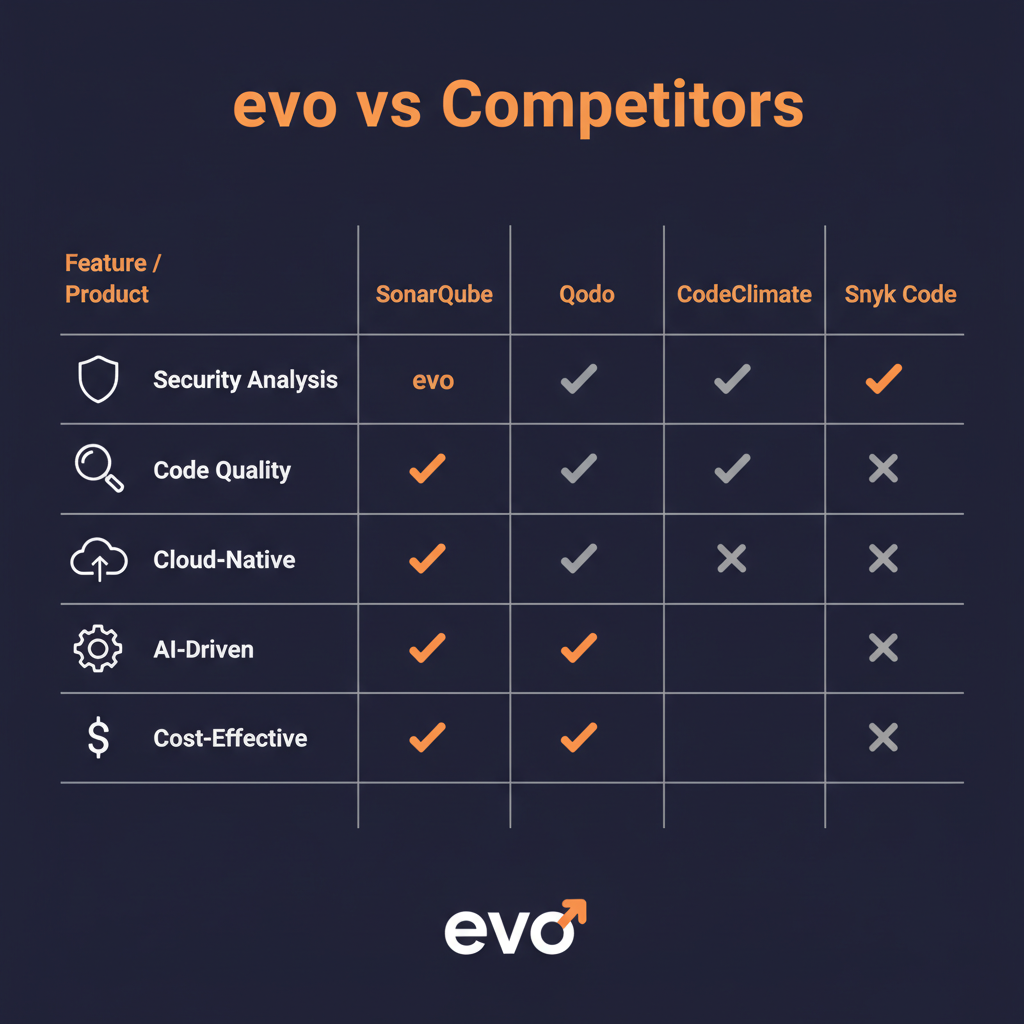
How evo compares to code quality alternatives
SonarQube is the industry standard for comprehensive code quality analysis covering bugs, vulnerabilities, code smells, and test coverage. However, it focuses on individual file-level issues rather than system-wide structural patterns. evo complements SonarQube well — use both for complete coverage.
Qodo excels at AI-powered code review with strong drift detection in PR context. It detects architectural drift and breaking changes but requires cloud processing. evo's local-first approach gives it an edge for teams with privacy requirements.
CodeClimate provides maintainability scoring and technical debt tracking with excellent GitHub integration. Its metrics are simpler than evo's multi-signal approach but more established. Good for teams that want straightforward maintainability grades.
Final Verdict: Is evo Worth It?
evo fills a genuine gap in the developer toolchain. While we have excellent tools for linting, testing, security scanning, and code review, structural drift detection has been largely manual — relying on senior engineers to spot architectural degradation during code reviews. evo automates this detection with a thoughtful, evidence-based approach.
The free tier is remarkably complete, offering core analysis, pattern detection, HTML reports, and GitHub Actions integration at no cost. The $19/month Pro tier is reasonable for teams that want AI-enhanced analysis. The local-first architecture addresses real privacy and compliance concerns that cloud-based alternatives cannot match.
The main limitation is maturity. As a newer tool, evo has a smaller community, fewer integrations, and less documentation than established alternatives like SonarQube. It also requires meaningful git history to build an effective baseline — brand-new repositories won't get much value immediately.
For teams actively using AI coding assistants and concerned about the cumulative architectural impact of AI-generated code, evo is a smart addition to the toolchain. It won't replace your linter or code reviewer, but it catches the structural issues they miss.
Our Rating: 4.1 / 5
Build an AI Tool? Get It in Front of the Right Audience
PopularAiTools.ai reaches thousands of qualified AI buyers monthly.
Submit Your AI Tool →Frequently Asked Questions
Is evo free?
Yes, evo's free tier includes the core analysis pipeline, local pattern detection, interactive HTML reports, and GitHub Action integration. No credit card or account required.
Does evo send my code to the cloud?
No. evo is 100% local-first. All analysis runs on your machine, and no code or data leaves your environment. This makes it safe for proprietary codebases and compliance-sensitive projects.
What is structural drift?
Structural drift is the gradual degradation of codebase architecture over time — growing coupling, boundary violations, convention divergence, and dependency bloat. Individual changes may look fine, but their cumulative effect weakens the system's maintainability.
Does evo work with any programming language?
evo analyzes structural patterns at the repository level (git history, file changes, dependency graphs) rather than parsing specific language syntax. This means it works with any language that uses git for version control.
How much git history does evo need?
evo works best with at least 3-6 months of git history to establish meaningful baselines. Newer repositories with less history will receive less accurate drift detection until the baseline matures.
Can evo auto-fix drift issues?
No. evo intentionally takes a human-in-the-loop approach. It detects drift and generates investigation prompts, but remediation decisions are left to developers. You can paste the prompts into AI assistants for fix suggestions.
Does evo integrate with GitHub?
Yes, evo includes a GitHub Action that runs automatically on pull requests and posts a comment summarizing any structural drift introduced by the changes.
Is evo useful for teams using AI coding tools?
Absolutely. evo was specifically designed to address the architectural drift that accelerates when teams use AI coding assistants. AI-generated code often works correctly in isolation but can introduce subtle structural inconsistencies over time.

Get Premium AI Tool Insights
Subscribe to get weekly curated AI tool recommendations, exclusive deals, and early access to new tool reviews.
Related Tools
V
VideoProc Converter AI
ai-coding

Relia
ai-coding
AI-powered Chrome extension that audits code flow, catches hallucinations in AI-generated code, and flags security vulnerabilities before they ship.

Git AutoReview
ai-coding
Updated March 2026 · 12 min read · By PopularAiTools.ai

Parallel Code
ai-coding
Free open-source desktop app that dispatches 10+ AI coding agents simultaneously across isolated git branches. Supports Claude Code, Codex CLI, and Gemini CLI. Keyboard-first Electron app with diff review workflow and QR code mobile monitoring. macOS + Linux. MIT license.
Related Articles
Suno v6 Intro and Ending Prompts: Unwanted Humming, Long Outros and Cut-Off Lyrics (2026)
Fix the edges of a Suno v6 track: three pasteable intro and outro templates, the documented Exclude field for unwanted humming, the arithmetic behind cut-off lyrics, and when to edit in Studio instead.
Suno v6 Keeps Changing Your Prompt? Variety, Style Influence and Weirdness Explained (2026)
Suno v6 rewrites your style prompt through the new Variety slider, and Suno documents the fix. What Variety, Style Influence, Weirdness and Max Mode each do, with a one-control-at-a-time worksheet.
Suno v6 Rock Prompts: Keep Guitar Riffs and Drums Alive Through the Verse (2026)
Why a strong Suno v6 rock intro turns into an empty verse, and how to fix it with a section-by-section instrument map, the Exclude field, pasteable rock and metal prompts and an A/B rubric.