
TL;DR — TEN
TEN is the world's first truly real-time multimodal agent framework for building next-generation conversational AI. Open-source and backed by Agora, TEN enables developers to create AI agents that can see, hear, and speak in real time with ultra-low latency. It supports voice, video, data streams, images, and text, integrating with models from OpenAI, Google, DeepSeek, and more — all through a plug-and-play extension system and visual Graph Designer.
Table of Contents
What is TEN?
TEN is the world's first truly real-time multimodal agent framework for building next-generation conversational AI. Open-source and backed by Agora, TEN enables developers to create AI agents that can see, hear, and speak in real time with ultra-low latency. It supports voice, video, data streams, images, and text, integrating with models from OpenAI, Google, DeepSeek, and more — all through a plug-and-play extension system and visual Graph Designer.
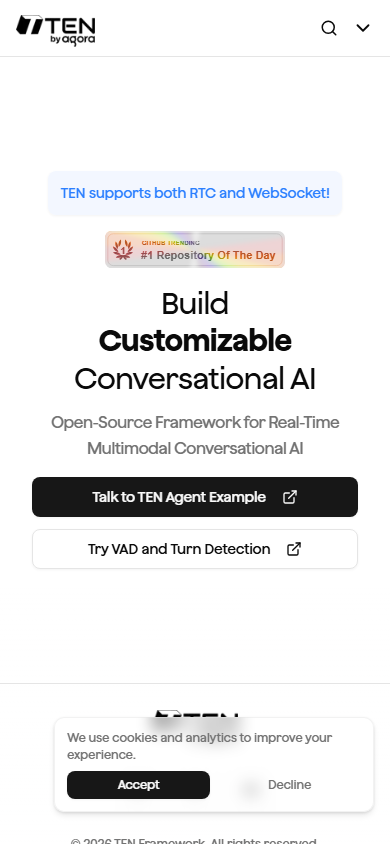
Screenshot of TEN homepage — captured March 21, 2026 by PopularAiTools.ai
Key Features of TEN
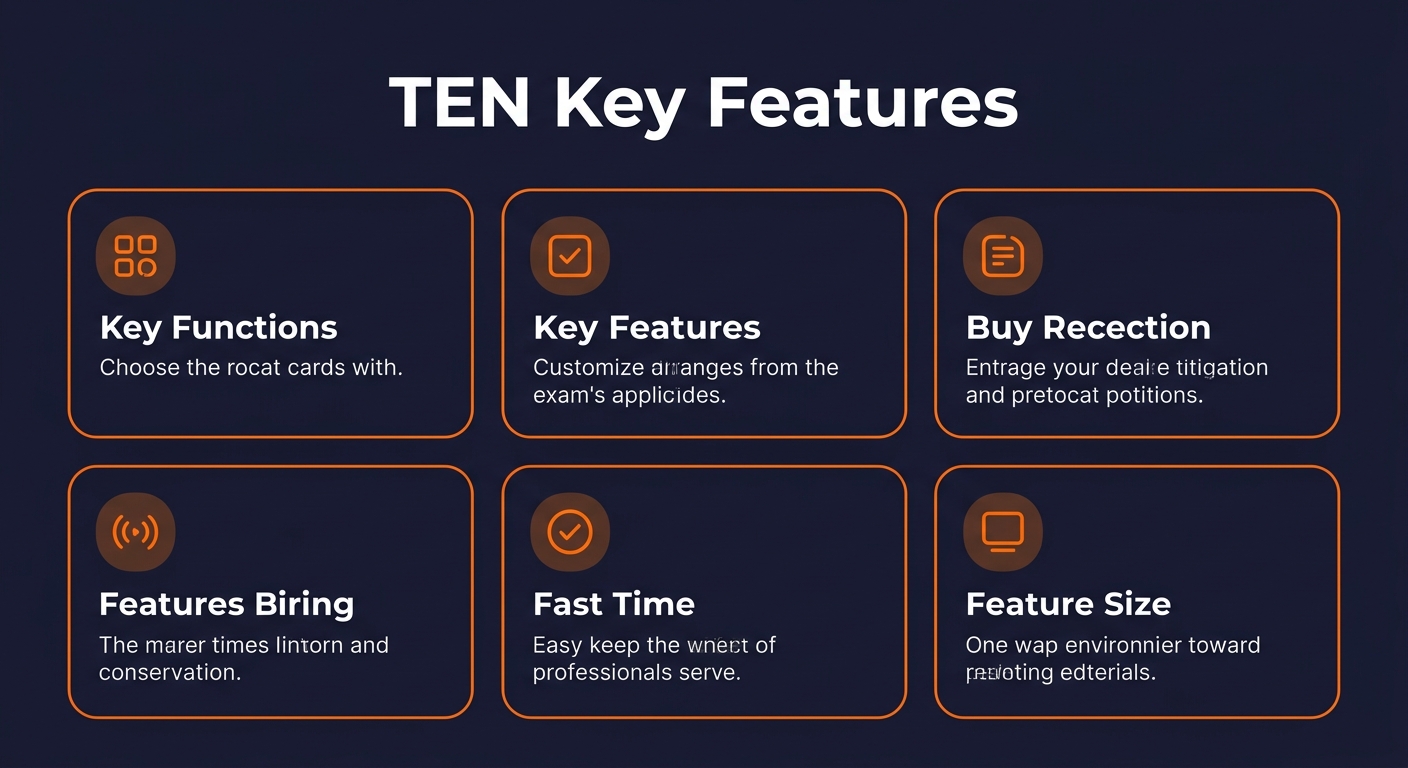
Real-Time Multimodal AI
Build agents that process voice, video, images, text, and data streams simultaneously with ultra-low latency.
Plug-and-Play Extensions
Choose from pre-built extensions for LLMs (OpenAI, Gemini, DeepSeek, Llama), STT, TTS, image generation, AI avatars, and more.
Visual Graph Designer
Drag-and-drop interface for designing agent workflows. Connect extensions, configure data flows, and visualize your agent's architecture.
Multi-Language Support
Build extensions in Golang, C++, and Python with Node.js support coming. Choose the language that fits your team.
Voice Activity Detection
Built-in VAD and turn detection ensure natural conversational flow without interruptions or awkward silences.
Agent Examples
Ready-to-deploy agent templates for voice chatbots, meeting minutes, language tutors, translators, and virtual companions.
TEN Manager
Manage data flow, dependencies, and deployment configurations through a centralized management tool.
Edge & Cloud Deployment
Deploy agents on cloud infrastructure, edge devices, or hybrid architectures depending on latency and privacy requirements.
How to Use TEN
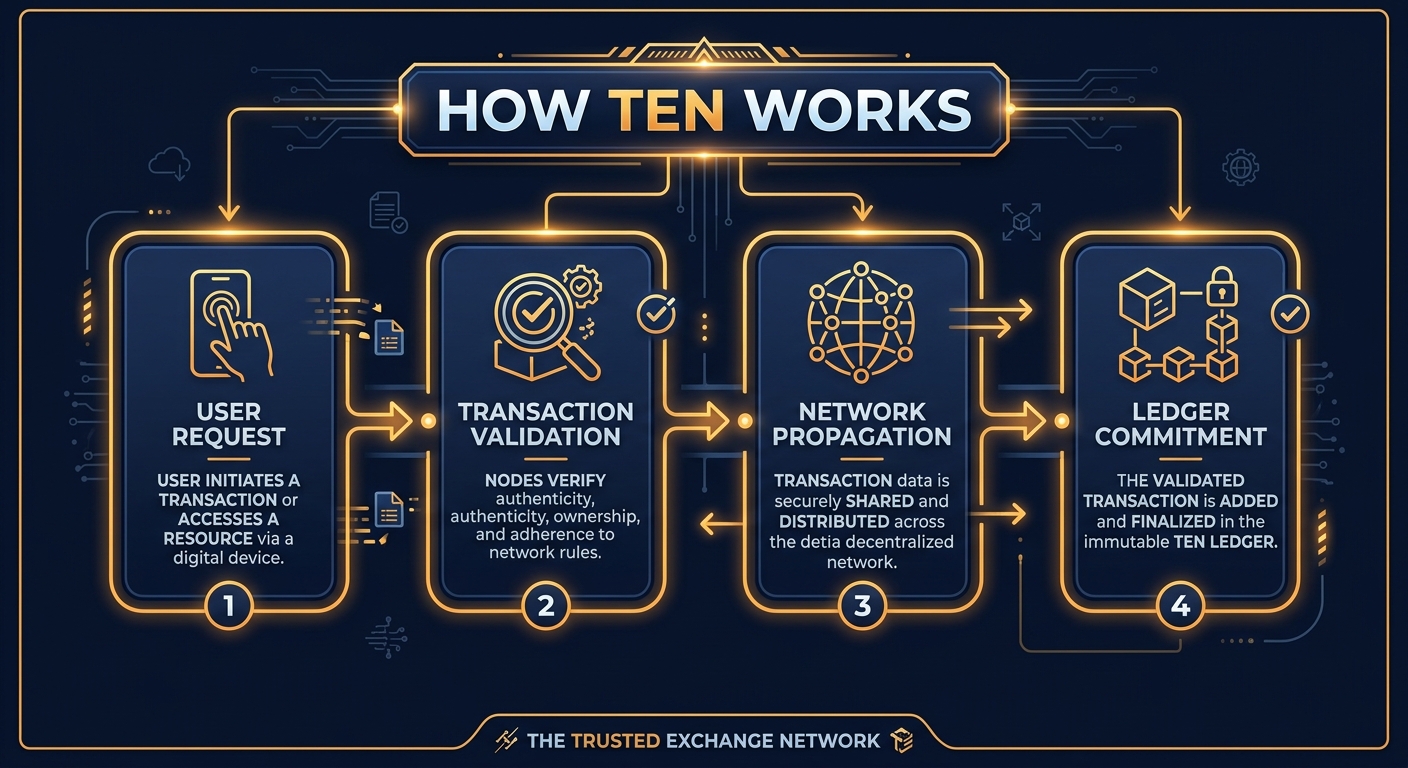
1
Clone the Repository
Clone the TEN framework from GitHub (github.com/TEN-framework/ten-framework) and follow the setup guide.
2
Choose Extensions
Select pre-built extensions for your use case — LLM provider, speech-to-text, text-to-speech, and any additional capabilities.
3
Design Your Agent
Use the Graph Designer to visually connect extensions and configure data flow between components.
4
Test Locally
Run your agent locally with the built-in development server. Test voice interactions, video processing, and multimodal capabilities.
5
Deploy to Production
Deploy your agent to cloud infrastructure, use Agora's real-time network for voice/video, or run on edge devices.
TEN Pricing
Open-source (free) | Cloud hosting via Agora
Pros and Cons
✓ Pros
- ✓Fully open-source — no licensing costs for the core framework
- ✓True real-time multimodal support (voice + video + text + images)
- ✓Visual Graph Designer makes complex agent design accessible
- ✓Multi-language extension support (Go, C++, Python) for flexible development
- ✓Pre-built agent templates accelerate development significantly
- ✓Backed by Agora with enterprise-grade real-time communication infrastructure
✗ Cons
- ✗Steep learning curve for developers without real-time systems experience
- ✗Self-hosting requires significant infrastructure for production workloads
- ✗Still maturing — documentation can be sparse in some areas
- ✗Node.js extension support not yet available
- ✗Cloud deployment costs can scale with heavy real-time usage
TEN Alternatives
LiveKit Agents
Similar real-time AI agent framework with strong WebRTC foundation
Retell AI
Managed voice AI platform — easier to deploy but less customizable
VAPI
Voice AI API with simpler integration but less multimodal capability
Pipecat
Open-source voice AI framework with simpler architecture but fewer features
Our Verdict
4.4/5
TEN is the most ambitious open-source framework for real-time conversational AI. The ability to build agents that simultaneously process voice, video, text, and images with ultra-low latency is genuinely cutting-edge. The visual Graph Designer democratizes what would otherwise require deep real-time systems expertise. The plug-and-play extension model means you can swap LLM providers, TTS engines, and other components without rewriting your agent. Being open-source and backed by Agora gives it both flexibility and enterprise credibility. The main challenge is complexity — this is a developer framework, not a no-code tool, and production deployment requires real infrastructure. For developers building real-time AI applications, TEN is the most capable open-source option available. Rating: 4.4/5
Try TEN Today →
Visit the official TEN website to get started
Frequently Asked Questions
Is TEN free to use?
Yes, TEN is fully open-source under the Apache 2.0 license. The framework is free to use, modify, and deploy. Cloud hosting through Agora is pay-as-you-go.
What can I build with TEN?
TEN supports voice chatbots, AI meeting assistants, language tutors, simultaneous translators, virtual companions, counseling agents, and any application requiring real-time multimodal AI.
What programming languages does TEN support?
TEN supports Golang, C++, and Python for building extensions. Node.js support is coming soon. The Graph Designer provides a visual interface for non-coding workflows.
How does TEN achieve real-time performance?
TEN is built from the ground up for low-latency processing. It uses optimized data pipelines, built-in Voice Activity Detection, and turn detection to maintain natural conversational flow.
What LLM providers work with TEN?
TEN integrates with OpenAI (GPT-4, Realtime API), Google (Gemini), DeepSeek, Llama, and any LLM that exposes a compatible API through its extension system.
Who is behind TEN?
TEN is supported by Agora, a publicly-traded real-time communication company, and maintained by an active open-source community.
Can I deploy TEN on edge devices?
Yes, TEN supports edge deployment for low-latency applications where cloud round-trips are unacceptable. You can also use hybrid architectures combining edge and cloud.
How does TEN compare to LiveKit Agents?
Both are excellent for real-time AI agents. TEN offers broader multimodal support and a visual designer. LiveKit has stronger WebRTC infrastructure and simpler initial setup. Choose TEN for complex multimodal agents; LiveKit for voice-first applications.
Last updated: March 21, 2026 | Review by PopularAiTools.ai
Get Premium AI Tool Insights
Subscribe to get weekly curated AI tool recommendations, exclusive deals, and early access to new tool reviews.
Related Tools
Google Gemini 3.1 Flash Live
ai-chatbots
Google Gemini 3.1 Flash Live is a fast, affordable multimodal AI model with real-time streaming. Handles text, images, audio, video, and code at a fraction of the cost of GPT-5.
P
Pulse Ai
ai-chatbots
Pulse AI is an always-on AI business intelligence analyst that builds dashboards, answers plain-language queries, detects trends and anomalies, and turns data into actionable insights.
Paperclip
ai-chatbots
Paperclip: A self-hosted platform that orchestrates autonomous AI-driven companies by hiring, organizing, and coordinating LLM- or agent-based workers.
flompt
ai-chatbots
Related Articles
10 Claude Code Skills, Plugins & CLIs to Install on Day One (April 2026)
Starting Claude Code from scratch in 2026? Install these 10 skills, plugins, and CLIs on day one — Codex CLI, Obsidian, Autoresearch, Firecrawl, Playwright, NotebookLM, Skill Creator, RAG-Anything, Google Workspace CLI, and awesome-design-md. Full install commands included.
We Tested 24 AI Models Inside Claude Code: The 2026 Tier List
We swapped 24 different AI models into Claude Code and ran identical tool-call tests on each. Here's the S-tier-to-D-tier ranking, real cost comparison, and the single best Claude Sonnet 4.6 alternative for 2026 — including the GLM 4.6 sleeper pick that matched Sonnet at 15% the cost.
Claude as a Creative Studio: Make Ads, Images, and Video From One Chat (2026)
Claude doesn't generate raster images natively, but in 2026 it's the smartest creative director on Earth — orchestrating Nano Banana 2, Sora 2, Runway, Higgsfield, Remotion, and VEED into a single ad-and-video factory. The full stack, the variant matrix trick, and how to build a YouTube Shorts factory.