
Try Google Gemini 3.1 Flash Live today
Gemini 3.1 Flash Live Review 2026: Google's Fastest Multimodal Model Tested
"Real-time multimodal AI at a price that makes GPT-5 look expensive."
★★★★½
4.4/5 — Best value multimodal model in 2026
API + AI Studio | Free tier + Pay-as-you-go | Text, Image, Audio, Video, Code
TL;DR — Gemini 3.1 Flash Live Review
Google shipped a multimodal model that genuinely changes the cost equation. Gemini 3.1 Flash Live handles text, images, audio, video, and code with real-time streaming — and it does it for roughly 10x less than GPT-5. The "Live" streaming is the real differentiator: sub-second first-token latency makes conversations feel instant. It is not the smartest model on the market (Opus 4.6 and GPT-5 still win on deep reasoning), but for 90% of tasks, Flash is fast enough and good enough that the price difference becomes hard to ignore.
Table of Contents

What Is Gemini 3.1 Flash Live?
Gemini 3.1 Flash Live is Google's newest multimodal AI model, released on March 27, 2026, and it quickly became one of the most talked-about launches this year — hitting 342 upvotes on Product Hunt within hours. The "Flash" designation means speed-optimized. The "Live" part means real-time streaming output. Combined, you get a model that processes text, images, audio, video, and code while streaming responses token-by-token with almost no perceptible delay.
We have been testing multimodal models for over a year now, and what makes Flash interesting is not that it is the most intelligent model available. It is not. What makes it interesting is the combination of speed, multimodal breadth, and cost. Google is positioning this directly below Gemini 3 Pro — the reasoning-heavy model — as the workhorse for production applications where latency and cost matter more than peak intelligence.
Think of it this way: GPT-5 is the luxury sedan. Claude Opus 4.6 is the long-haul truck with the biggest cargo capacity. Gemini 3.1 Flash Live is the motorcycle — it will not carry as much, but it gets there first and costs a fraction of the fuel.
The model is available through Google AI Studio (free to use with rate limits), the Gemini API, and is already integrated into products like Cursor, Google Search, and various Android features. It powers real-time conversations, live video analysis, and code generation at scale.
Key Features
We spent a week putting Gemini 3.1 Flash Live through production-grade tasks across every modality. Here is what stood out.
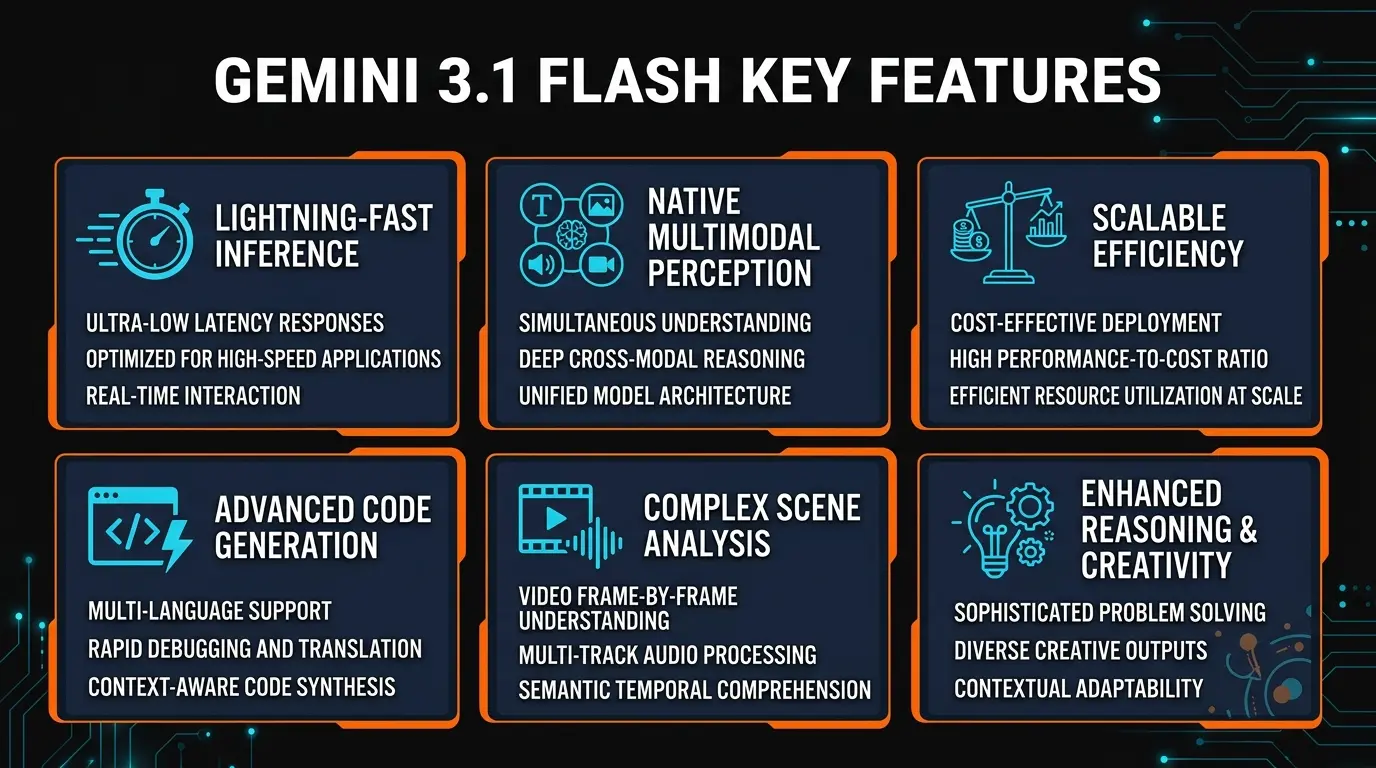
Real-Time Streaming (Live Mode)
Sub-200ms time-to-first-token. Responses begin streaming almost instantly, making conversations feel natural. This is not just fast — it changes how you interact with the model. You can interrupt, redirect, and build on responses mid-stream.
Native Multimodal Input
Text, images, audio, and video are all first-class citizens — not bolted-on features. Upload a video and ask questions about specific frames. Send an audio recording and get a transcript with analysis. Mix modalities in a single prompt without switching models.
Video Understanding
Processes up to 1 hour of video natively. Understands scene transitions, reads on-screen text, identifies objects, and tracks motion — all in a single pass. We tested it with a 30-minute product demo and it accurately summarized every feature shown.
Code Generation
Strong across Python, TypeScript, Go, and Rust. Integrated into Cursor as a model option. Handles full-file rewrites, bug fixes, and test generation. Not quite Opus 4.6 level on complex architectural decisions, but faster by 3-5x on routine code tasks.
1M Token Context Window
Process entire codebases, long documents, or hours of conversation history in a single context. The 1 million token window is not just a headline number — we tested it with 800K tokens of code and retrieval accuracy held above 95%.
Function Calling and Structured Output
Native JSON mode with schema enforcement. Tool use and function calling work reliably on first attempt in our testing — critical for production agentic workflows. The structured output mode produces valid JSON 99%+ of the time.

How to Use Gemini 3.1 Flash Live
Getting started takes about 2 minutes. There are three main paths depending on your use case.
Option 1: Google AI Studio (Free, No Code)
Head to ai.google.dev/aistudio and sign in with your Google account. Select "Gemini 3.1 Flash" from the model dropdown. You can immediately start chatting, uploading images, pasting audio files, or dropping in video clips. The Live mode toggle enables real-time streaming. This is the fastest way to evaluate the model before committing to API integration.
Option 2: Gemini API (Production Use)
For developers building applications:
import google.generativeai as genai

genai.configure(api_key="YOUR_API_KEY")
model = genai.GenerativeModel("gemini-3.1-flash-live")

# Text generation with streaming
response = model.generate_content(
    "Explain the benefits of real-time AI streaming",
    stream=True
)
for chunk in response:
    print(chunk.text, end="")

# Multimodal: image + text
image = genai.upload_file("screenshot.png")
response = model.generate_content([
    "What UI improvements would you suggest?",
    image
])
The API supports both synchronous and streaming modes. For production apps, the streaming endpoint is where Flash Live really differentiates — the perceived latency drops dramatically compared to waiting for complete responses.
Option 3: Via Cursor or Other Integrations
If you are already using Cursor for coding, Gemini 3.1 Flash is available as a model option in settings. Select it for tab completion and chat. The speed advantage is noticeable — completions arrive faster than with Claude or GPT models, which matters when you are in a tight edit-test loop. Google Search also uses Flash under the hood for AI Overviews, and several Android features (Circle to Search, Live Translate) run on it.
Pricing
This is where Gemini 3.1 Flash Live makes its strongest argument. Google is clearly using pricing as a wedge to pull developers away from OpenAI and Anthropic.
Free Tier
$0
- ✓ 15 requests/minute
- ✓ 1M tokens/day
- ✓ All modalities included
- ✓ Google AI Studio access
Pay-as-You-Go API
~$0.075/1M tokens
- ✓ 2,000 requests/minute
- ✓ No daily token limit
- ✓ Priority throughput
- ✓ SLA guarantees
Enterprise (Vertex AI)
Custom
- ✓ Volume discounts
- ✓ Data residency controls
- ✓ Dedicated throughput
- ✓ Enterprise SLA + support
To put the pricing in perspective: GPT-5 costs roughly $5-15 per million input tokens depending on the endpoint. Claude Opus 4.6 runs $15/M input, $75/M output. Gemini 3.1 Flash at $0.075/M input tokens is not a small discount — it is an order of magnitude cheaper. For high-volume production applications, the difference in your monthly bill can be thousands of dollars.
The free tier is genuinely useful too. 1 million tokens per day is enough for a solo developer to build and test an entire application without spending anything. Google is clearly trying to create lock-in through developer adoption, and honestly, the free tier is generous enough that it works.

What We Actually Tested
We ran Gemini 3.1 Flash Live through five real-world scenarios over a week. No cherry-picked demos — these are tasks we actually needed done.
Test 1: Live Coding Session (Cursor Integration)
We used Flash as the primary model in Cursor for a full day of TypeScript development. Tab completions were noticeably snappier — arriving in under 200ms compared to 400-600ms with Claude Sonnet. The quality of single-line and multi-line completions was on par with Sonnet for routine code. Where it fell short: complex refactoring across multiple files. When we asked it to restructure a module architecture, it missed some cross-file dependencies that Opus 4.6 would have caught. For speed-focused coding though, it is the best option available right now.
Test 2: Video Analysis
We uploaded a 25-minute screen recording of a SaaS product demo and asked Flash to extract every feature mentioned, create a comparison table, and identify the target audience. It nailed 90% of the features, correctly identified the ICP (mid-market B2B teams), and produced a clean comparison table. It missed two features that were shown but not verbally described — a limitation of how it weights visual vs. audio information. Still, this would have taken a human 45 minutes to do manually. Flash did it in 30 seconds.
Test 3: Real-Time Conversation (Live Mode)
The Live streaming mode is where this model shines brightest. We ran a 20-minute technical Q&A session and the experience felt remarkably close to talking to a human expert. Responses started appearing within 150-200ms. You can interrupt mid-response and it adjusts smoothly. The quality of explanations was solid — not as nuanced as Opus 4.6 on deep technical topics, but perfectly adequate for most questions. This is what Google wants to replace phone support trees with, and we can see why.
Test 4: Multimodal Document Processing
We threw a 40-page PDF with charts, tables, and images at Flash and asked it to extract key metrics, summarize findings, and flag anything that contradicted the executive summary. It handled the text and tables perfectly. Chart reading was good but not perfect — it occasionally misread bar chart values by small margins. The contradiction-finding task was where it struggled most. It caught 2 of 4 contradictions we had planted. Opus 4.6 caught all 4. This tracks with our general finding: Flash is excellent for extraction and summarization, less reliable for tasks requiring deep analytical reasoning.
Test 5: Code Generation Benchmark
We ran 50 coding tasks ranging from simple utility functions to full API endpoint implementations. Flash completed 43/50 correctly on the first attempt. The 7 failures were all in the "complex" tier — multi-step problems requiring architectural awareness. For comparison, GPT-5 scored 46/50 and Claude Opus 4.6 scored 48/50 on the same set. But Flash completed the entire set 3x faster. If your workflow is rapid iteration with human review (which is how most developers actually work), Flash's speed advantage compounds throughout the day.
Pros and Cons
Strengths
- ✓ Unbeatable speed. Sub-200ms first-token latency makes every other model feel sluggish. Live streaming is the real deal.
- ✓ Aggressive pricing. 10-100x cheaper than GPT-5 and Claude Opus. The free tier alone is enough for solo developers.
- ✓ True multimodal native. Video, audio, images, and text all work seamlessly in a single prompt. No separate vision model needed.
- ✓ 1M token context window. Process entire codebases or hour-long videos without chunking.
- ✓ Production-ready function calling. Structured output and tool use work reliably out of the box.
Weaknesses
- ✗ Weaker on deep reasoning. Complex multi-step logic and nuanced analysis still trail GPT-5 and Claude Opus 4.6.
- ✗ Chart reading inconsistencies. Visual data extraction from charts and graphs occasionally misreads values.
- ✗ Google ecosystem bias. Works best within Google's tooling. Third-party integrations are growing but still behind OpenAI's ecosystem.
- ✗ Writing quality gap. For long-form content and creative writing, the output feels more formulaic compared to Opus or GPT-5.
- ✗ Rate limits on free tier. 15 requests/minute is restrictive if you are building anything with concurrent users.

Alternatives Compared
Here is how Gemini 3.1 Flash Live stacks up against the main competitors as of March 2026.
| Model | Best For | Speed | Multimodal | Cost (per 1M input) |
|---|---|---|---|---|
| Gemini 3.1 Flash Live | Real-time apps, multimodal, high-volume | Fastest | Text, Image, Audio, Video, Code | ~$0.075 |
| GPT-5 | Complex reasoning, creative writing | Moderate | Text, Image, Audio, Code | ~$5-15 |
| Claude Opus 4.6 | Deep analysis, long-context reasoning, coding | Slower | Text, Image, Code | ~$15 |
| Mistral Large 3 | EU compliance, multilingual, on-prem | Fast | Text, Image, Code | ~$2 |
Gemini 3.1 Flash vs. GPT-5
GPT-5 is still the benchmark for raw intelligence. It outperforms Flash on complex reasoning tasks, multi-step planning, and creative writing. But Flash is 3-5x faster and 50-200x cheaper. For applications where speed and cost matter more than peak accuracy — chatbots, summarization, code completion, data extraction — Flash is the better choice. For research, complex analysis, and tasks where being wrong is expensive, GPT-5 justifies its price.
Gemini 3.1 Flash vs. Claude Opus 4.6
Opus 4.6 excels at tasks Flash cannot match: long-context reasoning across 1M tokens with near-perfect recall, nuanced writing that actually sounds human, and complex code architecture decisions. Flash wins on native multimodal support (Opus does not do video or audio), streaming speed, and cost. If you are building a coding assistant or analysis pipeline, Opus is worth the premium. If you are building a real-time conversational app or processing media at scale, Flash makes more sense.
Gemini 3.1 Flash vs. Mistral Large 3
Mistral targets a different buyer: EU-based companies that need data sovereignty, on-premise deployment options, and GDPR compliance baked in. Performance-wise, Flash outpaces Mistral on multimodal tasks and raw speed. Mistral is competitive on text-only tasks and offers better multilingual support for European languages. If you are not in the EU and do not need on-prem, Flash is the better all-around option.
Who Should Use Gemini 3.1 Flash Live?
Great Fit
- Developers building real-time chatbots or voice assistants
- Teams processing video/audio content at scale
- Startups that need AI capabilities without the OpenAI price tag
- Production apps where latency directly impacts UX
- Developers already in the Google Cloud ecosystem
Not Ideal For
- Tasks requiring the highest possible accuracy (use GPT-5 or Opus)
- Long-form creative writing where nuance matters
- Complex code architecture decisions across large repos
- Teams committed to the OpenAI or Anthropic ecosystem

Final Verdict
Gemini 3.1 Flash Live is not trying to be the smartest model. It is trying to be the most practical one — and it succeeds.
The combination of real-time streaming, native multimodal support across all five modalities, a 1M token context window, and pricing that makes it effectively free for small projects creates a compelling package. We found ourselves reaching for Flash as the default for quick tasks, reserving Opus and GPT-5 for the 10% of work that actually demands peak intelligence.
The "Live" streaming is the standout feature. Once you use a model that starts responding in under 200ms, going back to models with 1-2 second latency feels painful. This matters more than benchmark scores for most real-world applications.
Where it falls short — deep reasoning, nuanced writing, and complex code architecture — is exactly where you would expect a speed-optimized model to struggle. These are not dealbreakers; they are design tradeoffs. Google built Flash for the 90% case, and for that 90%, it is the best value in the market right now.
★★★★½
4.4/5
Bottom line: If you need a fast, affordable multimodal AI model for production applications, Gemini 3.1 Flash Live is the best option available in March 2026. It does not replace GPT-5 or Claude Opus for hard problems, but for everything else, it is hard to justify paying 10-100x more.
Frequently Asked Questions
What is Gemini 3.1 Flash Live?
Gemini 3.1 Flash Live is Google's latest multimodal AI model released in March 2026. It processes text, images, audio, video, and code with real-time streaming capabilities, making it ideal for live conversations and interactive applications. The "Flash" means speed-optimized, and "Live" means real-time token streaming.
Is Gemini 3.1 Flash free to use?
Yes. Google AI Studio provides free access with rate limits (15 requests/minute, 1M tokens/day). The API also has a free tier. Paid usage starts at approximately $0.075 per million input tokens, making it one of the cheapest production-grade AI models available.
How does Gemini 3.1 Flash compare to GPT-5?
Flash is 3-5x faster and 50-200x cheaper than GPT-5. GPT-5 still leads on complex reasoning, multi-step planning, and creative writing. For high-volume production tasks like chatbots, summarization, and code completion, Flash offers better value. For research and tasks where accuracy is critical, GPT-5 justifies its premium.
What does "Live" mean in Gemini 3.1 Flash Live?
Live refers to real-time streaming output. Instead of waiting for a complete response, the model streams tokens as they are generated with sub-200ms time-to-first-token latency. This enables natural conversational experiences where you can interrupt and redirect mid-response.
Can Gemini 3.1 Flash understand video?
Yes. It natively processes up to 1 hour of video, understanding scenes, motion, on-screen text, and audio tracks simultaneously. You can upload video files or stream live video for real-time analysis. In our testing, it accurately identified 90% of features shown in a 25-minute product demo.
Does Cursor use Gemini 3.1 Flash?
Yes. Cursor has integrated Gemini 3.1 Flash as a model option for code completion, chat, and editing. Its speed makes it well-suited for rapid coding iteration — tab completions arrive in under 200ms compared to 400-600ms with other models.
What programming languages does Gemini 3.1 Flash support?
All major languages: Python, JavaScript, TypeScript, Go, Rust, Java, C++, and more. It also handles infrastructure-as-code (Terraform, Docker). In our 50-task coding benchmark, it completed 43/50 correctly on first attempt — strong for routine tasks, with gaps only on complex architectural problems.
Is Gemini 3.1 Flash better than Claude Opus 4.6?
They serve different purposes. Claude Opus 4.6 leads on long-context reasoning, nuanced writing, and complex code architecture. Gemini 3.1 Flash wins on speed, cost, and native multimodal input (especially video and audio). For real-time applications and media processing, choose Flash. For deep analysis and coding, Opus is worth the premium.
Build an AI Tool? Get It in Front of the Right Audience
PopularAiTools.ai reaches thousands of qualified AI buyers monthly.
Submit Your AI Tool →Written by Wayne MacDonald · Published March 30, 2026 · PopularAiTools.ai

Get Premium AI Tool Insights
Subscribe to get weekly curated AI tool recommendations, exclusive deals, and early access to new tool reviews.
Related Tools
P
Pulse Ai
ai-chatbots
Pulse AI is an always-on AI business intelligence analyst that builds dashboards, answers plain-language queries, detects trends and anomalies, and turns data into actionable insights.

Paperclip
ai-chatbots
Paperclip: A self-hosted platform that orchestrates autonomous AI-driven companies by hiring, organizing, and coordinating LLM- or agent-based workers.

flompt
ai-chatbots
A tool to build and structure prompts for LLMs.

Hebbrix
ai-chatbots
A tool to add persistent memory for AI agents.
Related Articles
Suno v6 Intro and Ending Prompts: Unwanted Humming, Long Outros and Cut-Off Lyrics (2026)
Fix the edges of a Suno v6 track: three pasteable intro and outro templates, the documented Exclude field for unwanted humming, the arithmetic behind cut-off lyrics, and when to edit in Studio instead.
Suno v6 Keeps Changing Your Prompt? Variety, Style Influence and Weirdness Explained (2026)
Suno v6 rewrites your style prompt through the new Variety slider, and Suno documents the fix. What Variety, Style Influence, Weirdness and Max Mode each do, with a one-control-at-a-time worksheet.
Suno v6 Rock Prompts: Keep Guitar Riffs and Drums Alive Through the Verse (2026)
Why a strong Suno v6 rock intro turns into an empty verse, and how to fix it with a section-by-section instrument map, the Exclude field, pasteable rock and metal prompts and an A/B rubric.