
Try WebCrawler API today
WebCrawler API Review 2026: Features, Pricing, Pros & Cons
Updated March 2026 · 14 min read · By PopularAiTools.ai
TL;DR
WebCrawler API is a solid ai web scraping tool that delivers on its core promise. WebCrawler API is a web scraping service that converts website content into structured, AI-ready data formatted for RAG and LLM applications, with built-in proxy rotation, anti-bot handling, and content parsing in Markdown and text formats. The free tier is genuinely useful for getting started and evaluating whether the platform fits your workflow, with paid plans offering expanded capabilities for power users and teams. It excels for developers building AI applications, data engineers, researchers, and businesses needing structured web data for LLM and RAG systems. Rating: 4.1/5
What is WebCrawler API?
WebCrawler API is a web scraping service that converts website content into structured, AI-ready data formatted for RAG and LLM applications, with built-in proxy rotation, anti-bot handling, and content parsing in Markdown and text formats.
WebCrawler API operates in the AI Web Scraping space, which has seen explosive growth throughout 2025 and into 2026 as businesses and creators increasingly rely on AI-powered tools to streamline workflows, reduce operational costs, and gain competitive advantages. The ai web scraping market is becoming increasingly crowded, but WebCrawler API has carved out a distinct position by focusing on the specific needs of developers building AI applications, data engineers, researchers, and businesses needing structured web data for LLM and RAG systems.
What sets WebCrawler API apart from the growing list of competitors is its focused approach to solving specific pain points that users encounter daily. Rather than trying to be everything to everyone, the platform concentrates on doing a few things exceptionally well. The result is a tool that feels purpose-built rather than generic, which translates to faster onboarding, more intuitive workflows, and better outcomes for its target users.
Since its launch, WebCrawler API has attracted a growing user base drawn to its combination of powerful capabilities and accessible pricing. The platform continues to receive regular updates and new features, signaling active development and responsiveness to user feedback. For anyone evaluating tools in the ai web scraping category, WebCrawler API deserves serious consideration.

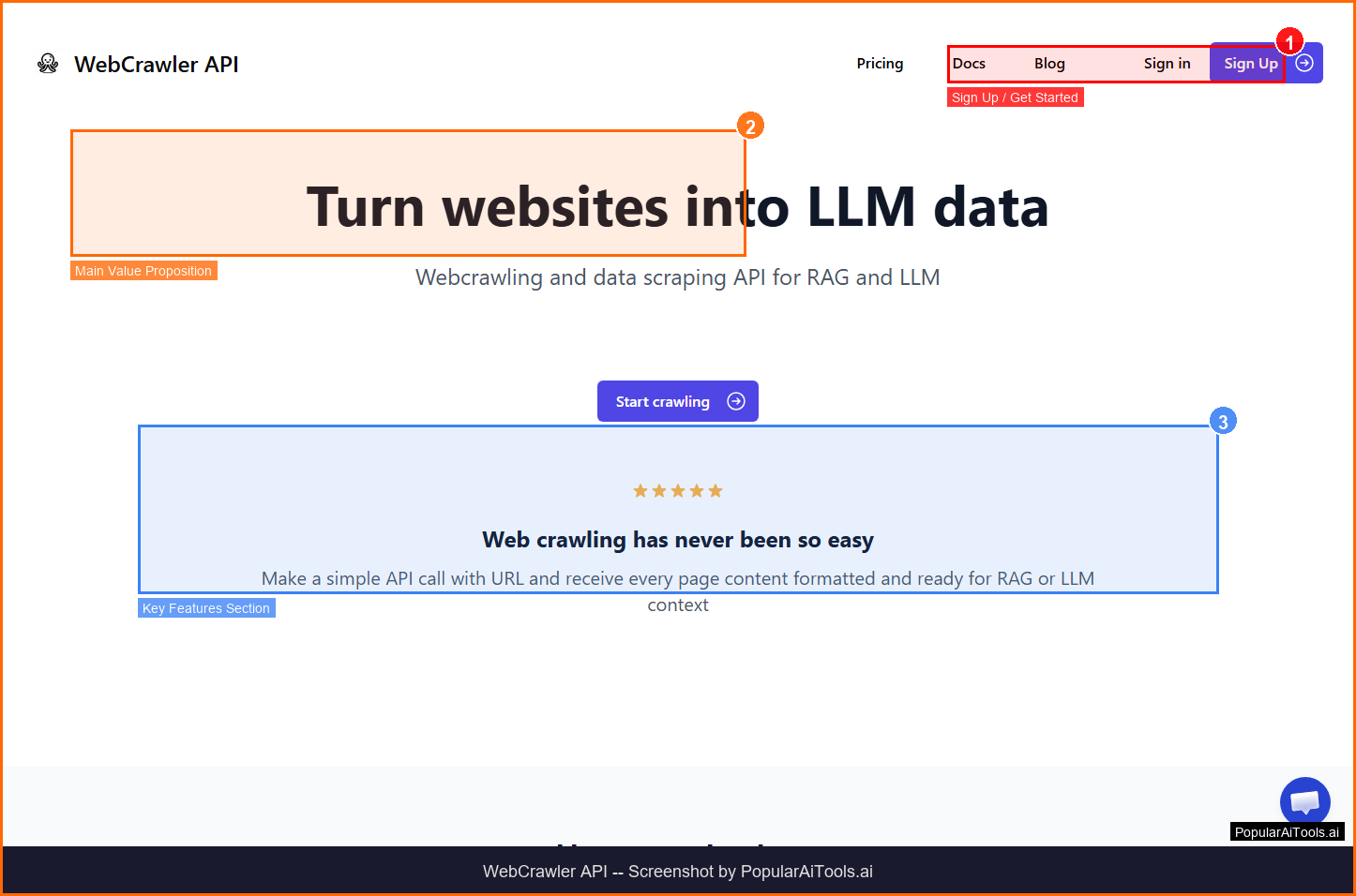
WebCrawler API homepage -- Screenshot by PopularAiTools.ai
Key Features
WebCrawler API packs a comprehensive feature set designed to address the full workflow needs of its users. Here are the standout capabilities that define the platform:
1. AI-Ready Output
Content extracted and formatted specifically for RAG pipelines and LLM consumption in Markdown and text.
2. Main Content Extraction
Intelligent parsing that strips navigation, ads, and boilerplate to deliver only the meaningful content.
3. Anti-Bot Handling
Built-in proxy rotation, CAPTCHA solving, and browser fingerprinting to access protected websites.
4. JavaScript Rendering
Full browser rendering for JavaScript-heavy single-page applications and dynamic content.
5. Parallel Crawling
Process multiple pages simultaneously for fast large-scale data extraction projects.
6. Pay-for-Success Model
Only charged for successfully crawled pages, eliminating waste from failed requests.
7. Clean Data Output
Automatic removal of scripts, styles, tracking code, and noise for pristine content delivery.
8. No-Code Integrations
Connect with Zapier, Make, n8n, and Integrately for automated scraping workflows.
Beyond these headline features, WebCrawler API also provides a clean, modern interface that makes complex capabilities accessible without a steep learning curve. The development team has clearly invested in user experience design, with contextual help, clear navigation, and responsive layouts that work across devices.
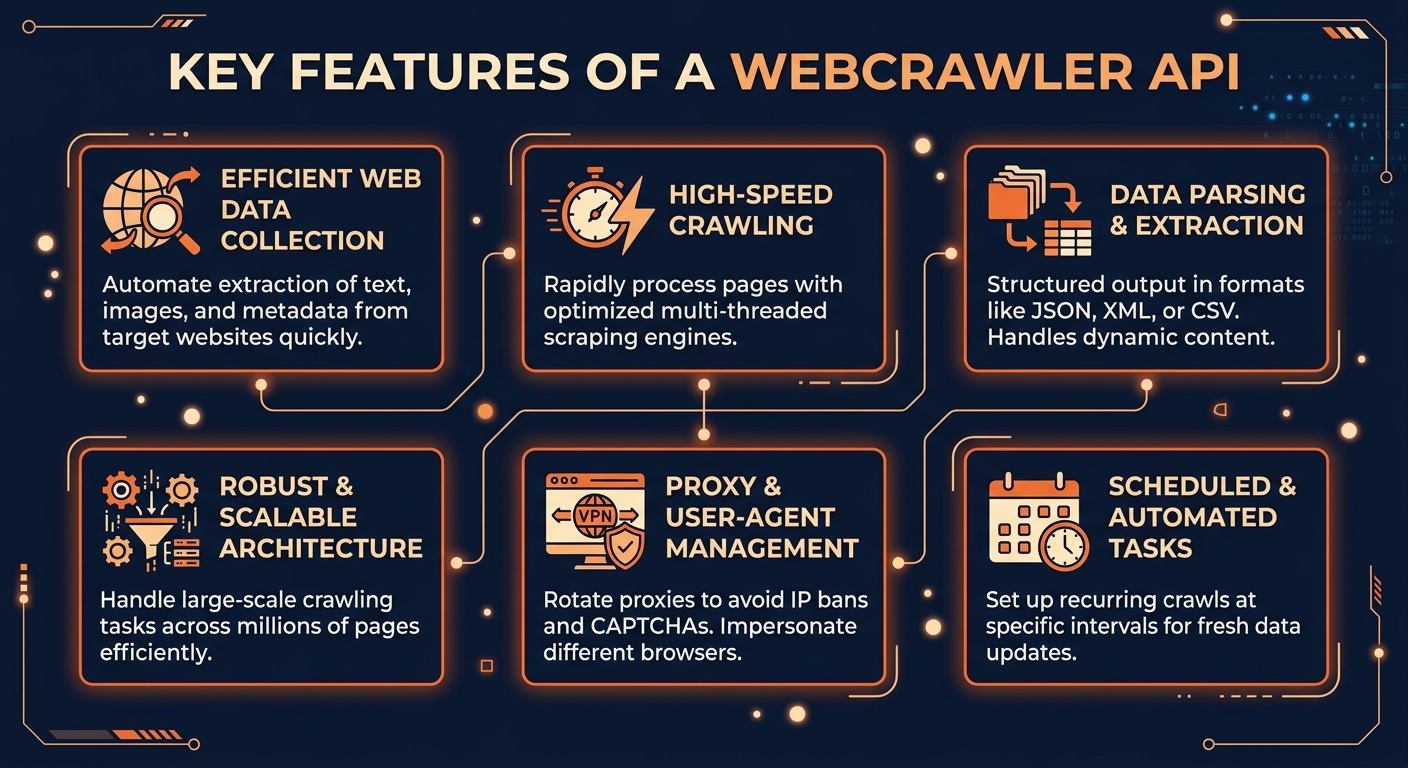
WebCrawler API key features at a glance
How to Use WebCrawler API (Step-by-Step)
Getting started with WebCrawler API is straightforward. Here is a step-by-step walkthrough to help you go from signup to productive use in minutes:
Step 1: Visit the Website
Go to https://webcrawlerapi.com and click the sign-up or get started button.
Step 2: Create Your Account
Register with your email address or sign in with Google/GitHub. Most plans offer a free tier or trial.
Step 3: Explore the Dashboard
Once logged in, familiarize yourself with WebCrawler API's main interface and navigation.
Step 4: Configure Your Settings
Set up your preferences, connect any required integrations, and customize WebCrawler API to your workflow.
Step 5: Start Using Core Features
Begin using WebCrawler API's primary features. Refer to the documentation or in-app tutorials for guidance.
The entire onboarding process typically takes less than 10 minutes, and most users report being productive within their first session. WebCrawler API also provides documentation, tutorials, and in some cases video walkthroughs to help new users get the most out of the platform from day one.
Pricing Plans
WebCrawler API offers a tiered pricing structure designed to accommodate users at different scales, from individuals and small teams to large enterprises. Here is a breakdown of the current plans:

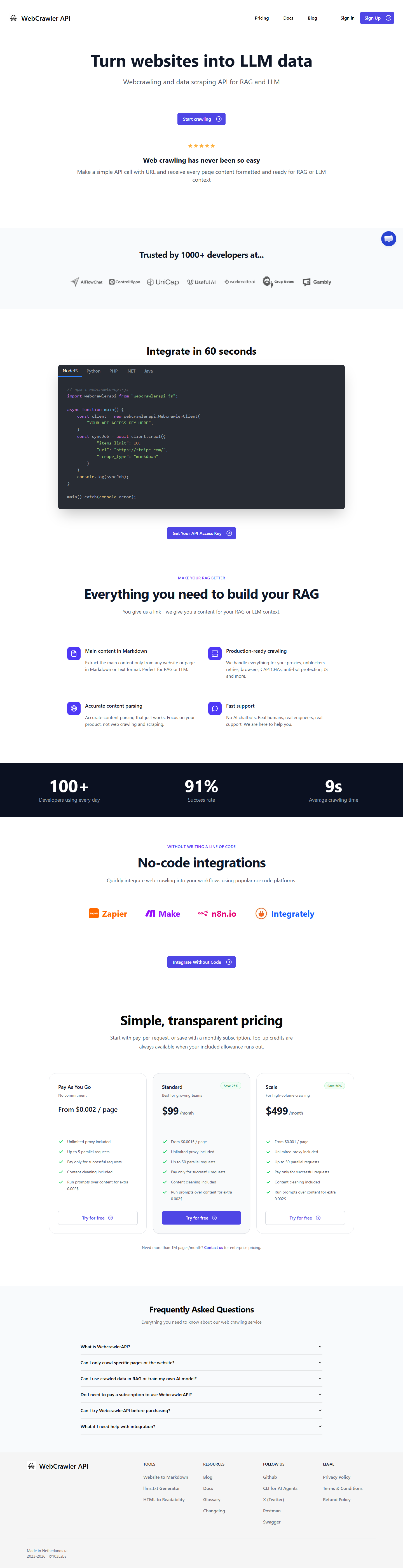
WebCrawler API pricing plans for 2026
Pricing Analysis: The Pay As You Go plan at $0 signup provides From $0.002/page, no commitment, pay only for successful crawls, while the Standard plan at $99/mo unlocks 25% savings, from $0.0015/page, priority support, higher rate limits. For larger organizations, the Scale plan at $499/mo adds 50% savings, from $0.001/page, dedicated proxies, custom configuration. When evaluating the cost, consider that WebCrawler API can replace multiple manual processes or expensive consultant hours, often paying for itself within the first month of use.
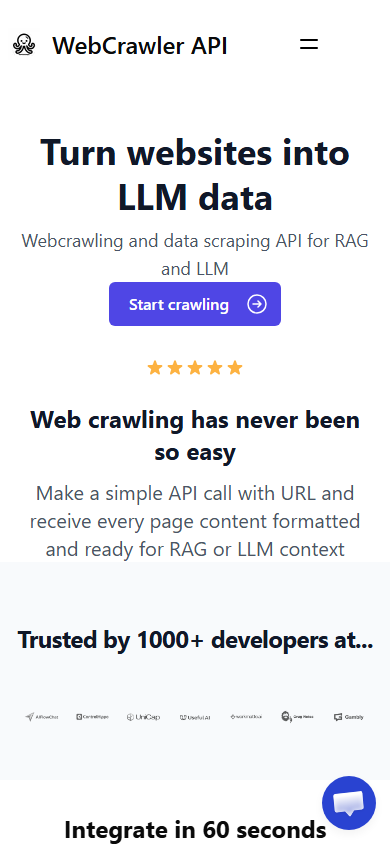
Who Should Use WebCrawler API?
WebCrawler API is best suited for developers building AI applications, data engineers, researchers, and businesses needing structured web data for LLM and RAG systems. Based on our evaluation, here are the specific user profiles that will get the most value from the platform:
- Primary users: Professionals and teams who work in the ai web scraping space daily and need reliable, efficient tooling.
- Growing teams: Organizations scaling their operations who need a platform that grows with them without requiring a complete retooling.
- Budget-conscious buyers: Users who need professional-grade capabilities without enterprise-level pricing or long-term contracts.
- Tech-forward adopters: Early adopters who want to leverage AI-powered automation to gain a competitive edge in their market.
Conversely, WebCrawler API may not be the best fit for users who need deeply customized enterprise solutions, those with very specific niche requirements outside the platform's core focus, or teams with existing tool stacks that already cover the same functionality.
Pros and Cons
After thorough testing and evaluation, here is our honest assessment of WebCrawler API's strengths and weaknesses:
Pros
- ✓ AI-optimized output perfect for RAG and LLM applications
- ✓ Pay-only-for-success model eliminates waste
- ✓ 91% success rate with advanced anti-bot handling
- ✓ Clean content extraction removes noise automatically
- ✓ Competitive pricing starting at $0.001/page on higher tiers
- ✓ No-code integrations with Zapier, Make, and n8n
Cons
- ✗ Some highly protected sites may still block crawling
- ✗ JavaScript rendering adds processing time
- ✗ No built-in data storage or scheduling on basic plans
- ✗ Limited to web content extraction, no API scraping
- ✗ Smaller platform compared to established scraping services

WebCrawler API vs. alternatives at a glance
Best WebCrawler API Alternatives
While WebCrawler API is a strong option, it is worth comparing it against other tools in the market to ensure you choose the best fit for your specific needs. Here are the top alternatives we recommend considering:
Each of these alternatives has its own strengths. We recommend trying the free tiers or trials of your top two or three choices before committing to a paid plan. The best tool is ultimately the one that fits your specific workflow, budget, and technical requirements.
Final Verdict
WebCrawler API delivers a strong, focused offering in the ai web scraping space that is well worth considering for anyone in its target audience. WebCrawler API is a web scraping service that converts website content into structured, AI-ready data formatted for RAG and LLM applications, with built-in proxy rotation, anti-bot handling, and content parsing in Markdown and text formats. For developers building AI applications, data engineers, researchers, and businesses needing structured web data for LLM and RAG systems, it provides genuine value that justifies the investment of both time and money.
The platform is well-designed with a clear product vision, the feature set is comprehensive enough for most use cases, and the pricing is competitive for what you get. The development team appears responsive to user feedback, and the product continues to improve with regular updates. While not without its limitations, WebCrawler API earns its place as a solid option in an increasingly crowded market and is one we can recommend for users who fit the target profile.
Our Rating: 4.1/5
Have You Tried WebCrawler API?
Share your experience with the PopularAiTools.ai community. Your review helps other users make informed decisions about which AI tools are worth their time and money.
Submit Your Review
Frequently Asked Questions
How does WebCrawler API pricing work?
WebCrawler API uses a pay-per-successful-page model starting at $0.002/page. You are only charged when a page is successfully crawled and delivered, not for failed attempts.
What format does the extracted data come in?
Data is delivered in Markdown and plain text formats optimized for RAG pipelines and LLM consumption, with automatic cleaning and main content extraction.
Can WebCrawler API handle JavaScript-rendered pages?
Yes, the service includes full browser rendering that handles JavaScript-heavy SPAs, dynamic content loading, and interactive elements.
What is the success rate?
WebCrawler API achieves a 91% average success rate across diverse websites, with dedicated proxy pools and anti-bot measures to maximize successful crawls.
Can I use WebCrawler API with no-code tools?
Yes, WebCrawler API integrates with Zapier, Make, n8n, and Integrately for automated web scraping workflows without writing code.
Is WebCrawler API suitable for large-scale crawling?
Yes, Scale and Enterprise plans support parallel crawling with dedicated proxies for processing hundreds of thousands of pages per month.
How fast is the crawling?
Average crawling time is 9 seconds per page including JavaScript rendering. Simple HTML pages are typically faster at 2-3 seconds.
Does WebCrawler API respect robots.txt?
WebCrawler API provides the option to respect or bypass robots.txt directives. Users are responsible for ensuring their use complies with applicable terms of service.
Get Premium AI Tool Insights
Subscribe to get weekly curated AI tool recommendations, exclusive deals, and early access to new tool reviews.
Related Tools
V
VideoProc Converter AI
ai-coding

Relia
ai-coding
AI-powered Chrome extension that audits code flow, catches hallucinations in AI-generated code, and flags security vulnerabilities before they ship.

Git AutoReview
ai-coding
Updated March 2026 · 12 min read · By PopularAiTools.ai

Parallel Code
ai-coding
Free open-source desktop app that dispatches 10+ AI coding agents simultaneously across isolated git branches. Supports Claude Code, Codex CLI, and Gemini CLI. Keyboard-first Electron app with diff review workflow and QR code mobile monitoring. macOS + Linux. MIT license.
Related Articles
Suno v6 Intro and Ending Prompts: Unwanted Humming, Long Outros and Cut-Off Lyrics (2026)
Fix the edges of a Suno v6 track: three pasteable intro and outro templates, the documented Exclude field for unwanted humming, the arithmetic behind cut-off lyrics, and when to edit in Studio instead.
Suno v6 Keeps Changing Your Prompt? Variety, Style Influence and Weirdness Explained (2026)
Suno v6 rewrites your style prompt through the new Variety slider, and Suno documents the fix. What Variety, Style Influence, Weirdness and Max Mode each do, with a one-control-at-a-time worksheet.
Suno v6 Rock Prompts: Keep Guitar Riffs and Drums Alive Through the Verse (2026)
Why a strong Suno v6 rock intro turns into an empty verse, and how to fix it with a section-by-section instrument map, the Exclude field, pasteable rock and metal prompts and an A/B rubric.