Voxtral TTS Review 2026: Mistral AI Open-Source Text-to-Speech

AI Creative Tools Specialist

TL;DR — Voxtral TTS Review
Voxtral TTS is Mistral AI's open-source multilingual text-to-speech model that generates realistic, expressive speech you can self-host and use commercially for free. It is the first credible open-weight challenger to ElevenLabs and Play.ht — delivering surprisingly natural output across multiple languages without per-character API costs. The tradeoff: you need GPU hardware, technical setup skills, and tolerance for a model that is not yet at parity with the best commercial offerings on emotional nuance and voice variety. For developers and companies building TTS into products, Voxtral changes the economics of speech synthesis entirely.
Table of Contents
What is Voxtral TTS?
Voxtral TTS is Mistral AI's open-source text-to-speech model that converts written text into realistic, expressive spoken audio across multiple languages. Unlike commercial TTS services that charge per character or per minute of generated speech, Voxtral is released as open weights — meaning you can download it, run it on your own hardware, and use it in commercial products without paying Mistral a dime.
The model launched in late March 2026 and immediately earned 164 upvotes on Product Hunt. That traction is not surprising. The TTS market has been dominated by closed, expensive APIs from companies like ElevenLabs and LOVO, and developers have been waiting for a capable open-source alternative. Voxtral is the first model from a major AI lab that credibly competes with commercial offerings while being completely free to deploy.
Voxtral fits into Mistral AI's broader open-model ecosystem alongside Mistral Large (their flagship large language model), Codestral (code generation), and Pixtral (vision). Adding speech synthesis to this lineup means developers already using Mistral for text and code can now add natural-sounding TTS without stitching in a separate vendor. That ecosystem coherence is a genuine strategic advantage.
We have been running Voxtral TTS for the past week across English, French, Spanish, and German text samples — testing narration quality, multilingual pronunciation, latency, and how it stacks up against the commercial tools we use daily. The results are genuinely impressive for an open model, with meaningful caveats that matter depending on your use case.
Key Features
Here is what Voxtral TTS brings to the table and why it matters in the 2026 TTS landscape:
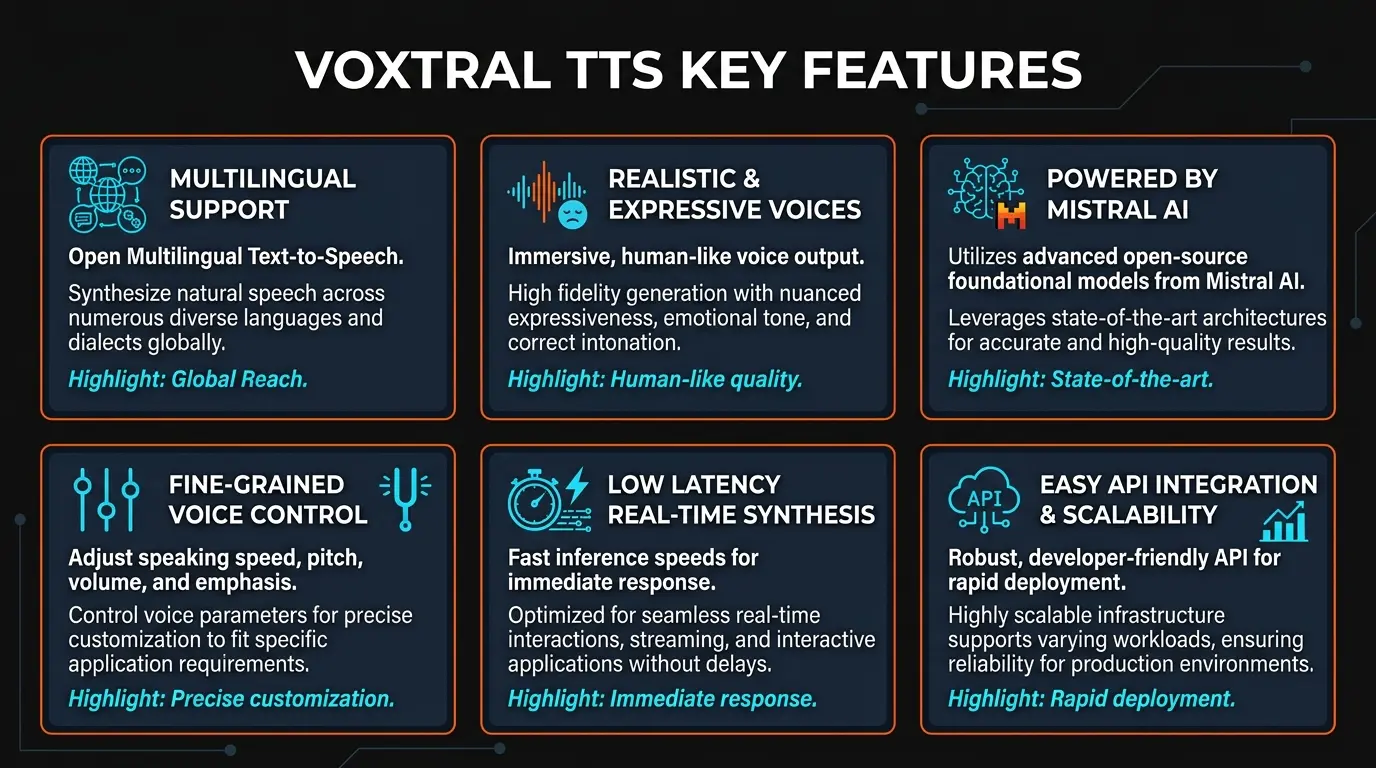
Open-Source and Self-Hostable
Full model weights available under a permissive license. Deploy on your own GPU infrastructure, cloud instances, or edge devices. No vendor lock-in, no API rate limits, no per-character charges. You own the entire inference pipeline.
Multilingual Speech Synthesis
Native support for English, French, Spanish, German, Italian, and other major European languages. French quality is particularly strong — unsurprising given Mistral's Paris roots. Pronunciation handling across languages is natural, not transliterated.
Expressive and Realistic Output
Generates speech with natural pacing, intonation, and prosody. Handles punctuation cues — question marks trigger rising intonation, exclamation marks add emphasis, ellipses create natural pauses. The output sounds like reading, not robotic dictation.
Voice Conditioning via Reference Audio
Provide a short reference audio clip to guide the model toward a target speaking style, pitch, and pace. Not full voice cloning like ElevenLabs, but effective for consistent output across long-form content generation.
Part of the Mistral Ecosystem
Integrates naturally with Mistral Large, Codestral, and Pixtral. Build multimodal applications using a single vendor's model family — text understanding, code generation, image analysis, and now speech — all with open weights.
API Access via La Plateforme
For developers who prefer not to self-host, Mistral offers Voxtral TTS through their La Plateforme API. Standard API interface with usage-based pricing, though the open-source option means you always have a zero-cost fallback.
How Voxtral TTS Works
Getting started with Voxtral TTS depends on whether you want to self-host or use the API. Here is the workflow for both paths:
Self-Hosted Deployment
Pull the Voxtral TTS weights from Hugging Face or Mistral's model hub. The download is several gigabytes depending on the model variant. You will need a machine with a compatible NVIDIA GPU (16GB+ VRAM recommended for real-time inference).
Install dependencies (Python, PyTorch, CUDA drivers). Mistral provides reference inference code and a Docker container for straightforward deployment. Most developers can have it running within 30 minutes if their hardware is ready.
Pass text input (with optional language tag and reference audio) to the model. Voxtral returns audio output as a WAV file. Inference speed depends on hardware — an RTX 4090 generates roughly 2-3x real-time (a 10-second clip takes 3-5 seconds to generate).
Wrap the inference code in an API endpoint, add it to your pipeline, or build a UI on top. Since you control the entire stack, you can optimize for latency, batch processing, or streaming output depending on your needs.
API Access (La Plateforme)
For developers who prefer a managed service, Mistral's La Plateforme offers Voxtral TTS through a standard REST API. Sign up, get an API key, send text with language and voice parameters, and receive audio back. No GPU provisioning required. Usage-based pricing applies, but rates are competitive with commercial alternatives — and you always have the self-hosted option as a zero-cost fallback.
Key technical note: Voxtral TTS is a model, not a product. There is no web UI where you type text and press "generate" like you get with ElevenLabs or LOVO. This is a deliberate design choice — Mistral builds models for developers to integrate, not consumer-facing products. If you want a polished hosted experience with a voice library and preset voices, the commercial tools are still the way to go. If you want to build TTS into your own product without ongoing API costs, Voxtral is the breakthrough you have been waiting for.
Pricing and Access
Voxtral TTS has the simplest pricing model in the TTS space: it is free. Here is how the economics break down compared to the competition:
Self-Hosted
- ✓ Open-source weights
- ✓ Commercial use allowed
- ✓ Unlimited generation
- ✓ Full model control
- Requires GPU hardware
La Plateforme API
- ✓ No GPU required
- ✓ Managed infrastructure
- ✓ Standard REST API
- ✓ Competitive rates
- Usage-based billing
vs ElevenLabs
- ✓ Polished web UI
- ✓ Voice cloning
- ✓ 200+ voice library
- ✓ Best-in-class quality
- Per-character limits
vs LOVO
- ✓ 500+ voices
- ✓ 100+ languages
- ✓ Video editor built in
- ✓ AI script writer
- Per-minute limits
The real cost calculation: Self-hosting Voxtral TTS on a cloud GPU instance (like RunPod or AWS g5.xlarge) costs roughly $0.50-$1.50 per hour. If you are generating speech for a few hours per month, that is $5-$20 in compute costs — comparable to ElevenLabs' Starter plan but without character limits. If you are generating at scale (thousands of minutes per month), the cost advantage becomes enormous. A company generating 10,000 minutes of speech monthly would pay $330+ on ElevenLabs' Business plan but under $100 in self-hosted GPU costs.
For a comprehensive look at how Voxtral stacks up against every major voice tool, see our Best Free AI Voice Generators 2026 guide.
Pros and Cons
Strengths
- ✓ Completely free and open-source. No API costs, no character limits, no vendor lock-in. Download the weights, run it forever on your own hardware. This is the single biggest differentiator in the entire TTS market.
- ✓ Genuinely natural-sounding output. For an open model, the speech quality is remarkably close to commercial offerings. English and French output in particular has natural pacing, appropriate emphasis, and convincing intonation that does not sound machine-generated.
- ✓ Strong multilingual support. Native handling of multiple European languages without the accent bleed or mispronunciation issues that plague many TTS models. Each language sounds like it was trained natively, not adapted from English.
- ✓ Full privacy and data control. Self-hosting means your text never leaves your infrastructure. Critical for healthcare, legal, financial, and enterprise applications where sending text to third-party APIs creates compliance risk.
- ✓ Ecosystem coherence with Mistral models. If you already use Mistral Large or Codestral, adding Voxtral TTS creates a unified multimodal stack. Text generation, code, and speech from one model family with consistent APIs and deployment patterns.
- ✓ Commercial use allowed. Build products, ship features, and serve customers — all without licensing fees. This is the model that makes "TTS as a product feature" financially viable for startups and indie developers.
Weaknesses
- ✗ No hosted UI or consumer product. Voxtral is a model, not an app. There is no web interface where you type text and click generate. You need to set up inference infrastructure or use the API. Non-technical users will find this inaccessible.
- ✗ GPU hardware required for self-hosting. Real-time inference needs 16GB+ VRAM. That means an RTX 4090, A100, or cloud GPU instance. CPU inference works but is too slow for production use. This is a meaningful barrier for smaller teams.
- ✗ Voice variety is limited. ElevenLabs offers 200+ preset voices and instant cloning. LOVO has 500+ voices across 100+ languages. Voxtral has a smaller set of voices with voice conditioning rather than true cloning. For projects requiring diverse voice options, the commercial tools are still ahead.
- ✗ Emotional range trails ElevenLabs. Voxtral handles neutral narration and conversational speech well, but it falls short on highly emotional content — excitement, sadness, anger, whispering. ElevenLabs' emotional control is a generation ahead of any open model.
- ✗ Asian and African language support is thin. The model excels in European languages but coverage for Japanese, Korean, Mandarin, Hindi, Arabic, and Swahili is less mature than what you get from LOVO (100+ languages) or even ElevenLabs (29 languages with strong quality across each).
Voxtral TTS vs ElevenLabs vs LOVO vs Play.ht vs WellSaid Labs
We use all five of these tools across different projects. Here is how they compare head-to-head in March 2026:
| Feature | Voxtral TTS | ElevenLabs | LOVO | Play.ht | WellSaid |
|---|---|---|---|---|---|
| Pricing | Free (open-source) | $5-$99/mo | $24-$99/mo | $31-$99/mo | $44-$99/mo |
| Voice Quality | Very Good | Best in class | Excellent | Excellent | Excellent |
| Open-Source | Yes | No | No | No | No |
| Self-Hostable | Yes | No | No | No | No |
| Voice Cloning | Conditioning only | Instant cloning | Paid plans | Yes | Custom voices |
| Languages | Major European | 29 | 100+ | 60+ | 8 |
| Web UI | No | Yes (polished) | Yes (Genny editor) | Yes | Yes |
| Best For | Developers, self-hosters | Quality-first creators | Multilingual content | Developer API | Enterprise teams |
The bottom line on alternatives: If you need the absolute best voice quality and a polished experience, ElevenLabs is still the leader — their emotional range and voice cloning are a generation ahead. If you need 100+ languages with a built-in video editor, LOVO is the multilingual champion. Play.ht is strong for developer API integration. WellSaid Labs targets enterprise teams with brand-specific voice creation. Voxtral TTS wins on a completely different axis: it is the only option that is free, open-source, and self-hostable. For developers building TTS into products, that changes everything.
Who Should Use Voxtral TTS?
Based on our testing, Voxtral fits specific workflows far better than others. Here is who benefits most and who should look elsewhere:
Ideal Users:
- Developers building products with TTS — Integrate natural speech into your SaaS, mobile app, or voice assistant without per-character API costs. The open weights mean you own the capability permanently.
- Companies with privacy requirements — Healthcare, legal, financial, and government organizations that cannot send sensitive text to third-party APIs. Self-hosting keeps everything on your infrastructure.
- High-volume TTS users — If you generate thousands of minutes of speech monthly, the cost savings over commercial APIs are massive. Self-hosted Voxtral at scale costs a fraction of ElevenLabs or LOVO.
- Mistral ecosystem users — Teams already using Mistral Large, Codestral, or Pixtral who want a unified model family for text, code, vision, and speech.
- Open-source advocates and researchers — Anyone who wants to study, modify, fine-tune, or extend a production-quality TTS model. The open weights enable research that closed APIs do not.
Not Ideal For:
- Non-technical content creators — If you want to type text, pick a voice, and download audio, use ElevenLabs or LOVO. Voxtral has no consumer-facing UI.
- Voice cloning projects — If you need to clone a specific person's voice from a short sample, ElevenLabs' instant voice cloning is far superior. Voxtral offers voice conditioning, not cloning.
- Multilingual projects beyond European languages — If you need high-quality Japanese, Korean, Hindi, or Arabic speech, LOVO with 100+ languages or ElevenLabs with curated multilingual support will serve you better.
Final Verdict
Voxtral TTS is not the best text-to-speech model in the world. ElevenLabs produces more natural speech with better emotional range. LOVO covers more languages with a polished editor. Play.ht and WellSaid Labs offer enterprise-ready platforms with extensive voice libraries. If raw output quality is your only metric, the commercial tools win.
But Voxtral TTS is something none of those tools are: open, free, and yours. You can download it, run it on your own hardware, integrate it into products, modify it, fine-tune it on your own data, and deploy it without paying a single dollar in licensing fees. For the first time, a capable multilingual TTS model exists that developers can own rather than rent. That is a structural shift in the market, not an incremental improvement.
The speech quality is genuinely impressive for an open model. English and French narration sounds natural and expressive — not perfect, but good enough for product voiceover, IVR systems, accessibility features, content narration, and any application where "very good" speech at zero marginal cost beats "excellent" speech at $0.30 per thousand characters. The gap between open and commercial TTS just shrank dramatically.
The limitations are real and should factor into your decision. No hosted UI means non-technical users are out. GPU requirements create a hardware barrier. Limited voice variety and weaker emotional range compared to ElevenLabs matter for creative projects. Thin Asian and African language support limits its usefulness for truly global applications. These are not minor issues — they define who Voxtral is for and who should stay with commercial tools.
Who should use Voxtral TTS: Developers integrating TTS into products, companies with privacy requirements or high-volume needs, Mistral ecosystem users, and anyone who believes that owning your AI capabilities is better than renting them. If you have GPU access and technical comfort, Voxtral delivers remarkable value.
Who should look elsewhere: Content creators who want a point-and-click voice generation experience, teams needing diverse voice cloning, and projects requiring strong non-European language support. For those use cases, ElevenLabs and LOVO remain the better choices. Check our full best free AI voice generators guide for detailed comparisons.
At 4.1 out of 5, Voxtral TTS earns a strong recommendation for its target audience. It is not trying to beat ElevenLabs on polish or LOVO on language coverage. It is doing something far more important — proving that production-quality TTS can be open, free, and self-hosted. For the developer community, that is the most significant TTS release of 2026.
Build an AI Tool? Get It in Front of the Right Audience
PopularAiTools.ai reaches thousands of qualified AI buyers.
Submit Your AI Tool →Frequently Asked Questions
Recommended AI Tools
played.fm
Sell your music and keep 100%: played.fm is a direct-to-fan store + sync marketplace with 0% commission, no gatekeepers, and no bans — a strong fit for AI musicians.
View Review →OpenCode
The open-source AI coding agent: terminal-first TUI, 75+ model providers, LSP context, subagents, and privacy-first design. Free software, ~180K GitHub stars.
View Review →Exa
The neural web search API for AI agents: embeddings-based retrieval, cited highlights, sub-180ms latency, and an MCP server. 20,000 free requests/month.
View Review →Google Antigravity
Google's agent-first IDE: run a fleet of AI agents from a Manager surface, on Gemini 3 Pro, Claude Sonnet 4.5, or OpenAI models. Free in public preview.
View Review →