


⚡ TL;DR — AgentMail Review
AgentMail is the email inbox API for AI agents — think Gmail, but provisioned by code and read by a model. It gives each agent its own real inbox that can send, receive, and reply in threads, with webhooks, WebSockets, custom domains, and Python and TypeScript SDKs. It's Y Combinator-backed, raised a $6M seed, and ships one of the most generous free tiers in the space. If you're building agents that hold two-way email conversations, it's an easy first pick.
📋 Table of Contents

What is AgentMail?
AgentMail is an email inbox API built for AI agents. Its own tagline says it best: it gives agents their own email inboxes, like Gmail does for humans. Instead of bolting a send-only API onto your agent, you provision a real, addressable inbox over REST — and your agent can send, receive, thread, and reply to messages autonomously.
The distinction that matters: most email APIs were built to fire one-way notifications. AgentMail is built for two-way conversations. An agent gets a persistent inbox it can read, search, and reply from, so it can do things like verify its own sign-ups, hold a back-and-forth with a customer, or act as a real correspondent rather than a no-reply address. That focus, plus a Y Combinator pedigree and a $6M seed round led by General Catalyst, has made it one of the most talked-about tools in the agent-infrastructure niche in 2026.
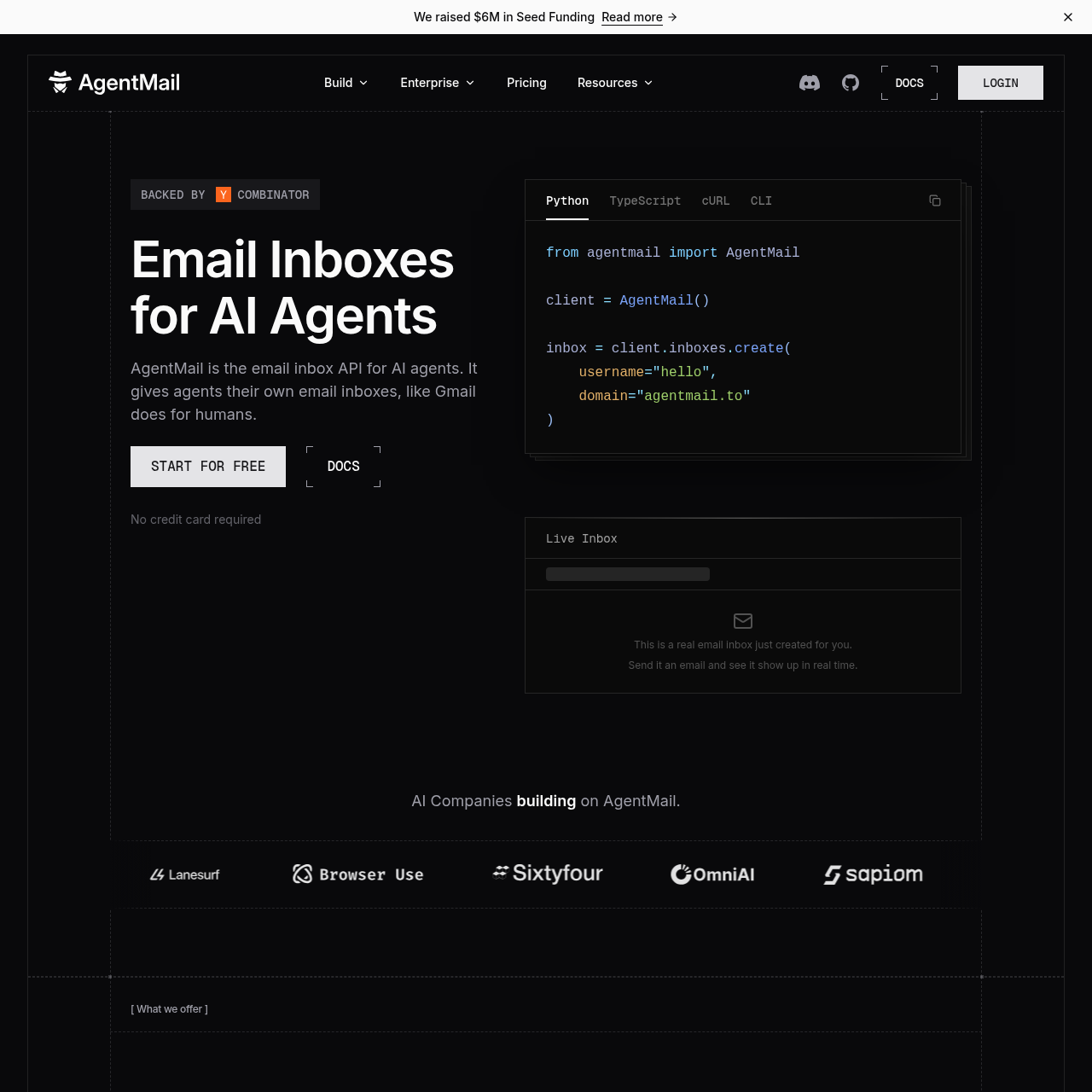
It's aimed squarely at platform builders and agent developers — teams whose agents need a verifiable identity (a real email address), structured communication (threads and attachments), and a searchable, persistent record of everything sent and received. Companies like Browser Use, Sixtyfour, OmniAI, and Sapiom are already building on it.
Key Features
📥 Programmatic Inboxes
Provision a real inbox with a single REST call. Each agent gets its own addressable mailbox on agentmail.to or your custom domain.
🧵 Full Threading
Real conversation threads with attachment support, so an agent can follow a back-and-forth instead of treating each message as isolated.
⚡ Real-Time Events
Get notified the instant mail lands via webhooks and WebSockets — ideal for agents that need to react to a reply in real time.
🌐 Custom Domains
Full DKIM, SPF, and DMARC configuration so your agents send from your own domain with proper authentication and deliverability.
🔌 MCP Server + SDKs
A Model Context Protocol server lets MCP-aware agents call AgentMail directly, plus first-party Python and TypeScript SDKs.
🔗 IMAP/SMTP Access
Standard IMAP and SMTP protocols alongside the REST API, so existing mail tooling and frameworks work without a rewrite.
🏢 Multi-Tenant Ready
Built for platform builders who need to hand every one of their own customers isolated inboxes, with SOC 2 and SSO on higher tiers.
🆔 Verifiable Identity
A real inbox gives an agent an identity it can use for sign-ups, verification codes, and service authentication — not just outbound blasts.

How to Use AgentMail
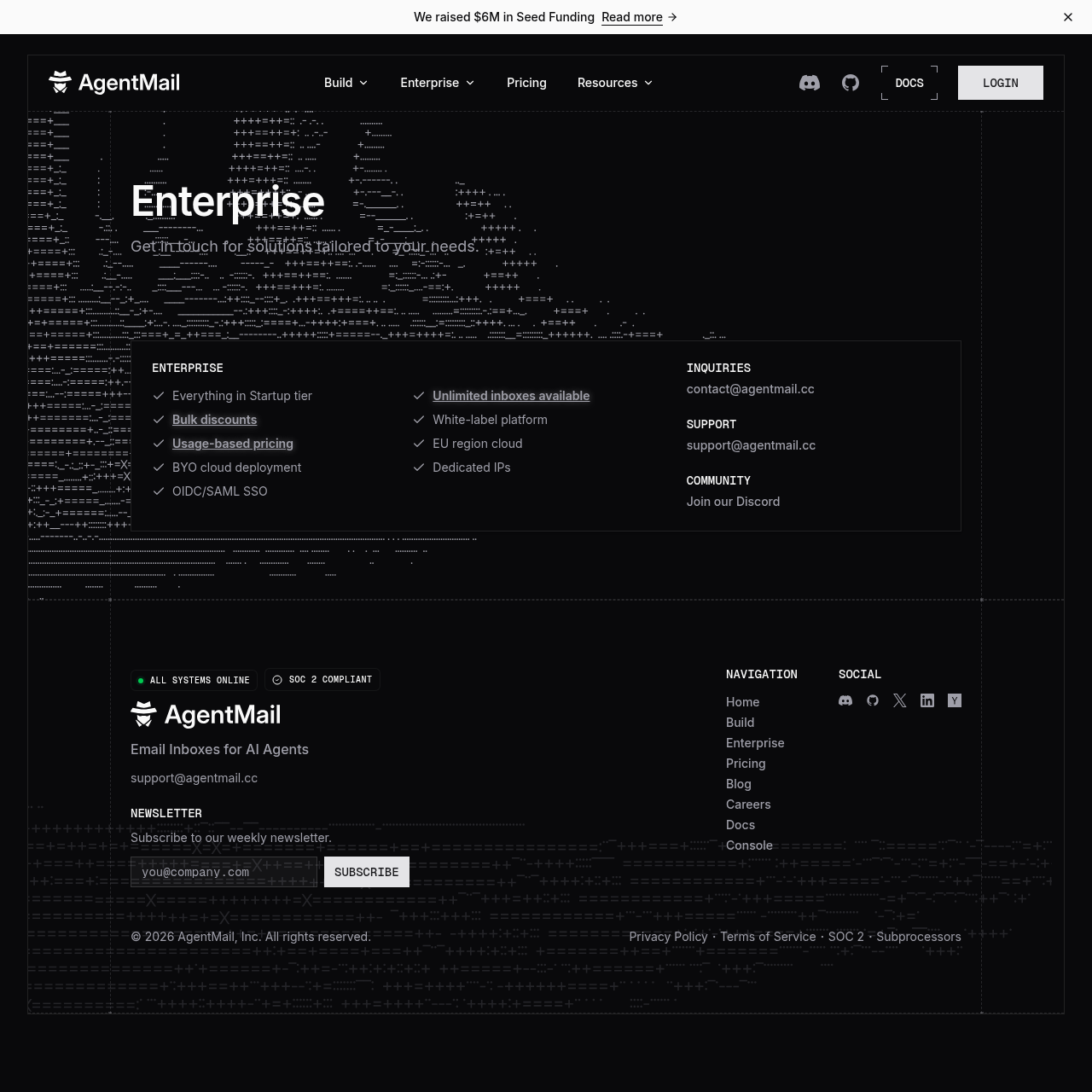
Getting an agent onto email takes about four lines of Python. The homepage demo literally shows it:
from agentmail import AgentMail

client = AgentMail()
inbox = client.inboxes.create(
    username="hello",
    domain="agentmail.to",
)
From there the flow is straightforward:
- Create an inbox. One API call provisions a live, real inbox — you can send it an email and watch it arrive in the dashboard in real time.
- Wire up events. Subscribe a webhook or open a WebSocket so your agent is notified the moment a reply lands.
- Read and reply. Pull the thread, hand the clean message to your model, and send a reply — all through the SDK or the MCP server.
- Add your domain. For production, verify a custom domain with DKIM/SPF/DMARC so mail sends from your brand.
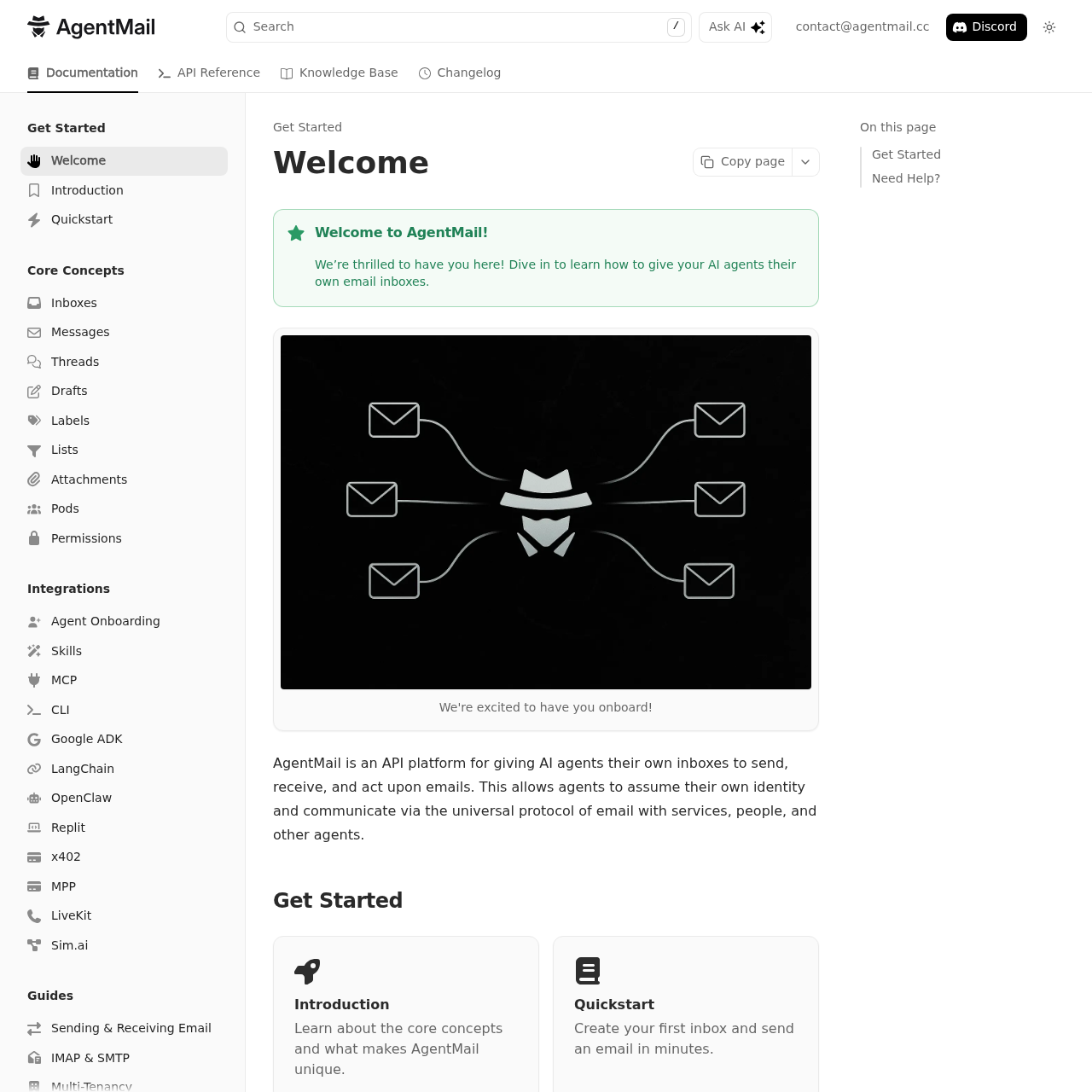
The API reference is clean and complete, and because AgentMail ships an MCP server, an MCP-aware agent like Claude can discover and call the inbox tools directly — no custom wrapper to maintain.
Pricing Plans
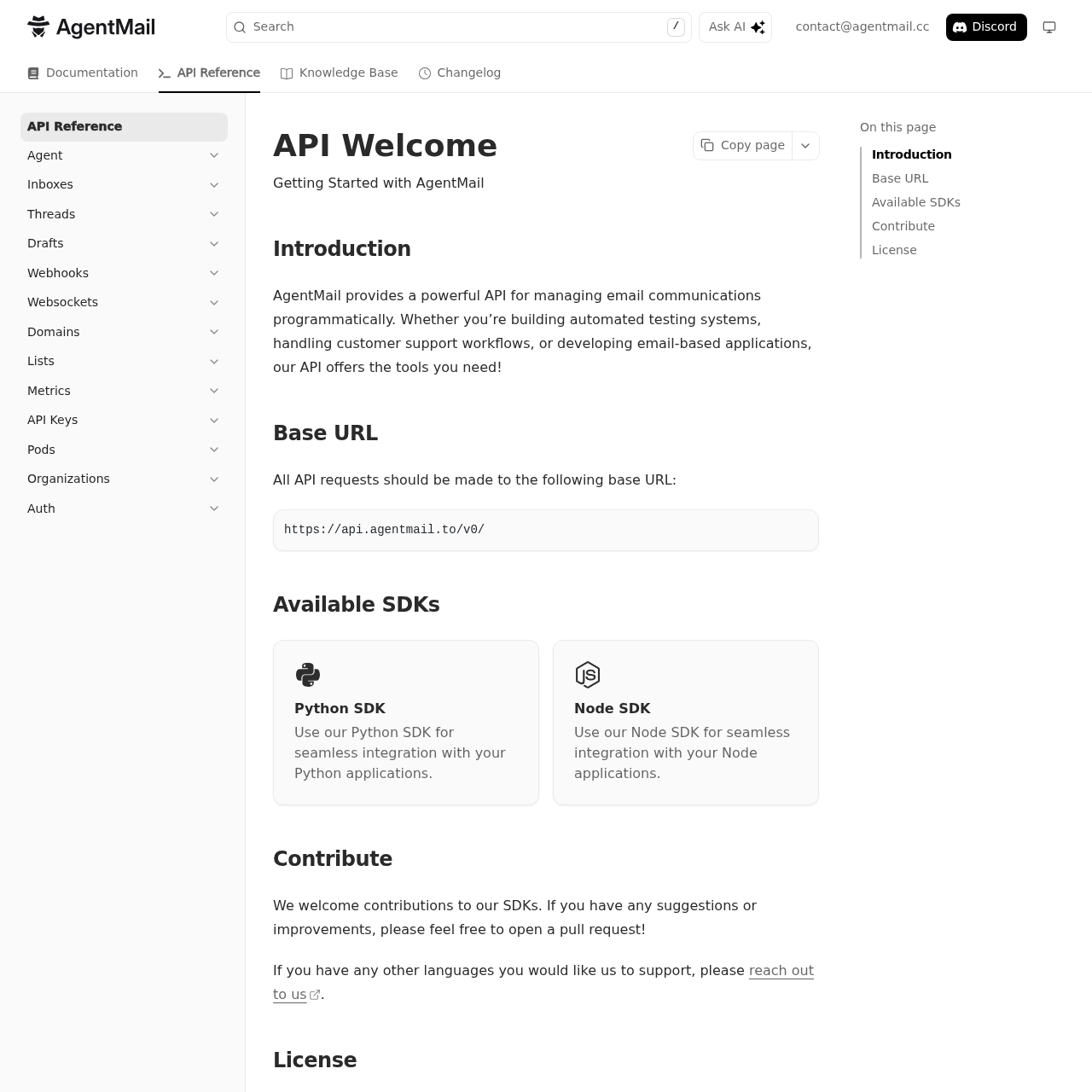
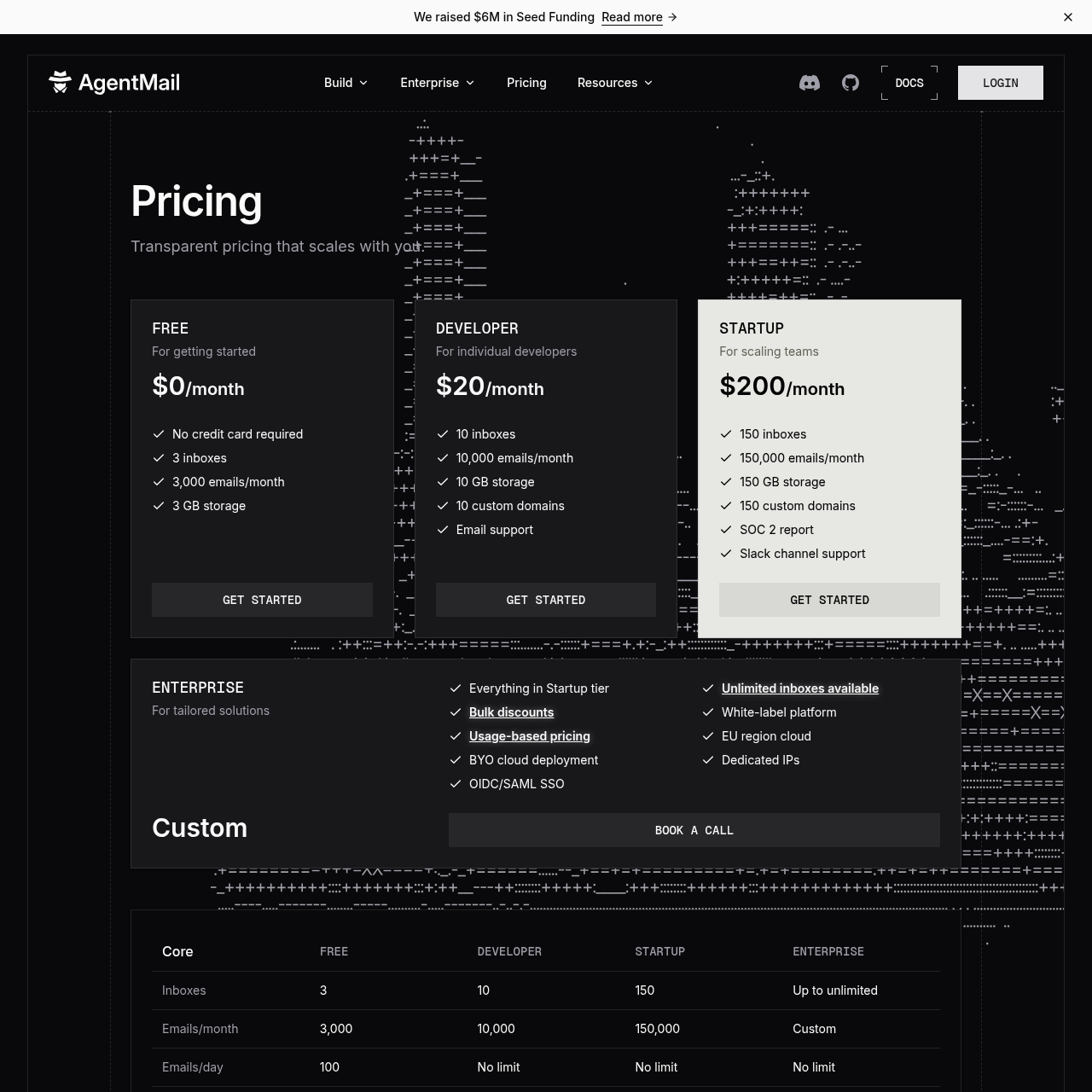
AgentMail's pricing is plan-based with a genuinely usable free tier — no credit card required to start, and no per-seat charges on API access.
Free
$0/mo
- ✓ 3 inboxes
- ✓ 3,000 emails/mo
- ✓ 3 GB storage
- ✓ No credit card
POPULAR
Developer
$20/mo
- ✓ 10 inboxes
- ✓ 10,000 emails/mo
- ✓ 10 custom domains
- ✓ Email support
Startup
$200/mo
- ✓ 150 inboxes
- ✓ 150,000 emails/mo
- ✓ SOC 2 report
- ✓ Slack support
Enterprise
Custom
- ✓ Unlimited inboxes
- ✓ White-label + SSO
- ✓ EU region / BYO cloud
- ✓ Dedicated IPs

Pros and Cons
Strengths
- ✓True two-way email. Real inboxes with threading, not a send-only endpoint — agents can hold conversations.
- ✓Generous free tier. 3 inboxes and 3,000 emails a month with no credit card is plenty to build and test a real agent.
- ✓Strong backing. Y Combinator plus a $6M seed means the roadmap and support are well-funded.
- ✓Great DX. Four-line setup, clean SDKs, an MCP server, and IMAP/SMTP for legacy tooling.
- ✓Platform-ready. Multi-tenant, SOC 2, SSO, and white-label make it viable to resell inboxes to your own users.
Weaknesses
- ✗AgentMail owns delivery. Unlike bring-your-own-provider tools, you send through AgentMail's infrastructure, not your existing SES or Gmail setup.
- ✗Only two SDKs. Python and TypeScript are covered; Go, Ruby, and PHP shops will use the raw REST API.
- ✗Inbox-count tiers. Pricing scales on inbox and email counts, so a fleet of many low-volume inboxes can jump tiers faster than pure per-email pricing.
- ✗Young product. It's fast-moving and early, so expect APIs and limits to keep evolving.
Best Alternatives
AgentMail's closest rival is SendMux, which takes a different bet: bring your own providers. Here's how the field compares.
| Tool | Model | Agent Inboxes | Starting Price |
|---|---|---|---|
| AgentMail | Managed inbox platform | ✓ Native | Free, then $20/mo |
| SendMux | Bring-your-own providers + failover | ✓ Native | $0.15 / 1,000 |
| Resend | Modern transactional sending | Limited | Free, then ~$20/mo |
| Amazon SES | Raw send infrastructure | ✗ Send-focused | ~$0.10 / 1,000 |
The quick call: pick AgentMail if you want a fully managed inbox with the least setup and a great free tier. Pick SendMux if you'd rather route through your own providers and keep your existing sender reputation. We break the two down in detail in our SendMux vs AgentMail comparison.
Related Reviews

Frequently Asked Questions
❓ What is AgentMail?
An email inbox API for AI agents. It provisions dedicated inboxes over REST so agents can send, receive, thread, and reply to email autonomously, with webhooks and WebSocket events.
❓ How much does AgentMail cost?
Free ($0/mo, 3 inboxes, 3,000 emails), Developer ($20/mo, 10 inboxes, 10,000 emails), Startup ($200/mo, 150 inboxes, 150,000 emails, SOC 2), and custom Enterprise pricing with unlimited inboxes and SSO.
❓ Does AgentMail work with Claude and MCP agents?
Yes. AgentMail ships an MCP server, so MCP-aware agents like Claude can call its inbox tools directly, alongside first-party Python and TypeScript SDKs.
❓ AgentMail vs SendMux — which should I use?
AgentMail is a fully managed inbox platform with a great free tier and the least setup. SendMux routes through your own providers (SMTP, Gmail, SES) with failover, so you keep your sender reputation. See our full SendMux vs AgentMail breakdown.
Final Verdict
4.7/5. AgentMail is the cleanest on-ramp we've found for giving an AI agent a real, two-way email identity. The four-line setup, the live-inbox demo, the generous free tier, and the MCP server make it genuinely fun to build on, and the multi-tenant features mean it scales from a weekend project to a platform you resell. It loses a little ground only to bring-your-own-provider tools if keeping your existing sending infrastructure and reputation is a hard requirement — that's a real architectural choice, not a flaw. For most teams putting agents on email for the first time, AgentMail is the fastest path from zero to a working inbox.
Give your agents their own inbox
Start free — 3 inboxes and 3,000 emails a month, no credit card. Spin up a live inbox in one API call.
Try AgentMail Free →
Get Premium AI Tool Insights
Subscribe to get weekly curated AI tool recommendations, exclusive deals, and early access to new tool reviews.
Related Tools

Droidrun
ai-automation
Open-source AI framework that lets LLM agents control Android and iOS apps via native accessibility APIs. 91.4% success rate, €2.1M funded.
M
Manus AI
ai-automation
Autonomous AI agent platform that executes complex multi-step tasks — browses the web, writes code, creates files, and works in the background without guidance.
R
Renamer.ai
ai-automation
AI-powered file renaming tool that uses OCR to read document content and automatically generates meaningful file names. Supports 30+ file types and 20+ languages.

MuleRun
ai-automation
Related Articles
Secure Your Suno Catalogue Now: An Action Plan Before the Watermark and Download-Limit Rollout
Suno's download limits and watermarking arrive within weeks. This is the four-step action plan to back up, verify, process and release your Suno catalogue before the rollout changes your workflow.
Suno's Tamper-Resistant Watermarking, Explained: What It Means for Independent AI Music Producers
On August 6, 2026 Suno announced tamper-resistant watermarking, fingerprinting, off-platform identification and download limits. Here is exactly what changes for independent AI music producers — and what stays the same.
Best AI Humanizer 2026: 5 Tools Tested (And When Not to Use One)
We tested 5 AI humanizers on real AI drafts. Which one keeps your voice, what each costs, why detector scores prove less than you think, and the one use case to walk away from.