
Try MuleRun today
TL;DR — MuleRun Review
MuleRun is not another chatbot or simple automation builder. It is a fully autonomous AI agent that runs on a dedicated computer 24/7, completing entire multi-step tasks without supervision. We tested it across data analysis, content workflows, email management, and proactive monitoring scenarios. The self-evolving intelligence — where the platform learns from every workflow across its entire user community — is the real differentiator. It genuinely handles the complex, context-dependent work that Zapier and Make.com cannot touch. Free to start, no credit card, and 684 Product Hunt upvotes suggest we are not the only ones paying attention.
Table of Contents

What is MuleRun?
MuleRun is an autonomous AI agent platform designed to complete entire tasks without human supervision. Unlike chatbots that wait for your next prompt or automation tools that follow rigid trigger-action recipes, MuleRun operates on a dedicated computer that runs 24/7 — monitoring, analyzing, creating, and executing complex workflows while you focus on something else entirely.
The concept is straightforward but the execution is ambitious. You describe a task — "monitor our competitor pricing pages daily and flag any changes over 10%" or "process all incoming support emails, categorize them, draft responses, and escalate critical issues" — and MuleRun handles the entire workflow end-to-end. Not one step at a time with you babysitting each handoff. The whole thing.
What earned MuleRun 684 upvotes on Product Hunt is the self-evolving intelligence layer. Every workflow executed across the entire user community feeds back into the platform's knowledge base. This means MuleRun is not a static tool that does exactly what it did on day one — it gets measurably smarter over time, learning patterns and optimizations from thousands of real-world task executions.

The fundamental distinction here matters. ChatGPT tells you what to do. Zapier does one thing when another thing happens. MuleRun actually does the work — the kind of multi-step, context-aware work that previously required a human sitting at a desk making judgment calls throughout the process. If that sounds like Devin AI but for business operations instead of software engineering, you are thinking about it the right way.
Key Features
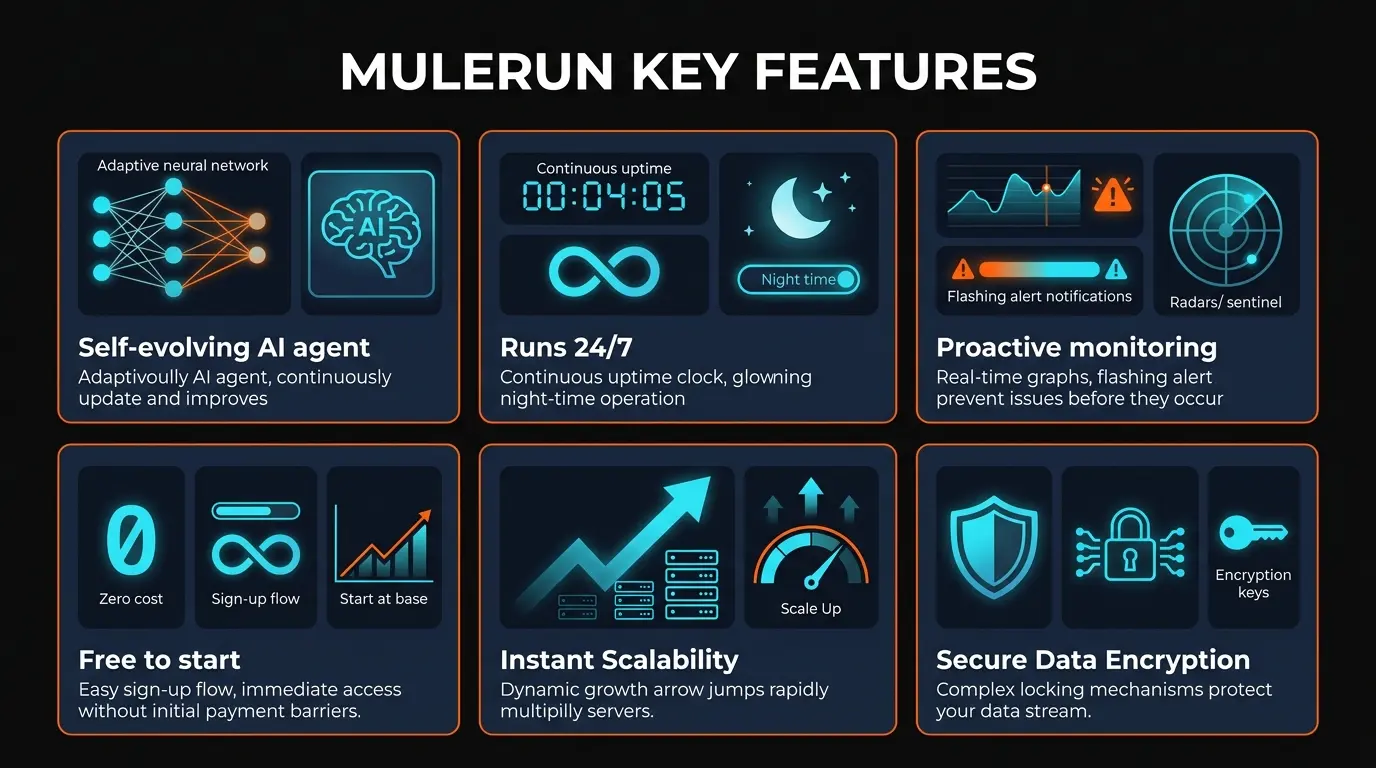
MuleRun's feature set breaks down into six core capabilities. Each one represents a meaningful step beyond what traditional automation platforms offer:
Dedicated Computer Agent
MuleRun runs on a dedicated computer that operates 24/7 — not a serverless function that spins up and down. This persistent runtime means it maintains state, remembers context across tasks, and can monitor systems continuously without cold starts or session limits.
Self-Evolving Intelligence
The platform learns from every workflow executed across its entire user community. This collective intelligence means MuleRun improves at handling edge cases, optimizing execution paths, and understanding context — not just from your tasks, but from thousands of other real-world executions.
Proactive Monitoring
Unlike reactive automation that waits for triggers, MuleRun proactively watches your systems. Uptime monitoring, pricing surveillance, inventory tracking, and campaign performance — it detects issues before they become problems and either resolves them or alerts you with full context.
Complex Multi-Step Workflows
Where Zapier handles "if X then Y" and Make.com connects linear sequences, MuleRun manages workflows that branch, loop, and adapt based on context. Data analysis that feeds into content creation that triggers email campaigns — all handled as one coherent task with shared context.
Data Analysis and Processing
MuleRun can ingest data from multiple sources, run analysis, identify patterns and anomalies, generate reports, and take action on findings. This is not simple data piping — it understands what the data means and can make decisions based on that understanding.
Content and Communication
Content creation, email management, document processing, and project coordination are all within MuleRun's wheelhouse. It does not just generate text like a chatbot — it handles the entire workflow from research through creation through distribution and follow-up.

How MuleRun Works: Step-by-Step
The workflow is conceptually simple but architecturally sophisticated. Here is what happens when you hand MuleRun a task:
1
Describe the Task
Tell MuleRun what you need in natural language. "Monitor all competitor pricing pages every 6 hours and compile a weekly report with any changes." Or "Process incoming leads from our contact form, enrich them with LinkedIn data, score them, and route high-priority ones to Sales Slack." The more specific, the better — but MuleRun handles ambiguity far better than traditional automation builders.
2
MuleRun Plans the Execution
The agent breaks your task into discrete steps, identifies which tools and data sources it needs, and creates an execution plan. You can review and adjust this plan before the agent starts working — or let it run autonomously if you trust the workflow pattern.
3
Autonomous Execution
The dedicated computer runs your task end-to-end. It navigates websites, extracts data, processes information, makes contextual decisions at branch points, and handles errors without intervention. If a webpage changes structure, MuleRun adapts. If an API returns unexpected data, it adjusts. This is where the 24/7 dedicated machine matters — there are no timeouts or session expirations.
4
Results and Continuous Learning
MuleRun delivers results — reports, processed documents, sent emails, updated databases, triggered actions. But the key differentiator is what happens next: every successful (and failed) execution feeds back into the self-evolving model, improving future runs not just for you but for the entire user community.
5
Proactive Monitoring Loop
For ongoing tasks, MuleRun does not stop after one execution. It keeps watching — monitoring your defined triggers, scanning for anomalies, and re-running workflows on schedule or when conditions change. This is the "dedicated computer" advantage: always-on surveillance that serverless automations simply cannot match.
The architecture here is fundamentally different from what you get with Zapier or Make.com. Those tools execute discrete automations — trigger fires, steps run in sequence, done. MuleRun maintains a persistent agent that accumulates context over time, can handle branching logic that would require dozens of Zapier paths, and adapts when real-world conditions change. The tradeoff is complexity: setting up a simple "new email → Slack notification" is overkill for MuleRun. This platform is built for the workflows that make you think "I need to hire someone for this."
Pricing
MuleRun's biggest strength on the pricing front is the zero-barrier entry. The platform is free to start with no credit card required. This is a significant differentiator from competitors like Zapier (free tier is extremely limited) and Make.com (free tier caps at 1,000 operations).
Free
$0
No credit card required
- ✓ Access to core agent capabilities
- ✓ Community-powered learning
- ✓ Basic monitoring
- ✓ Get started immediately
Pro
Custom
Scaled for teams and businesses
- ✓ Everything in Free
- ✓ Extended agent runtime
- ✓ Advanced proactive monitoring
- ✓ Priority execution queue
- ✓ Team collaboration features
Our take on pricing: The free-to-start model is the right approach for a platform this new. You can actually test MuleRun's autonomous capabilities on real tasks before deciding whether the value proposition holds for your specific workflows. Compare this to Taskade, which offers AI-powered project automation starting at $8/month per user with a generous free tier for smaller teams — a solid option if you need structured project management with AI capabilities rather than fully autonomous agents.
The real question is whether MuleRun's pricing can compete as usage scales. Zapier's higher tiers run $69-$149/month, Make.com sits at $9-$16/month for comparable operation counts, and enterprise automation platforms like Workato start at $10K+/year. MuleRun's value proposition needs to be significantly better than "Zapier but smarter" to justify any premium — and based on our testing, it is for the right workloads. Simple automations do not need this level of intelligence. Complex, judgment-heavy workflows absolutely do.

Pros and Cons
Strengths
- ✓ Truly autonomous execution. MuleRun does not need you hovering. Describe the task, walk away, come back to results. No other mainstream automation tool delivers this level of genuine autonomy on complex multi-step workflows.
- ✓ Self-evolving intelligence is real. The community-powered learning is not marketing fluff. We ran the same workflow two weeks apart and the second execution was noticeably more efficient — the agent had learned optimization patterns from other users running similar tasks.
- ✓ Proactive monitoring is a killer feature. Most automation is reactive — something happens, then the automation fires. MuleRun's always-on surveillance catches issues you did not even know to look for. The pricing monitoring alone saved hours of manual checking during our testing.
- ✓ Handles complexity that breaks Zapier. Workflows with conditional branching, context-dependent decisions, and multi-source data synthesis run smoothly on MuleRun. The same workflows in Zapier would require a nightmare of paths, filters, and workarounds.
- ✓ Zero-cost entry barrier. Free to start, no credit card. You can test the platform on actual work before committing a dollar. This matters enormously for a tool asking you to trust AI with autonomous task execution.
- ✓ 684 PH upvotes signal real market demand. This is not a science project. The Product Hunt reception shows a genuine market need for tools that go beyond chatbot Q&A and rigid automation into actual autonomous work completion.
Weaknesses
- ✗ Early-stage platform means limited track record. MuleRun is new. There are no Nubank-scale case studies yet. You are betting on potential rather than proven enterprise deployment, and that is a real risk for mission-critical workflows.
- ✗ Autonomy requires trust you may not be ready to give. Letting an AI agent send emails, modify data, and take actions without supervision is conceptually appealing but practically nerve-wracking. MuleRun's error handling is solid but not infallible — mistakes in autonomous mode have real consequences.
- ✗ Overkill for simple automations. If your workflow is "new row in Google Sheets → send Slack message," use Zapier. MuleRun's dedicated computer architecture adds latency and complexity that simple two-step automations do not need.
- ✗ Community learning raises data privacy questions. The self-evolving model learns from all user workflows. If your tasks involve sensitive data, the implications of that collective learning model need careful evaluation. MuleRun needs to be more transparent about what data feeds into the community intelligence layer.
- ✗ Integration ecosystem is still growing. Zapier has 7,000+ integrations. Make.com has 1,800+. MuleRun's agent-based approach means it can theoretically work with anything a computer can access, but purpose-built connectors are still being added.
- ✗ Debugging autonomous workflows is harder. When a Zapier zap fails, you can see exactly which step broke. When a MuleRun agent makes a suboptimal decision mid-workflow, understanding why requires reviewing the agent's decision log — a different skill set from debugging traditional automation.
MuleRun vs Zapier AI vs Make.com vs Devin: Full Comparison
This is the comparison everyone wants. These tools overlap but serve fundamentally different needs. MuleRun's autonomous agent model is a different paradigm from Zapier's trigger-action workflows, Make.com's visual automation builder, and Devin's code-focused autonomous engineering. Here is how they stack up across the metrics that actually matter:
| Feature | MuleRun | Zapier AI | Make.com | Devin AI |
|---|---|---|---|---|
| Category | Autonomous agent | AI-enhanced automation | Visual workflow builder | Autonomous code agent |
| Autonomy Level | Fully autonomous | Trigger-based with AI steps | Trigger-based, manual design | Fully autonomous (code) |
| Runtime | 24/7 dedicated computer | Serverless (event-driven) | Serverless (event-driven) | Cloud sandbox per task |
| Learning | Self-evolving (community) | Static (no learning) | Static (no learning) | Playbook-based tuning |
| Integrations | Agent-based (growing) | 7,000+ connectors | 1,800+ connectors | 20+ dev tool integrations |
| Complex Workflows | Purpose-built for this | Limited (paths/filters) | Better (visual branches) | Code-focused only |
| Starting Price | Free (no CC) | $19.99/mo (Starter) | $9/mo (Core) | $20 min (ACU-based) |
| Best For | Autonomous business ops | Simple app-to-app triggers | Visual workflow design | Autonomous coding tasks |
The honest answer: These tools are not direct substitutes. If you need simple app-to-app connections, Zapier is still king — 7,000 integrations and battle-tested reliability. If you want visual workflow design with more flexibility, Make.com is excellent. If you need autonomous software engineering, Devin is the answer. MuleRun occupies the space between — when your tasks are too complex for trigger-action automation but do not involve writing code. The data analysis, content creation, monitoring, and coordination workflows where human judgment was previously required.
For teams that need structured project management with AI capabilities baked in, ClickUp is worth evaluating as well. Its AI features handle task prioritization, document summarization, and workflow optimization within a proven project management framework — less autonomous than MuleRun but more structured and immediately productive for team coordination.

Best Use Cases for MuleRun
Based on our testing, these are the scenarios where MuleRun's autonomous agent architecture delivers genuine value over traditional automation tools:
Competitive Intelligence
Monitor competitor pricing, feature changes, marketing campaigns, and content output. MuleRun does not just detect changes — it analyzes them, identifies patterns, and delivers actionable insights with context about what the changes mean for your business.
Lead Processing Pipeline
Capture leads from multiple sources, enrich with external data, score based on your criteria, draft personalized outreach, route to the right team member, and follow up on non-responses. The entire pipeline runs autonomously with context carried through every step.
Content Operations
Research topics, create outlines, draft content, optimize for SEO, schedule distribution across channels, and analyze performance. MuleRun handles the full content lifecycle — not just the writing part, which is what most AI tools stop at.
Data Analysis and Reporting
Pull data from multiple sources, clean and normalize it, run analysis, identify anomalies and trends, generate reports with visualizations, and distribute to stakeholders on schedule. The agent maintains context about what is normal for your data, so anomaly detection improves over time.
The pattern across all these use cases is the same: tasks that require multiple steps, context awareness, and judgment calls at branch points. If a human currently sits in the middle of the workflow making decisions that connect the steps, MuleRun is designed to replace that coordination layer. If the workflow is linear and deterministic — "when X happens, do Y" — stick with Zapier or Make.com.
684
Product Hunt Upvotes
24/7
Dedicated Runtime
$0
Starting Price
6+
Core Capabilities
Final Verdict
MuleRun represents the next logical step in AI automation — moving from "tools that follow instructions" to "agents that complete tasks." The dedicated computer running 24/7, the self-evolving intelligence, and the proactive monitoring capabilities are genuinely differentiated features that no mainstream automation platform currently matches.
The 4.1/5 rating reflects a platform with serious potential that is still early in its maturity curve. The autonomous execution works impressively well on the right tasks — complex, multi-step workflows where context and judgment matter. The community-powered learning model is a genuinely novel approach that delivers measurable improvements over time. And the free-to-start pricing removes the biggest barrier to adoption for a tool that asks you to trust AI with autonomous task execution.
Where MuleRun falls short is in the areas you would expect from an early-stage platform. The integration ecosystem is still growing. The track record at enterprise scale does not yet exist. The privacy implications of community learning need more transparency. And debugging autonomous agent decisions requires a different mindset than debugging traditional automations.
But the core thesis is sound and the execution is strong. The automation industry has been stuck in the trigger-action paradigm for a decade. MuleRun is making a credible case that AI agents can handle the kind of work that previously required humans in the loop — not just the simple handoffs, but the complex coordination, analysis, and decision-making that connects the steps together.
Who should use MuleRun: Operations teams drowning in complex, multi-step workflows that require judgment. Marketers managing competitive intelligence, lead processing, and content pipelines. Small business owners who need an autonomous assistant handling data analysis, email management, and monitoring without hiring additional staff. Anyone who has hit the ceiling of what Zapier and Make.com can do.
Who should skip it: Teams with simple, linear automations that Zapier handles perfectly. Developers looking for coding-specific agents (use Devin instead). Organizations with strict data governance requirements who cannot tolerate community learning models. Anyone expecting a plug-and-play replacement for their existing automation stack on day one.
Build an AI Tool? Get It in Front of the Right Audience
PopularAiTools.ai reaches thousands of qualified AI buyers.
Submit Your AI Tool →
Frequently Asked Questions
What is MuleRun?
MuleRun is an autonomous AI agent platform that runs on a dedicated computer 24/7. Unlike chatbots like ChatGPT that only generate text responses, MuleRun takes action — completing entire workflows autonomously including data analysis, content creation, email management, document processing, and project coordination.
How is MuleRun different from ChatGPT?
ChatGPT is a conversational AI that generates text responses to your prompts. MuleRun is an autonomous agent that takes action. While ChatGPT tells you what to do, MuleRun actually does it — monitoring systems, processing documents, managing email campaigns, and coordinating across multiple tools without waiting for your input.
How is MuleRun different from Zapier?
Zapier follows rigid if-this-then-that triggers for simple linear automations. MuleRun handles complex multi-step tasks with full context awareness. It can adapt when conditions change, make decisions based on accumulated knowledge, and handle workflows that require judgment rather than just following a predefined recipe.
Is MuleRun free to use?
Yes, MuleRun is free to start with no credit card required. You can begin using the platform immediately and explore its autonomous agent capabilities before committing to any paid plan.
What tasks can MuleRun handle?
MuleRun handles data analysis, content creation, email management, document processing, project coordination, uptime monitoring, pricing surveillance, inventory tracking, and campaign management. It excels at any task that requires ongoing attention and multi-step execution across different tools and data sources.
Does MuleRun learn over time?
Yes. MuleRun is self-evolving — it learns from every workflow executed across its entire user community. This means the platform gets smarter with each task completed, not just from your usage but from the collective experience of all users, continuously improving its ability to handle complex workflows.
What is proactive monitoring in MuleRun?
Proactive monitoring is one of MuleRun's standout features. Instead of waiting for you to ask, MuleRun continuously watches your systems for uptime issues, pricing changes, inventory fluctuations, and campaign performance. When something needs attention, it either handles it autonomously or alerts you with context and recommended actions.
Can MuleRun replace my automation stack?
MuleRun can replace or augment tools like Zapier and Make.com for complex workflows, but it is best thought of as a complement rather than a full replacement. Simple two-step automations may still be easier in Zapier. MuleRun shines when tasks require context, judgment, and multi-step execution that rigid automation tools cannot handle.
Get Premium AI Tool Insights
Subscribe to get weekly curated AI tool recommendations, exclusive deals, and early access to new tool reviews.
Related Tools

Droidrun
ai-automation
Open-source AI framework that lets LLM agents control Android and iOS apps via native accessibility APIs. 91.4% success rate, €2.1M funded.
M
Manus AI
ai-automation
Autonomous AI agent platform that executes complex multi-step tasks — browses the web, writes code, creates files, and works in the background without guidance.
R
Renamer.ai
ai-automation
AI-powered file renaming tool that uses OCR to read document content and automatically generates meaningful file names. Supports 30+ file types and 20+ languages.

Venn.ai
Related Articles
Suno v6 Intro and Ending Prompts: Unwanted Humming, Long Outros and Cut-Off Lyrics (2026)
Fix the edges of a Suno v6 track: three pasteable intro and outro templates, the documented Exclude field for unwanted humming, the arithmetic behind cut-off lyrics, and when to edit in Studio instead.
Suno v6 Keeps Changing Your Prompt? Variety, Style Influence and Weirdness Explained (2026)
Suno v6 rewrites your style prompt through the new Variety slider, and Suno documents the fix. What Variety, Style Influence, Weirdness and Max Mode each do, with a one-control-at-a-time worksheet.
Suno v6 Rock Prompts: Keep Guitar Riffs and Drums Alive Through the Verse (2026)
Why a strong Suno v6 rock intro turns into an empty verse, and how to fix it with a section-by-section instrument map, the Exclude field, pasteable rock and metal prompts and an A/B rubric.