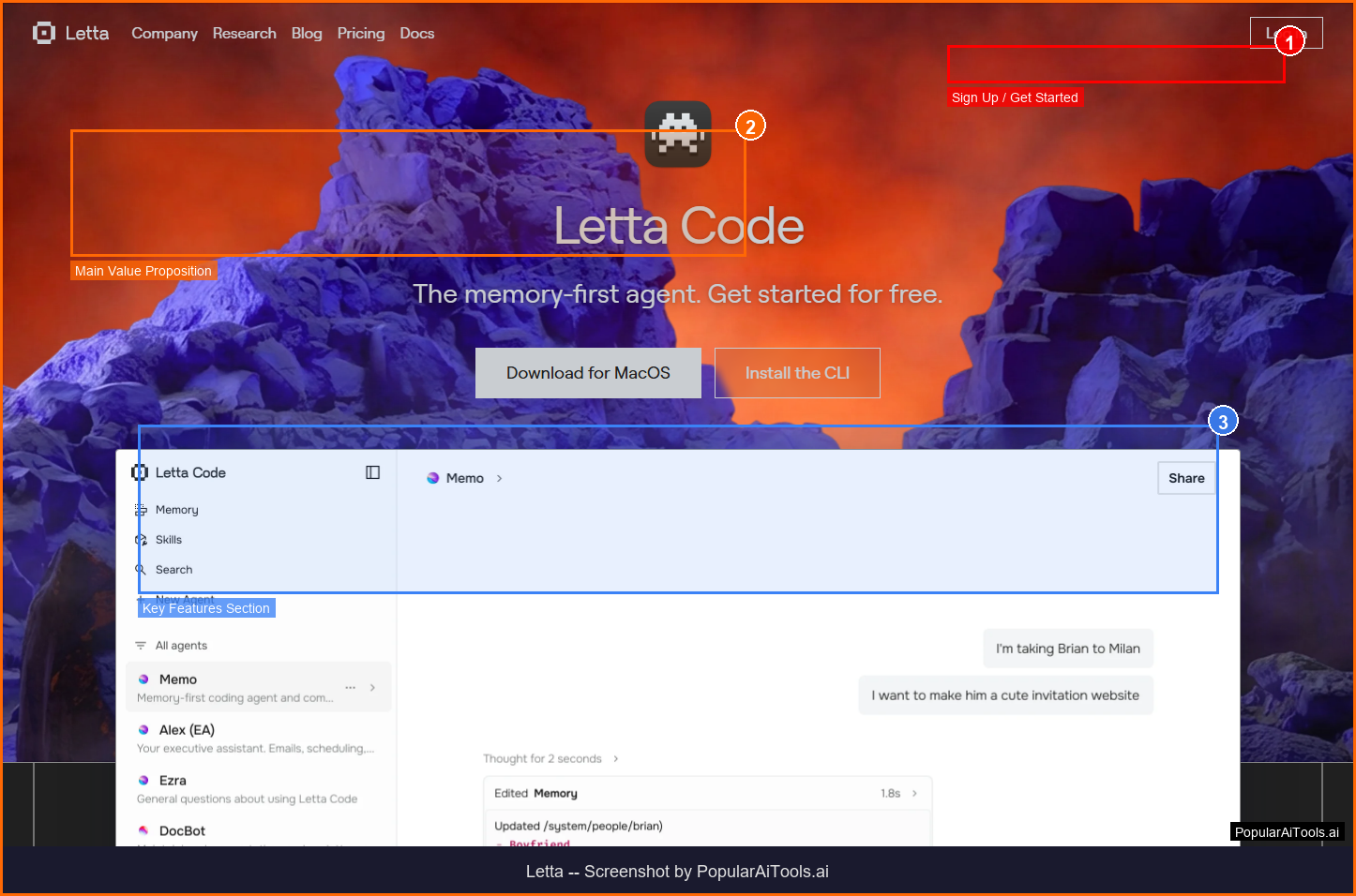

TL;DR -- Letta Review
Rating: 4.4/5
Best For: Developers building AI agents that need persistent memory, long-term learning, and production-grade deployment
Pricing: Usage-based pricing with unlimited agents. Free tier, Pro, and Max plans available.
Verdict: Letta addresses a genuine gap in the AI agent landscape: persistent memory and state management. The white-box approach to memory gives developers unprecedented visibility into what their agents remember and why. With $10M in funding and an open-source foundation, Letta is positioned to become a core infrastructure layer for the emerging agent economy.
Table of Contents
What is Letta?
Letta is a platform for building stateful AI agents with advanced memory that can learn and self-improve over time. It enables developers to create AI assistants with long-term memory, evolving personalities, and transparent reasoning -- all deployed via REST APIs at scale.

Letta falls into the AI Development category and is designed for developers building ai agents that need persistent memory, long-term learning, and production-grade deployment. In this review, we will explore its features, pricing, pros and cons, and how it compares to alternatives in the market.
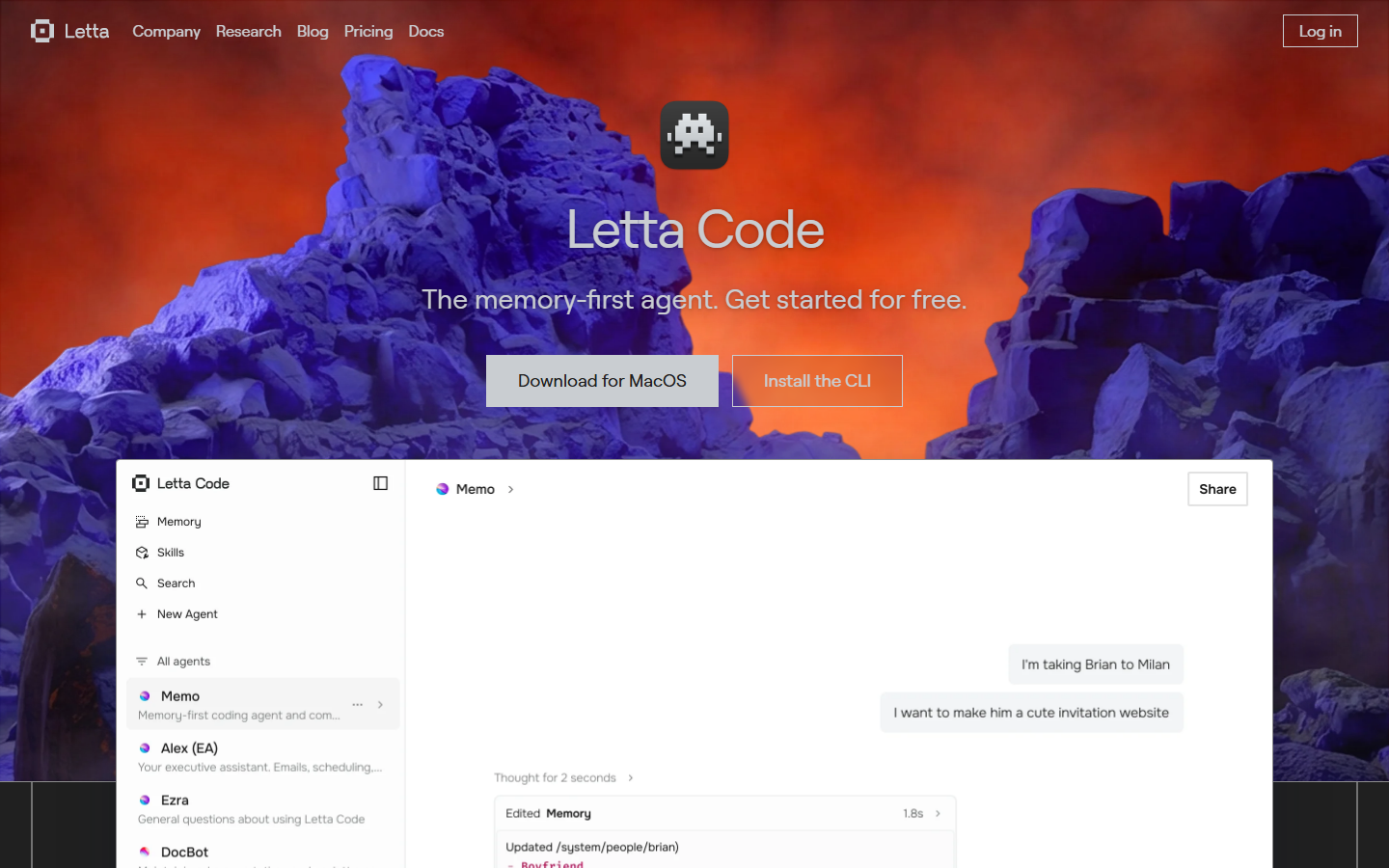
Key Features
Here are the standout features that make Letta worth considering:
White-Box Memory
Agents manage their own context windows by reading and writing to memory blocks with fully transparent prompts and memories visible to developers.
Cloud Deployment
Deploy and run stateful agents via REST APIs with production-grade agent microservices at scale.
Model Agnostic
Swap model endpoints freely and run agents on any LLM provider, even enabling a single agent to run on multiple models.
Agent Development Environment
Build, debug, and iterate on agents by directly viewing and editing prompts and memory in real time.
Scalable Architecture
Scale from initial prototypes to millions of agents on the same stack with data and state safety.
How to Use Letta
Getting started with Letta is straightforward. Here is the typical workflow:
1
Visit the Website
Go to https://www.letta.com and create your account. Most tools offer a free tier or trial to get started.
2
Explore the Dashboard
Familiarize yourself with Letta's interface, settings, and available features. The onboarding flow will guide you through initial setup.
3
Configure Your Workflow
Set up Letta for your specific use case. Connect integrations, customize settings, and configure any automations.
4
Start Using & Iterate
Begin using Letta for real tasks. Monitor results, adjust settings, and scale usage as you become comfortable.
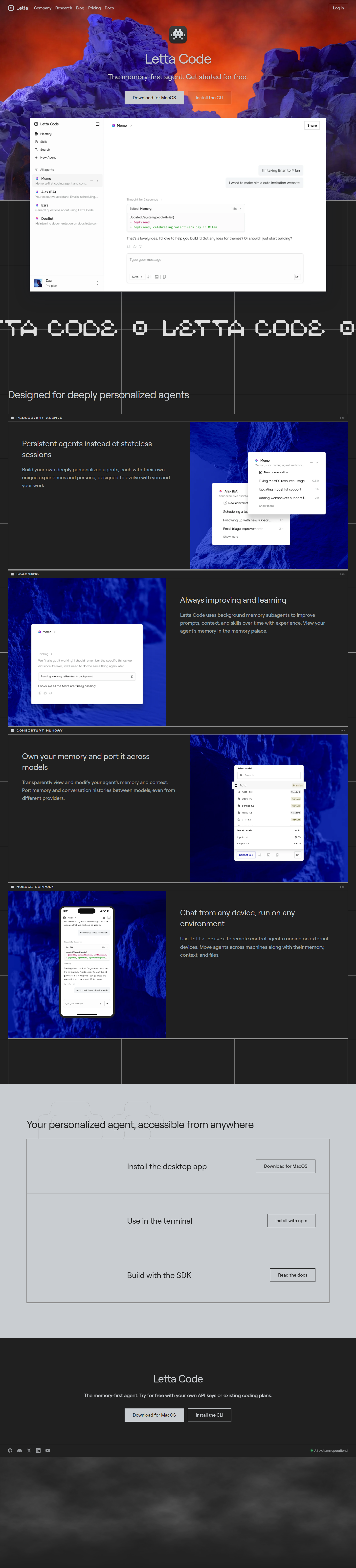
Pricing Plans
Usage-based pricing with unlimited agents. Free tier, Pro, and Max plans available.

| Plan | Price | Includes |
|---|---|---|
| Free | $0 | Limited tokens, basic features, community support |
| Pro | Usage-based | Higher limits, priority support, full ADE access |
| Max | Usage-based | High-throughput workloads, generous request limits |
| Enterprise | Custom | Dedicated infrastructure, SLA, custom integrations |
Pros and Cons
Pros
- ✓ Open-source core with transparent memory management
- ✓ Model-agnostic -- works with any LLM provider
- ✓ Scales from prototype to millions of agents
- ✓ $10M funding validates the platform
Cons
- ✗ Learning curve for developers new to stateful agents
- ✗ Usage-based pricing can be unpredictable for large workloads
- ✗ Max plan limited to personal use only
Letta Alternatives
If Letta does not fit your needs, here are some alternatives worth considering:
| Alternative | Description |
|---|---|
| LangChain | LLM application development framework |
| AutoGen | Multi-agent conversation framework |
| CrewAI | AI agent orchestration platform |
| Mem0 | Memory layer for AI applications |
Final Verdict
Letta addresses a genuine gap in the AI agent landscape: persistent memory and state management. The white-box approach to memory gives developers unprecedented visibility into what their agents remember and why. With $10M in funding and an open-source foundation, Letta is positioned to become a core infrastructure layer for the emerging agent economy.

Frequently Asked Questions
What is Letta?
Letta is a platform for building stateful AI agents with persistent memory, transparent reasoning, and production-grade deployment capabilities.
Is Letta open source?
Yes, Letta has an open-source core available on GitHub with a cloud offering for production deployment.
What is white-box memory?
White-box memory means the exact prompts and memories passed to the LLM on each reasoning step are transparent and visible to the developer.
Can Letta work with any LLM?
Yes, Letta is model-agnostic and supports swapping between LLM providers, even for a single agent.
How does Letta pricing work?
Letta uses usage-based pricing with a free tier and paid plans (Pro and Max) based on token consumption.
What is the Agent Development Environment?
The ADE lets developers build and debug agents by directly viewing and editing prompts and memory in real time.
Can Letta scale to production?
Yes, Letta scales from prototypes to millions of agents with production-grade REST APIs and state safety.
What funding has Letta received?
Letta emerged from stealth with $10M in funding for building AI agents with advanced memory.
Review by PopularAiTools.ai | Last updated: March 21, 2026
Get Premium AI Tool Insights
Subscribe to get weekly curated AI tool recommendations, exclusive deals, and early access to new tool reviews.
Related Tools

Droidrun
ai-automation
Open-source AI framework that lets LLM agents control Android and iOS apps via native accessibility APIs. 91.4% success rate, €2.1M funded.
M
Manus AI
ai-automation
Autonomous AI agent platform that executes complex multi-step tasks — browses the web, writes code, creates files, and works in the background without guidance.
R
Renamer.ai
ai-automation
AI-powered file renaming tool that uses OCR to read document content and automatically generates meaningful file names. Supports 30+ file types and 20+ languages.

MuleRun
ai-automation
Related Articles
10 Claude Code Skills, Plugins & CLIs to Install on Day One (April 2026)
Starting Claude Code from scratch in 2026? Install these 10 skills, plugins, and CLIs on day one — Codex CLI, Obsidian, Autoresearch, Firecrawl, Playwright, NotebookLM, Skill Creator, RAG-Anything, Google Workspace CLI, and awesome-design-md. Full install commands included.
We Tested 24 AI Models Inside Claude Code: The 2026 Tier List
We swapped 24 different AI models into Claude Code and ran identical tool-call tests on each. Here's the S-tier-to-D-tier ranking, real cost comparison, and the single best Claude Sonnet 4.6 alternative for 2026 — including the GLM 4.6 sleeper pick that matched Sonnet at 15% the cost.
Claude as a Creative Studio: Make Ads, Images, and Video From One Chat (2026)
Claude doesn't generate raster images natively, but in 2026 it's the smartest creative director on Earth — orchestrating Nano Banana 2, Sora 2, Runway, Higgsfield, Remotion, and VEED into a single ad-and-video factory. The full stack, the variant matrix trick, and how to build a YouTube Shorts factory.